


SEOUL, May 29 (AJP) - South Korea's artificial intelligence boom is creating winners far beyond the stock market, with cities hosting semiconductor plants emerging as some of the biggest beneficiaries of a tax windfall fueled by record earnings at Samsung Electronics and SK hynix.
The central government is expected to collect tens of trillions of won in additional tax revenue this year as the AI-driven semiconductor boom boosts corporate profits and equity valuations. At the local level, the gains are increasingly concentrated in a handful of cities in Gyeonggi Province that host facilities of the world's two largest memory-chip makers.
For local governments that only a few years ago struggled with shrinking tax bases and relied heavily on central government transfers, the turnaround has been striking.
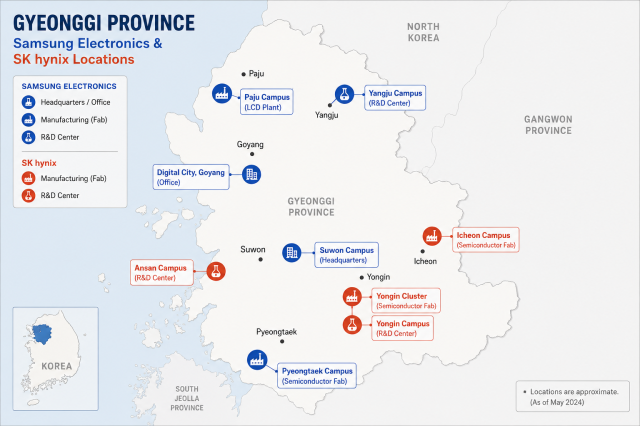
Since the semiconductor industry's recovery began in the second half of 2025, five semiconductor cities in Gyeonggi Province have collected between 60 billion won and 200 billion won ($44 million-$147 million) more in tax revenue than initially budgeted as of April, according to local government data.
The rebound marks a dramatic reversal from 2023, when corporate local income tax payments from major chipmakers nearly disappeared during one of the industry's deepest downturns.
The surge reflects record profits at Samsung Electronics and SK hynix, whose earnings have been turbocharged by global demand for AI servers and high-bandwidth memory chips.
As tax revenue floods into South Korea's semiconductor belt, local governments are increasingly divided over whether to spend the windfall on infrastructure and public services or save part of it for the next downturn in the notoriously cyclical chip industry.
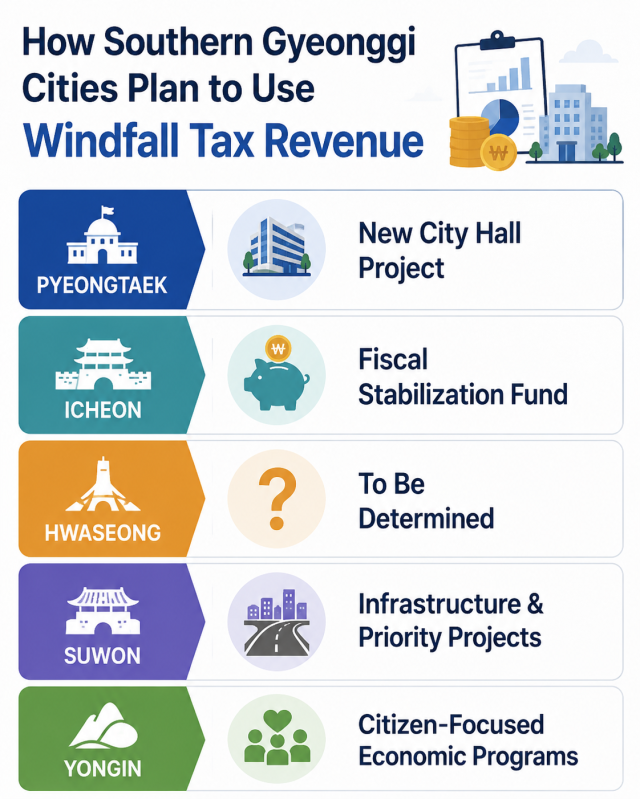
The debate is most intense in Hwaseong, one of South Korea's most important semiconductor hubs and home to major Samsung Electronics production facilities.
City officials have declined to disclose detailed figures, but industry estimates suggest tax revenue linked to Samsung Electronics could exceed 1 trillion won. Under South Korea's tax-sharing system, part of corporate local income taxes is distributed to municipalities where production facilities are located.
"Windfall tax revenue should be invested in infrastructure for the city's long-term growth potential rather than short-term spending," said Rep. Kwon Chil-seung of the ruling Democratic Party, who represents part of Hwaseong.
Other semiconductor cities are taking different approaches.
Icheon, home to SK hynix's flagship memory-chip complex and one of the largest beneficiaries of the company's earnings surge, is expected to receive nearly 200 billion won in corporate local income tax revenue. Rather than spending the proceeds immediately, city officials plan to place a substantial portion into fiscal reserve funds to cushion future economic downturns.
Pyeongtaek, home to Samsung Electronics' largest semiconductor manufacturing complex, expects corporate local income tax revenue linked to Samsung to nearly triple to 155.6 billion won ($115 million) in 2026 from 51.6 billion won a year earlier.
City officials plan to direct much of the increase toward construction of a new municipal government complex, one of the city's largest ongoing projects, while allocating additional funds to transportation and public services.
Suwon, where Samsung Electronics maintains its headquarters, expects roughly 80 billion won in additional tax revenue. Officials say the funds will support transportation projects, electric-vehicle initiatives and other public investments.
Yongin, which hosts facilities operated by both Samsung Electronics and SK hynix and is positioning itself as South Korea's next-generation semiconductor cluster, projects collecting about 64.9 billion won in corporate local income taxes from the two companies this year.
Officials there remain cautious about treating the increase as a permanent revenue source.
"It should ultimately be used to improve residents' quality of life," said Rep. Lee Sang-sik, who represents part of Yongin. "I hope some of the funds will be invested in cultural and sports facilities in Cheoin-gu, where related infrastructure remains underdeveloped."
The discussion illustrates how the AI boom is widening economic disparities not only between companies and industries but also between local governments.
While semiconductor hubs enjoy overflowing coffers, many municipalities elsewhere continue to struggle with stagnant tax revenue, aging populations and rising welfare costs.
Some politicians and education officials have proposed directing a portion of the windfall toward social programs and public education, while others argue the money should be used to strengthen transportation networks and industrial infrastructure that can attract future investment.
The debate has taken on added political significance ahead of local elections on June 3, with competing visions emerging over how to spend what many view as the first major local-government dividend from the global AI boom.
For now, one thing is clear: the benefits of South Korea's semiconductor renaissance are no longer confined to chipmakers and investors. They are increasingly reshaping the finances—and political priorities—of the cities that host the factories powering the world's AI revolution.

Copyright ⓒ Aju Press All rights reserved.
