

Journalist

Chang SeongWon
-
 Government Takes Action Against Employers Delaying Wage Payments #. A construction company operating in the metropolitan area has received approximately 900 million won in wage payments but has yet to fulfill its repayment obligations.#. Another construction firm in Gyeongnam has failed to repay 470 million won of the 500 million won it owes, and its CEO is reportedly missing.The government is set to implement credit sanctions for the first time against employers who have not repaid wage payments for an extended period.The Ministry of Employment and Labor and the Korea Workers' Compensation and Welfare Service announced that they will impose credit sanctions on 2,057 employers who have not repaid wage payments since August 7 of last year, starting on May 29. The total amount owed by these employers is 386.8 billion won.Wage payments are a system where the state pays workers who have been deprived of their wages due to employer defaults and then seeks reimbursement from the employers.This action marks the first instance of credit sanctions since the revised Wage Claim Guarantee Act was enacted. The government plans to provide the personal information and unpaid amounts of employers who have not repaid wage payments for over a year and whose total unpaid amounts exceed 20 million won to the Korea Credit Information Service.Employers subject to credit sanctions will be registered as credit management subjects for seven years, which could lead to disadvantages in financial transactions and loan assessments.The government expects this measure to increase the recovery rate of wage payments and enhance awareness among habitual wage defaulters. There are also expectations that the strengthened sanctions against repeat offenders will help prevent wage defaults.Kim Young-hoon, Minister of Employment and Labor, stated, "Wage defaults are a theft of wages that threaten the livelihoods of workers and their families, and it is a serious crime. We will enhance the sustainability of the wage payment system through the application of national tax collection procedures and credit sanctions."* This article has been translated by AI. 2026-05-29 11:02:00
 -
 Accelerating AI Robot Ecosystem Development: Expanded Support for Humanoids and Key Components Artificial intelligence (AI) robot industry development is gaining momentum through the public-private partnership platform known as the Manufacturing AI Transformation (M.AX) Alliance, which shared its collaborative achievements and future plans in the AI robot sector. The government aims to enhance the competitiveness of related industries by focusing on humanoid development, localization of key components, and advancement of robot AI models.The Ministry of Trade, Industry and Energy announced on May 29 that it discussed major achievements and future policy directions with stakeholders from academia and industry during the 2nd M.AX Conference held at the headquarters of Roboteers in Seoul.The M.AX Alliance's AI robot division was established to respond to intensifying global competition in AI and robotics, currently involving over 280 organizations, including robot manufacturers, AI companies, component suppliers, and end-users. These entities are collaborating across various fields, including robot AI model development, localization of key components, and on-site demonstrations.This year, the government is investing approximately 180 billion won in research and development (R&D) for the robotics sector and about 76 billion won in on-site demonstration projects to support technology development and commercialization.Since its inception, the M.AX Alliance has fostered collaboration between robot manufacturers and end-users, resulting in various practical applications. Notably, the AI-based quadruped welding robot developed through a partnership between Didun Robotics and HD Hyundai Samho has garnered attention for overcoming limitations in working on curved sections inside ships.Additionally, a vision AI-based livestock processing robot being developed by Robos and the Changnyeong Livestock Auction House, as well as an autonomous patrol robot operated in collaboration with Seongnam City Hall and Bundang Police Station by Newbility, are also seeing expanded on-site implementation.Recently, the development of humanoids, identified as a next-generation key area, has gained traction. The Ministry initiated a project last year to develop six types of industry-specific humanoids, targeting tasks that existing industrial robots struggle with, such as fire monitoring on ships, valve operation in hazardous environments, and product reclassification in logistics centers. Related projects aim for commercialization by 2028, with concurrent development and on-site demonstrations.In addition, the Ministry is increasing investments in the localization of key humanoid components, such as actuators and robotic hands. A research team led by Professor Park Hae-won from KAIST has developed a humanoid lower body platform capable of speeds up to 13 km/h based on its own actuator, while Aiden Robotics has introduced robotic hand technology that can withstand loads over 20 kg and features tactile sensing capabilities.The development of robot foundation models, which serve as the brain of robots, is also accelerating. Tomorrow Robotics is working on a model with a high processing speed compared to global competitors, while Real World is advancing AI models capable of precision tasks based on tactile feedback.The Ministry is also addressing regulatory improvements based on feedback from companies. Last year, the review period for outdoor mobile robot safety certification was shortened from 60 days to 30 days, and the number of review items was halved. The Ministry is also supporting the on-site demonstration of bipedal humanoids through regulatory sandboxes.In the future, the planned robot mega-special zone will implement various regulatory exceptions, such as utilizing original video data for robot AI model training, allowing outdoor advertising for outdoor mobile robots, and special provisions for fire-fighting robots on roads. Additionally, a dedicated fund of 500 billion won will be established to support funding for outstanding robot startups, with a mandatory investment in the humanoid sector.Conference attendees emphasized that AI robots are a key industry that will determine the future competitiveness of manufacturing, highlighting the need for not only technology development and demonstrations but also large-scale data collection and support for initial demand creation.A Ministry official stated, "We will actively reflect related opinions in future policy and budget planning processes."* This article has been translated by AI. 2026-05-29 11:02:00
 -
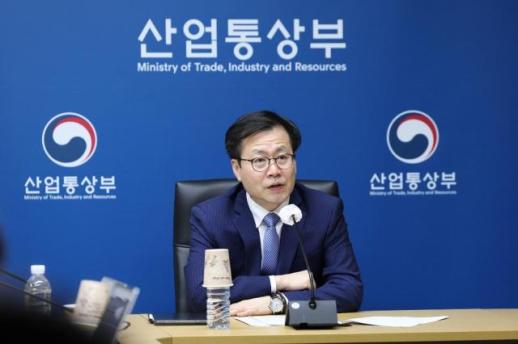 Korea's Electric Equipment Sector Positioned as Key Export Industry Yeo Han-goo, the head of the Trade Negotiation Bureau at the Ministry of Trade, Industry and Energy, stated on May 29 that despite increasing volatility in exports due to factors like the Middle East conflict and U.S. tariff policies, South Korea is turning these challenges into opportunities. He emphasized that electric equipment has established itself as a key export industry for South Korea, and the government will provide comprehensive support to ensure continued growth in exports. Yeo made these remarks during a meeting with the electric equipment industry at HD Hyundai Electric. In the months of March and April, exports exceeded $80 billion for two consecutive months, with electric equipment exports, including transformers, circuit breakers, cables, and motors, also showing an upward trend. Last year, electric equipment exports reached $16.7 billion, marking a 7.2% increase from the previous year and setting a record. From January to April this year, exports continued to grow by 3.8%. This growth is significantly influenced by the global expansion of artificial intelligence (AI) infrastructure and ongoing policies for transitioning to eco-friendly energy. Additionally, the replacement of aging power grids in the U.S. is driving global demand, suggesting that this year could also see record performance in the sector. To support the continued growth of electric equipment exports, the Ministry of Industry held this meeting to mark the first anniversary of the Lee Jae-myung administration. Companies attending the meeting requested assistance in stabilizing supply chains for raw materials and other resources to maintain stable business operations and exports amid global uncertainties. The ministry plans to provide extensive support to ensure that the electric equipment sector and other industries can sustain their export momentum. This includes expanding trade insurance to a record 275 trillion won this year, with 114 trillion won allocated for small and medium-sized enterprises. Furthermore, financial support for large-scale projects in nuclear power, defense, and electric equipment will be increased to 127 trillion won over the next five years. Regarding the electric equipment industry, the ministry aims to support the entire process from identifying global energy infrastructure projects to matching companies and providing proactive financial assistance in response to the growing demand from global AI data centers. Yeo stated, "Despite the instability in international circumstances, our electric equipment industry is leading the global market with its exceptional technological capabilities. The government will do its utmost to expand the operational scope of our companies through trade channels with major countries to maintain our leadership in the global market." 2026-05-29 11:02:00
 -
 April Tax Revenue Reaches 55.2 Trillion Won Amid Rising Corporate and Income Taxes Tax revenue in South Korea has shown an upward trend, coinciding with a strong performance in semiconductor exports. According to the Ministry of Finance and Economy, corporate tax revenue has increased due to improved corporate performance, while income tax has also risen due to higher performance bonuses. Additionally, the securities transaction tax has surged due to a booming stock market. In its report released on May 29, the ministry stated that tax revenue for April reached 55.2 trillion won, marking an increase of 6.3 trillion won (12.9%) compared to the same month last year. Corporate tax revenue rose significantly by 2.2 trillion won to 12.8 trillion won, largely due to improved corporate performance. A ministry official noted, "The increase includes amounts reported by semiconductor companies in March that were paid in installments, as well as figures from financial institutions' consolidated tax filings." The official added, "The rise in operating profits for semiconductor companies will likely have a more significant impact on the mid-term tax payments due in August and September rather than this reporting period." Income tax also saw an increase of 1.3 trillion won, totaling 9.7 trillion won. This rise was driven by higher performance bonuses and an increase in capital gains tax from rising stock prices. The securities transaction tax surged by 1.1 trillion won to 1.3 trillion won, more than five times higher than last year. The official explained, "The increase in securities transactions in March led to a rise in transaction taxes submitted in April, while the special rural tax also increased by 1.3 trillion won due to higher trading volumes on the KOSPI." Value-added tax increased by 300 billion won to 21.2 trillion won, and inheritance and gift taxes rose by 200 billion won to 3.5 trillion won, attributed to an increase in real estate gifts. The individual consumption tax and transportation, energy, and environmental taxes each rose by 100 billion won. As a result of the increase in April tax revenue, the cumulative tax revenue for the year reached 164.1 trillion won, up 21.9 trillion won from the previous year. The revenue progress rate stands at 39.5%, surpassing last year's rate of 38.0% and the average of 38.6% over the past five years. With the increase in tax revenue, the government anticipates a larger surplus for the year. Earlier, the government projected an excess tax revenue of 25.2 trillion won while preparing the first supplementary budget for the year. A ministry official stated, "To align with last year's performance of 373.9 trillion won, we need an increase of 41.5 trillion won this year. We have already secured about half of that, so there should be no major issues in meeting the supplementary budget amount." However, the official cautioned, "With first-half results still pending, there is currently no data indicating a large surplus will occur, so we will need to monitor corporate tax revenue in the second half." 2026-05-29 11:02:00
 -
 First Quarter Bank Non-Performing Loan Ratio Rises to 0.6%, Increasing by 1 Trillion Won in Three Months The rise in the non-performing loan ratio in the banking sector is increasing the burden of soundness management, particularly as defaults expand among small and medium-sized enterprises and individual business owners. According to the Financial Supervisory Service's report on the status of non-performing loans in domestic banks released on May 29, the non-performing loan ratio at the end of the first quarter of this year was 0.60%, up 0.03 percentage points from the previous quarter's 0.57%. Compared to the same period last year (0.59%), it increased by 0.01 percentage points, marking the highest level since March 2021 (0.62%). The total amount of non-performing loans reached 17.7 trillion won, an increase of 1.1 trillion won from the previous quarter. Corporate loans accounted for the largest share at 14.2 trillion won, while household loans totaled 3.3 trillion won, and credit card debts amounted to 300 billion won. By sector, the non-performing loan ratio for corporate loans rose to 0.74%, up 0.04 percentage points from the previous quarter. Among these, the non-performing loan ratio for small and medium-sized enterprises increased to 0.88%, up 0.05 percentage points, while the ratio for individual business loans rose to 0.66%, an increase of 0.09 percentage points. The non-performing loan ratio for household loans also increased to 0.32%, up 0.01 percentage points from the previous quarter. Mortgage loans recorded a ratio of 0.22%, while other credit loans stood at 0.66%. In the first quarter, the amount of non-performing loans resolved was 4.4 trillion won, a decrease of 1.3 trillion won from the previous quarter. The Financial Supervisory Service explained that the rise in the balance and ratio of non-performing loans was influenced by a decrease in the volume of sales and transfers. The reserve ratio for loan loss provisions continued to decline. As of the end of March, the reserve ratio was 150.4%, down 9.9 percentage points from the previous quarter's 160.3%. This trend follows a significant accumulation of loan loss provisions during the COVID-19 pandemic. However, the amount of newly generated non-performing loans in the first quarter decreased slightly. New non-performing loans totaled 5.5 trillion won, down 400 billion won from the previous quarter. New corporate loan defaults were 4.1 trillion won, a decrease of 300 billion won, while new household loan defaults also fell to 1.3 trillion won, down 100 billion won. The Financial Supervisory Service stated, "Considering the ongoing domestic and international uncertainties, we will closely monitor the trends in non-performing loan ratios and delinquency rates. We plan to check the reserve status of each bank and encourage active sales and transfers of non-performing loans." It added, "We will ensure that there are no unfair infringements on the rights of individual debtors during the process of managing the banks' soundness."* This article has been translated by AI. 2026-05-29 11:00:00
 -
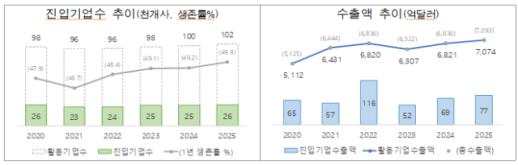 New Export Market Faces: 26,000 Companies Entering in Record Numbers Last year, nearly 26,000 companies entered the export market, marking the highest number in five years. The increase in new exporters is accompanied by a rise in survival rates, indicating a broader export base.According to the Customs Service's report on the status of new entrants in the export market for 2025, 25,953 companies entered the export sector last year, a 2.7% increase from the previous year. This figure represents the largest number of new exporters in the past five years.New entrants are defined as companies that recorded export or import activity for the first time after having no such activity in the previous year. This analysis is part of a deeper examination of the export market statistics released by the Customs Service in April as part of the '2025 Business Trade Activity Statistics'.The survival rate of new exporters has also improved. The percentage of companies that continued export activities for more than one year after entering the market reached 49.9%, the highest in five years. The Customs Service attributes this increase to the overall boost in exports, which surpassed $700 billion for the first time last year.In terms of product categories, companies dealing in machinery and computer-related products were the most numerous, followed by those in electrical products, plastics, cosmetics, and automobiles. On average, each new exporter handled 1.7 product categories.The average export volume per company was around $300,000. However, 82% of these companies had export volumes of less than $100,000, indicating a significant presence of small-scale exporters.The number of countries targeted for exports reached 175. Companies exporting to China were the most numerous, followed by those exporting to the United States, Japan, Vietnam, and the European Union. Each new exporter, on average, exported products to 1.5 countries.Regionally, companies located in the metropolitan area, including Seoul, Incheon, and Gyeonggi Province, accounted for the largest share, followed by those in the southeastern region of Busan, Ulsan, and Gyeongnam, the Daegu and Gyeongbuk area, and the central region of Sejong, Daejeon, Chungnam, and Chungbuk.A Customs Service official stated, "The increase in new exporters can lead to an expansion of our export base and enhanced competitiveness, and we plan to continue providing relevant statistical analyses."* This article has been translated by AI. 2026-05-29 11:00:00
 -
 KAI Strengthens Partnership with Strategic Command to Enhance Future Battlefield Response Korea Aerospace Industries (KAI) is enhancing its cooperation framework to respond to changes in future battlefield environments and advance cutting-edge defense capabilities.On May 29, KAI announced that it has signed a memorandum of understanding (MOU) with the Strategic Command to establish a strategic partnership and strengthen operational collaboration.The agreement aims to jointly explore the development direction of future military capabilities based on advanced technologies such as artificial intelligence (AI), space, and unmanned systems in the rapidly changing security landscape.The two organizations plan to expand cooperation in various areas, including sharing information and policies of mutual interest, holding regular expert seminars and discussions, increasing personnel exchanges, and jointly identifying advanced military needs for future battlefield environments.This collaboration with the Strategic Command is expected to be a significant opportunity for expanding civil-military technological cooperation and advancing future advanced weapon systems.Choi Jong-won, KAI's Strategic Headquarters Chief, stated, "This is a meaningful starting point for the development of South Korea's future strategic capabilities. We will actively share the aerospace technology and battlefield response experience that KAI has accumulated to support our military in swiftly acquiring the capabilities needed to succeed in future battlefields."Meanwhile, KAI is accelerating its efforts to enhance future battlefield response capabilities by increasing investments in manned-unmanned teaming (MUM-T), AI-based combat systems, and next-generation aerial power.* This article has been translated by AI. 2026-05-29 11:00:00
 -
 Paid Broadcasting Subscribers Decline for Second Consecutive Year The domestic paid broadcasting market continues to experience a decline in subscribers, following its first drop in the first half of 2024. The Broadcasting and Communications Commission announced on May 29 that the number of paid broadcasting subscribers in the second half of last year was 36,150,070, a decrease of 76,030 from the previous half. This downward trend has persisted since the initial decline in early 2024. Specifically, the number of IPTV subscribers in the second half of last year rose to 21,435,425, an increase of 0.46 percentage points compared to the first half. In contrast, the number of subscribers for cable operators (SO) fell to 11,935,236, a decrease of 0.37 percentage points, while satellite broadcasting subscribers dropped to 2,679,578, down 0.1 percentage points from the first half. By operator, KT maintained the highest number of subscribers at 9,123,463 (25.24%), followed by SK Broadband (IPTV) with 6,691,354 (18.51%), LG Uplus with 5,720,439 (15.82%), LG HelloVision with 3,391,130 (9.38%), and SK Broadband (SO) with 2,747,125 (7.60%). Meanwhile, the paid broadcasting industry is calling for swift government policy responses due to declining subscribers and worsening profitability. According to industry sources, cable TV revenues have decreased by 33% over the past decade, with operating profits plummeting by 97%. The burden of the broadcasting development fund is also a major concern for the industry. A representative from a cable company stated, "We are paying 168% of our operating profit towards the broadcasting development fund," adding that some cable operators are unable to meet their fund obligations. He further emphasized, "It is urgent to implement comprehensive and effective support measures, such as reducing the broadcasting development fund, securing legal status for regional channel support, and establishing reasonable content pricing, to ensure that cable TV can maintain its unique value of regional representation and achieve sustainable growth." 2026-05-29 10:56:00
 -
 LIGHTSUM's Yujeong set to make acting debut in YouTube rom-com SEOUL, May 29 (AJP) - Yujeong of K-pop girl group LIGHTSUM is set to make her acting debut in the web-based drama series "Subscription Love," her agency Cube Entertainment said on Friday. "Subscription Love," scheduled for release later in the day on the YouTube channel Rocodi, is a romance comedy set in a world where an artificial intelligence (AI)-powered dating subscription service matches a young man and woman, who grow closer while carrying out missions assigned in each episode. Yujeong plays a young woman who keeps failing at relationships and begins to experience changes through the subscription service. "I am thrilled that the series is finally being released," Yujeong said. "Since it was my first time acting in a drama, everything felt new to me, and I learned a lot while filming it." Expectations are high among fans to see Yujeong reveal a new side of herself through her acting debut, beyond her activities as a member of LIGHTSUM. Since debuting in 2021, the six members of LIGHTSUM, known for their bright songs, sharp choreography and youthful performances, have remained active through television appearances, festival performances and unit projects 2026-05-29 10:54:23
 -
 Korea Credit Guarantee Fund Celebrates 50th Anniversary with Vision for Future Growth The Korea Credit Guarantee Fund marked its 50th anniversary by reflecting on its achievements alongside small and medium-sized enterprises (SMEs) and outlining plans to enhance its role as a policy finance institution. On May 28, the fund held a ceremony titled '50 Years of Corporate Partnership' at Dragon City in Seoul. The event aimed to highlight the fund's contributions to the growth of SMEs over the past five decades and to share a vision for sustainable growth moving forward. Approximately 300 attendees included lawmakers such as Ahn Do-geol, Deputy Chairman of the Financial Services Commission Kwon Dae-young, former Minister of Strategy and Finance Yoon Jeung-hyun, and former Chairman of the Financial Services Commission Kim Joo-hyun, along with financial experts, business representatives, and current and former employees of the fund. In his speech, Chairman Kang Seung-jun stated, "The past 50 years of South Korea's economy is a history of growth shared between the fund and SMEs. We will continue to fulfill our role as a policy finance institution to support corporate growth in the next 100 years." Kang emphasized the need to strengthen the fund's role in corporate finance to support economic growth and to pave the way for a new future for the organization. The fund introduced its 'PIPE' strategy, which encompasses four key areas: Productive finance, Inclusive finance, People-centered financial services, and Enduring sustainable futures. This strategy aims to enhance the support system for businesses. Established in 1976 with a basic capital of 32.4 billion won and a guarantee balance of 101.6 billion won, the fund has since expanded its policy finance functions, growing to provide over 100 trillion won in financial support, including 13.3 trillion won in basic capital, 78 trillion won in credit guarantees, and 22 trillion won in credit insurance as of the end of last year. The anniversary ceremony was designed to focus on corporate clients, with the fund presenting awards to 50 outstanding companies recognized for their achievements in five sectors: advanced technology, innovation, and globalization, expressing gratitude to businesses that have contributed to national economic development.* This article has been translated by AI. 2026-05-29 10:54:00