

Journalist

Chang SeongWon
-
![[6·3 Local Election] Ruling Party Focuses on Pyeongtaek... The Fake Democratic Party Candidate](https://image.ajunews.com//content/image/2026/05/30/20260530145150423106_518_323.jpg) [[6·3 Local Election]] Ruling Party Focuses on Pyeongtaek... 'The Fake Democratic Party Candidate' On the last day of early voting, the leadership of the Democratic Party focused its efforts on securing votes in Pyeongtaek, where a five-way race is underway. Jo Seung-rae, the Democratic Party's secretary-general, held a meeting at the campaign office of Kim Yong-nam, the party's candidate for Pyeongtaek, on the morning of May 30. He urged voters to support Kim, stating, "Please vote for Kim, the real Democratic Party candidate." Jo noted, "We have held our headquarters meetings privately until now, but this is our first public meeting in Pyeongtaek. This clearly shows how important we consider the Pyeongtaek by-election and the Pyeongtaek mayoral election." Supreme Council member Kang Deuk-gu added, "The strategic committee, led by Representative Jeong Cheong-rae, is responsible for Kim's nomination. Here, Kim's campaign chairman is Representative Jeong. This election is one that Representative Jeong is fully committed to, and the Democratic Party is also fully supporting him." The party also targeted Zhukuk Innovation Party candidate Jo Guk, stating that he is misleading voters by presenting himself as a legitimate Democratic Party candidate. Jo Seung-rae remarked, "The fake Democratic Party candidate is deceiving people into thinking he is the real one. If you mistakenly vote for the fake Democratic Party, it could lead to a victory for the People Power Party. We must support the real Democratic Party candidate." Kim Hyun-jeong, a lawmaker from the Pyeongtaek Byeong district, emphasized that the party is actively supporting Kim Yong-nam through a dedicated election support team, stating, "This confirms that the candidate is not someone who embodies 'Democratic Party values' as Jo claims." She criticized Jo's campaign strategy, saying, "Jo's side is attempting to divide Democratic Party members and supporters. He claims that if elected, he will lead a merger, which is simply not true and goes beyond acceptable bounds." Supreme Council member Hwang Myeong-seon also clarified, "As a supreme council member, I want to make it clear that I am not considering a merger between the Democratic Party and the Zhukuk Innovation Party after the election."* This article has been translated by AI. 2026-05-30 15:00:00
[[6·3 Local Election]] Ruling Party Focuses on Pyeongtaek... 'The Fake Democratic Party Candidate' On the last day of early voting, the leadership of the Democratic Party focused its efforts on securing votes in Pyeongtaek, where a five-way race is underway. Jo Seung-rae, the Democratic Party's secretary-general, held a meeting at the campaign office of Kim Yong-nam, the party's candidate for Pyeongtaek, on the morning of May 30. He urged voters to support Kim, stating, "Please vote for Kim, the real Democratic Party candidate." Jo noted, "We have held our headquarters meetings privately until now, but this is our first public meeting in Pyeongtaek. This clearly shows how important we consider the Pyeongtaek by-election and the Pyeongtaek mayoral election." Supreme Council member Kang Deuk-gu added, "The strategic committee, led by Representative Jeong Cheong-rae, is responsible for Kim's nomination. Here, Kim's campaign chairman is Representative Jeong. This election is one that Representative Jeong is fully committed to, and the Democratic Party is also fully supporting him." The party also targeted Zhukuk Innovation Party candidate Jo Guk, stating that he is misleading voters by presenting himself as a legitimate Democratic Party candidate. Jo Seung-rae remarked, "The fake Democratic Party candidate is deceiving people into thinking he is the real one. If you mistakenly vote for the fake Democratic Party, it could lead to a victory for the People Power Party. We must support the real Democratic Party candidate." Kim Hyun-jeong, a lawmaker from the Pyeongtaek Byeong district, emphasized that the party is actively supporting Kim Yong-nam through a dedicated election support team, stating, "This confirms that the candidate is not someone who embodies 'Democratic Party values' as Jo claims." She criticized Jo's campaign strategy, saying, "Jo's side is attempting to divide Democratic Party members and supporters. He claims that if elected, he will lead a merger, which is simply not true and goes beyond acceptable bounds." Supreme Council member Hwang Myeong-seon also clarified, "As a supreme council member, I want to make it clear that I am not considering a merger between the Democratic Party and the Zhukuk Innovation Party after the election."* This article has been translated by AI. 2026-05-30 15:00:00 -
 South Korea Expresses Regret Over U.S. General's Comments on China U.S. Forces Korea Commander Jay B. Brunson recently sparked controversy by likening South Korea to a "dagger" from China's perspective, prompting the South Korean government to convey its regret to the United States.According to Yonhap News on May 30, National Security Office Director Wi Seong-rak, along with officials from the Ministry of National Defense and the Ministry of Foreign Affairs, communicated the government's stance on Brunson's remarks through various diplomatic and security channels. The government is expected to have expressed concern and regret over the comments while requesting restraint.A Blue House official stated to Yonhap, "We cannot confirm the specific details of discussions through diplomatic and security channels between South Korea and the U.S.," but added, "We are aware of Brunson's recent series of public statements, and communication on various issues has been ongoing between the two countries."On May 22, Brunson appeared on a podcast hosted by the U.S. Army War College, stating, "When they (China) look from the eastern coast of China, what they see is South Korea, which is at the center of Asia, and serves as a kind of shield, along with Japan, as they aspire to expand beyond the South China Sea."He also described South Korea's geographical position last May as resembling an island or a fixed aircraft carrier between Japan and mainland China.In response, the Chinese Embassy in South Korea criticized Brunson's characterization of South Korea and the U.S. military presence there as a "forward base" aimed at China. The embassy also expressed discontent through some South Korean media, stating, "Your remarks have clearly crossed the line."Democratic Party spokesperson Boo Seung-chan also commented on Brunson's remarks, expressing regret for infringing on South Korea's strategic status and creating diplomatic tension. He emphasized that South Korea's foreign and security strategy should be determined solely by its sovereign citizens.Boo also criticized the Chinese government's response, stating, "The manner in which the Chinese government criticized the U.S. through the South Korean media is also inappropriate," adding that while they are aware of the remarks directed at them, the approach of involving South Korean public opinion is far from the diplomatic restraint expected from neighboring countries.* This article has been translated by AI. 2026-05-30 14:42:00
 -
 US Forces Korea Commander Clarifies 'Dagger' Comment Javier Brunson, the commander of US Forces Korea, clarified his recent comment that "Korea is a dagger pointed at China," stating that he intended to explain the operational environment the US faces. According to Yonhap News on May 30, Brunson made this clarification during the 23rd Shangri-La Dialogue in Singapore when asked whether his "dagger" remark represented the official stance of the Trump administration or had Pentagon approval. The question arose during a Q&A session following a public speech by US Secretary of Defense Pete Hegseth, where a Chinese professor in the audience directed the question to Hegseth, who then passed it to Brunson. Brunson explained, "What I wanted to convey to the students at the War College was the need to change our perspective and consider our position. It is important for students to understand and respect viewpoints beyond our own." He used a map with the Korean Peninsula oriented upwards to illustrate his point, saying, "Changing the perspective of the map allows us to consider how other countries in the region view us." He added, "While we must be strong and maintain military capabilities in South Korea, we also need to understand that such perspectives from other countries still exist." Brunson also recalled a statement from a Prussian military philosopher who referred to Korea as a "dagger aimed at Japan," referencing the words of Prussian Army Major Jakob Meckel, who described the Korean Peninsula as a "dagger aimed at the heart of Japan" in 1885. He emphasized that his comments were not intended to be hostile toward China, advocating instead for a nuanced view of US-China relations that encourages dialogue.* This article has been translated by AI. 2026-05-30 13:57:00
 -
 BTS rides sold-out North American tour and AMA wins into Busan homecoming SEOUL, May 30 (AJP) -BTS is bringing home a winning streak. The group wrapped up the first North American leg of its "ARIRANG" world tour after drawing 840,000 fans to 15 sold-out stadium concerts, while collecting three trophies at the 2026 American Music Awards in Las Vegas, setting the stage for a highly anticipated homecoming concert in Busan next month. BigHit Music said Saturday that BTS attracted 840,000 concertgoers across five cities — Tampa, El Paso, Stanford, Las Vegas and Mexico City — with every show sold out. Additional dates added in Tampa, Stanford and Las Vegas due to overwhelming demand were also fully booked. The North American run marked a milestone in the group's first full-scale world tour since all seven members completed their mandatory military service and resumed activities as a full group earlier this year. BigHit said BTS performed songs from its comeback album "ARIRANG" alongside many of its signature hits, with fans singing Korean lyrics throughout the concerts. The company highlighted the audience-wide singalong of the Korean folk song "Arirang" during the performance of "Body to Body" as one of the defining moments of the tour. The tour's momentum carried into a successful awards week in Las Vegas, where BTS won three honors at the American Music Awards, including Artist of the Year — the group's second victory in the show's top category. BTS also took home Song of the Summer for its Billboard Hot 100 chart-topper "Swim" and Best Male K-Pop Artist. The group attended the ceremony at the MGM Grand Garden Arena while in the middle of its Las Vegas stadium residency. he wins underscored the staying power of BTS' global fanbase following a nearly four-year hiatus that included military service obligations. The group's commercial performance has matched its awards success. According to Billboard, BTS generated $76.2 million in revenue and sold 417,000 tickets from eight concerts held in Goyang, Tokyo and Tampa during April, making it the world's top-grossing tour for the month. Tampa's three stadium concerts ranked as April's highest-grossing engagement at a single venue, while average revenue per show in Tampa and El Paso climbed roughly 64 percent from BTS' previous U.S. performances. The comeback album "ARIRANG" debuted at No. 1 on the Billboard 200 in March with 641,000 equivalent album units in its opening week, giving BTS its seventh chart-topping album in the United States. Attention now shifts to Busan, where BTS will perform at Busan Asiad Main Stadium on June 12 and 13. The June 13 concert coincides with the 13th anniversary of the group's debut, making the stop one of the most symbolic and anticipated dates of the world tour. Following Busan, BTS will launch its European leg in Madrid on June 26 before returning to North America for a second stadium run beginning in August. The second North American leg will take the group to East Rutherford, New Jersey (Aug. 1-2), Foxborough, Massachusetts (Aug. 5-6), Baltimore, Maryland (Aug. 10-11), Arlington, Texas (Aug. 15-16), Toronto (Aug. 22-23), Chicago (Aug. 27-28) and Los Angeles (Sept. 1-2 and Sept. 5-6), extending the momentum of a comeback tour that has already filled stadiums across Asia and North America. Billed as BTS' largest tour to date, the "ARIRANG" world tour spans 85 concerts in 34 cities across 23 countries through March 2027. Future stops include Melbourne, Sydney, Kaohsiung, Bangkok, Kuala Lumpur, Singapore, Jakarta, Hong Kong and Manila as BTS continues what is shaping up to be one of the biggest global tours ever mounted by a K-pop act. 2026-05-30 13:02:16
 -
 Oh Se-hoon Criticizes President Yoon's Voting Behavior as 'Unreasonable' Oh Se-hoon, the People Power Party candidate for Seoul mayor, criticized President Yoon Suk Yeol on May 30 for his behavior during the early voting process, calling it "unreasonable." Speaking to reporters before a campaign event in Gangseo-gu, Oh stated, "From the perspective of ordinary citizens, it is difficult to understand this behavior." He added, "Human behavior is often governed by the unconscious. The actions displayed yesterday suggest a mindset of 'I am above the law because I am the president' or 'I am different from ordinary citizens,' which is an unlawful unconsciousness that became apparent in his actions." Oh further remarked, "With an important election approaching, it seems like a declaration to the public that he intends to push for a special investigation to dismiss charges immediately after the election." He emphasized that the public is closely watching this situation. He also noted that the high early voting rate in this local election indicates a significant level of voter anger towards the current administration's failures. On the same day, Oh took to Facebook to address President Yoon's comment to a voting official, saying, "It doesn't matter, so..." and responded, "It matters to every citizen of South Korea." Earlier, during early voting at the Samcheong-dong Community Center in Jongno-gu, President Yoon had stepped out of the voting booth and asked a staff member, "Is it okay if it’s only partially marked? Will it be considered invalid?" After being told that showing the ballot was not allowed, he replied, "Come here. It doesn't matter," before returning to complete his vote.* This article has been translated by AI. 2026-05-30 12:51:00
 -
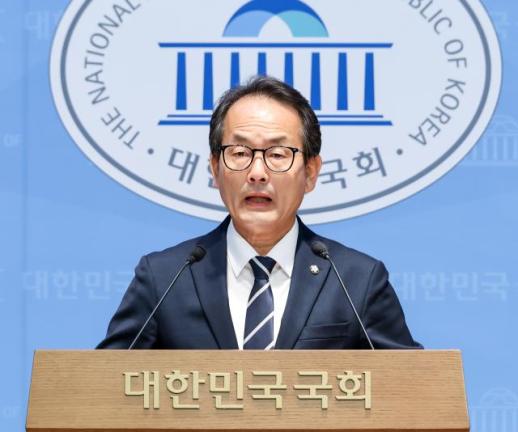 Kang Jun-hyun Criticizes Han Dong-hoon for Election Law Violations Kang Jun-hyun, the chief spokesperson for the Democratic Party, criticized independent candidate Han Dong-hoon, who is running in the Busan Buk-gap district in the local elections, stating, "He is now openly engaging in actions that could violate election laws, and he seems to be suffering from a delusion of being a significant frontrunner." Kang made these remarks during a press conference held on the morning of May 30 at the National Assembly in Yeouido, Seoul. He expressed concern that Han's illegal activities disrupting the election order are becoming increasingly serious. Kang reported that there have been numerous reports of Han's fan club members engaging in prohibited activities, such as wearing white clothing with Han's campaign symbols and carrying oversized placards, actions that are only permitted for official campaign workers. "This is a clear violation of the law. Is the election law an exception only for him?" he questioned. He further pointed out, "This is not enthusiasm but rather the excessive behavior of supporters, which is a show of arrogance and illegality that troubles the residents of Buk-gu." Kang also criticized the People Power Party for involving former presidents Lee Myung-bak and Park Geun-hye in the election campaign. He stated, "The People Power Party is not only lacking in new ideas but is also blatantly dragging these former presidents into the election. What qualifications do those who hindered the development of Busan have to come back and support a party that has caused turmoil?" Former President Lee is scheduled to visit Busan on May 31 to support the candidacy of Park Hyung-jun, the People Power Party's candidate for mayor. Earlier, former President Park visited Gijang with Park Hyung-jun on May 27. Kang emphasized support for Democratic Party candidates Ha Jung-woo in Busan Buk-gap and Jeon Jae-soo for mayor. He stated, "Without Jeon Jae-soo as mayor and Ha Jung-woo as a representative, Busan's future will be bleak, even with President Lee Jae-myung. The only hope for Busan's development is to build an unbeatable coalition with Lee Jae-myung, Jeon Jae-soo, and Ha Jung-woo."* This article has been translated by AI. 2026-05-30 11:39:00
 -
 Hegseth touts South Korea as model ally as U.S. presses Asia on defense spending SEOUL, May 30 (AJP) -U.S. Defense Secretary Pete Hegseth on Saturday held up South Korea as a model ally for taking greater responsibility for its own defense, while urging Asian partners to sharply increase military spending and warning China against seeking regional hegemony. Speaking at the annual Shangri-La Dialogue security summit in Singapore, Hegseth said Washington was pursuing a "strong, quiet and clear" alliance strategy aimed at maintaining a stable balance of power in the Indo-Pacific while ensuring allies shoulder a larger share of the defense burden. "The security of this region has rested disproportionately on American military power for too long," Hegseth said, repeating the Trump administration's call for allies and partners to raise defense spending to 3.5 percent of gross domestic product. He singled out South Korea for praise, describing Seoul's commitment to higher defense spending and greater operational responsibility as "a breath of fresh air." The remarks reinforced a message Hegseth delivered earlier this month during talks at the Pentagon with South Korean Defense Minister Ahn Gyu-back, where he praised Seoul's efforts to assume greater responsibility for the defense of the Korean Peninsula and cited burden-sharing as the foundation of a resilient alliance. "As I noted during my visit to Seoul last November, the Republic of Korea's commitment to increase defense spending and your leadership in assuming primary responsibility for the security of the Korean Peninsula is very important," Hegseth told Ahn during their May 11 meeting. The Pentagon chief's speech reflected the Trump administration's broader effort to reshape alliance relationships around greater military contributions from partners while concentrating U.S. resources on deterring China. Hegseth warned that Beijing's military buildup and expanding regional activities were generating "rightful alarm" across the Indo-Pacific. "What we seek is a favorable but durable balance of power in which no state, including China, can impose its hegemony," he said. "America is a Pacific nation, and we insist that China respect our longstanding position in the region." He also emphasized the strategic importance of the so-called First Island Chain stretching from Japan through Taiwan and the Philippines, underscoring Washington's continued focus on deterring Chinese military expansion despite recent efforts by President Donald Trump and Chinese President Xi Jinping to stabilize bilateral ties. South Korea used the summit to present its own vision for regional security. Defense Minister Ahn, attending the three-day gathering in Singapore, was scheduled to deliver a keynote address titled "Regional Security Challenges and South Korea's Strategic Response," outlining Seoul's defense strategy amid a rapidly evolving security environment. On the sidelines, Ahn was expected to hold bilateral meetings with congressional delegations from the United States and defense leaders from Japan, Australia, Norway, the Philippines and Thailand to discuss expanding defense cooperation and arms industry partnerships. The annual Shangri-La Dialogue, organized by the International Institute for Strategic Studies, has become Asia's premier security forum, bringing together defense ministers, military officials and strategic experts from across the Indo-Pacific and Europe. This year's gathering opened amid renewed concerns over Taiwan, the aftermath of the Middle East conflict and questions about the future shape of U.S. security commitments in Asia. 2026-05-30 11:17:33
 -
 National Growth Fund Sells Out, Encouraging Productive Investment The National Growth Fund, designed for public participation, sold out its entire 600 billion won allocation within just five days of its launch. The number of subscribers surpassed 30,000, with approximately 39% classified as low-income based on annual income. The average subscription amount per person reached about 20 million won. In a financial market still marked by uncertainty, the fact that many citizens entrusted their funds to the growth fund carries significant implications. What stands out most is the choice made by investors. In recent years, market funds have tended to concentrate on real estate, deposits, and short-term financial products. As the low-growth phase has prolonged, there has been a strong preference for stability over risk-taking in future industries. However, the success of the growth fund suggests that at least some funds may shift back toward productive investment. Economic growth stems not from consumption but from investment—more specifically, investment that enhances future productivity. New companies must emerge, technologies must be developed, and innovative industries must grow to increase jobs and income. If funds remain tied up in real estate and short-term financial products, the overall growth potential of the economy will inevitably decline. In fact, developed countries have long established various systems to connect citizens' assets to productive investments. A prime example is the United States. A significant portion of American household assets is invested in companies and capital markets through pensions, mutual funds, and ETFs. The 401(k) retirement plan has served as a crucial source of funding for innovative companies for decades. The assets held by American households ultimately contribute to the growth of companies like Apple, Nvidia, and Microsoft. Japan is following a similar path. The Japanese government has expanded the NISA (Nippon Individual Savings Account) program to encourage household financial assets, which have long been tied up in long-term deposits, to flow into capital markets. This is part of a broader 'from savings to investment' policy. While more than half of Japanese household assets were previously locked in cash and deposits, the proportion of investments in stocks and funds has been gradually increasing. Singapore also utilizes its sovereign wealth fund and pension system to channel national and citizen assets into long-term investments, prioritizing national competitiveness and the development of future industries over short-term gains. South Korea faces similar challenges. A high proportion of household financial assets in the country remains in deposits and real estate. While maintaining stable assets is important, there are ongoing concerns about the lack of long-term funds available for investment in future industries. Sectors such as artificial intelligence (AI), semiconductors, biotechnology, space industry, and energy transition require substantial capital to grow. In this context, the complete sell-out of the growth fund can be seen as a positive signal. It demonstrates the potential for citizens' assets to be linked to future growth industries. Notably, the participation rate of low-income individuals approaching 40% indicates that citizens are eager to share in the long-term benefits of growth beyond simple deposit interest. However, success should not be judged solely by initial popularity. The real test begins now. In the past, various funds with policy objectives have garnered interest at launch but often failed to deliver expected results. Poor selection of investment targets or political interference can lead to deteriorating returns. Investment failures undermine public trust and negatively impact the development of capital markets. It is crucial to clarify that the growth fund is an investment product, not a policy finance tool. Investment always carries risks. While profits can be gained, there is also the possibility of losses. If the government is perceived as guaranteeing principal or if the fund is used for political gain, market principles could be compromised. Independence and professionalism in management are also vital. Investment decisions should be based on market logic, not political considerations. Support for specific industries or companies should not be the goal. When funds are allocated based on growth potential and profitability, both the fund and the industry can thrive. Transparency is essential. Investors should be able to regularly verify where their money is invested and what returns are being generated. The disclosure of asset management reports and information is not merely an administrative procedure but a key mechanism for maintaining trust. The significance of the growth fund lies not just in raising 600 billion won. Its true meaning is in connecting citizens' assets to future industries and creating a new financial ecosystem that encourages productive investment. Economist Joseph Schumpeter defined innovation as a "new combination." The growth fund should serve as a new combination that links citizens' funds with corporate innovation. This way, investors can earn returns, companies can grow, and the nation can enhance its competitiveness. The sell-out is just the beginning. What matters now is how well it is managed. There is hope that the growth fund will not be a short-term success but will establish itself as a new successful model for South Korea's capital markets. Creating a virtuous cycle where market funds flow into productive investments and the benefits return to the citizens is the most pressing task for the South Korean economy today.* This article has been translated by AI. 2026-05-30 11:06:00
 -
 White House: Trump Will Only Make Agreements Beneficial to the U.S. On May 29, the White House stated that President Donald Trump will only engage in negotiations with Iran that are beneficial to the United States and meet his red lines.According to Yonhap News on May 30, a White House official responded to questions about the results of a meeting regarding Iran negotiations held in the Situation Room with Trump's senior security team. The official emphasized, "Iran must never possess nuclear weapons." The meeting reportedly lasted about two hours before concluding.Just before the meeting began, President Trump announced on the social media platform Truth Social, "I will be having a meeting in the Situation Room to make a final decision." However, after the meeting, Trump did not disclose specific outcomes. The New York Times reported that Trump postponed a final decision on Iran's proposal.Meanwhile, on Truth Social, Trump outlined his top conditions, which include a ban on Iran's nuclear weapons development, the complete opening of the Strait of Hormuz without tolls, the immediate removal of underwater mines by Iran, and the U.S.-led excavation and removal of highly enriched uranium buried at Iranian nuclear facilities.* This article has been translated by AI. 2026-05-30 10:36:00
 -
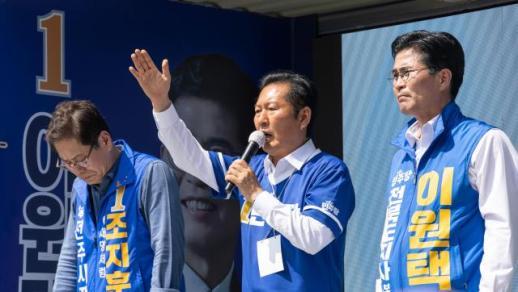 Election Campaigns Intensify Ahead of Local Elections Amid Internal Party Struggles As early voting begins, the leaders of both major parties are ramping up efforts for victory in the June 3 local elections. However, internal dissent is surfacing within their parties. On May 30, political sources reported that Jeong Cheong-rae, the leader of the Democratic Party, is struggling in the Jeollabuk-do region, where there have been signs of avoidance of Jang Dong-hyuk, the leader of the People Power Party. The Democratic Party is facing concerns about potentially losing the Jeollabuk-do governorship, a traditional stronghold, due to the rise of independent candidate Kim Kwan-young, who has declared his candidacy in defiance of the party's primary results. Local sentiment in Jeollabuk-do has led regional committee leaders to request Jeong to refrain from campaigning in the area, stating, "Please stop coming here." Song Tae-kyu, the Democratic Party's Iksan City committee chair, expressed on Facebook on May 29, "We appreciate the efforts you are making across the country, and we feel your genuine affection for Jeollabuk-do. However, it is time for you to stop coming. Please focus your efforts on other regions and let go of your concerns for Jeollabuk-do." He added, "Jeollabuk-do is not a region that will always wait patiently. Central politics must remember that it is not a quiet place without a voice." Previously, Jeong had posted about five times on Facebook by May 28, urging support for candidate Lee Won-taek. On the same day, he appeared on Kim Eo-jun's News Factory, apologizing for not understanding the sentiments of Jeollabuk-do residents and demonstrating efforts to secure the region. Jang is also facing challenges as some candidates from the People Power Party are distancing themselves from him due to concerns about losing moderate voters. Oh Se-hoon, the candidate for Seoul mayor, has kept his distance from Jang since the early stages of the campaign. On May 26, during an appearance on BBS Radio's "Kim Tae-seop's Morning Journal," he stated regarding Jang, "There probably won't be any invitations in the metropolitan area. There is no reason for him to rush to support the election in Seoul." Daejeon's mayoral candidate Lee Jang-woo also did not appear alongside Jang during his campaign activities in Daejeon on May 28, raising suspicions of a "Jang avoidance" phenomenon. Dissatisfaction within the party has surged since Jang was appointed as the head of the election campaign committee on May 13. Woo Jae-jun, a prominent member of the pro-Han (pro-Han Dong-hoon) faction, called for Jang to step back from the front lines and did not attend the launch ceremony, insisting that Jang should withdraw from active campaigning.* This article has been translated by AI. 2026-05-30 10:03:00