

Journalist

Chang SeongWon
-
 Chef Son Jong-won draws buzz with crisp first pitch at SSG home opener Son Jong-won, head chef at Eatanic Garden and La Mange Secrete and a cast member of Netflix’s “Culinary Class Wars 2,” drew attention after taking the mound for a KBO season opener. SSG Landers selected Son as the ceremonial first-pitch thrower for its 2026 home opening game against the KIA Tigers on Friday at Incheon SSG Landers Field. The ballpark hosted fan events and cheering programs that added to a festive atmosphere. Son drew cheers with what spectators described as a sharp uniform look, a clean throwing motion and steady posture. Before the pitch, he said, “It’s an honor to throw out the first pitch for the opener, and I hope SSG carries good energy through the season and wins the championship.” Online commenters praised the moment, writing, “His form is almost like a player,” “Isn’t he a pitcher, not a chef?” and “Perfect from the visuals to the first pitch.” * This article has been translated by AI. 2026-03-28 19:24:17
 -
 Jungkook’s TikTok Follow of aespa Rekindles Rumors Linking Him to Winter Reports that BTS member Jungkook followed girl group aespa on TikTok have resurfaced online rumors linking him to aespa member Winter. On social media and online communities, users said they spotted Jungkook following aespa’s official TikTok account. The activity prompted renewed discussion of earlier dating rumors involving Winter. The two previously faced speculation that they were dating. Online posts claimed they wore matching fashion items such as shoes and even got couple tattoos, drawing attention from fans. Photos also circulated showing Jungkook attending an aespa concert during his military service. At the time, neither agency issued a clear statement, leading some fans to interpret the silence as tacit confirmation. Reaction to the latest follow has been divided. Many commenters criticized Jungkook, saying he should have avoided actions that could reignite speculation, while others argued the relationship was already widely assumed and voiced support for the pair. BTS recently drew about 20,000 people to a comeback concert in Gwanghwamun. The group is set to begin a monthlong South American world tour in October.* This article has been translated by AI. 2026-03-28 18:48:16
 -
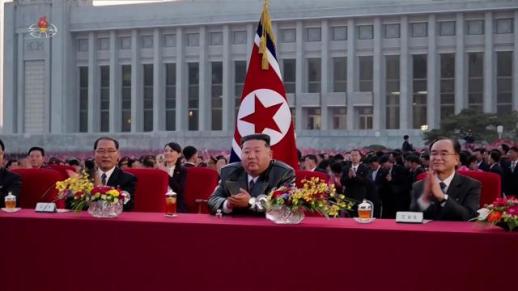 Kim Jong-un reaffirms closer ties with Beijing in message to Xi SEOUL, March 28 (AJP) - North Korean leader Kim Jong-un sent a message to Chinese President Xi Jinping reaffirming Pyongyang’s commitment to strengthening bilateral ties, state media reported Saturday. According to the Korean Central News Agency (KCNA), Kim sent a reply on Friday to Xi, who had congratulated him on his reappointment as chairman of North Korea’s State Affairs Commission. Kim expressed “deep thanks,” saying he felt the “invariable support and emotion of friendship” from Xi and the Chinese government toward him, his party and North Korea’s government. Referring to what he described as key agreements reached during a North Korea-China summit held last September on the sidelines of China’s 80th Victory Day parade, Kim said he was pleased that the “traditional DPRK-China relations are being put on a new high stage in keeping with the aspiration and desire of the two parties and the peoples of the two countries.” He also stressed that North Korea’s position remains firm in continuing to deepen and develop bilateral cooperation centered on socialism. Kim further expressed confidence that China, under Xi’s leadership, would achieve “fresh progress” in building a modern socialist state. North Korea’s Supreme People’s Assembly, the country’s parliament, reappointed Kim as chairman of the State Affairs Commission on March 22. Xi sent a congratulatory message on Thursday, saying that safeguarding, consolidating and developing China–North Korea relations is a consistent and unwavering policy of the Communist Party of China and the government. 2026-03-28 17:14:39
 -
 EDITORIAL: Tokenized securities are reshaping U.S. markets — Is Korea ready? SEOUL, March 28 (AJP) - The U.S. capital market is once again attempting to reshape the backbone of financial infrastructure. This time, the catalyst is not artificial intelligence, but tokenized securities — asset tokenization built on blockchain technology. The Financial Times recently observed that tokenized stocks may succeed precisely because investors hardly notice the transition. In an opinion piece titled “Tokenised stocks are coming, and ideally nobody will notice,” the newspaper argued that real-time, blockchain-based settlement could transform trading infrastructure without dramatically changing the user experience. Industry leaders are echoing this view. BlackRock CEO Larry Fink has repeatedly emphasized tokenization as a key evolution in capital markets, arguing that expanding access to investments through tokenization could modernize financial ownership structures. Meanwhile, Robinhood CEO Vladimir Tenev has argued that token-based ownership could soon demonstrate advantages over traditional stock ownership, highlighting faster settlement and broader access. The core issue is not marketing hype but efficiency — speed, cost reduction and simplified market infrastructure. Today’s stock trading is digital, yet it still relies on multiple intermediaries and layered record-keeping systems, resulting in delayed settlement. Blockchain-based tokenized assets, by contrast, could theoretically enable near-instant settlement and 24-hour trading. What matters most is that major exchanges are already moving. Nasdaq received approval from the U.S. Securities and Exchange Commission (SEC) in March to allow certain securities to trade in tokenized form. Initially, the program will cover companies within the Russell 1000 index and major ETFs, with settlement conducted through the Depository Trust Company, integrating blockchain into existing infrastructure. The New York Stock Exchange is taking a different approach. NYSE recently partnered with digital asset firm Securitize to develop a blockchain-based platform for tokenized securities. The proposed system aims to enable round-the-clock trading, instant settlement and even the use of stablecoins for transactions. London is not standing still either. The London Stock Exchange Group announced plans to develop an on-chain settlement service called the Digital Securities Depository, designed to support tokenized bonds, equities and private market assets. The first deliverables are expected in 2026, pending regulatory approval. This signals that tokenization is no longer an experiment within the crypto industry. Traditional exchanges and financial institutions are now competing to shape the next generation of capital market infrastructure. However, the future is not without risks. One of the biggest challenges is ensuring investor protection. Tokenized securities can blur the boundaries of ownership, custody and settlement finality. If investor rights are not clearly defined, trust in markets could erode quickly — as seen in past financial crises. Critics also note that some tokenized securities currently available in global markets resemble price-tracking instruments rather than actual shares, lacking full shareholder rights such as dividends or voting power. The real challenge, therefore, is not whether tokenization happens, but whether it can be implemented without weakening investor protections. Where does Korea stand? Despite active discussions around digital assets, Korea has been slower to address how tokenization could reshape capital market infrastructure. Tokenized securities should not be viewed merely as another financial product. They represent a fundamental redesign of issuance, custody, settlement, disclosure and investor protection. The direction emerging from the United States is clear. First, regulated exchanges must take the lead. Second, regulators must allow controlled experimentation. Third, the goal must be market efficiency — not speculative hype. Korea’s task is equally clear. The Korea Exchange, Korea Securities Depository, brokerages, banks, asset managers and fintech firms should jointly develop a roadmap for tokenized securities infrastructure. This does not mean immediately tokenizing listed equities. A phased approach — beginning with private securities, private debt, fund shares and alternative assets — would allow regulators to build safeguards gradually. Financial history often changes quietly. When markets transitioned from paper to digital records, investors did not immediately grasp the magnitude of change. Tokenization may follow the same path. But by the time the shift becomes visible, the infrastructure leadership may already be decided. The digital tokenization of U.S. securities markets is not merely an American experiment. It is a competition to define the future standard of global capital markets. If the era of tokenized securities truly arrives, Korea should not be a spectator — but a designer. 2026-03-28 16:23:50
 -
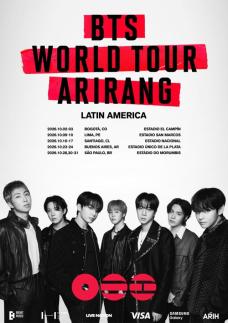 BTS sets Latin America tour across five cities in October SEOUL, March 28 (AJP) - BTS will embark on a Latin America leg of its world tour in October, performing across five cities, the group’s agency said Saturday. Big Hit Music released detailed schedules for the “Arirang” world tour in Latin America, with concerts set to begin in Bogotá on Oct. 2–3. The tour will then continue to Lima on Oct. 9–10, Santiago on Oct. 16–17, Buenos Aires on Oct. 23–24, and São Paulo on Oct. 28 and 30–31, for a total of 11 shows. The concerts will mark BTS’s first full-group performances in Colombia, Peru and Argentina. Member Jin previously appeared as a guest during Coldplay’s world tour concert in Buenos Aires in 2022. The world tour will kick off on April 9 at Goyang Stadium in Goyang. According to the agency, all 46 shows across South Korea, Japan, North America and Europe have already sold out. BTS returned as a full group on March 21 after nearly four years. The group held a special comeback performance at Seoul’s Gwanghwamun Square the following day, drawing about 22,000 fans. 2026-03-28 15:43:45
 -
 KBO League Opens 2026 Season With Sellouts at All Five Ballparks Marking its 45th anniversary, South Korean professional baseball opened the 2026 season with strong turnout from the first day. The KBO League said 105,878 fans attended the season openers held March 28 at five ballparks nationwide. It was the third-largest opening-day total on record, behind 2019 (114,021) and 2025 (109,950). All five stadiums sold out. The first sellout came at Incheon SSG Landers Field for the KIA Tigers-SSG Landers game, where all 23,000 seats were gone by 10 a.m. The Daejeon game between the Kiwoom Heroes and Hanwha Eagles also sold out about two hours before first pitch. Sellouts followed at Jamsil for kt wiz-LG Twins, in Daegu for the Lotte Giants-Samsung Lions game, and in Changwon for Doosan Bears-NC Dinos. The league has now recorded sellouts at all opening-day venues for four straight years. After topping 10 million in total attendance in back-to-back seasons — about 10.88 million in 2024 and about 12.31 million in 2025 — the KBO is on track to reach the mark for a third consecutive year. Before the season began, exhibition games drew more than 440,000 fans, setting a record and adding to expectations for strong interest this year.* This article has been translated by AI. 2026-03-28 15:42:00
 -
 BTS to Tour South America in October With 11 Shows in Five Cities BTS will launch a South American leg of its world tour in October, with 11 concerts across five cities, its agency said. According to the detailed schedule released on the 28th for the “World Tour ‘ARIRANG’ in Latin America,” the group will open in Bogota, Colombia, on Oct. 2-3, then play Lima, Peru, on Oct. 9-10; Santiago, Chile, on Oct. 16-17; Buenos Aires, Argentina, on Oct. 23-24; and Sao Paulo, Brazil, on Oct. 28 and Oct. 30-31. The agency said it will be the first time BTS visits Colombia, Peru and Argentina as a full group. The agency also said all 46 dates on BTS’ world tour — starting with an April 9 show at the main stadium of Goyang Sports Complex in Gyeonggi Province and continuing through Japan, North America and Europe — have sold out. * This article has been translated by AI. 2026-03-28 15:18:15
 -
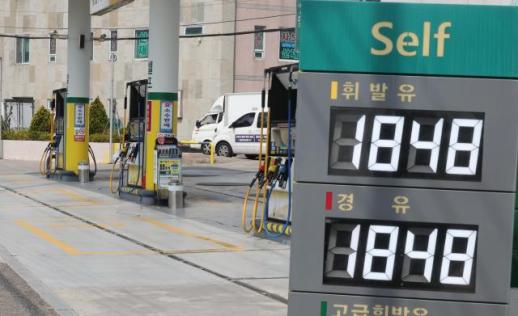 Fuel prices near 1,900 won in Seoul as price cap raised SEOUL, March 28 (AJP) - Fuel prices at gas stations across South Korea continued to rise for a second consecutive day after the government raised oil price caps. According to Opinet, the state-run fuel price information system, the nationwide average price of gasoline stood at 1,849.7 won ($1.23) per liter as of 9 a.m. on Saturday, up 10.9 won from the previous day. Diesel prices also climbed 9.6 won to 1,844.1 won per liter, extending the upward trend in fuel costs. The increase was particularly pronounced in Seoul. The average gasoline price in the capital surged 24.9 won in a single day to 1,890.5 won per liter, while diesel rose 18.6 won to 1,872.1 won. Prices had already jumped sharply on Friday, the first day of the price cap. The nationwide average gasoline price rose 19.4 won to 1,838.8 won, while diesel increased 18.8 won to 1,834.6 won. The government set the new price ceilings at 1,934 won per liter for regular gasoline, 1,923 won for diesel used in vehicles and ships, and 1,530 won for kerosene. The caps were raised by 210 won across all fuel types from the previous caps introduced in July. Market observers say the higher caps are feeding directly into retail prices at gas stations. When the earlier price cap was introduced in July, pump prices were about 100 won higher than refinery supply prices, raising the possibility that the nationwide average gasoline price could soon exceed 2,000 won per liter if the current trend continues. The record-high weekly average gasoline price nationwide was 2,137.7 won per liter, recorded in the fifth week of June 2022. Given the recent upward momentum and inflationary pressures, analysts say the record could be challenged again. 2026-03-28 14:32:19
 -
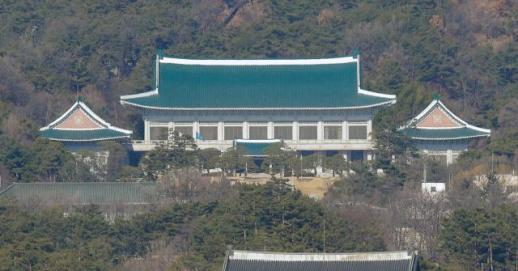 S. Korea considering participation after France invites Lee to June G7 summit SEOUL, March 28 (AJP) - South Korea is considering whether President Lee Jae Myung will attend the Group of Seven (G7) summit in June hosted by France, the presidential office said Friday. A presidential official said Seoul is “considering participation while taking into account diplomatic schedules and domestic and international circumstances.” “France conveyed its intention to invite South Korea to this year’s G7 summit during close consultations between the two sides,” the official said. France, which holds the rotating G7 presidency this year, plans to host the summit in Evian in June and has invited leaders from South Korea, India, Brazil and Kenya, according to local media reports including AFP, citing a statement from the French presidency released Thursday. The G7 comprises the United States, the United Kingdom, Germany, France, Italy, Japan and Canada, with the presidency rotating annually among member states. The chair country can invite non-member nations and international organizations to expanded sessions. South Korea has previously been invited to G7 meetings hosted by the United Kingdom in 2021, Japan in 2023 and Canada last year. French officials also said Paris had initially planned to invite China to the summit, but Beijing declined the invitation. France is expected to engage with China separately. France had planned to focus on global economic imbalances, but the Iran conflict could reshape the agenda, officials said, adding that the situation remained uncertain. It remains unclear whether U.S. President Donald Trump will attend the summit. Meanwhile, South Africa claimed it had been excluded from the summit due to U.S. pressure. Vincent Magwenya, spokesperson for South Africa’s presidency, said France had withdrawn an invitation following “sustained pressure.” Magwenya said South Africa would not attend the summit. Trump has criticized South Africa over its land expropriation law, calling it discriminatory against white farmers. He also skipped the G20 summit there last November and called for the country’s removal from the grouping. 2026-03-28 11:35:30
 -
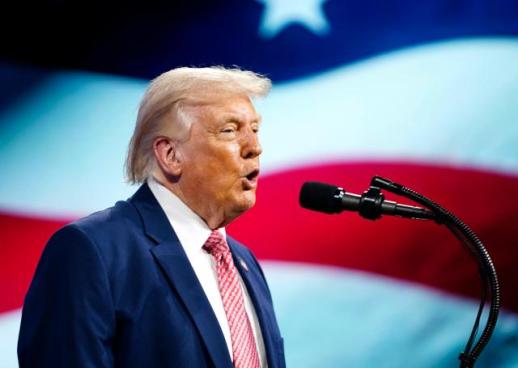 Trump hints at NATO split over Hormuz deployment, says 'Cuba could be next' SEOUL, March 28 (AJP) - U.S. President Donald Trump on Thursday suggested the possibility of withdrawing from NATO after criticizing member states for failing to send naval forces to the Strait of Hormuz, warning that future military action could target Cuba. Speaking at the Future Investment Initiative (FII) Institute hosted by Saudi Arabia’s sovereign wealth fund in Miami, Florida, Trump expressed frustration with NATO allies’ reluctance to respond to Washington’s call for military support in the Gulf. “Hundreds of protecting them and we would have always been there for them. But now based on their actions, I guess we don't have to be, do we?” Trump said. He specifically criticized European NATO allies for not deploying naval assets to the Strait of Hormuz, calling their decision “a terrible mistake.” The United States has been urging allies, including South Korea, Japan and European countries, since March 14 to dispatch naval forces to help secure shipping routes after Iran’s strategy of restricting transit through the Strait of Hormuz disrupted maritime traffic. However, no country has readily agreed to deploy forces, prompting Trump to escalate criticism of NATO allies and raise the prospect of distancing the United States from the alliance. NATO, formed in 1949, comprises 32 member states from North America and Europe. Its core principle of collective defense treats an attack on one member as an attack on all, and the alliance has long played a central role in deterring Russian threats in Europe. Trump has repeatedly criticized NATO members for what he describes as “free-riding” under the U.S. security umbrella, citing low defense spending by European allies. Trump’s criticism could also extend beyond Europe. Trump previously complained that despite the presence of tens of thousands of U.S. troops stationed in South Korea and Japan, Washington had received little support from those allies in the Iran conflict. Trump also suggested that Cuba could become the next target of U.S. military action after the Iran conflict ends. “I built this great military. I said you'll never have to use it. But sometimes you have to use it. And Cuba's next, by the way,” he said. The Trump administration has been increasing pressure on Cuba as part of its broader effort to expand U.S. influence in the Western Hemisphere. Following the removal of Venezuelan President Nicolás Maduro in January, Washington tightened restrictions on oil supplies to Cuba while negotiations led by Secretary of State Marco Rubio continue, U.S. officials have also kept open the possibility of military action. 2026-03-28 10:31:10