

Journalist

Chang SeongWon
-
 NH NongHyup Financial to Launch $1 Billion Shared Growth Fund for Strategic Industries NH NongHyup Financial Group said on the 26th it will create the "NH Korea Shared Growth Fund" (tentative name) totaling 1 trillion won. The fund is intended to support the successful rollout of the government’s flagship growth policy, the "National Growth Fund," and to foster advanced strategic industries. It will be formed in two rounds within the year, with all 1 trillion won to be contributed by NongHyup affiliates. Investments will focus on national advanced strategic industries such as artificial intelligence and digital technology. In infrastructure investment and lending, the group plans equity investments in projects building out strategic-industry infrastructure and to provide funding through the project financing (PF) stage. The aim is to help national strategic infrastructure projects grow on a stable footing. PF is a financing method that raises funds based on expected future cash flow and project viability. Direct investments will concentrate on government initiatives to develop advanced strategic industries, including efforts described as fostering a "K-Nvidia." NongHyup Financial also said it will support the selection of sub-fund managers chosen under financial regulators’ plans for policy funds, and it expects to participate as a major investor in individual funds to be created. The group plans to form a first fund of 500 billion won as early as next month and deploy it in infrastructure investment and lending. NH-Amundi Asset Management will serve as the general partner. Chairman Lee Chan-woo said the fund will serve as a "reliable pillar" for nurturing advanced strategic industries and revitalizing regional economies. He said all NongHyup Financial affiliates will unite to take the social responsibility of finance and proactively cooperate with national growth policies through what he called productive finance. * This article has been translated by AI. 2026-03-26 17:21:00
 -
 South Korea Supreme Court overturns 2021 ruling dismissing forced labor claims SEOUL, March 26 (AJP) - South Korea’s Supreme Court belatedly confirmed Thursday that it has dismissed and ordered a retrial of a lower court decision that rejected a collective damages suit against Japanese companies filed by victims of wartime forced labor during World War Two. The Supreme Court said that on Feb. 12 that it upheld an appellate court decision overturning the Seoul Central District Court’s dismissal of the case. The proceedings date back to 2015 when 85 alleged victims and their bereaved families took the action against 16 Japanese companies, including Mitsubishi Heavy Industries, Nippon Steel, Nissan Chemical and Hokkaido Colliery & Steamship Co., seeking unpaid wages and compensation for damages. While exact figures are unavailable, it is estimated that about 1.5 million Koreans, then subjects of Japan, were mobilized to Japan, Manchuria, and other areas, and about 2 million were forcibly mobilized within the Korean Peninsula. The Seoul Central District Court’s initial dismissal of the case in June 2021 cited the 1965 Korea-Japan Claims Agreement when the two countries normalized their relations, saying it effectively ended individual claims. This decision ran counter to a Supreme Court October 2018 ruling which upheld an earlier decision ordering Nippon Steel to compensate Korean victims of forced labor. The Seoul High Court overturned the lower court ruling on appeal in February 2024, saying the Supreme Court’s 2018 ruling recognized Japanese companies’ liability. Mitsubishi Heavy Industries and Hokkaido Colliery & Steamship Co. appealed, but the Supreme Court dismissed both, finding no error in the lower court’s judgment, including on legal principles concerning international jurisdiction, treaties, or the scope and effect of the Claims Agreement. With the latest ruling by the Supreme Court, the case is to be retried at the Seoul Central District Court. Hokkaido Colliery & Steamship Co. argued it had been discharged from liability under Japan’s former Corporate Reorganization Law and that any lawsuit based on discharged claims was inadmissible, but the Supreme Court rejected the argument, noting that under South Korea’s former Corporate Reorganization Act — which follows the principle of territoriality — such discharge does not extend to the plaintiffs’ claims. Many of those conscripted endured brutal working conditions, with numerous deaths resulting from accidents or suicide. In 1942, for instance, 136 Koreans were killed in a mass drowning incident at the Chosei coal mine in Yamaguchi Prefecture. After liberation, the South Korean government showed limited interest in compensating individual victims, but rather focused on national-level compensation. The 1965 Korea-Japan Basic Treaty and its supplementary Agreement on Claims and Economic Cooperation stipulated that Japan would provide $500 million — $300 million in grants and $200 million in loans — and that “the problems concerning property, rights and interests of the two countries and their nationals have been settled completely and finally.” 2026-03-26 17:18:00
 -
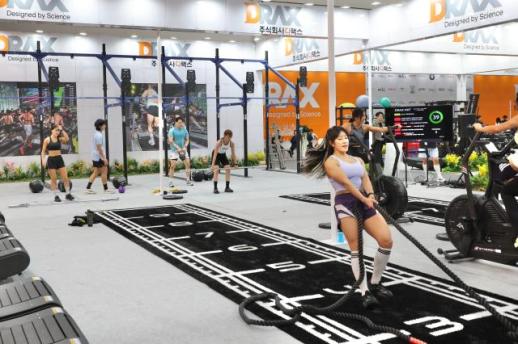 Annual sports-themed show awes visitors with cutting-edge technologies SEOUL, March 26 (AJP) - The annual sports-themed trade show is taking place at COEX in southern Seoul this week. The Seoul International Sports & Leisure Industry Show (SPOEX), South Korea's largest and one of Asia's biggest exhibitions where sports, technology, and industry converge, kicked off on Thursday and runs until this weekend. This year's event brought together around 300 domestic and international companies, offering a comprehensive platform that goes beyond a simple exhibition. Visitors can explore cutting-edge technologies and industry trends while building networks for new business opportunities. A wide range of products including health and fitness equipment, sports goods, healthcare technologies, and water sports gear, are on display. Advanced services integrating cutting-edge technologies, such as artificial intelligence (AI)-based exercise programs and digital fitness measurement solutions are also showcased. At the main stage of the exhibition hall, visitors can enjoy a variety of fun programs including bodybuilding competitions, fitness demonstrations, yoga and Pilates classes, as well as K-pop and hip-hop dance performances. 2026-03-26 17:12:59
 -
 BTS may be offstage, but Seoul still hums SWIM SEOUL, March 26 (AJP) -The concert is over, but Seoul has yet to come down from the high of BTS. At the courtyard of MMCA Seoul, the “Love Quarter” still pulses with the afterglow of the group’s comeback, its energy spreading in gentle waves. Inside the blue “BTS Sound Cube,” BTS’ new song “SWIM” plays as ribbons flutter in the wind like water in motion. Stepping into the installation, visitors are invited to feel the music not just through sound, but through space and movement. The installation is part of the “BTS THE CITY ARIRANG SEOUL” stamp rally, an interactive program that connects BTS-linked sites across the city and encourages fans to complete missions along the way. While the comeback concert at Gwanghwamun Square ended on March 21, the “BTS Sound Cube” will stay open through April 19, allowing the city to hold on a little longer. 2026-03-26 17:00:46
 -
 OTT Platforms Move Into Live Sports, Challenging Traditional TV Broadcasters Live broadcasting has long been considered the crown jewel of TV networks. Traditional live coverage typically requires expensive equipment and highly trained crews, including outside broadcast trucks that send signals by satellite back to a station for transmission. For decades, broadcasters with deep capital and specialized staff — and, in some cases, public funding — have carried major events as part of their role as large news organizations. But broadcasters have already been losing ground to over-the-top, or OTT, platforms in dramas and entertainment. Now, OTT services are moving aggressively into live programming as well. Netflix, which recently live-streamed BTS' comeback performance at Gwanghwamun, has built a track record in live events. After testing live-streaming technology with a U.S. comedy show in 2023, it aired an unconventional golf event featuring Formula One figures and professional golfers, marking a push into sports coverage. Netflix later signed an exclusive deal for WWE Raw and has offered live streams since 2025. In January, it also live-streamed “Skyscraper Live,” featuring a climb up a 101-story building in Taiwan without ropes, drawing global attention. Netflix Live has now moved into Major League Baseball. Netflix said on the 25th it will broadcast the 2026 season opener between San Francisco and the New York Yankees. Netflix said it will work with the Emmy-winning MLB Network production team to live-stream key MLB games. It said the broadcasts will be available in five languages: English, Korean, Spanish, Portuguese and Japanese. Netflix is not alone. Coupang Play said it will live-stream two international soccer friendlies: a match against Cote d'Ivoire on the 28th and a match against Austria on April 1, described as the national team's final A matches before its final roster is set as it targets a World Cup quarterfinal run. TVING recently exclusively live-streamed every game from the start of the World Baseball Classic main tournament. It also holds exclusive rights for Korean professional baseball live streams on mobile and PC, meaning those broadcasts can be watched only through TVING. With OTT platforms expanding into real-time programming, major terrestrial broadcasters appear to be feeling a sharper sense of threat. If OTT services come to dominate live content, the article asks, what role will remain for free-to-air networks? In Netflix's case, an estimated 19,000 servers deployed worldwide have lowered barriers that once made live broadcasting difficult. Backed by vast capital, Netflix has built infrastructure that can deliver live content directly to viewers around the world. That scale is fueled by subscription fees paid each month by hundreds of millions of people. Traditional media organizations — sometimes labeled “old-fashioned” — face shrinking influence and declining advertising revenue. The article says concerns are growing that legacy media could weaken further as capital tightens and talent leaves. Still, terrestrial broadcasting continues to function as public infrastructure closely tied to daily life, providing news, local information, and programming such as variety shows and daily dramas that reach multiple generations. Its reach, however, is largely limited to local audiences. Korean content is widely favored globally under the banner of K-content, but the article argues that trend can also work against traditional TV broadcasters. It says a local market that once looked solid for decades is shrinking as capital becomes less available. The article concludes by questioning whether legacy media has the tools to compete with global OTT platforms, saying those tools are hard to see even as the pressure intensifies.* This article has been translated by AI. 2026-03-26 16:57:18
 -
 Son Heung-min Seeks First Open-Play Goal of 2026 With South Korea vs. Ivory Coast 최근 소속팀에서 골 가뭄에 시달리고 있는 홍명보호 '캡틴' 손흥민(로스앤젤레스FC)이 태극마크를 달고 분위기 반전에 나선다. Hong Myung-bo's South Korea national team will play Ivory Coast in its first March A-match friendly at 11 p.m. on March 28 (Korea time) at Stadium MK in Milton Keynes, England. With the 2026 FIFA World Cup finals in North America about three months away, the match is intended as a stand-in test for South Africa, South Korea's opponent in the third group-stage game. Hong has called in his core overseas-based players for what he described as the final A match before the World Cup, including Son, Lee Kang-in (Paris Saint-Germain), Kim Min-jae (Bayern Munich) and Lee Jae-sung (Mainz). Attention is on whether Son can end his scoring drought with his first goal from open play this year. Son's 2026 scoring has been muted. In his first match of the year, he had one goal and three assists in a 6-1 win over Espania (Honduras) in the CONCACAF Champions Cup on Feb. 18. Since then, he has gone eight straight official matches without a goal, adding four assists. His goal against Espania came from the penalty spot, leaving him without an open-play goal this year. Some have raised concerns about decline for Son, born in 1992, but Hong said his confidence has not changed. Before the team's first training session of its Europe trip on March 24 in Milton Keynes, Hong told South Korean reporters, "I am not worried because of the time and role Son has played." He added, "He knows well what role he needs to play. It is very important for us to judge the right timing for his strengths to come out." Hong also pointed to tactical options aimed at maximizing Son. If Son starts as a wide attacker, Oh Hyeon-gyu (Besiktas) or Cho Gue-sung (Midtjylland) is expected to play up front. With their size and ability to battle defenders and link play, South Korea hopes Son will have more room for his trademark shooting. Hong said, "Because we have strikers in good condition like Oh Hyeon-gyu and Cho Gue-sung, there is a possibility Son will be used as a winger this time." Son has 54 goals in 140 A matches. If he scores four goals in the March A matches, he would move into a tie for the national record of 58 goals, matching Cha Bum-kun. One more would set a new mark. Ivory Coast, however, is not expected to be an easy opponent. It is ranked 37th by FIFA, below South Korea at 22nd, but is known in Africa for strong defense. It went unbeaten in 10 World Cup African qualifying matches (eight wins, two draws) without conceding a goal. Its squad includes Europe-based players such as Amad Diallo (Manchester United), Odilon Kossounou (Atalanta) and Ibrahim Sangare (Nottingham Forest). South Korea is 1-0 all-time against Ivory Coast. In a friendly in London in March 2010, South Korea won 2-0 on goals by Lee Dong-gook and Kwak Tae-hwi.* This article has been translated by AI. 2026-03-26 16:54:00
 -
 Samsung Biologics, Celltrion expand CDMO investment as labor and safety risks rise Samsung Biologics and Celltrion, after posting record results last year, are pressing ahead this year with multitrillion-won investments centered on contract development and manufacturing (CDMO) to expand capacity, industry officials said. Even with strong growth, both companies face rising internal and external risks, including labor friction, a factory safety incident and geopolitical uncertainty. Samsung Biologics reported 4.55 trillion won ($4.55 trillion won) in revenue and 2.06 trillion won in operating profit last year, reinforcing its No. 1 position in the CDMO sector, according to the industry. The company is reinvesting earnings to build Plants 5 and 6 in Songdo, Incheon, and plans to spend about 7 trillion won to develop a third bio campus. It is also moving to expand overseas production, including a $280 million investment to acquire a plant in Rockville, Maryland, as part of its strategy to widen its lead. Celltrion posted 4.16 trillion won in revenue and 1.16 trillion won in operating profit last year, and has been assessed as a global player spanning biosimilars and new drugs. It plans to invest 1.2265 trillion won to complete Plants 4 and 5 in Songdo. In the United States, it plans to invest $330 million to expand its Branchburg, New Jersey, facility to 75,000 liters. Once domestic and overseas expansions are completed, Celltrion expects to secure total production capacity of 570,000 liters, building infrastructure not only for new drugs and biosimilars but also for its contract manufacturing business. Risks have also intensified. At Samsung Biologics, labor-management tensions have deepened in recent years over disputes tied to revisions of internal rules on information security and discipline, including the introduction of a “three strikes” policy. A document was disclosed showing the human resources department separately classified and managed participants in a lawsuit over ordinary wages and union members, prompting allegations of discrimination in promotions and personnel decisions. Distrust has also lingered after negotiations over wages and working hours reductions. In this year’s wage talks, the union has demanded a 4.5-day workweek, higher starting pay and a new hazard allowance for ADC work, with talk of a possible strike. If a strike occurs, production stoppages could delay deliveries to clients and damage global confidence, given the industry’s reliance on continuous operations. It could also disrupt completion of Plants 5 and 6 and the Rockville plant, the report said. Celltrion is also under scrutiny after a subcontractor worker fell to his death at its Songdo plant, drawing criticism over industrial safety and health management. The Ministry of Employment and Labor issued a work stoppage order and launched a full investigation, including whether the case violated the Serious Accidents Punishment Act. At Celltrion’s shareholders meeting on March 24, Chairman Seo Jung-jin appeared in person for the first time in 11 years to address concerns and emphasize “responsible management,” the report said. Geopolitical uncertainty is another factor. As the war in the Middle East drags on, volatility in raw materials and fuel prices and broader supply-chain risks have increased, and there are signs global drugmakers are adjusting clinical and production budgets, the report said. “Companies are facing a new test in which they must design growth and responsibility at the same time, with good news and bad news coexisting,” an industry official said. How well they manage labor issues, major safety risks and geopolitical uncertainty “appears to be a key variable that will determine sustainable growth going forward,” the official said.* This article has been translated by AI. 2026-03-26 16:36:00
 -
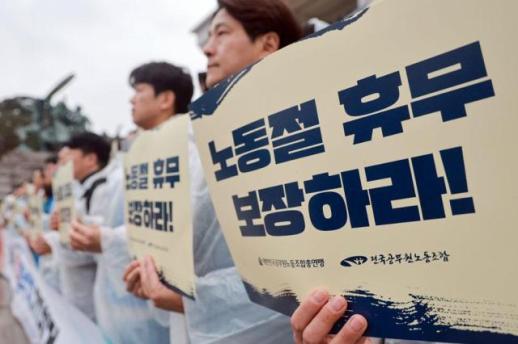 More workers to get day off as Labor Day set to become public holiday SEOUL, March 26 (AJP) - A bill to designate Labor Day as a statutory public holiday passed a committee in the National Assembly on Thursday. If it clears the remaining legislative steps including Cabinet approval, May 1 will be observed as a public holiday, taking effect this year. Labor Day was made a paid holiday in 1994, but public officials, teachers, and platform workers such as deliverymen have not been able to take the day off because they are not classified as employees under the relevant labor laws. 2026-03-26 16:29:44
 -
 South Korean ships can pass through Strait of Hormuz only with prior consultation, Iranian envoy says SEOUL, March 26 (AJP) - South Korean ships can pass through the Strait of Hormuz, but "only with prior consultation" with Tehran, Iran's top envoy said on Thursday. At a press conference at the Iranian Embassy in Yongsan, Seoul, Iranian Ambassador to South Korea Saeed Koozechi said there have been no safety concerns so far involving South Korean vessels or crew members, adding that the foreign ministers and embassies of both countries are "communicating smoothly" on the issue. Currently, some 26 South Korean vessels and their 178 crew members are stranded in the strategically important waterway, a critical chokepoint for roughly one-fifth of the world's oil supply. Koozechi also said that Iranian Foreign Minister Abbas Araghchi asked South Korean Foreign Minister Cho Hyun over the phone earlier this week to provide a list of stranded South Korean ships. Despite the Middle Eastern country seeing South Korea as a "non-hostile country," it would be "unavoidable" for ships doing business with U.S. firms to face restrictions as part of its "self-defense measures," the envoy said on a radio program earlier in the day. He also claimed that there is no dialogue between Tehran and Washington, saying Iran cannot trust U.S. statements and suspects the U.S. may be trying to buy time to prepare for renewed airstrikes. 2026-03-26 15:51:33
 -
 Korean game publishers play it safe as AI reshapes industry fault lines SEOUL, March 26 (AJP) - South Korea's major game publishers are sticking to safer bets — stable leadership and proven revenue drivers — as they navigate the uncharted waters of artificial intelligence. A wave of executive reappointments during this year's shareholder season reflects that caution. Krafton renewed the terms of Chairman Chang Byung-gyu and CEO Kim Chang-han for a third consecutive term, while Nexon retained CEO Lee Jung-hun after posting a record 4.5 trillion won in annual revenue. Netmarble and NHN are also set to extend leadership tenures on the back of strong earnings. The continuity underscores a structural shift in the industry, where blockbuster titles now take five years or more to develop, making leadership changes mid-cycle a costly risk. At the same time, publishers are accelerating a pivot beyond their traditional mobile-gaming base toward console and PC platforms, targeting global markets. Netmarble has launched its first cross-platform open-world title, The Seven Deadly Sins: Origin, spanning PlayStation 5, Steam and mobile, while NC — rebranded from NCSoft — is preparing console-focused titles such as Defect and Limit Zero Breakers. Pearl Abyss' Crimson Desert, a domestically developed triple-A open-world title, has already sold more than three million copies since its March debut, highlighting the industry's growing ambition to compete globally. Yet the rollout also exposed a new tension point: artificial intelligence. Players discovered AI-generated artwork embedded in Crimson Desert, including distorted visual elements, prompting an apology from Pearl Abyss. The company said the assets were created during early development using experimental tools and were unintentionally left in the final version. The backlash contrasted sharply with Nexon's Arc Raiders, which has been widely praised for using procedural AI to enhance gameplay environments. The title has sold over 14 million copies since its October 2025 launch, underscoring how AI can add value when deployed transparently. The divergence highlights a widening fault line across the industry: AI that enhances user experience tends to be rewarded, while undisclosed use — particularly in visible creative assets — risks consumer backlash. "AI output still reaches only about 90 percent of human quality," said Jung Nae-hun, a professor at the Tech University of Korea. "Studios tend to avoid using it for visible elements like characters or interfaces. When it slips through, it invites backlash." Korea's regulatory framework is also evolving. The Framework Act on Artificial Intelligence, which took effect in January, requires disclosure of AI-generated content, though the industry has raised concerns that additional rules could create overlap and confusion during iterative development processes. Beyond AI, publishers are facing broader structural challenges. Game production remains excluded from Korea's content production tax credit system, even as film and television receive incentives of up to 30 percent. Officials have acknowledged the gap, noting that flagship game titles now routinely cost more than 1 trillion won to develop. Meanwhile, legal risks are also emerging alongside technological shifts. A U.S. court recently ruled that Krafton breached its acquisition contract with Unknown Worlds Entertainment, after executives consulted ChatGPT in shaping a takeover strategy — a case that underscores the growing intersection between AI use and corporate governance. Despite these headwinds, the industry continues to grow modestly. Domestic game revenue reached 23.85 trillion won in 2024, up 3.9 percent on-year, while exports rose to $8.5 billion. Console games recorded the fastest growth, reinforcing the strategic pivot. North America's share of exports climbed to 19.5 percent, signaling early traction in Western markets, while industry employment expanded to around 87,600. Still, publishers say the numbers mask deeper constraints. "The biggest thing the government can do is curb excessive regulation," Jung said. "That remains a heavier drag on the industry than any tax gap." 2026-03-26 15:43:07