

Journalist

Chang SeongWon
-
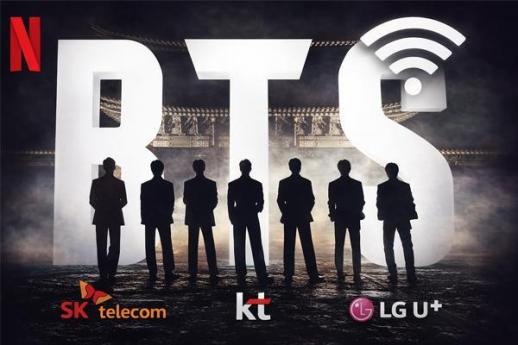 BTS Live D-2: K-tech takes center stage for a show of the century SEOUL, March 19 (AJP) - South Korea is home not only to BTS but also to some of the world's most advanced technology — and it does not need the Olympics to prove it. Saturday's comeback spectacle is set to showcase both K-pop and K-tech prowess on a truly global stage. The K-pop supergroup will return after nearly four years in groundbreaking fashion — an open-air concert at Gwanghwamun, Seoul's historic government and palace district — staged free of charge for nearly 300,000 spectators and streamed live to audiences in 190 countries via Netflix. Netflix, which secured exclusive global broadcasting rights, is deploying its full content delivery arsenal for its first-ever live event from Korea. The streamer will use Emmy Award-winning video encoding that automatically adjusts quality to each viewer's network and device, along with a load-balancing system featuring triple-redundancy encoder failover. A dedicated live-operation mode will reprioritize infrastructure resources to keep the stream uninterrupted — all powered by Open Connect, Netflix's proprietary CDN built with more than 1,000 ISP partners worldwide since 2012. In plain terms, the live feed will run on a highly resilient, high-capacity system designed to deliver seamless streaming regardless of demand. "BTS live broadcasts have always functioned as global gatherings, with fans setting alarms, taking long lunch breaks or staying up late so they can experience the moment together," Netflix said on its Tudum platform. AI-powered network defense In wireless technology, South Korea is second to none. All three telecom carriers have mounted a full-scale network defense. SK Telecom will deploy its proprietary AI-driven system "A.One" for the first time at a live event, dividing the venue into three zones based on crowd density. The carrier has also installed temporary base stations and dedicated roaming infrastructure for foreign visitors. "This large-scale K-pop concert is a global event drawing worldwide attention, and we expect an ultra-high-density traffic environment. We will demonstrate Korea's world-class AI-powered network capabilities and deliver stable telecommunications services," an SK Telecom spokesperson said. KT is applying its AI-based traffic management solution "W-SDN" to automatically control base station overloads, while deploying six mobile base stations, 79 wireless units and 14 Wi-Fi access points across the venue. "KT has the country's largest international network and internet backbone, and has significantly expanded capacity for the BTS concert. Drawing on experience from major events such as the Olympics and the WBC, we will ensure stable and seamless connectivity," a KT spokesperson said. LG Uplus is leveraging autonomous network technology to predict traffic surges and has installed temporary relay equipment at more than 10 locations near the square. Smart security and crowd control An extraordinary crowd also requires highly digitized security and crowd management. Organizers have introduced a mobile ticketing system that links each ticket to a device's unique identifier, preventing unauthorized transfers and scalping. At entry points, 31 metal-detection gates will screen attendees, while a real-time crowd management system will monitor density levels and relay data instantly to safety personnel. Police have deployed counter-drone vehicles and explosive-detection dog units around the venue. Mapping the mega crowd Internet and messaging platforms are also stepping in to guide the unprecedented influx of visitors into Gwanghwamun — an area roughly the size of three soccer fields. Naver Map has reconfigured the concert zone into an indoor-style navigation system, highlighting restrooms, entry gates, screens and information centers. Kakao Map has launched a pilot service through March 22, providing ultra-precise bus location data across about 420 Seoul routes to help commuters navigate detours caused by the event. "We are working closely with the Seoul Metropolitan Government to provide accurate traffic information so citizens can travel safely and conveniently," said Lee Chang-min, head of Kakao's map business development team. A city turned into a stage Technology will extend beyond the venue into the city itself. The Seoul Metropolitan Government and BigHit Music are transforming the capital into a citywide media canvas under the "BTS The City Arirang Seoul" project, running from Friday through April 19. Media facades will illuminate Sungnyemun Gate and Namsan Seoul Tower on the album's release day, followed by a drone light show over Ttukseom Hangang Park. Dongdaemun Design Plaza will host synchronized music-and-light shows every 30 minutes through April 12. Built on a legacy of tech-driven performance Saturday's showcase builds on BTS's long history of pushing technological boundaries — from volumetric hologram displays at the 2020 MAMA to multi-view XR livestreaming during "Map of the Soul ON:E," and a 108-camera volumetric capture system that rendered the group as AR holograms alongside Coldplay on The Voice in 2021. The upcoming 82-date Arirang World Tour, launching April 9 at Goyang Stadium, will feature a 360-degree "in-the-round" stage across 34 cities in 23 countries. As RM told GQ: "The most important thing is just that we are here back together again. We're going to see the fans all over the world." And this time, they are doing it at a truly global technological standard. 2026-03-19 14:54:49
 -
 AMAZE CEO Lee Seung-jun: In the AI era, VR concerts must deliver irreplaceable experiences Artists can feel close enough to touch, and inside the theater, cheers and singalongs break out naturally. VR concert films are changing not only how audiences experience performances, but also what it looks like to go to the movies. Lee Seung-jun, CEO of AMAZE, which has released VR concert films featuring ENHYPEN, TOMORROW X TOGETHER, ATEEZ and TWS, said demand is rising as the format spreads. With TWS’ first VR concert, “TWS VR CONCERT : RUSH ROAD,” selling out day after day, Lee said word-of-mouth is lifting expectations. “Honestly, the response has been better than we expected, so I think it could set our best results yet,” he said. “As people talk about VR content, audience demand is going up. Albums cost money, concert tickets cost much more, and getting tickets is hard, so a VR concert film can be a good way to see an artist. I love concerts too, but it’s not easy to see a top artist right in front of you. This is much more of an up-close experience, so I think it’s a medium that fits music well.” AMAZE did not start out focused only on concerts. Lee said that while thinking about what might come after mobile, the company bet on “space” and VR headsets, tried multiple formats, and found concerts delivered the biggest impact. “It’s been 10 years since I started the company,” he said. “AMAZE is made up of early Kakao members, engineers who worked together back then. I used to work at a consulting firm, but seeing mobile as a new innovation and media paradigm led me to start a business. Then I thought about what would come next, and when the paradigm shifts, I wanted to go global. What we bet on was ‘space’ and ‘VR headsets.’ At first we didn’t do only music — we tried films and other things — but the biggest impact was concerts. So we decided to expand that and build content step by step, centered on entertainment.” That approach also shaped interactive features such as letting fans pick a favorite member and use a virtual light stick. Lee said the experience becomes denser when fans can respond and participate, not just watch. “Because these are K-pop artists, we thought it would be good if fans could choose their favorite member and keep watching that person,” he said. “So we added things like ‘pick your favorite’ and a ‘light stick.’ The elements can differ by artist. Recognizing hands and actions like waving a light stick can ultimately make the experience bigger.” Lee also drew a clear line between watching VR at home and watching it in a theater. When people who like the same artist gather and react together, he said, the content shifts from a private viewing to a shared event. “Of course you can watch at home,” he said. “But the feelings you get watching an artist you love with other people are definitely different. That’s why I think in the AI era, the value of 2D content or 2D images could gradually fall. What we make is, in a way, like Disneyland — we’re building an attraction for an artist. We’ll keep thinking about how to help audiences experience it with more immersion and a stronger sense of being there. And we plan to make it available online too for people with headsets at home. Even now, like selling concert DVDs, we sell a version you can watch by inserting a phone.” He said the format could expand beyond K-pop, and that U.S. and Chinese artists have shown significant interest. For now, he said, the company is weighing how to broaden genres without limiting itself to one market. “First, we’re thinking about expanding genres,” he said. “We’re not only thinking about K-pop artists. We’ve been getting a lot of contact from U.S. artists and Chinese artists, so we’re thinking about how to expand this. At the moment, male idol groups seem relatively easier in some ways. But we’re not limiting ourselves to that, and I think there’s a lot we can do with other artists too.” Lee said AMAZE’s edge is technology, built on two pillars: computer graphics based on Unreal Engine and AI. But he argued that, rather than competing with general-purpose image-generation AI, the key is accumulating VR-specific data and postproduction techniques. “Basically, we have two technical pillars,” he said. “One is CG-based technology like Unreal Engine used in games, and the other is AI. But AI should be viewed differently. AI that makes 2D video or images is closer to the domain of big companies like Google or OpenAI, and it’s not easy for an independent company to own that space — it’s expensive and competition is intense. But VR content is a different format. In this area, unique data for specific categories keeps accumulating, and learning based on that is how the technology advances. We have technology optimized for VR content. Using it, postproduction, image-quality improvement and interactive implementation can keep getting better. In VR, it’s important to raise image quality and immersion together. As that technology builds, audiences feel more like they’re on site, and we can add more spatial design and interactive elements. It matters that a single title does well, but we think it’s important to keep building that technology.” Asked why he believes the format will matter more in the future, Lee pointed to what he called an “irreplaceable experience.” “I think content keeps evolving,” he said. “The grammar we’ve built so far is centered on music concerts, but I don’t think this kind of new spatial experience will stay only with music. To get people to pay and come, it has to be a different experience from existing 2D content. We’re in an era of content overload, so it will only get harder to make people spend extra money on 2D content they can watch on a phone or TV. In the end, if it’s not more immersive and valuable, people won’t spend easily. Even in the AI era, I think what matters is an irreplaceable experience. We film real artists and create a real experience with sweat, time and a story inside it. AI can make fake performances, but I don’t think people will spend money on them in the same way.” Some viewers may still see the 33,000 won price and the VR format as barriers. Lee said he expects the market to move away from one-size-fits-all hits and toward sharper individual tastes. “I’m not sure how much longer traditional mass content will be possible,” he said. “There could be another case like ‘Wangsnam,’ but I don’t think it will repeat often. In the end, I think people spend money on experiences they truly love. Even if they spend 10,000 to 20,000 won on some content, they can spend much more on what they really like. I think we’re heading into an era of ‘micro interests’ — an era where people spend more deeply on what they truly like. Rather than focusing only on making each individual title a hit, we’re closer to building an environment and paradigm where more of those experiences can be made.” Lee said motion sickness — a frequent concern in VR — should be addressed differently depending on an artist and fan base. “Because each artist’s fan base differs in age and gender, the level of camera movement they can accept also differs,” he said. “Motion sickness happens because you’re still but the world moves. Taking that into account, if we later build dedicated theaters, we’ll make the chairs move in sync with the camera movement. We’re considering ways to make it less dizzying while delivering a more dynamic experience.” Ultimately, Lee said he is aiming for dedicated venues that go beyond putting on a headset. He said he wants to design the full experience so that, from the moment people enter, it feels like stepping into an artist’s world. “If we go in the direction I’m thinking, there would be motion chairs, and if we add elements like haptics matched to the music, the physical sensation could be much bigger,” he said. “It won’t end with just watching in a theater. We’ll likely design the space so people can enjoy things from the moment they arrive, and feel like they’re entering the artist’s musical world. This isn’t a far-future story — it’s at the stage of being discussed now.”* This article has been translated by AI. 2026-03-19 14:54:33
 -
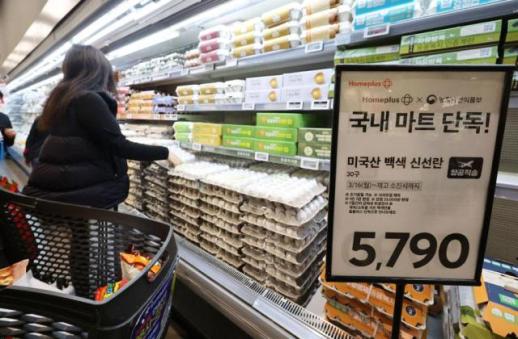 Retailers to slash grocery prices to ease burden on households SEOUL, March 19 (AJP) - Major retailers will cut prices by more than 10 percent next month to ease the burden on households. After a meeting in Seoul on Thursday, the Ministry of Agriculture, Food and Rural Affairs said retail prices for roughly two dozen items including confectionery, bakery products, and ice cream will be reduced by 100 to 400 won (US$0.07 to $0.27) or up to 13.4 percent starting from next month. Cooking oil and instant noodle makers will also lower prices on their major products. According to the ministry, the retailers voluntarily decided to lower prices amid a looming global inflation that is already biting people's livelihoods, as the Middle East conflict that began with U.S.-led airstrikes on Iran shows no signs of ending soon. The ministry said it has also been closely monitoring prices of other key items such as eggs, pork, garlic, toilet paper, and laundry detergent to curb sharp price hikes and crack down on unfair practices trying to take advantage of supply shortages. It also vowed to inspect and punish anyone found illegally colluding to hike prices. 2026-03-19 14:48:56
 -
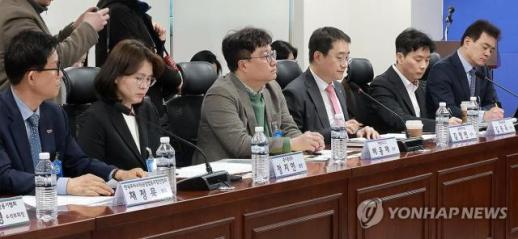 Naphtha Supply Shock Puts South Korea’s Plastics Industry at Risk, Calls Grow for Price-Linking System The National Assembly held a meeting with petrochemical and plastics industry representatives as disruptions in naphtha supplies deepened after the Strait of Hormuz was effectively blocked amid the war between the United States and Iran. The session focused on steps to ease pressure on small plastics manufacturers as synthetic resin prices rise with surging global oil prices. Attendees included LG Chem, Hanwha Solutions, Lotte Chemical and Yeochun NCC, along with the Korea Plastics Industry Cooperative Federation, the Korea Federation of SMEs, and officials from the Ministry of Trade, Industry and Energy, the Ministry of SMEs and Startups, the Ministry of Economy and Finance, the Fair Trade Commission and the Financial Services Commission, according to political officials on March 19. Petrochemical companies said spikes in feedstock prices such as naphtha and unstable supply were causing production disruptions and delivery delays, worsening profitability and adding to management strain. Plastics manufacturers countered that large petrochemical suppliers have raised synthetic resin prices citing higher feedstock costs, leaving factories squeezed between rising material costs and sales prices that do not reflect those increases. Industry officials said raw materials account for about 80% of plastics makers’ costs. Chae Jeong-mook, head of the Korea Plastics Industry Association, said raw materials make up about 83% of costs, leaving the sector directly exposed to oil price increases. He said prices have risen by about 200,000 won per ton since the war began and that there are signs of supply being cut off, adding, “The industry feels like it’s bleeding day by day.” Chae called for stable supply and measures to prevent sharp short-term price spikes. He also urged adoption of a delivery price-linking system so increases in raw material costs can be reflected immediately in contract prices. Petrochemical firms, while citing difficulties as naphtha cracking capacity (NCC) is being reduced, said they would do their best to stabilize the domestic supply chain. Jeong Jong-eun, an executive director at LG Chem, pointed to what he described as a lack of government-level stockpiling and support for naphtha. “For crude oil or LNG, the state expands storage tanks through the national power network, but naphtha is not in that situation,” he said, adding the company was making every effort to secure supplies. He said the industry understands the concerns raised and plans to respond while working to stabilize domestic supply. Kim Dong-wook, an executive director at Hanwha Solutions, said the company was trying to maintain production within its limits. He said inventories were already low because the market had been weak even before the situation escalated, making the impact appear quickly. Kim Young-beon, an executive director at Lotte Chemical, said Lotte has substantial ethylene facilities and is heavily affected by overseas market conditions, adding it is proceeding as “model No. 1” in petrochemical restructuring. On synthetic resin pricing, he said the company was taking preemptive steps to stabilize the domestic market, including minimizing export volumes in March and April and expanding the domestic supply share from 45% to 90%. Bae Yong-jae, a managing director at Yeochun NCC, said securing naphtha has become difficult due to the Strait of Hormuz blockade. He said the company had relied on that route for about 70% of its total volume and that prices have nearly doubled. He said the firm is maintaining minimum operating rates because naphtha is hard to obtain and called for broader discussions that include supply shortages, price pass-through and industry losses. After the meeting shifted to a closed session, participants were reported to have discussed limiting the volume of petroleum products refiners export overseas. Democratic Party lawmaker Kim Nam-geun said naphtha is sourced through domestic production (47%) and imports (53%), and that with the government also reviewing export controls, participants discussed ways to secure supplies quickly. Democratic Party lawmaker Min Byung-deok raised concerns about price increases occurring before higher crude prices were reflected in actual import costs. He said he asked the Fair Trade Commission and the Ministry of SMEs and Startups to monitor whether there was collusion or abuse of market power in the price-setting process and to submit their findings. On financial support, Kim Nam-geun said about 20.3 trillion won in financing is being prepared in response to the Middle East situation, and the plastics and petrochemical industries are expected to be included. On alternative naphtha sources, he said imports are being considered from India, Algeria and the United States, adding that Russia-related matters were mentioned only as a request and drawing a line on importing Russian supplies. 2026-03-19 14:45:23
 -
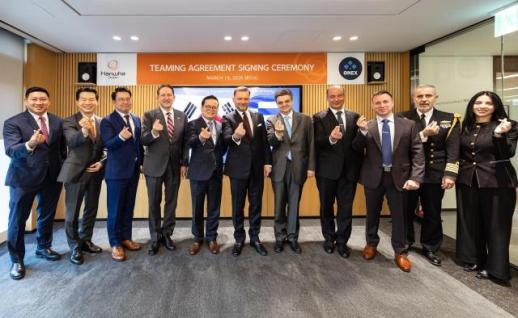 Hanwha Ocean Signs Deal With ONEX to Pursue Greece Naval Defense Market Hanwha Ocean is moving to expand into Greece’s maritime defense market after signing a strategic cooperation agreement with ONEX Group, Greece’s largest shipbuilder. Hanwha Ocean said the agreement was signed on the 19th by Eo Seong-cheol, president of its Special Ship Business Unit, and ONEX Group CEO Panagiotis Xenokostas. Greek Ambassador to South Korea Loukas Tsokos and Acting U.S. Ambassador to South Korea James Heller attended the event, the company said. Under the deal, Hanwha Ocean and ONEX Group plan to participate as mutually exclusive partners in projects ordered by the Greek coast guard and navy, including submarine programs. The companies also agreed to seek cooperation, by project, in third countries over the mid- to long term, including nations neighboring Greece in the Mediterranean and Black Sea regions. Xenokostas said, “It is an honor to stand in Seoul, the center of a world-class maritime power,” and called on South Korea, the United States and Greece to “sail together toward a future of shared security and prosperity.” Eo said the company plans to “enter the local market in a stable way through exclusive cooperation with a major local shipyard” and to take an active role in upcoming Greek coast guard and navy projects. ONEX Group is Greece’s largest shipbuilding and defense company and operates the Syros Neorion Shipyard and the Elefsis Shipyards. Hanwha Ocean noted that ONEX Group is backed by investment from the U.S. International Development Finance Corp., a U.S. government development finance institution. Heller also attended the event.* This article has been translated by AI. 2026-03-19 14:39:19
 -
 Mercedes-Benz Korea Names Shirin Emeera as New CEO Mercedes-Benz Korea said March 19 it has appointed Shirin Emeera, head of Mercedes-Benz in Sweden and Denmark, as its new CEO. She will officially begin her term July 1. The company described Emeera as a global leader with more than 20 years of experience at Mercedes-Benz. It said she led the Sweden and Denmark businesses to No. 1 in the premium segment in both markets. She currently oversees dealer model market management and global network development at Mercedes-Benz AG. A Mercedes-Benz official said Emeera is a leader with an entrepreneurial mindset who can drive strategic growth in challenging conditions, adding that the appointment was made to further strengthen the company’s position in South Korea. Emeera said it is meaningful to lead Mercedes-Benz Korea in South Korea, which she called one of the most influential and trend-leading markets in the global auto industry. She said she will work closely with the Korea team and dealer partners to deliver a differentiated customer experience, building on the company’s solid foundation in the market. Meanwhile, current CEO Matthias Geisen was appointed to a promotion effective July 1 as head of marketing and sales for the vans division at Mercedes-Benz AG in Stuttgart, Germany. Since taking the top job at Mercedes-Benz Korea in September 2023, Geisen has been credited with opening the world’s first Seoul Maybach Brand Center and an SUV Experience Center, and with successfully introducing a new sales approach called “Retail of the Future.” Geisen thanked South Korean customers and business partners for their continued trust and support. He said he will support growth in the South Korean market from headquarters, drawing on his experience leading what he called a dynamic and high-standard market.* This article has been translated by AI. 2026-03-19 14:00:21
 -
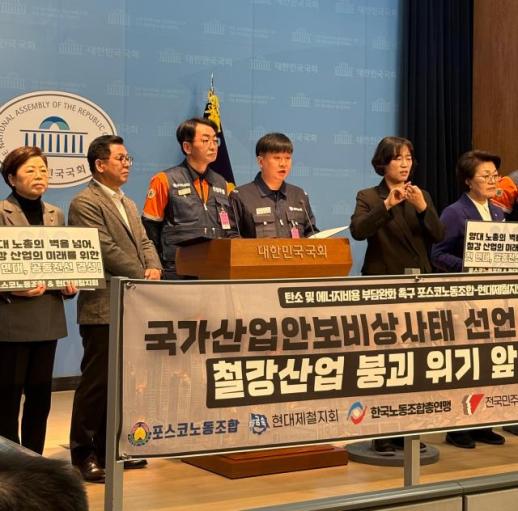 POSCO, Hyundai Steel unions urge relief on power and carbon costs, warn of industry crisis "South Korea’s steel industry is standing on the edge of a cliff. This is not a simple downturn. It is a national industrial security emergency." Labor unions at POSCO and Hyundai Steel held a joint news conference March 19 at the National Assembly press center, urging the government to ease the burden of industrial electricity rates and carbon-related costs. The unions called for measures including relief on industrial power bills, improvements to the carbon emissions-permit system and expanded financial and infrastructure support for shifting to cleaner processes such as hydrogen-based steelmaking. Kim Seong-ho, chair of the POSCO union under the FKTU-affiliated Korea Metal Workers’ Federation, said the industry is being squeezed by sharply worsening profitability, stronger protectionism in advanced economies and what he described as astronomical carbon-emissions costs. He said the government should step in with practical support. Kim said it was the first time in POSCO’s 57-year history that its union had joined Hyundai Steel in a coordinated response, underscoring the severity of the crisis. Song Jae-man, head of Hyundai Steel’s Pohang branch under the KCTU-affiliated Korean Metal Workers’ Union, said industrial electricity rates have risen about 85% over the past five years while steel output has dropped sharply, pushing the industry to its limits. He said plant downsizing and job insecurity are becoming reality and are weighing on local economies. The unions also cited added pressure from war risk involving Iran, saying the steel industry relies heavily on imported raw materials, making it vulnerable to higher oil prices and exchange-rate swings. A union official said even a small rise in the exchange rate can sharply increase fixed-cost burdens, and that weak market conditions combined with energy costs have pushed worksites to the brink. On the government’s recently announced electricity-rate overhaul, the unions said steelmaking is a continuous, 24-hour process and could be hit harder by higher nighttime rates than helped by lower daytime rates, limiting any real relief. Lawmakers attending the event included Rep. Lee Sang-hwi of the People Power Party, Rep. Kwon Hyang-yeop of the Democratic Party and independent lawmaker Kim Jong-min, who voiced support for a joint response to the steel industry’s challenges. 2026-03-19 13:27:20
 -
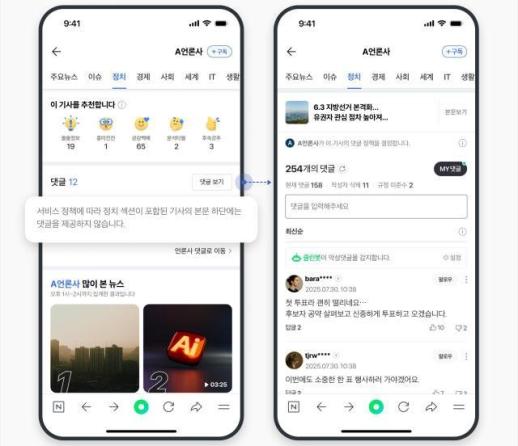 Naver to bolster AI tools to block abusive comments ahead of local elections SEOUL, March 19 (AJP) - Naver will enhance its artificial intelligence (AI)-based system to detect abusive comments ahead of local elections in early June, South Korea's largest online portal said on Thursday. It plans to introduce a feature dubbed "Cleanbot" by April that will automatically prevent users from leaving comments on certain articles such as politically sensitive or election-related stories, months ahead of the June 4 elections to elect mayors and governors across metropolitan and provincial governments. Naver is also considering extending the feature to all news articles throughout the official campaigning period including election day. Users will also be restricted from posting comments on certain news stories and sections to prevent any impact on or influence over voters, and will be limited to a maximum of three comments per article after verifying their accounts. Cleanbot, first introduced in 2019, has been continuously upgraded to detect not only explicit or violent language but also hateful and discriminatory expressions. "We will continue our efforts to serve as a trustworthy platform for news as well as a healthy space for communication," said Kim Su-hyang, a Naver executive. 2026-03-19 11:18:23
 -
 Asian stocks turn lower on Fed inflation warning, oil surge SEOUL, March 19 (AJP) — Asian stock markets opened lower on Thursday as a renewed surge in oil prices driven by escalating Middle East tensions and a more hawkish Federal Reserve outlook weighed on investor sentiment. Israel struck Iran’s South Pars gas field on Wednesday, marking its first attack on the country’s energy infrastructure in retaliation for the killing of senior intelligence and military officials. The escalation sent Brent crude up 6.1 percent to $109.75 per barrel, with Citi warning prices could climb further toward $120. Investor sentiment was also pressured by hawkish signals from the Federal Reserve. The Fed held its benchmark interest rate at 3.50–3.75 percent and refrained from offering forward guidance amid uncertainty stemming from the Middle East conflict. However, markets interpreted its upgraded inflation outlook as a hawkish signal. All three major U.S. stock indexes fell more than 1 percent overnight. The Korean won weakened sharply, with the one-month non-deliverable forward (NDF) rising to 1,508.25 per dollar. In onshore trading, the won fell to 1,500.20 per dollar from a previous close of 1,483.1. Technology heavyweights declined, with Samsung Electronics and SK hynix down around 3 percent and 4 percent, respectively, partially erasing their previous gains of 7.53 percent and 8.87 percent. The declines tracked overnight weakness in global chip stocks, with Nvidia down 0.84 percent and ASML falling 2.45 percent, pushing the Philadelphia Semiconductor Index down 0.53 percent. Losses were broad-based across sectors. Automakers declined, with Hyundai Motor down 3.85 percent to 524,000 won and Kia falling 2.11 percent to 171,400 won. Battery and industrial shares also weakened. LG Energy Solution slipped 2.35 percent to 374,500 won, Samsung C&T fell 2.68 percent to 291,000 won, and SK Square dropped 3.65 percent to 60,700 won. Shipbuilders and defense-related stocks moved lower, with HD Hyundai Heavy Industries down 3.73 percent to 568,000 won and Hanwha Aerospace falling 1.80 percent to 1,365,000 won. Financials traded lower, with KB Financial down 1.36 percent to 152,600 won and Shinhan Financial falling 1.89 percent to 93,200 won. Biopharmaceutical shares also slipped, with Celltrion down 3.34 percent to 202,500 won and Samsung Biologics falling 1.66 percent to 1,599,000 won. Brokerages said near-term volatility may increase, though a recovery remains possible. Han Ji-young, an analyst at Kiwoom Securities, said energy-driven inflation uncertainty has reinforced the Federal Reserve’s hawkish stance. She added that a stabilization in geopolitical conditions could shift markets into a more supportive phase, noting that markets have often rebounded after initial declines during past conflicts. As of 10:07 a.m., the benchmark KOSPI fell 2.72 percent to 5,764.10, while the KOSDAQ declined 1.88 percent to 1,142.52. Japan’s Nikkei 225 dropped 2.59 percent to 53,806.16 in morning trading, as rising energy costs threatened corporate earnings in import-dependent Japan while Fed-driven rate concerns further dampened sentiment. 2026-03-19 10:46:35
 -
 AutoInside Relocates and Expands Gwangju Direct Store to Grow Honam Reach AutoHands’ direct-run and certified used-car platform, AutoInside, said on the 19th it has opened an expanded and relocated Gwangju direct store to strengthen its presence in the Honam region. The Gwangju store moved to the second floor of the “M Plus Complex Auto Sales Center” in Seo-gu, Gwangju. The company said the new location, near the Honam Expressway and the Songam, Seochang interchanges, improves access for customers across Honam. With the move, the store secured a larger display area to showcase a wider range of vehicles. It also added more comfortable consultation and lounge space and offers one-stop service covering both vehicle purchases and sales, the company said. To mark the reopening, AutoInside said it will temporarily expand benefits under its trade-in program. Through the end of April, customers who sell their current vehicle to AutoInside and then buy a direct-run or certified used car will receive additional benefits of up to 400,000 won on the purchase price, depending on the vehicle’s condition. “Many consumers considering a vehicle change feel burdened by complicated procedures, so we prepared additional benefits through the trade-in program to help them sell and buy more quickly and conveniently,” an AutoInside official said. AutoInside operates five showrooms nationwide, including the Gwangju store. The company said it runs the full process — from vehicle purchasing and inspection to sales and extended warranties — through a direct management system. AutoInside’s certified used-car program, officially launched in February last year, sells only accident-free vehicles that are less than eight years old with under 100,000 kilometers and that pass a 205-point inspection, the company said. Buyers receive a free warranty for six months from the purchase date or up to 10,000 kilometers, whichever comes first. Kim Seong-jun, CEO of AutoHands, said the expanded relocation is intended to improve convenience for Honam customers and provide more consistent, high-quality service across the buying and selling process. “We will continue to build a used-car purchasing environment customers can trust, based on a thorough direct management system,” he said. * This article has been translated by AI. 2026-03-19 10:39:18