


Latest by
-
 TSMC Hints at Potential Semiconductor Price Increases Amid Rising AI Costs World's largest foundry, Taiwan Semiconductor Manufacturing Company (TSMC), has indicated a possibility of increasing semiconductor prices. Rising production costs due to inflation and a growing demand for artificial intelligence (AI) semiconductors are putting pressure on advanced semiconductor pricing. Wendell Huang, TSMC's Chief Financial Officer, stated in a BBC interview on June 9 that "inflation has led to increased costs," leaving the door open for potential price hikes. However, he clarified that TSMC would not implement drastic increases of "four or five times" the current prices. Huang explained that TSMC reflects its value, including technological advantages and manufacturing capabilities, in its pricing. This suggests that, in addition to rising costs, the value of advanced processes may also be factored into pricing. TSMC manufactures advanced semiconductors designed by global companies such as NVIDIA, AMD, and Apple. Any price increases from TSMC could raise costs for AI data centers and servers, potentially impacting the prices of electronic devices like smartphones and laptops in the long term. Recently, TSMC has faced pressure to expand its production capacity due to a surge in demand for AI semiconductors. Chairman Mark Liu mentioned at a recent shareholders' meeting that it would take time to meet customer demand. According to Reuters, Liu expressed a desire to raise prices amid rising component costs but emphasized that TSMC would not pursue sharp increases like some memory manufacturers. TSMC is expanding its manufacturing presence overseas, including in Arizona, Japan, and Germany. The U.S. has been urging TSMC to invest locally to secure its critical semiconductor supply chain. TSMC's total investment in the U.S. is projected to reach $165 billion (approximately 252 trillion won). However, Huang clarified that the expansion of overseas factories is not driven by geopolitical pressures. He stated, "We are building production capacity outside Taiwan because our customers want it, not due to government requests." For the foreseeable future, the center of advanced semiconductor production is expected to remain in Taiwan. Huang noted that shifting the semiconductor manufacturing ecosystem to the U.S. could take five to ten years or even longer. Addressing concerns about an AI bubble, he remarked, "We view AI as a long-term trend," adding that TSMC is confirming demand not only from direct customers like NVIDIA but also from hyperscalers operating large data centers.* This article has been translated by AI. 2026-06-10 14:00:00
 -
 Park Ji-hoon Discusses His Role in 'The Legend of the Cook' and the Challenges of Comedy Park Ji-hoon, who sparked a 'Dan Jong Syndrome' with his role in the film 'The King and the Man,' has returned as a private in the military. He has completely erased his previous work in a short time, donning an apron as a cook to blend comedy with a coming-of-age narrative. The Tving original series 'The Legend of the Cook' (written by Choi Ryong and directed by Jo Nam-hyung) is based on a popular web novel and webtoon, telling the story of Private Kang Sung-jae, who overcomes the challenges of military life through cooking. Park Ji-hoon has transitioned to a new genre, once again becoming the center of attention for a hit production."'The King and the Man' ended, and 'The Legend of the Cook' started right after. I found the script very entertaining. Park Ji-hoon is someone who is far from cooking; I don't even know the first letter of the word 'cooking.' I was curious about what it would look like for someone like me to cook. I thought that working on this project might spark a new hobby in cooking, but in reality, I feel even further away from it. The only thing I've improved is my knife skills. While reading the script, I found the fantasy elements and Sung-jae's special skills particularly intriguing," he said.'The Legend of the Cook' does not merely depict cooking scenes realistically. It creatively expresses flavors, showcases Sung-jae's unique abilities, and incorporates CGI and reactions that enhance the comedy and fantasy of the piece. Park Ji-hoon believes that rather than completing all scenes based solely on the script, he needed to create specific movements and eye contact on set."I didn't think too much while reading the script. I felt it was important to create on set. Where I stood and where I looked were things I developed on location. The director had specific positions and angles in mind, and I simulated my actions on set. I wanted to show viewers a natural interaction with others, so I tried to keep my eyes moving and maintain cute expressions. I also worked on parts during post-production dubbing, and I'm glad that what I simulated was captured well," he explained.Given the fantasy elements, there were many scenes that required the actor to adapt on set. For instance, a scene where he descends on wires while wearing seaweed could have felt strange or silly, but Park Ji-hoon said he was able to embrace it thanks to the atmosphere on set and the camaraderie with veteran actors."It was so much fun to do what the director wanted. Working with veteran actors made it easy to handle any situation on set without hesitation. I think I managed to enjoy the scene where I descended on wires while wearing seaweed," he said.In this project, Park Ji-hoon faced the new challenge of comedy. Instead of forcing humor, he trusted the natural rhythm of the scenes and the atmosphere on set. In fact, many spontaneous movements and reactions not included in the script emerged during filming."I tried not to act overly exaggerated. But I think it turned out funny. The atmosphere on set was great, and there were many unscripted moments. A lot of additional elements were added to the script as we thought through each scene on set," he noted.There were many moments that were hard to suppress laughter. Particularly, scenes like the chicken coop, which were created during rehearsals, provided unexpected humor for the actors. Park Ji-hoon learned a lot from his senior colleagues who excelled in comedy."It was hard to hold back laughter every time. There were many additions on set. The scene in the chicken coop was developed during rehearsal, and I think the reason I didn't lose focus was that the atmosphere on set was so enjoyable. My seniors, Kyung-ho and Jung Woong-in, are great at comedy, and I learned a lot from them. Seeing them work so hard made me want to put in the effort as well," he said.Although the series is based on a web novel and webtoon, Park Ji-hoon focused on the script to develop his character, Kang Sung-jae. While he did look at some of the webtoon after his military assignment, he ultimately relied on the script as his primary reference for acting preparation."I felt that the script I received was quite different from the webtoon. I didn't read the webtoon to the end. After my assignment, I focused more on the script than on the webtoon. I think I prepared according to the script," he explained.After the success of 'The King and the Man,' Park Ji-hoon quickly found himself in another hit project, but he shared that he hasn't experienced any significant changes within himself."I haven't changed much inside. I'm very grateful. I feel fortunate to have good seniors around me. Recently, while filming 'Wanna One Go' in Taean, many elderly people recognized me. I think it was because the movie did well. I was very thankful for their kindness," he said.He is cautious about his attitude following the success of his projects, fully aware that a production is the result of collective effort. He expressed his aversion to appearing arrogant due to a successful project."I dislike seeing someone act arrogant. It feels distasteful. While success can lead to that, it’s important to remember that many people contribute to the work," he stated.'The Legend of the Cook' features both humorous and poignant moments. In a scene revealing the past and transformation of Kwan-cheol (played by Kang Ha-kyung), Park Ji-hoon portrayed Kwan-cheol's grandmother. While the scene appears funny on screen, it was a delicate moment tied to the emotions of his co-star."It’s a funny scene on air, but it was a challenging one for me. It was an emotional scene for Ha-kyung. The grandmother's narrative about the hamburger was significant, and before filming that scene, the director asked if I could play the grandmother. I was surprised and thought, 'Me?' I could do it, but since the script indicated that Kwan-cheol would cry, I wondered if he could cry looking at my face. It was a sensitive scene. I was serious on set, trying to immerse myself and provide energy. He actually thanked me, saying I made him cry. It was a cautious yet grateful scene. It’s funny, but it can also be sad if you dig deeper. So, I remained quietly composed," he shared.Park Ji-hoon is also increasing his opportunities to connect with fans this year. Preparing for his first fan meeting in seven years, he expressed a desire to spend more time with fans after a long hiatus. He noted that it’s not just the fans who miss seeing him on stage."I think I will enlist next year. I want to join the Marine Corps, but there’s an age limit, so I have to enlist by next year. I don’t feel regret about the timing, as I need to fulfill my military duty. Since my hiatus has been so long, I want to spend more time connecting with fans this year. I missed being on stage for three years, and as someone who was first recognized on stage, I know fans want that too. I think I missed it as well," he said.Whether in his projects or on stage, meeting fans' expectations remains a task for Park Ji-hoon. He views this responsibility not as a burden but as a commitment he is eager to fulfill."Meeting fans' expectations is part of our job. Whether as an idol or on screen, it feels like a quest we always carry," he concluded.* This article has been translated by AI. 2026-06-10 14:00:00
 -
 Kakao Shares Plummet as Company Faces First Partial Strike Kakao's stock price has sharply declined as the company experiences its first partial strike since its founding. As of 1:27 PM on June 10, shares of Kakao were trading at 37,800 won, down 1,700 won (4.30%) from the previous trading day, according to the Korea Exchange. The drop in stock price is attributed to the partial strike that began at 10 AM. The Kakao branch of the National Chemical Fiber Food Industry Labor Union announced that the strike would continue until 3 PM, excluding a break from noon to 1 PM, totaling four hours of action. Employees from five subsidiaries, including Kakao's headquarters, Kakao Pay, Kakao Enterprise, DK Tech, and XL Games, are participating in the strike. These subsidiaries secured the right to strike after negotiations over wage collective agreements broke down, and a vote on whether to strike passed in favor. Previously, Kakao and the union failed to reach an agreement regarding performance bonuses, which were proposed to be 13% to 14% of last year's operating profit, as well as the inclusion of 5 million won worth of restricted stock units (RSUs) as part of the bonus. The union is demanding a performance bonus equivalent to approximately 10 million won, based on the 13% to 14% of operating profit, and insists that RSUs should not be included in the bonus calculation. The company, however, has stated that these demands pose a financial burden on management.* This article has been translated by AI. 2026-06-10 13:57:00
 -
 Newly Elected Floor Leader Jeong Jeom-sik Must Address Concerns Over Party's Direction The People Power Party has elected Jeong Jeom-sik, a three-term lawmaker, as its new floor leader. This decision comes after the party faced disappointing results in last year’s general elections, the presidential election, and the recent local elections, marking a critical juncture for the party's future direction. Immediately following his election, Jeong stated, "I will not be swayed by the voices of specific factions," and acknowledged concerns about the party being perceived as a pro-Yoon faction, saying, "I will accept that criticism painfully." At least his recognition of the reality is not incorrect. The most significant issue facing the People Power Party is not a lack of seats but a lack of public trust. Since the Yoon Suk-yeol administration began, the party has promised several reforms and innovations, yet it has left a stronger impression of factional conflicts, power struggles, and evasion of responsibility. Many have criticized the party for focusing on personnel reshuffles and leadership changes rather than fundamental changes following its electoral defeats. The results of the recent local elections can also be seen as an extension of this public sentiment. With Jeong, who is classified as part of the pro-Yoon faction, being elected as floor leader, concerns have arisen both inside and outside the party that the pro-Yoon system will continue. Jeong asserted, "There is no pro-Yoon faction." While this may be politically accurate, what the public cares about is not the name of the faction but the actual operational methods. If the perception persists that the party's operations are influenced by specific individuals or factions, the names—whether pro-Yoon or anti-Yoon—become irrelevant. Jeong's emphasis on the "collective intelligence of the general assembly" in his acceptance speech is therefore significant. For the party to operate healthily, diverse opinions must be freely discussed, and minority views must be respected. A party that does not practice internal democracy cannot gain the trust of the public. The role of the floor leader is not to line up lawmakers but to harmonize and integrate differing voices. Moreover, the People Power Party faces the challenge of redefining its role as an opposition party. If it continues to rely solely on unconditional opposition or aggressive confrontation, it will struggle to gain public sympathy. The party must demonstrate a responsible opposition by cooperating on effective government policies while critically assessing those that are flawed. It is crucial to present alternatives on national issues such as livelihoods, the economy, security, and diplomacy. The upcoming negotiations on the composition of the National Assembly are expected to be a test. During the floor leader election process, there were calls for a more aggressive stance against the ruling party, but what the public desires is not extreme confrontation but a functioning National Assembly. Legislative work on public welfare has stalled, and the economy remains uncertain. A National Assembly that prioritizes cooperation over conflict and results over disputes is needed. If the People Power Party genuinely seeks reconstruction, it must not treat this floor leader election as merely a personnel change. The public has already heard numerous declarations of reform and promises of innovation. What is now needed is action, not just words. The way the party operates, its nomination culture, and its attitude toward the public must change. Jeong Jeom-sik's term as floor leader may represent the last opportunity for the People Power Party to change. His promises to "not be swayed by specific factions" and to "painfully accept concerns about being a pro-Yoon party" must ultimately be proven through action. The public is no longer moved by mere words of reform. The authenticity of change will be confirmed not by statements made in meetings but by future decisions and actions. Returning to the fundamentals of politics—prioritizing public sentiment over factional interests, responsibility over loyalty, and unity over division—is the only path for the People Power Party to stand before the public again. 2026-06-10 13:51:00
 -
 Can Tourists Become Residents in the Era of Local Decline? Local decline is no longer a future statistic; it has become a reality. Young people are leaving for metropolitan areas, regional schools are closing, and local businesses are losing vitality. This is why the government and local authorities are focusing on increasing the resident population, as relying solely on registered population figures no longer adequately reflects regional vitality. The digital tourism resident card, promoted by the Ministry of Culture, Sports and Tourism and the Korea Tourism Organization, is a policy born from these concerns. It grants 'honorary resident' status to tourists visiting declining population areas and offers discounts on accommodations, transportation, experiences, and attractions to encourage regional visits. Recently, the ministry expanded the number of participating areas from 44 to 52, meaning more than half of the 89 designated declining population areas are now involved. The most significant aspect of the digital tourism resident card is its shift in focus for tourism policy. While past policies concentrated on attracting as many tourists as possible, there is now a growing emphasis on how long visitors stay and how often they return. The goal has shifted from merely increasing visitor numbers to enhancing the resident population. The resident population has emerged as a new key to addressing local decline. Many declining areas actually host a transient population that far exceeds their registered residents, supporting the local economy. Weekend travelers, remote workers, rural experience participants, and festival attendees are prime examples. There is a growing recognition that even those who do not have a registered address in the area but spend time and money there are vital contributors to local vitality. In this context, the digital tourism resident card represents more than just a discount coupon initiative. It signifies a shift in perspective, viewing tourists not merely as consumers but as individuals who form connections with the region. If discounts can lead to visits, experiences at local festivals, purchases of local specialties, and repeat visits, it could significantly benefit the local economy. However, several conditions must be met for the program to succeed. Above all, there must be compelling reasons for tourists to return. While discounts may encourage initial visits, they do not guarantee repeat visits. If regions continue to offer similar festivals and experiences, they will struggle to leave a lasting impression on tourists. Efforts are needed to develop unique local resources into differentiated content, such as marine healing in Wando, fermentation culture in Sunchang, and ecological tourism in Uljin. Improving basic tourism infrastructure, such as transportation, accommodations, and information systems, is also crucial. No matter how good the policy is, if transportation is inconvenient and there is a lack of lodging, the length of stay will not increase. It is essential to remember that the competitiveness of local tourism lies not in discount rates but in the quality of experiences offered. The evaluation methods for these policies also need to change. Future assessments should focus more on actual visit frequency, return rates, length of stay, and increases in local spending rather than merely counting the number of cardholders or partner facilities. This way, the digital tourism resident card can evolve from a mere promotional event into a policy that revitalizes the local economy. Tourism alone cannot resolve local decline. More fundamental issues such as jobs, education, healthcare, and housing remain. However, tourism serves as a practical entry point for people to first engage with a region. It has the power to draw people in, foster relationships, and encourage repeat visits. If the digital tourism resident card can serve as a first step in this direction, it could be a meaningful experiment in addressing local decline. The key is not merely to issue more resident cards but to create more connections between people and the region.* This article has been translated by AI. 2026-06-10 13:42:00
 -
 Anthropic Launches 'Mythos Class' AI Models, Pressuring OpenAI and Google On June 10, Anthropic unveiled two high-performance AI models, Claude 5 and Mythos 5, which are expected to disrupt the AI model industry. The introduction of these models intensifies pressure on OpenAI and Google regarding their upcoming model roadmaps. Anthropic established a new performance tier called the "Mythos Class," adding it above the existing top-tier model, Opus. Both Claude 5 and Mythos 5 share the same foundational model but differ in access controls. Anthropic determined that the capabilities of these models could pose potential risks in cybersecurity and biology if released publicly, leading to a dual-release strategy. Claude 5 features a safety classifier that routes cybersecurity and biology-related queries through Opus 4.8, making it available for general use. In contrast, Mythos 5, which has this safeguard disabled, is restricted to partners in cybersecurity defense and infrastructure, marking the first commercial service phase for the previously surprising Mythos model. Both models support a context window of 1 million tokens and a maximum output of 128,000 tokens, with pricing set at $10 per million tokens for input and $50 per million tokens for output, double the rates of Opus 4.8. Benchmark performance significantly surpasses competing models. In the SWE-Bench Pro, a key indicator in software engineering, Claude 5 scored 80.3%, well above Opus 4.8's 69.2%, GPT-5.5's 58.6%, and Gemini 3.1 Pro's 54.2%. In the more challenging Frontier Code Diamond set, it achieved 29.3%, more than double Opus 4.8's 13.4%. In the GDPval-AA knowledge work assessment, it ranked first with an Elo score of 1932. Anthropic emphasizes that "the longer and more complex the task, the greater the gap compared to competing models." Real-world performance is also noteworthy. In initial tests by Stripe, Claude 5 completed a migration of a codebase with 50 million lines in just one day. External researcher Matthew Pines reported that in his frontier physics research project, Claude 5 matched a task that took GPT-5.5 four days in just 36 hours. The launch of these models has made the pressure on OpenAI and Google more apparent. On April 23, OpenAI released the previously anticipated GPT-6, codenamed "Spurd," as GPT-5.5, effectively delaying the GPT-6 schedule and opting for a mid-version response to the market. However, GPT-5.5's SWE-Bench Pro performance lags 21.7 percentage points behind Claude 5. As of now, no official release date for GPT-6 has been announced. Google is in a similar position. At the Google I/O event on May 19, it showcased Gemini 3.5 Flash and is currently rolling out Gemini Omni, but industry experts assess that Gemini Omni's performance is on par with GPT-5.5 and does not reach the levels of the Mythos Class. The competition for IPO funding is also a factor. With both OpenAI and Anthropic pursuing public listings, the launch of Anthropic's high-performance models is likely to attract investor interest. Industry analysts suggest that the arrival of Claude 5 and Mythos 5 goes beyond mere model performance updates, resetting the benchmarks within the AI sector. Anthropic's strategy of creating a new tier above Opus is forcing competitors to thoroughly reassess their roadmaps.* This article has been translated by AI. 2026-06-10 13:39:00
 -
 KOSPI Plummets Over 5% Amid Foreign Selling of 2.7 Trillion Won The KOSPI index has dropped over 5% during trading, driven by significant selling from foreign and institutional investors. In contrast, individual investors have focused on bargain hunting, recording net purchases exceeding 3 trillion won. On June 10, the Korea Exchange reported that the KOSPI opened at 7,899.77, down 197.16 points (2.43%) from the previous trading day (8,096.93). The index continued to decline, reaching 7,665.38, a drop of 431.55 points (5.33%) as of 1:25 PM. Foreign and institutional investors led the sell-off, with foreign investors selling a net 27.66 trillion won and institutions offloading 7.884 trillion won. Meanwhile, individual investors purchased a net 34.196 trillion won, absorbing the selling pressure. Major stocks also showed weakness, with Samsung Electronics down 4.50% and SK Hynix falling 3.70%. SK Square and Samsung SDI dropped 3.70% and 3.10%, respectively, while Hyundai Motor saw a decline of 2.66%. The KOSDAQ index also faced losses, starting at 958.58, down 9.23 points (0.95%) from the previous day (967.81), and later recording a decline of 23.81 points (2.46%) to 944.00. In the KOSDAQ market, foreign selling continued, with foreign investors net selling 253.1 billion won, while individuals and institutions recorded net purchases of 228.7 billion won and 25.6 billion won, respectively. Most of the top KOSDAQ stocks experienced declines. Alteogen fell 2.60%, EcoProBM dropped 1.55%, EcoPro decreased by 0.47%, and Rainbow Robotics saw a decline of 3.05%. However, JUSUNG Engineering bucked the trend, rising 9.55% amid the overall market downturn. Analysts suggest that the recent surge in volatility has accelerated the outflow of foreign capital, increasing downward pressure on the domestic stock market. However, the substantial net buying by individual investors is helping to mitigate further declines.* This article has been translated by AI. 2026-06-10 13:39:00
 -
 Moss Tan Files Recusal Request in Lawsuit Against Travel Ban Moss Tan, a professor at Liberty University in the U.S. accused of spreading false information about President Lee, has filed a recusal request against the court handling his lawsuit against a travel ban imposed by the Ministry of Justice. The Seoul Administrative Court held its first hearing on June 10 regarding Tan's lawsuit against the Ministry of Justice's travel ban. However, the hearing was postponed after Tan's legal team claimed there were grounds for recusal. Lee Ha-sang, Tan's attorney, pointed out that the ruling on the travel ban was delivered on June 4, the same day Tan was scheduled to depart. He argued, "This is an unlawful decision that effectively deprives him of the possibility of leaving the country." Tan's legal team has also filed a complaint against the presiding judge for alleged dereliction of duty, stating, "The defendant is the presiding judge, raising concerns about a fair trial." While the court acknowledged that there were delays in the proceedings, Tan's team emphasized the importance of receiving a fair trial. Consequently, the court decided to postpone the hearing to address the recusal request. After the hearing, attorney Lee criticized the situation, stating, "The president, being the highest authority, has an obligation to directly address any questions about himself. Blocking Tan's departure under the absurd defamation framework and pursuing a lawsuit against him challenges the freedom of expression that citizens in free democracies should enjoy." Moss Tan made statements last June suggesting that President Lee was involved in a murder case during his youth, which led to his imprisonment in a juvenile facility, preventing him from attending middle and high school. The police subsequently investigated Tan for defamation against the president. Upon Tan's return to South Korea on May 28, police requested his attendance for an investigation, but he did not comply. The police then requested a travel ban from the Ministry of Justice, which was granted until June 30. In response, Tan filed a lawsuit to cancel the travel ban and also requested a stay of execution. The court denied the stay request on June 4, citing that the public interest in the travel ban outweighed any harm to Tan.* This article has been translated by AI. 2026-06-10 13:33:00
 -
 70% of U.S. Economists Predict Fed Will Hold Interest Rates Steady This Year The outlook is growing that the Federal Reserve will keep interest rates steady for the remainder of the year. Rising inflation pressures stemming from the conflict in the Middle East and strong employment data have diminished expectations for rate cuts. On June 9, Reuters reported that a survey conducted from June 4 to 9 among 102 economists revealed that 72 respondents expect the Fed's benchmark interest rate to remain in the current range of 3.50% to 3.75% through the end of the year. This represents about 70% of those surveyed. The proportion of respondents predicting a hold has increased significantly from less than half in last month’s survey and about one-third in the previous one. Reuters noted, "This survey marks the first clear majority opinion confirming expectations for a rate hold this year." No economists anticipated a rate cut at the upcoming Federal Open Market Committee (FOMC) meeting scheduled for June 16-17, which will be chaired for the first time by Kevin Warsh, the newly appointed Fed Chair. Inflation rates have risen to nearly double the Fed's target of 2%. According to a separate Reuters survey, the consumer price index in the U.S. is expected to show a 4.2% increase in May, marking the highest level in over three years. The Fed's preferred inflation measure, the Personal Consumption Expenditures (PCE) price index, also rose by 3.8% year-over-year in April, the highest since May 2023. The Reuters survey projected PCE inflation rates of 3.9% for the second quarter, 3.8% for the third quarter, and 3.6% for the fourth quarter. Strong employment data has further weakened the outlook for rate cuts. The employment figures released last week for May were stronger than expected, reducing the likelihood of a rate cut due to economic slowdown concerns. The futures market is pricing in at least one rate hike by the end of the year. Some Fed officials have also indicated that rates may be raised later this year. Growth and employment forecasts have not changed significantly. The Reuters survey indicated that the U.S. unemployment rate is expected to remain around 4.3%, with economic growth projected to average about 2% over the next few years.* This article has been translated by AI. 2026-06-10 13:33:00
 -
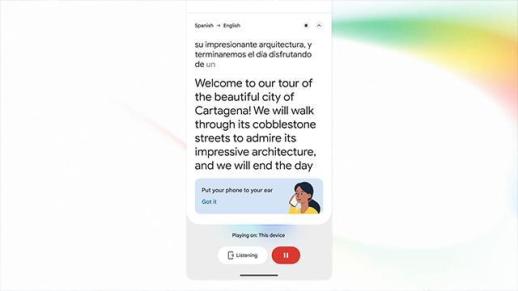 Google Launches Real-Time Translation Model Supporting Over 70 Languages Google has unveiled an artificial intelligence (AI) translation model capable of real-time interpretation in over 70 languages. The new model aims to reduce delays compared to traditional methods that wait for the speaker to finish before translating, while also capturing the speaker's tone and style. On June 9, Google introduced its new real-time voice translation model, "Gemini 3.5 Live Translate." This model will be gradually integrated into the Google Translate app, Google Meet video conferencing service, and the Gemini Live API for developers. The new model automatically detects the language being spoken without requiring users to select a translation language in advance. It can recognize speech in over 70 languages and convert it into another language's audio, even in conversations that mix multiple languages. The most significant improvement is in translation speed. Traditional voice translation often delivers the translated audio only after the speaker has finished talking. In contrast, the new model provides translation audio while the speaker is still talking. Google noted that the difference between the original speech and the translated audio is typically just a few seconds. The quality of the audio has also been enhanced. The model not only conveys the meaning of sentences but also strives to reflect the original speaker's tone, style, speed, and pitch as closely as possible. The goal is to produce a translation that sounds more like a natural conversation rather than a mechanical reading. This new model will be available on both Android and iOS versions of the Google Translate app. Users can connect earphones to listen to real-time voice translations. On Android devices, a "listening mode" allows users to hold their smartphones to their ears, similar to a phone call, to hear the translated audio. This feature will enable travelers to receive near real-time voice translations when conversing with locals in different languages through their smartphones. The new functionality will initially be available to select corporate clients using Google Meet. Google plans to test the new voice translation feature with Google Workspace customers this month and expand availability later this year for multilingual meetings. For developers, the Gemini Live API and Google AI Studio will provide early access to this feature, allowing them to create real-time voice translation services. Real-time media platforms like Agora and LiveKit will also support integration of related features. Ride-hailing service Grab is testing the model for multilingual communication between drivers and passengers. This would allow real-time translation during calls within the app for users speaking different languages. Google has stated that all generated voices will include a SynthID watermark to help identify AI-generated audio. This technology embeds an invisible identifier in AI-generated voices.* This article has been translated by AI. 2026-06-10 13:21:00