

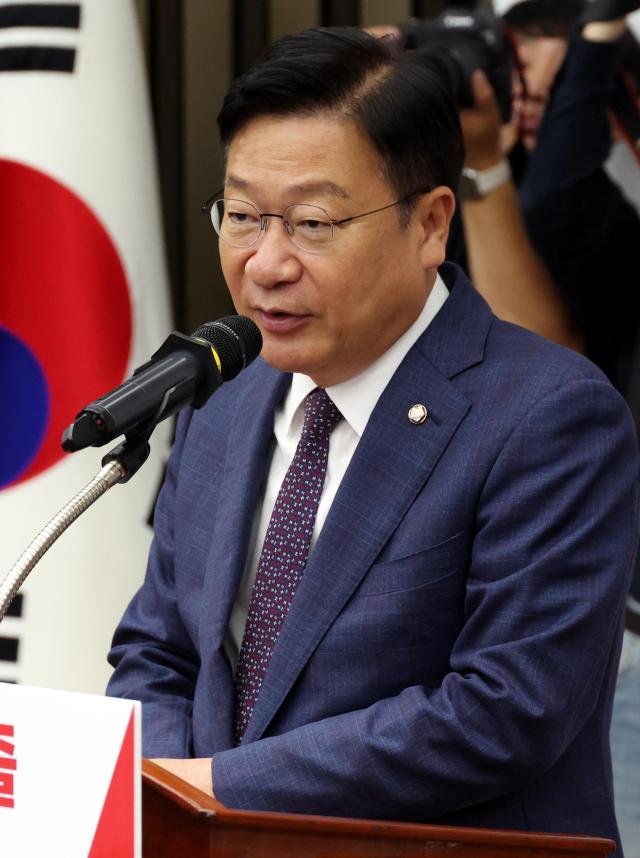
The People Power Party has elected Jeong Jeom-sik, a three-term lawmaker, as its new floor leader. This decision comes after the party faced disappointing results in last year’s general elections, the presidential election, and the recent local elections, marking a critical juncture for the party's future direction. Immediately following his election, Jeong stated, "I will not be swayed by the voices of specific factions," and acknowledged concerns about the party being perceived as a pro-Yoon faction, saying, "I will accept that criticism painfully." At least his recognition of the reality is not incorrect.
The most significant issue facing the People Power Party is not a lack of seats but a lack of public trust. Since the Yoon Suk-yeol administration began, the party has promised several reforms and innovations, yet it has left a stronger impression of factional conflicts, power struggles, and evasion of responsibility. Many have criticized the party for focusing on personnel reshuffles and leadership changes rather than fundamental changes following its electoral defeats. The results of the recent local elections can also be seen as an extension of this public sentiment.
With Jeong, who is classified as part of the pro-Yoon faction, being elected as floor leader, concerns have arisen both inside and outside the party that the pro-Yoon system will continue. Jeong asserted, "There is no pro-Yoon faction." While this may be politically accurate, what the public cares about is not the name of the faction but the actual operational methods. If the perception persists that the party's operations are influenced by specific individuals or factions, the names—whether pro-Yoon or anti-Yoon—become irrelevant.
Jeong's emphasis on the "collective intelligence of the general assembly" in his acceptance speech is therefore significant. For the party to operate healthily, diverse opinions must be freely discussed, and minority views must be respected. A party that does not practice internal democracy cannot gain the trust of the public. The role of the floor leader is not to line up lawmakers but to harmonize and integrate differing voices.
Moreover, the People Power Party faces the challenge of redefining its role as an opposition party. If it continues to rely solely on unconditional opposition or aggressive confrontation, it will struggle to gain public sympathy. The party must demonstrate a responsible opposition by cooperating on effective government policies while critically assessing those that are flawed. It is crucial to present alternatives on national issues such as livelihoods, the economy, security, and diplomacy.
The upcoming negotiations on the composition of the National Assembly are expected to be a test. During the floor leader election process, there were calls for a more aggressive stance against the ruling party, but what the public desires is not extreme confrontation but a functioning National Assembly. Legislative work on public welfare has stalled, and the economy remains uncertain. A National Assembly that prioritizes cooperation over conflict and results over disputes is needed.
If the People Power Party genuinely seeks reconstruction, it must not treat this floor leader election as merely a personnel change. The public has already heard numerous declarations of reform and promises of innovation. What is now needed is action, not just words. The way the party operates, its nomination culture, and its attitude toward the public must change.
Jeong Jeom-sik's term as floor leader may represent the last opportunity for the People Power Party to change. His promises to "not be swayed by specific factions" and to "painfully accept concerns about being a pro-Yoon party" must ultimately be proven through action. The public is no longer moved by mere words of reform. The authenticity of change will be confirmed not by statements made in meetings but by future decisions and actions. Returning to the fundamentals of politics—prioritizing public sentiment over factional interests, responsibility over loyalty, and unity over division—is the only path for the People Power Party to stand before the public again.
* This article has been translated by AI.

Copyright ⓒ Aju Press All rights reserved.