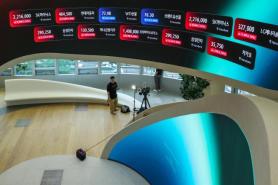
The selling was led by foreign investors, who dumped a net 2.77 trillion won of Korean shares, the heaviest single-day foreign outflow of this entire turbulent stretch, with institutions selling another 2.27 trillion won while domestic retail buyers absorbed 4.86 trillion won.
Beneath the headline drop, money fled the chip names and rotated hard into defense, shipbuilding and power equipment, the sectors that stand to gain from rising geopolitical tension.
KOSPI shed 366.11 points to 7,730.83. Bellwether SK hynix fell 7.5 percent to 2,048,000 won ($1,344) and Samsung Electronics dropped 6.1 percent to 302,500 won ($199).
The renewed conflict sent investors toward companies built for a more dangerous world.
Hanwha Ocean jumped 7.8 percent, the power-equipment maker LS Electric rose 7.5 percent, HD Korea Shipbuilding and Offshore Engineering climbed 6.3 percent and HD Hyundai Electric added 4.5 percent. On a day defined by a Middle East conflict, investors rebuilt their portfolios around firms that benefit from rising tension, and sold those that depend on global growth and calm.
The trigger came from overnight, when the U.S. forces launched fresh strikes against Iran after President Donald Trump vowed to respond to the downing of an American helicopter, an escalation that threatens a fragile ceasefire.
The market impact, however, was about risk appetite more than oil itself, which rose only about 1 percent.
What made the damage so uneven across the region was exposure: Korea, the most globally connected market in Asia, took the hardest hit, while Japan fell less and China barely moved at all.
The split was visible at home before it was visible abroad. The junior KOSDAQ, with less eight in the foreign-held heavyweight names, dropped just 1.7 percent, a gap that showed the selling was concentrated in the large-cap chip and export stocks that foreigners and institutions hold most heavily.
Japan followed the shock but not the script. The Nikkei 225 closed down nearly 2 percent at around 64,288, yet the rotation ran the opposite way to Korea's, with chip-equipment names holding their recent strength while the broader market sank, a sign the selling was index-wide rather than a clean move into oil and defense.
The yen and a possible Bank of Japan rate increase later this month remain a separate weight on Japanese stocks regardless of the Middle East.
China barely registered the shock. The Shanghai Composite slipped only a fraction of a percent to around 3,990, holding its place as the region's steadiest market in both directions. Driven more by domestic policy than global sentiment, and cushioned by years of strategic energy stockpiling built for exactly this kind of supply scare, China absorbed a global shock with barely a ripple.
The won held near 1,525 against the dollar, steady even as equities fell, leaving the currency one of the few calm readings in the picture.
But the signal that matters most is the sustained foreign exodus for KOSPI and won impacts. Traders see investors cashing out of inflated Korean equities to reposition for the much-awaited SpaceX debut on the Nasdaq.
Copyright ⓒ Aju Press All rights reserved.