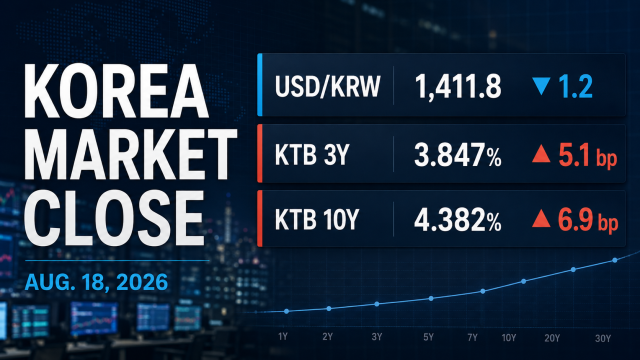
The won closed daytime trading at 1,411.8 per dollar, strengthening by 1.2 won from the previous session's close of 1,413.
The currency opened at 1,417.0 and briefly strengthened toward the 1,409 level as foreign investors bought Korean shares and exporters sold dollars, before giving back part of the gain.
The expiry of a U.S.-Iran ceasefire memorandum and Brent crude above US$90 a barrel supported the dollar, while the KOSPI's reversal from an early rally to a 1.55 percent loss limited further gains in the won.
The three-year Korean government bond yield rose 5.1 basis points to 3.847 percent, while the 10-year yield climbed 6.9 basis points to 4.382 percent, according to final afternoon quotations from the Korea Financial Investment Association.
The 20-year yield jumped 10.3 basis points to 4.661 percent, the 30-year rose 8.2 basis points to 4.751 percent and the 50-year advanced 8.1 basis points to 4.661 percent, with all three reaching new year-to-date highs.
The gap between the 10-year and three-year yields widened by 1.8 basis points to 53.5 basis points, although both yields retreated from their morning reference levels as the initial selloff eased.
The U.S. 30-year Treasury yield reached 5.321 percent in Asian trading, its highest since 2007, while a 3 trillion won ($2.1 billion) Korean 10-year bond auction added to the amount of long-term debt the market had to absorb.
With the Bank of Korea due to decide next week whether to raise its base rate again on Aug. 27, the increase in the policy-sensitive three-year yield suggests markets continue to price a meaningful chance of another hike.
The won's strength near the low 1,410s reduces imported-inflation pressure, however, while sharply higher market borrowing costs give policymakers a counterargument for holding rates steady and assessing the tightening already under way.

Copyright ⓒ Aju Press All rights reserved.