

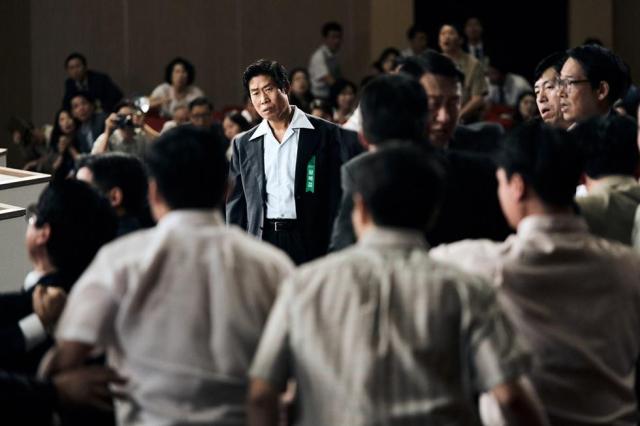
SEOUL, October 03 (AJP) - A film about the 1974 shooting that killed South Korea's first lady drew its 2 millionth viewer Saturday, 11 days after release, despite accusations from conservative politicians that it distorts history.
Hive Media Corp, which produced and distributed "The Assassin(s)," said Saturday afternoon that cumulative admissions had passed 2 million. It is the ninth film released in South Korea this year to reach that mark.
The film opened Sept. 23 and drew about 1.41 million viewers over the four-day Chuseok harvest holiday from Sept. 24 to 27, finishing ahead of "Tazza: The Song of Beelzebub" and "Odyssey." It lost the daily box-office lead to "Tazza" on Sept. 28 as criticism of its portrayal of history mounted, then reclaimed first place at the start of October and has held it since.
As of 4 p.m. Saturday, it held 16.9 percent of advance ticket sales, with more than 84,000 seats booked. That put it second only to the Japanese animated feature "Chiikawa the Movie: The Secret of Mermaid Island," at 25.7 percent.
Directed by Hur Jin-ho, best known for the 1998 romance "Christmas in August," the film follows a police officer and two newspapermen who chase unanswered questions about the attack. Yoo Hai-jin plays Cheol-gu, a detective at the scene. Park Hae-il plays Jae-hwan, a newspaper's city editor, and Lee Min-ho plays Young-il, a rookie reporter.
The shooting took place on Aug. 15, 1974, at a Liberation Day ceremony at the National Theater in Seoul, where President Park Chung-hee was delivering a speech. The holiday marks the end of Japanese colonial rule in 1945. Park was unhurt, but first lady Yuk Young-soo was shot in the head and died that evening. A high school student, Jang Bong-hwa, was killed by a bullet fired by a member of Park's security detail.
The gunman, Moon Se-gwang, was a 22-year-old ethnic Korean born and raised in Osaka. He had stolen a revolver from a Japanese police box and entered South Korea on a Japanese passport.
Seoul concluded that he acted on orders from North Korea relayed through Chongryon, a pro-Pyongyang association of Korean residents in Japan. Tokyo disputed that finding, and the case badly strained relations between the two countries. Moon was hanged on Dec. 20, 1974.
The film does not name the president as the mastermind. Its characters, however, raise the possibility that the Korean Central Intelligence Agency, the state spy service of Park's era, was involved. That premise drew charges of historical distortion, most loudly from the People Power Party, the main opposition.
Party leader Jang Dong-hyuk wrote on Facebook that the film floated an "absurd" possibility that Park was behind his wife's killing. Rep. Yoo Yeong-ha, a longtime associate of former President Park Geun-hye, the couple's daughter, called it "political propaganda."
Rep. Yoon Sang-hyun took a softer line. He said cinematic imagination deserved protection but argued that creative freedom should be kept separate from altering historical fact.
Online audience scores split along similar lines. As of Sept. 28, verified ticket buyers on the portal Naver rated the film 8.6 out of 10. Naver's open netizen score, which requires no proof of purchase, stood at 2.4.
The dispute has since spread beyond the theater. Protest comments flooded YouTube ads for a fast-food brand and a securities firm featuring Yoo, and comments on both videos were closed. Hive Media Corp also canceled promotional events for the film, including an outdoor stage greeting at the Busan International Film Festival.
Hur has said the film was never meant to settle the case. In a pre-release interview, he said he had reviewed broadcasts, documentaries, Japanese materials, books and academic papers, but found no basis for declaring a single answer.
"This was not a story where I could reach a conclusion from the beginning," Hur said.

Copyright ⓒ Aju Press All rights reserved.
