
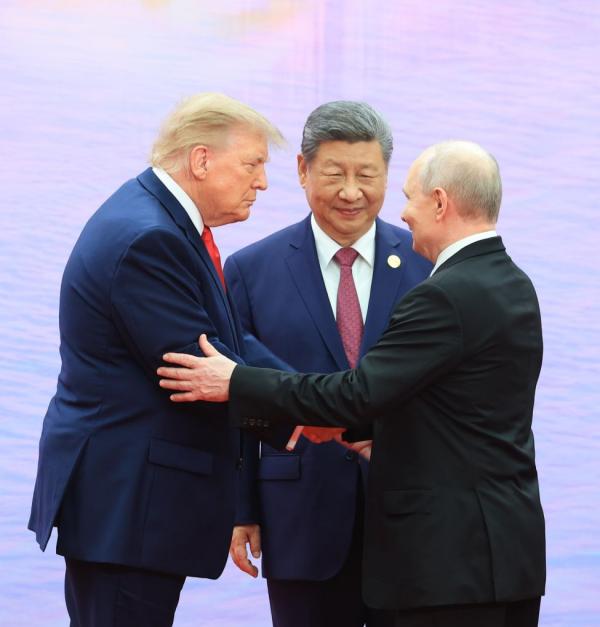
Donald Trump and Chinese President Xi Jinping are scheduled to meet first on Thursday at 1:45 p.m. Korean time, or 12:45 p.m. in Shenzhen. Russian President Vladimir Putin will join them for three-way talks at 3:30 p.m. Korean time at Shenzhen Kylin Villa.
The sequence moves the day from a meeting between the world’s two largest economies to a gathering of three nuclear powers whose ambitions reach well beyond the Asia-Pacific. The setting is the Asia-Pacific Economic Cooperation (APEC) summit, a forum built around trade and economic cooperation. Yet the smaller gathering threatens to eclipse the wider one, with attention shifting to nuclear weapons, war and the influence the three men seek over the international order.
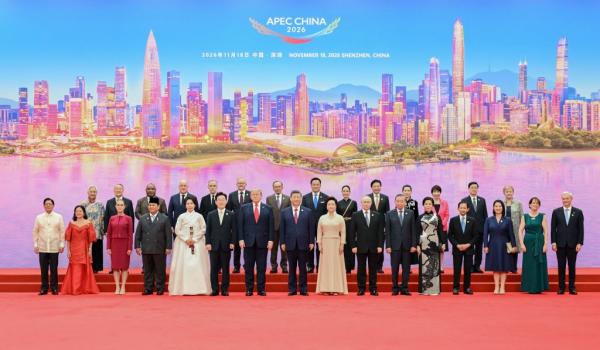
South Korea had a front-row seat for the photograph, but it won't likely get a seat at Thursday’s three-way table.
Neither will Ukraine or European governments, although any discussion of Russia’s war could touch directly on their security. The distinction between appearing in the picture and participating in the decisions is part of what gives this meeting its weight.
Inside the banquet hall, the presentation was more inclusive. Cantonese dishes and wine from China’s Ningxia region offered a taste of the host country, while Xi presented Shenzhen’s transformation from a small border town into a technology center as an argument for openness and cooperation.
“To see 50 years of China, come to Shenzhen,” he told his guests. “Openness is in Shenzhen’s DNA. Innovation is the wellspring of Shenzhen’s vitality. Cooperation is the source of Shenzhen’s strength,” the foreign ministry quoted Xi as saying.
Xi presented the city’s transformation as a reflection of China’s reform and opening up and an example of Asia-Pacific cooperation. After dinner, the leaders and their spouses attended a gala performance celebrating the region’s cultural diversity, the ministry said.
Trump has said he wants to discuss nuclear arms control and ending the war in Ukraine. His aides have offered a narrower account of the agenda, leaving uncertainty over how much of the conflict will enter the three-way talks. A separate Trump-Putin meeting is also planned, according to White House officials.
The gathering has invited comparisons with Yalta, where Franklin D. Roosevelt, Winston Churchill and Joseph Stalin met in 1945 to shape the postwar settlement. The analogy has limits. Those leaders were wartime allies approaching a shared victory and negotiated over eight days.
The Shenzhen meeting is expected to last roughly an hour, bringing together governments divided over wars, trade, technology and military power and produce little more than photographs for the history books.
The political balance is also different. Two of the three leaders at Yalta represented democracies. In Shenzhen, Trump will sit alongside two authoritarian rulers whose partnership is rooted partly in opposition to U.S. dominance.
For Xi, hosting offers a chance to present China as a convening power. For Putin, standing alongside the American and Chinese presidents challenges Western efforts to isolate him over Ukraine. For Trump, bruised by the U.S. midterm elections, the gathering offers a chance to reclaim the international spotlight.
Those interests can produce a striking photograph. Whether they can produce a common position will become clearer when Putin joins the room.
Tags: APEC 2026, Shenzhen summit, Donald Trump, Xi Jinping, Vladimir Putin, U.S.-China relations, China-Russia relations, trilateral summit, nuclear arms control, Ukraine war, Lee Jae Myung, South Korea
Copyright ⓒ Aju Press All rights reserved.
Related News
-
 Trump, Xi, Putin leave historic photo op
SEOUL, November 19 (AJP) -The leaders of the United States, China and Russia shared a rare three-way photo opportunity at the Asia-Pacific Economic Cooperation (APEC) summit on Wednesday, putting Russian President Vladimir Putin back at the center of a major international gathering for the first time in nine years. Chinese President Xi Jinping and his wife, Peng Liyuan, stood at the center of the group photograph, flanked by U.S. President Donald Trump and Putin. South Korean President Lee Jae Myung and first lady Kim Hea Kyung stood beside Trump. The image marked Putin's first appearance in an APEC leaders' family photo since the 2017 summit in Vietnam, challenging Western efforts to isolate Moscow over its invasion of Ukraine. Tags: APEC, Shenzhen, China, United States, Russia, Vladimir Putin, Lee Jae Myung
-
Xi's embrace sets Trump apart at APEC
SEOUL, November 19 (AJP) - Chinese President Xi Jinping rolled out an unusually warm welcome for U.S. President Donald Trump on Wednesday, personally greeting him at Shenzhen airport with a hug and full red-carpet ceremony — a rare honor not extended even to his close ally, Russian President Vladimir Putin. Xi sent senior officials to receive Putin and other visiting leaders, while Japanese Prime Minister Sanae Takaichi received a considerably more subdued welcome amid strained China-Japan relations. Xi said his personal reception for Trump reciprocated the U.S. president's airport greeting during his visit to Washington in September. The contrasting welcomes highlighted Beijing's delicate diplomatic balancing act ahead of Thursday's high-stakes trilateral summit involving Trump, Xi and Putin. Tags: Donald Trump, Xi Jinping Vladimir Putin, APEC, Shenzhen, high-stakes, three-way meeting, United States, Russia, China
-
Heavy Security in Shenzhen Ahead of Trump's Visit
Intense security measures are being implemented in Shenzhen, China, ahead of U.S. President Donald Trump's visit for the Asia-Pacific Economic Cooperation (APEC) summit.According to Hong Kong media outlets HK01 and i-CABLE on November 18, metal barricades have been erected around the expected hotel for President Trump, the Langham Hotel in Donghai, Futian District, and access controls have been tightened.Only a few pathways remain open for nearby residents and shopping mall visitors, while metal fences have been installed along pedestrian walkways. At least three armed police officers have been stationed at the hotel parking entrance to control photography. A separate security checkpoint has also been established, and an APEC logo has been displayed at the entrance.Local merchants are experiencing disruptions to their businesses. One merchant told HK01, "We will remain closed until the 21st due to the arrival of a distinguished guest," indicating plans to stop operations starting November 18. In contrast, another merchant stated they had not received any notice to close and continued normal operations.The shopping mall connected to the hotel, Donghai Binfen Tianji, operated normally on November 17. Citizens and tourists enjoyed coffee and meals in the area surrounded by metal plates, while nearby residents used the pathways created between the barricades to move around.i-CABLE reported on November 18 that some roads near the hotel were blocked, and around noon, some vehicles leaving the hotel had signs indicating "United States" attached to their front ends.Residents also gathered to commemorate the summit. On the evening of November 17, about 100 people gathered on the pedestrian bridge at Sunan Road near the hotel to take photos against the backdrop of the APEC logo and various national flags. Security personnel at the scene informed that temporary traffic controls would be implemented the following day.The 33rd APEC summit is being held in Shenzhen from November 18 to 19.* This article has been translated by AI.