
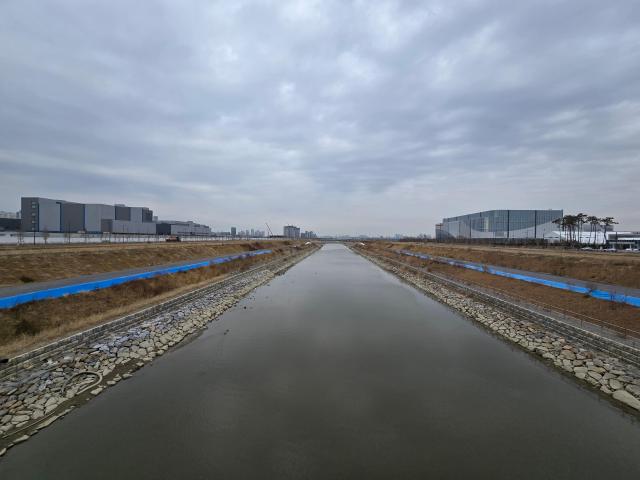
The neighborhood is already home to familiar names Samsung Biologics and Celltrion.
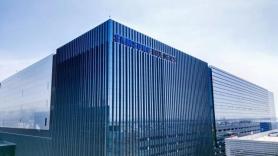
Just across the street, a new blue-striped Samsung Biologics building under construction – fifth on the second campus compound - stands on one side of an unfinished waterway.
Half-built roads and empty lots give little hint that this corner of Songdo is the front line of the country's contract drugmaking race.
Group Chairman Shin Dong-bin attended the completion ceremony for Plant 1 at the Lotte Biologics Songdo Bio Campus with his eldest son, Shin Yoo-yeol, the unit's co-CEO. The 120,000-liter antibody plant, begun in March 2024, runs eight 15,000-liter stainless steel bioreactors alongside smaller units. dealsite
The plant reached "GMP Ready" status this month, six months ahead of the original target, CEO James Park told reporters, meaning it is prepared to make drugs under global manufacturing and quality standards.
A day earlier, Lotte announced the plant's first large-scale commercial order, from a global drugmaker it declined to name, covering everything from clinical drug substance to finished product.
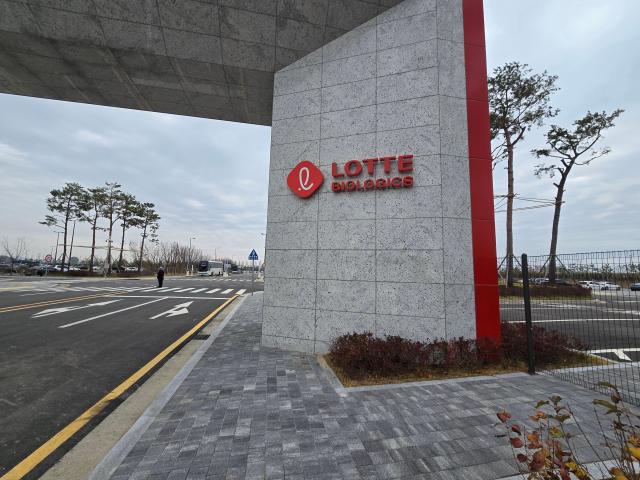
Production has begun with batches needed for regulatory approval, Chief Financial Officer Kang Hyun-shim said. Revenue will start in 2027, with commercial-scale production expected in 2028.
At full capacity, Plant 1 can generate about 700 billion won ($525.4 million) a year, Chief Growth Officer Chun Ji-won said.
With about 300 billion won from its U.S. plant, that would put Lotte near its target of more than 1 trillion won in revenue by 2030.
Syracuse is running far below capacity. It produced seven of a possible 45 batches in the first half, regulatory filings show, a 16 percent utilization rate, down from 74 percent in 2025 as BMS volumes ended. First-half revenue fell 73 percent from a year earlier to 23.9 billion won. The company said an unannounced U.S. Food and Drug Administration inspection of the site in September found no issues.
Lotte Group has put about 1.5 trillion won into the unit through seven capital increases. It plans three 120,000-liter plants in Songdo at a total cost of about 4.6 trillion won, with the timing of Plants 2 and 3 dependent on orders.
Across the water, Samsung Biologics has been building since 2011. It runs five Songdo plants with 785,000 liters of capacity, plus a 60,000-liter plant in Rockville, Maryland, bought from GSK this year, for a total of 845,000 liters. Its third-quarter revenue rose 18.5 percent from a year earlier to 1.49 trillion won.
Asked why a drugmaker would pick Lotte over its neighbor, Chun said clients often spread work across several CDMOs, matching each project to the right scale. "Once a CDMO grows past a certain level of revenue, it builds an operating framework, and that makes it less flexible for individual clients," she said. "As a latecomer, we can meet customer needs faster."
Lotte is targeting biosimilar makers, antibody-drug conjugate developers and Japanese drugmakers, Chun said, adding that Japanese firms prize long-built trust and the group can draw on its long-standing ties with Japan.
A stock market listing is not yet on the calendar. Kang said an IPO needs a clear rationale and that its timing will depend on future orders and the product pipeline. "We are heading toward making that dream come true," Chief Business Officer Park Min-soo said in English when asked about investor interest.
The waterway between the two campuses is still under construction. The 685,000-liter gap in their total capacity will take longer to close.
Kim Dong-young
Kim Dong-young is a bilingual journalist at AJU Press (AJP), covering Korean tech, energy, and bio/pharma.
He reports from the field at events like CES and APEC, runs AJP's YouTube channels,
and is pursuing a master's at Sogang's MOT program.
Copyright ⓒ Aju Press All rights reserved.
Related News
-
 Lotte Biologics Secures First Major Commercial Production Order for Songdo Plant
Lotte Biologics has secured its first major commercial production order ahead of the completion of its first plant in Songdo, Incheon. By securing customers before the factory is completed, the company has established a foundation for generating revenue from the start of operations.Lotte Biologics announced on the 17th that it has signed a contract for contract manufacturing organization (CMO) services with a global pharmaceutical company. This order marks the first large-scale commercial production to be carried out at the Songdo Bio Campus's first plant. The names of the customer and the product, as well as the scale of the contract, were not disclosed due to confidentiality agreements. Lotte Biologics will provide a 'one-stop service' for the customer's main products, handling everything from the production of clinical raw materials to finished pharmaceuticals.With this contract, the Songdo first plant will fill the necessary volume for initial operations after its completion. In the contract development and manufacturing organization (CDMO) industry, it is common to pursue significant orders only after the factory is fully constructed. Lotte Biologics emphasizes the significance of attracting major customers from the design and construction phase, thereby reducing this gap.The Songdo first plant features a production facility with a capacity of 120,000 liters, equipped with eight stainless steel bioreactors of 15,000 liters each. The goal is to commence full-scale commercial production next year. The company is expanding its supply chain with a 'dual site' strategy that combines the commercial production experience from its Syracuse Bio Campus with the large-scale production capabilities in Songdo. The Syracuse campus has received over 62 regulatory approvals and has not received any issues during recent inspections by the U.S. Food and Drug Administration (FDA). The company plans to apply this quality management system to the Songdo facility as well.James Park, CEO of Lotte Biologics, stated, "This contract demonstrates that Lotte Biologics is positioning itself as a key supply chain partner for global customers, moving beyond being a mere new entrant in the CDMO sector. We will actively support our customers' successful commercialization of new drugs based on our accumulated quality competitiveness and stable supply capabilities."Meanwhile, Lotte Biologics will hold a completion ceremony for the Songdo first plant on the 18th. With the combined production capacity of the Syracuse plant, which will increase to 160,000 liters, securing orders to support this capacity is expected to be a prerequisite.However, the company's performance continues to be lackluster. Lotte Biologics reported third-quarter revenues of 48.5 billion won and a quarterly net loss of 184.9 billion won. Compared to the same period last year, revenues decreased by 68.61%, and the net loss widened from 60.4 billion won.* This article has been translated by AI.
-
Lotte Biologics wins first large-scale commercial order
SEOUL, November 17 (AJP) - Lotte Biologics has signed a contract manufacturing deal with a global pharmaceutical company, its first large-scale commercial production order, the company said Tuesday. It did not name the client and kept the product, contract value and location confidential under the deal’s terms. The order lands before the company’s first plant in Songdo, Incheon, is finished. The 120,000-liter facility has eight 15,000-liter stainless steel bioreactors and is set to begin full operations next year. “Unlike the industry practice of ramping up orders after a plant is completed, we brought in a major client at the design and construction stage, securing a stable revenue base,” a company official said. Lotte Biologics plans to combine its commercial manufacturing experience at its Syracuse campus in the United States with Songdo’s capacity to grow its contract development and manufacturing business. Tags: Lotte Biologics, Syracuse, United States, Bioreactors, Songdo, Incheon, Pharama, CDMO, Samsung Biologics
-
 Samsung Biologics secondary share sale draws $8 billion
Samsung Biologics' Plant 4 in Songdo/ Courtesy of Samsung Biologics SEOUL, November 16 (AJP) - Investors poured more than 11 trillion won ($8.23 billion) into the public tranche of Samsung Biologics' rights offering, which will fund South Korea's biggest-ever drug industry takeover, the company said Monday. Orders for about 9.75 million shares chased just 71,854 shares in the two-day offering that ended Friday, a subscription ratio of 135.6 to 1. An investor had to put up about 160 million won in deposits to secure a single share at the final price of 1,174,000 won. Deposits totaled 11.44 trillion won, the most ever for a Korean rights issue that went on to a public offering, the company said. As of 11:00 a.m. Monday, shares were 0.57 percent lower at 1,404,000 won. Existing shareholders and employees had already taken up 96.8 percent of the 2.27 million new shares, with major shareholders Samsung C&T and Samsung Electronics subscribing in full. The sale will raise 2.67 trillion won, short of the 3 trillion won targeted in August, because the final price came in below the indicative 1,322,000 won. All of the money goes toward PolyPeptide Group, the Swiss peptide producer Samsung Biologics agreed in July to buy for 1.46 billion Swiss francs ($1.8 billion). The deal takes the contract drug manufacturer beyond antibodies, messenger RNA and antibody-drug conjugates into peptides, the building blocks of popular obesity and diabetes drugs. "We launched this rights offering to lay the groundwork for our leap to become a global top-tier CDMO," Chief Executive John Rim said in August. PolyPeptide runs six production sites in the United States, Europe and India. Holders of 97.98 percent of its shares accepted a recent tender offer, and Samsung Biologics plans to squeeze out the rest. Payment for the new shares is due Tuesday, and the shares are set to list Nov. 30.