
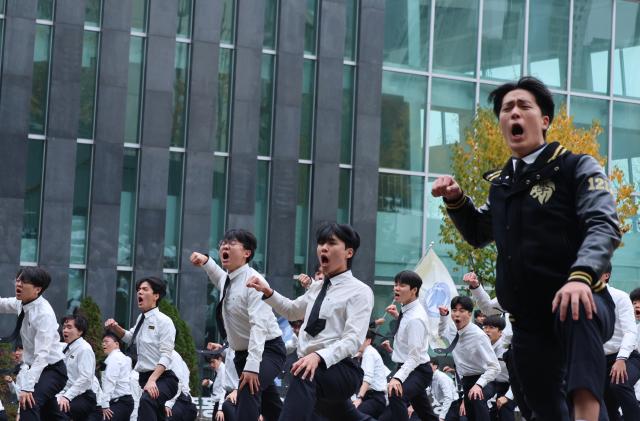
Glasses will be inspected. Phones will be surrendered. Clothing buttons will be covered with stickers. Black pencils are the only writing tools students may bring.
And at 8:30 a.m. Thursday, 10 minutes before the exam begins, every phone switched on in the country will blare an emergency alert designed to expose any device a candidate failed to hand in.
“All this fuss is just making everyone so nervous. Parents are getting all different information and guidelines,” said Oh Eun-ji, 51, a Seoul resident whose daughter at Chungdam High School will sit the College Scholastic Ability Test (CSAT), known as suneung.
“I have to double-check my daughter’s wardrobe and have her wear contact lenses instead of eyeglasses tomorrow to lessen her stress before sitting down for the test.”
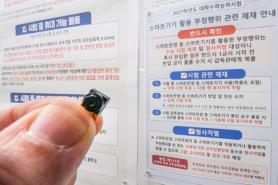
The crackdown follows a scandal over electronic devices in the national tax accountant exam, in which a test-taker came forward as an AI cheat after earning a near-perfect score.
This year’s students are bearing the collateral damage, and the sarcasm has spread as fast as the rules. Must South Korea follow India, some asked online, sharing a decade-old photo of military recruitment applicants taking an exam outdoors in their underwear?
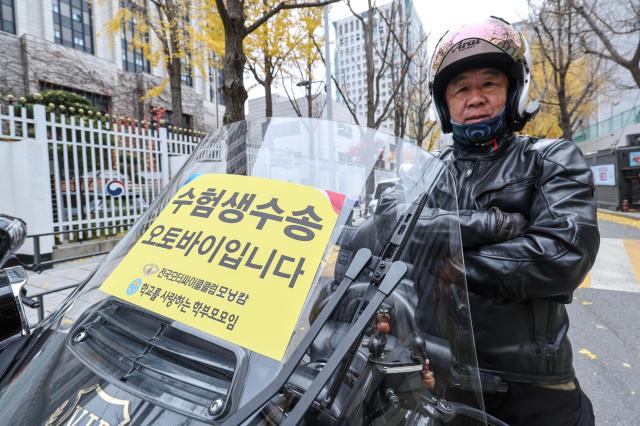
The alert reaches furthest. The Ministry of Education and the Ministry of the Interior and Safety said Wednesday that a first message will go out at 8:30 a.m., with another to follow without warning. It cannot be blocked and will sound at maximum volume for 10.5 seconds on every phone that is on, including those of foreign residents, with English text included.
“This is a message to prevent cheating on the CSAT,” the unannounced alert will read. “Please do not be alarmed and carry on with your daily lives.” The government said supervisors’ phones will be kept from sounding in exam rooms and that testing will not be disrupted.
The stationery rule landed just as abruptly as prior improvised measures.
Under an emergency notice issued Wednesday, computer-marking pens, correction tape, erasers and mechanical pencil leads, all previously allowed, will instead be handed out at test centers. The ministry said the change is meant to block miniature cameras and communication devices disguised as ordinary stationery.
Candidates who bring the banned items must leave them in bags outside the classroom. Anyone caught merely holding one during the exam will have it confiscated and examined for possible cheating.
Inside the rooms, supervisors will put stickers over clothing buttons to block concealed cameras. Students must place their glasses on their desks for inspection, roll up their sleeves and submit to checks of collars, wristwatches and other accessories. The ministry urged candidates to wear buttonless clothes and skip necklaces, rings and hats.
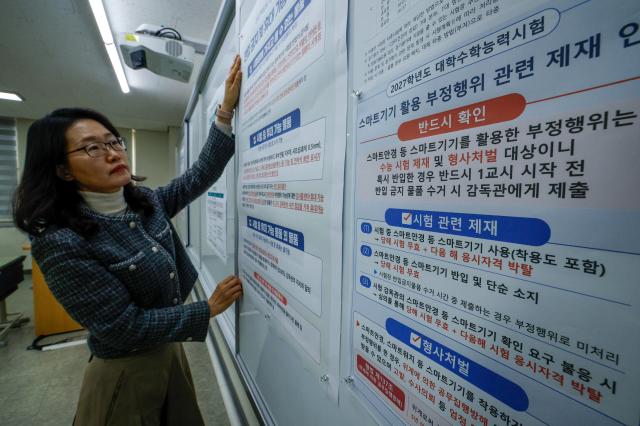
Test centers are struggling to keep up. Some schools had to find thousands of stickers on their own because none were centrally supplied, while newly recruited corridor supervisors were scheduled for online training Wednesday afternoon. Teachers’ groups questioned whether every button and accessory can be checked in the limited time without unsettling candidates.
At Eunpyeong High School in Seoul, teacher Cho Min-jin rushed to explain the new rules. “We prepared signature pens, correction tape and erasers as gifts to cheer the students on, but now they can’t be used,” she said.
Underscoring the gravity of the matter, President Lee Jae Myung, chairing an emergency video meeting from the Philippines on Tuesday, called exam cheating a “serious crime” that undermines fair competition and public trust.
“The fairness and credibility of the CSAT must never be shaken,” he said, demanding zero tolerance and investigations into suspected uploads of exam papers to AI services.
Lee ordered a review of whistleblower rewards of at least 100 million won [$750,000) for reporting sophisticated cheating and called for legislation requiring AI companies to hand over records relevant to suspected exam fraud.
The ruling Democratic Party is pursuing special legislation that would extend the one-year ban on retaking the CSAT to as long as 10 years for AI-assisted cheating. It also wants tougher penalties to apply to offenses at this year’s exam. The proposals are not yet law.
Online, jokers posted jackets covered in dozens of buttons, picturing supervisors spending the whole exam applying stickers, while others proposed handing candidates buttonless T-shirts. One AI-generated image showed Seoul’s Yongsan electronics district celebrating dozens of admissions to Seoul National University.
For ordinary students and parents, the well-wishing cheers and prayer rituals went on.
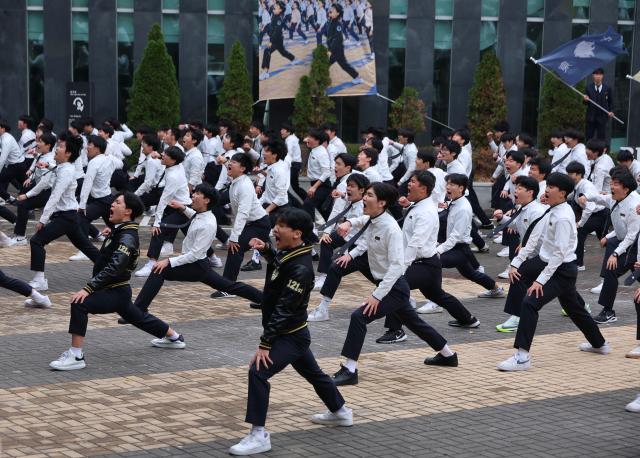
“I studied more than seven hours a day, so it’s a relief to think it ends tomorrow,” said Jungang senior Kim Min-jun, laughing. “It’s noisy because of AI, but that actually makes me less nervous.”
Oh Jun-young, a senior at Eunpyeong High, was just as unmoved. “I’m worried about the AI issue, but I won’t let it get to me,” he said. “I’ll take the test the way I always have.”

Aircraft takeoffs and landings will halt from 1:05 p.m. to 1:40 p.m. during the English listening test, affecting 130 domestic and international flights. The military will suspend noisy drills, artillery fire and aircraft operations near test centers, and more than 10,000 police officers will guard exam materials and support transportation.
This is the last CSAT under the current elective-subject system before a major overhaul in 2028. Total applicants fell by 2,310 from last year, but the 196,473 graduates and equivalency certificate holders among them are the most in 23 years, sharpening the competition.
The exam begins at 8:40 a.m. Thursday as scheduled.

Joonha Yoo
Joonha Yoo is a bilingual journalist at AJU Press (AJP), covering music, culture, entertainment and Korea’s automotive industry.
Raised in Fort Collins, Colorado, he often writes from the scene, bringing firsthand detail to stories ranging
from BTS comeback concerts to unique cultural events that catch the world's eye.
Copyright ⓒ Aju Press All rights reserved.
Related News
-
 Korea clamps down on AI cheating ahead of CSAT
A participant wearing smart glasses looks over a practice test paper during a hands on training session ahead of South Korea's college entrance exam. Courtesy of Seoul Metropolitan Office of Education SEOUL, November 17 (AJP) - Every test-taker’s glasses will be inspected and every phone collected before the first bell of Thursday’s national college entrance exam, Prime Minister Han Seong-sook said Tuesday, as South Korea moves to seal off AI-assisted cheating. Mobile phones and all other electronic devices will be switched off, collected and held at each site’s exam headquarters until the College Scholastic Ability Test (CSAT) ends, Han said in a national address at the Government Complex Seoul. Test-takers’ bags will be left in hallways outside classrooms. An emergency alert text will also be sent before the exam starts to expose any phones not handed in, with extra supervisors posted in hallways. “All test-takers will put their glasses down on their desks, and supervisors will check every pair for smart glasses,” Han said. Stickers will cover every button on test-takers’ clothing, and candidates will roll up both sleeves and have their collars checked for hidden micro-cameras. Glasses will be screened again while worn in every period, and all belongings will be re-inspected during an identity check before the third period. About 75,000 supervisors will be stationed across 1,312 test sites nationwide, reinforced this year by about 8,400 additional staff, including about 1,800 smart-device specialists and about 6,600 hallway monitors. A notice warning of penalties for cheating with smart devices is displayed behind commercially available miniature cameras at an exam venue inside Yeongdeungpo Girls’ High School in Seoul on November 16, 2026, three days before South Korea’s national college entrance exam for the 2027 academic year. AJP Yoo Na-hyun Global tech giants have agreed to cooperate with post-exam investigations into suspected cases of test pages being photographed and fed to AI. Cheaters will be barred from the exam for 10 years instead of one, and those admitted to universities through cheating will have their admissions revoked, Han said. Repeat test-takers already enrolled at universities will be expelled. “We will not stop investigating cheating and holding people accountable even after the exam is over,” she said. The measures follow a confession by Han Won-seok, 34, the top scorer on this year’s tax accountant exam, that he photographed questions with a miniature camera, fed them to an AI program and read the answers on a smartphone. He answered 159 of 160 first-round questions correctly in April.
-
 Jogyesa Temple bustles 10 days ahead of CSAT
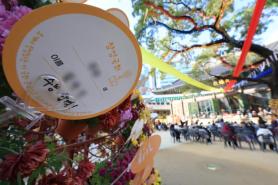
AJP Han Jun-gu Wish notes inscribed with messages hoping for good scores hang at Jogyesa Temple in Jongno-gu, Seoul, 10 days before the 2027 College Scholastic Ability Test (CSAT), November 9, 2026.
-
 Jogyesa Temple bustles 10 days ahead of CSAT
AJP Han Jun-gu A Buddhist prays at Jogyesa Temple in Jongno-gu, Seoul, 10 days before the 2027 College Scholastic Ability Test (CSAT), November 9, 2026.