
Strong earnings from the U.S. chip giant offered a glimmer of hope to investors battered by the selloff, although doubts over the future of artificial intelligence (AI) spending continued to cloud the recovery.
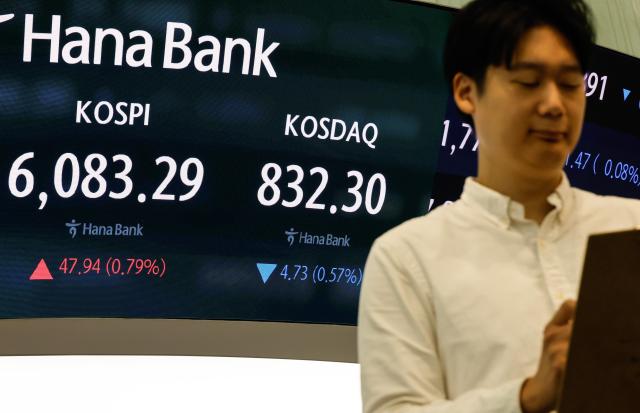
The KOSPI rose 1.83 percent to 5,059.34 as of 10:21 a.m., up from Tuesday's close of 4,968.48. The junior KOSDAQ gained 2.02 percent to 663.21. By midday, it gave up much of the gains as foreigners turned to sellers.
Foreign investors purchased a net 269.6 billion won ($201 million) of KOSPI shares in earlier session. Retail investors and institutions sold a net 260.8 billion won and 104 billion won, respectively.
On the KOSDAQ, foreign investors and institutions bought a net 45.5 billion won and 78.8 billion won, respectively, while retail investors sold 117.1 billion won.
SK hynix gained 5.01 percent to 1,153,000 won, while Samsung Electronics rose 2.79 percent to 195,600 won as of 10:18 a.m. SK Square gained 5.15 percent and Samsung Electro-Mechanics climbed 7.43 percent, although Samsung Biologics, KB Financial Group and Celltrion traded lower.
The rebound followed a bruising four-day losing streak that sent the benchmark index below 5,000 for the first time in more than nine months. The index plunged 3.59 percent Monday and another 2.59 percent Tuesday, with foreign investors selling a net 1.56 trillion won ($1.16 billion) of shares in the latest session despite buying by retail and institutional investors.
Even as stocks tumbled, South Korean retail investors were betting that the worst was over.
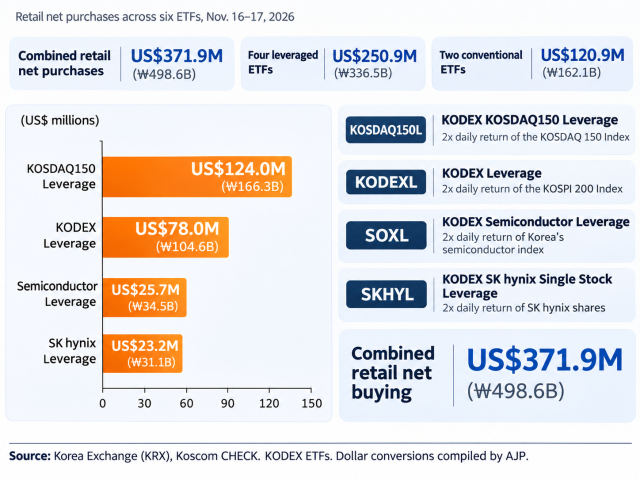
Individuals poured a net 336.5 billion won ($251 million) into four major leveraged exchange-traded funds (ETFs) on Monday and Tuesday, according to the latest available data from Korea Exchange (KRX) and Koscom CHECK.
The biggest inflows went to KODEX KOSDAQ150 Leverage, which tracks twice the daily return of the KOSDAQ 150 index, attracting 166.3 billion won. KODEX Leverage, which does the same for the KOSPI 200, followed with 104.6 billion won.
Investors also bought 34.5 billion won of KODEX Semiconductor Leverage, which doubles the daily return of the country’s semiconductor index, and 31.1 billion won of KODEX SK hynix Single Stock Leverage, which targets twice SK hynix's daily return, betting on a recovery in battered chip shares.
Including conventional KOSPI 200 and KOSDAQ 150 ETFs, retail purchases totaled 498.6 billion won across six funds over the two days, as domestic investors bet on a rebound despite heavy foreign selling.
Those bets gained some support from Nvidia's latest earnings report. The chipmaker reported fiscal third-quarter revenue of $115.8 billion, up 103 percent from a year earlier and above Wall Street's forecast of roughly $109 billion. Adjusted earnings reached $2.68 per share, beating expectations of $2.47.
The company also projected fourth-quarter revenue of $126 billion to $134 billion, exceeding Wall Street expectations of about $125 billion, and offering some reassurance that demand for AI computing infrastructure remains strong despite growing concerns over slowing investment.
The results helped ease concerns about AI spending, but questions remain over whether slower investment could eventually weaken demand for AI chips and high-bandwidth memory (HBM).
"Weaker forecasts for future AI spending can no longer be dismissed as noise," an analyst at Yuanta Securities said, warning that slowing investment growth could eventually weigh on semiconductor earnings.
Still, the analyst cautioned against assuming that slower investment growth in 2028 would hurt semiconductor earnings in 2027. Data-center projects already underway and long-term memory supply contracts could help support demand in the nearer term.
The recovery extended to the junior board, led by a sharp rise in robotics shares. Rainbow Robotics, a maker of collaborative and humanoid robots, surged 13.72 percent, while battery materials group EcoPro and its cathode materials subsidiary EcoPro BM gained 1.48 percent and 1.30 percent, respectively. Biotechnology firm Alteogen also rose 1.68 percent as of 10:09 a.m.
Several major events could still test the rebound. Minutes from the U.S. Federal Reserve's latest policy meeting are due early Thursday in Korea, while AI developer Anthropic is expected to make its Nasdaq debut the same day.
Reports that Anthropic's final IPO price could exceed the top of its proposed $70-to-$78 range have added to optimism about investor demand for AI-related companies, although the listing could also draw funds away from existing technology stocks.
Meanwhile, the Asia-Pacific Economic Cooperation (APEC) leaders' summit begins Wednesday in Shenzhen, China, with investors watching for any signs of progress in U.S.-China trade relations, particularly over chip export restrictions.

Ryu Yuna
Yuna Ryu covers finance, capital markets and Southeast Asian affairs.
She is drawn to the questions that numbers raise and the stories that data alone cannot answer.
Prior to journalism, she worked at Hyundai Motor Company and the Singapore Chamber of Commerce, focusing on business strategy and international affairs. She has also hosted diplomatic receptions and international conferences as an MC.
Ryu holds a master's degree in Media and Communication from Korea University, where her research focused on neuroscience-based studies of media effects.
Copyright ⓒ Aju Press All rights reserved.
Related News
-
 KOSPI Listed Companies' Cumulative Operating Profit Soars 264% in Q3
Listed companies on the securities market reported a cumulative operating profit increase of 264% in the third quarter of this year compared to the same period last year. Samsung Electronics and SK Hynix led the overall performance improvement, while the operating profit of companies excluding these two also increased by over 60%.According to the '2026 Q3 Financial Results of December Settlement Corporations' released by the Korea Exchange on November 18, the cumulative sales of 635 companies analyzed under consolidated financial statements from January to September this year reached 3,018.9 trillion won (KRW), marking a 31.29% increase from the previous year.During the same period, operating profit surged to 638.28 trillion won (KRW), up 264.39%, while net profit skyrocketed to 553.83 trillion won (KRW), an increase of 272.65%. The operating profit margin on sales rose from 7.62% during the same period last year to 21.14% this year, a jump of 13.53 percentage points.The performance improvement was significantly influenced by Samsung Electronics and SK Hynix. The cumulative consolidated sales of these two companies amounted to 737.14 trillion won (KRW), accounting for 24.42% of the total sales analyzed. Their operating profit reached 435.65 trillion won (KRW), representing about 68.3% of the total.However, even excluding these two companies, the performance improvement was evident. The cumulative sales of listed companies excluding Samsung Electronics and SK Hynix increased by 14.35% year-on-year, while operating profit rose by 63.94% and net profit surged by 94.86%.By sector, the electrical and electronic industries showed remarkable growth. Based on individual financial statements, the cumulative sales of the electrical and electronic sector increased by 125.69% compared to the same period last year, with operating profit and net profit soaring by 1,001.15% and 598.76%, respectively.In contrast, the operating profit of the electrical and gas sector decreased by 44.50%, and the transportation equipment and parts sector saw a decline of 19.80%, indicating performance disparities among sectors.In the standalone Q3 results, a decrease in net profit was confirmed. The consolidated sales for Q3 reached 1,070.06 trillion won (KRW), a 2.32% increase from the previous quarter, and operating profit also grew by 10.55% to 253.78 trillion won (KRW). However, net profit fell to 169.61 trillion won (KRW), down 30.41%.The proportion of profitable companies also slightly decreased. In Q3, 492 companies reported a cumulative net profit, accounting for 77.48% of the total. This was a decrease of six companies from 498 in the same period last year. Loss-making companies numbered 143, representing 22.52% of the total.The financial sector also showed signs of performance improvement. The consolidated operating profit of the financial sector increased by 19.46% year-on-year, while net profit rose by 15.59%. Notably, the securities industry recorded the highest growth rates in the financial sector, with operating profit and net profit increasing by 95.72% and 80.53%, respectively.This analysis excluded the financial sector, newly established, split, and merged corporations, as well as companies with adverse audit opinions, and the financial sector's consolidated results were compiled separately.* This article has been translated by AI.
-
KOSPI rebounds above 5,000
SEOUL, November 18 (AJP) - South Korea's benchmark KOSPI opened 2.62 percent higher at 5,098.82 on Wednesday, reclaiming the 5,000-point mark after four consecutive sessions of losses. As of 9:02 a.m., the index was trading at 5,082.81, up 2.30 percent from the previous close. The tech-heavy KOSDAQ also opened 2.29 percent higher at 664.93 before easing to 662.92. The rebound followed Tuesday's sharp sell-off, which saw the KOSPI plunge 2.59 percent to close at 4,968.48. Tags: South Korea, KOSPI, KOSDAQ, Stock Market, Korean Stocks, Korea Exchange, KRX, Financial Markets, Market Rebound, Equities, Investment, Economy
-
NVIDIA Risks Weigh on South Korean Stock Market as KOSPI Falls Below 5000
◆Aju Economy Major News▷South Korean Stock Market Struggles with NVIDIA Risks as KOSPI Falls Below 5000 for the First Time in 288 Days- Concerns over the collapse of the AI investment ecosystem stemming from NVIDIA and the U.S. measures to block indirect exports of AI semiconductors to China contributed to the KOSPI's 2.59% drop, closing at 4968.48 on November 17, marking the first time in 288 days that it fell below the 5000 mark.- In the securities market, foreign investors sold a net 1.45 trillion won (KRW) for three consecutive trading days, while individuals and institutions bought a net 421.8 billion won (KRW) and 543.6 billion won (KRW), respectively.- The KOSDAQ also closed down 2.34% at 650.06, with both foreign investors and institutions selling, while individuals were net buyers.- Following uncertainties related to Jensen Huang, the KOSPI recorded the largest decline among major global stock markets over the past 20 days, with a market capitalization decrease of approximately 900 trillion won (KRW), indicating vulnerability to external factors.- The domestic stock market is expected to remain volatile until NVIDIA's earnings announcement and the IPO of Anthropic, with market participants citing NVIDIA's AI investment strategy and the success of Anthropic's IPO as key variables for a rebound.◆Major Reports▷Reflections on Recent Outperformance of Defensive Stocks - Over the past three months, defensive stocks such as consumer staples and healthcare have shown strong performance in the U.S. stock market, recording double-digit returns, but their earnings growth rates of 5% and 13%, respectively, fall significantly short of other sectors (46%).- The strong performance of defensive stocks is attributed to three factors: demand to reduce the high volatility of tech and high-beta stocks, short covering of defensive stocks due to the liquidation of tech stock positions, and concerns over economic and corporate profit downturns.- The 52-week relative return of consumer staples and healthcare has risen to levels seen during past economic downturns and bear markets, indicating that for further gains, a serious downturn in actual economic conditions and corporate profits must be supported.- The peak of earnings growth rates for tech stocks and the decline in corporate profits are separate issues, and current analyses suggest that the likelihood of profit declines materializing in the near term is low given the current corporate profit structure.- For the recent strength of defensive stocks to be justified, corporate profits need to decline starting in the first half of next year; however, if profit growth continues into early next year, the excessive preference for defensive stocks in the second half could quickly reverse.◆Major Announcements After Market Close (November 17)▷Suprema HQ Designated as a Short Selling Overheated Stock▷Hwashin Precision Designated as a Short Selling Overheated Stock▷Purontier Designated as a Short Selling Overheated Stock◆Fund Trends (As of November 16, Excluding ETFs)▷Domestic Equity: +16.2 billion won (KRW)▷Overseas Equity: +8 billion won (KRW)◆Key Schedule for Today (November 18)▷United Kingdom: Consumer Price Index (October)▷Eurozone: Consumer Price Index (October Final)▷United States: Housing Starts, Building Permits (October), Pending Home Sales (October)* This article has been translated by AI.