
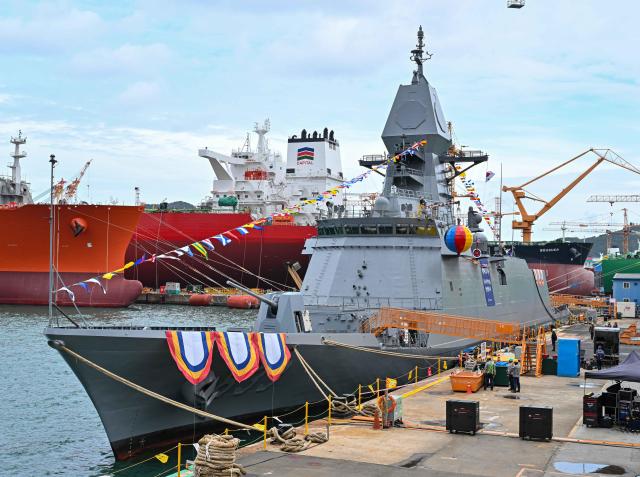
The Navy and the Defense Acquisition Program Administration (DAPA) will hold a launching ceremony at Hanwha Ocean's Okpo shipyard in Geoje, South Gyeongsang Province.
The Pyeongtaek (FFG-833) is the fifth Ulsan-class Batch-III frigate, following the Chungnam, Gyeongbuk, Jeonnam and Jeju. The vessels are designed to replace the Navy's aging frigates and patrol combat corvettes.
The vessel is named after Pyeongtaek, a city in Gyeonggi Province that is home to the Navy's Second Fleet Command.
It is the second South Korean naval vessel to bear the name. The first Pyeongtaek (ATS-27), a former U.S. Navy rescue and salvage ship, entered South Korean service in 1996 and retired in December 2016 after about two decades of service.
Measuring 129 meters in length and 14.8 meters in width, the second Pyeongtaek is equipped with a domestically developed combat management system, sensors and weapons.
One of its most notable features is an integrated sensor mast (ISM), which incorporates a four-sided fixed multifunction phased-array radar and an infrared search and tracking system.
Similar to radar systems used on Aegis-equipped warships, the new radar can detect and track aerial and surface targets in all directions and engage multiple aerial threats simultaneously.
While the previous Batch-II frigates focused on improving anti-submarine warfare capabilities, the Batch-III vessels are designed to strengthen air defense capabilities while retaining the anti-submarine capabilities of their predecessors.
The new frigate also features a hybrid propulsion system designed to minimize underwater noise, making it more difficult for enemy submarines to detect.
Its weapons include a five-inch naval gun, the Korean Vertical Launching System (KVLS), anti-ship missiles, tactical ship-to-land missiles and long-range anti-submarine torpedoes.
"The Pyeongtaek is a state-of-the-art frigate incorporating advanced domestic technologies, demonstrating the strength of our defense technology and shipbuilding capabilities," said Jung Jae-jun, a senior DAPA official.
"We expect these proven technologies to contribute significantly to future defense exports."
The Pyeongtaek is scheduled to be delivered to the Navy in December 2027 following sea trials. It will enter operational service after completing further preparations.

Kim Hee-su
Kim Hee-su is a bilingual reporter at AJU Press, covering defense and foreign affairs. Before joining AJP in 2025, she worked at The Korea Times, where she wrote interview stories, including a profile of North Korean defector Kim Gum-hyok, and produced digital content. She also previously worked as a researcher for KBS News 9’s International News Department, supporting correspondents in 10 countries around the world. She graduated from the University of Toronto in Canada with a double major in Book and Media Studies and East Asian Studies.
Copyright ⓒ Aju Press All rights reserved.
Related News
-
 Samsung Expands AI Semiconductor Production in Pyeongtaek and Onyang
Samsung Electronics held a groundbreaking ceremony on November 12 at its Onyang campus in Asan, South Chungcheong Province, for a fifth line dedicated to high-bandwidth memory (HBM) packaging. This facility will serve as a post-processing hub connecting increased HBM DRAM production in Pyeongtaek to a new fab in Gwangju.According to political and industry sources on November 12, Samsung chose Onyang due to its long history of semiconductor assembly and testing since 1991. Nearby Cheonan already has HBM and wafer-level packaging (WLP) production facilities, allowing for the concentration of technology and workforce needed to turn processed wafers into market-ready products.A prime example of this division of labor is HBM4, which combines 10-nanometer sixth-generation (1c) DRAM for data storage with a 4-nanometer logic base die for signal control. The packaging line is where chips produced in memory and foundry processes come together as a single product. Industry experts believe that even with increased DRAM production in Pyeongtaek, the facilities for stacking and testing chips must be able to handle the volume to meet customer demand for HBM. This is why investments in front-end processes in the metropolitan area align with post-processing investments in South Chungcheong.The main facilities in the metropolitan area also have distinct roles. In Giheung, next-generation processes are being developed and validated before mass production, with Samsung planning to invest 20 trillion won in this research and development complex by 2030. Hwaseong hosts a DRAM production line and a foundry utilizing extreme ultraviolet (EUV) lithography technology, while Pyeongtaek is responsible for mass production of memory and advanced foundry products. Notably, Pyeongtaek's fourth line is expanding its production capacity for the 1c DRAM used in HBM4.The timelines for expansions in Pyeongtaek and Onyang are also synchronized. Samsung plans to fully operationalize the fifth line in Pyeongtaek's second complex as a core hub for HBM production by 2028. The Onyang fifth line, which broke ground on the same day, aims to begin operations by June 2028, a year earlier than initially planned. Samsung clarified that the 46 trillion won investment in Onyang is not just for the construction of one building but for establishing five HBM production lines on the campus, with 40 trillion won allocated for equipment.The next expansion for front-end processes in the metropolitan area will take place in Yongin. Samsung plans to gradually build six fabs in the advanced system semiconductor national industrial complex, with the first production line expected to start operations in October 2029. Investments in the Honam region are seen as a longer-term strategy. In June, Samsung announced a 400 trillion won investment to construct two new fabs in Gwangju. At that time, the vice chairman noted that with the Pyeongtaek facility nearing completion and the Yongin national industrial complex investment schedule accelerating, the preparation for the new site was being expedited.The fabs in Gwangju will serve as front-end production facilities for creating circuits on wafers. If Samsung's plans proceed as intended, the space for chip production will expand from southern Gyeonggi Province into Honam. Meanwhile, in South Chungcheong, existing facilities will be leveraged to enhance both the scale and capabilities of advanced post-processing. Cheonan will modernize and expand its HBM-related facilities, while Onyang will shift its focus from general semiconductor assembly and testing to high-performance memory stacking. Industry observers believe that the significance of South Chungcheong lies not just in its geographical position between the two regions but in the transformation of the products completed there.Lee Jae-yong, Vice Chairman of Samsung Electronics, emphasized at the groundbreaking ceremony, "Samsung Electronics will take on greater responsibility and actively promote mega-projects in Chungcheong, Honam, and Yeongnam for the irreplaceable success story of South Korea."* This article has been translated by AI.
-
Vehicle Fire in Geumgwang 1 Tunnel on Pyeongtaek-Jecheon Expressway
A vehicle fire occurred in the Geumgwang 1 Tunnel on the Pyeongtaek-Jecheon Expressway.On November 12, the Korea Expressway Corporation announced via a safety disaster message that "traffic is fully blocked in the direction of Jecheon from Namansung IC to Namansung JCT (40.6 km) due to the vehicle fire in the Geumgwang 1 Tunnel." They urged drivers to check real-time traffic information and use alternative routes.The exact cause of the fire has not yet been determined.* This article has been translated by AI.
-
Pyeongtaek Apartment Prices Surge 40% Amid Upcoming 5,700 Units
Pyeongtaek Apartment Prices Surge 40% Amid Upcoming 5,700 UnitsIn Pyeongtaek, new apartments in the Jije and Goddeok areas are seeing record-high transactions. A 64.94 square meter unit at the Jije Station The Sharp Central City has increased from 600 million won last November to 845 million won this month, marking a 40.8% rise in about 11 months. Transactions exceeding previous highs have also been reported at the Pyeongtaek Jije Station Xi and Goddeok Jeil Pungkyungchae 3rd Centum, as well as Hills State Goddeok Sky City. However, with 5,711 units across four major complexes set to be completed in the first half of next year in the Gajwa and Brain City areas, the extent to which the market can absorb this large supply, especially with some pre-sale rights trading at a negative premium of 70 to 80 million won, will be a critical test for the recovery of Pyeongtaek's housing prices. Seoul Plans to Add 100 Moa Towns, But Local Opposition GrowsThe Seoul city government plans to designate 100 additional Moa Town sites by 2030, aiming to establish a foundation for approximately 80,000 housing units. However, existing projects are facing reductions in designated areas due to local opposition. In the Beondong 4 area of Gangbuk District, four out of five planned zones—A-1, A-2, A-4, and A-5—have already been excluded. The only remaining zone, A-3, may also be withdrawn based on the results of a re-survey of resident opinions. Residents cite concerns over additional costs, relocation burdens, and decreased rental income as reasons for their opposition. To prevent similar conflicts, the city has raised the required agreement rate for new proposals from 30% to 60%. Seoul Officetel Purchases Drop 21.6%, Yet Mid-Sized Units Rise 8.9%In September, individual purchases of officetels in Seoul fell to 581 transactions, a 21.6% decrease from 741 in the same month last year. However, transactions for units sized between 40 and 60 square meters increased from 90 to 98, reflecting an 8.9% rise, contrary to the overall market trend. The share of officetels larger than 40 square meters in total individual purchases grew from 22.8% to 28.1%. Conversely, the most common size range of 20 to 30 square meters saw a significant drop from 326 transactions to 223, a decline of 31.6%. Price trends also varied, with the average sale price of officetels in Seoul decreasing by 0.06% for units under 40 square meters, while prices for those between 60 and 85 square meters rose by 1.07%, and those over 85 square meters increased by 1.57%, indicating a growing preference for larger units.* This article has been translated by AI.