
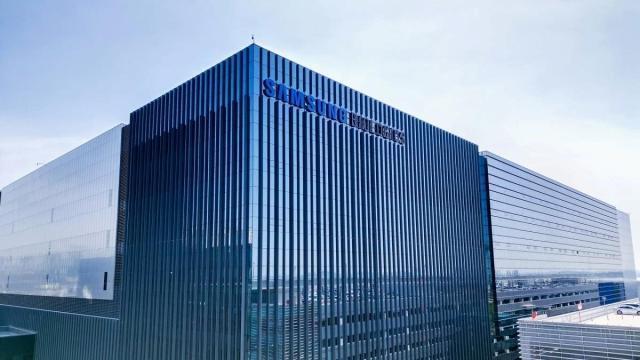
Orders for about 9.75 million shares chased just 71,854 shares in the two-day offering that ended Friday, a subscription ratio of 135.6 to 1. An investor had to put up about 160 million won in deposits to secure a single share at the final price of 1,174,000 won.
Deposits totaled 11.44 trillion won, the most ever for a Korean rights issue that went on to a public offering, the company said.
As of 11:00 a.m. Monday, shares were 0.57 percent lower at 1,404,000 won.
Existing shareholders and employees had already taken up 96.8 percent of the 2.27 million new shares, with major shareholders Samsung C&T and Samsung Electronics subscribing in full.
The sale will raise 2.67 trillion won, short of the 3 trillion won targeted in August, because the final price came in below the indicative 1,322,000 won.
All of the money goes toward PolyPeptide Group, the Swiss peptide producer Samsung Biologics agreed in July to buy for 1.46 billion Swiss francs ($1.8 billion).
The deal takes the contract drug manufacturer beyond antibodies, messenger RNA and antibody-drug conjugates into peptides, the building blocks of popular obesity and diabetes drugs.
"We launched this rights offering to lay the groundwork for our leap to become a global top-tier CDMO," Chief Executive John Rim said in August.
PolyPeptide runs six production sites in the United States, Europe and India. Holders of 97.98 percent of its shares accepted a recent tender offer, and Samsung Biologics plans to squeeze out the rest.
Payment for the new shares is due Tuesday, and the shares are set to list Nov. 30.
Kim Dong-young
Kim Dong-young is a bilingual journalist at AJU Press (AJP), covering Korean tech, energy, and bio/pharma.
He reports from the field at events like CES and APEC, runs AJP's YouTube channels,
and is pursuing a master's at Sogang's MOT program.
Copyright ⓒ Aju Press All rights reserved.
Related News
-
 AI Expands Its Territory in Film and Immersive Cinematic Experiences
Artificial intelligence (AI) is transforming not only how videos are created but also how they are experienced. Generative AI is being used to produce feature films, and it is also being integrated into the creation of ultra-high-definition immersive videos that envelop viewers. In an era flooded with convincing online videos, the new battleground is 'immersion.' The ability to capture and hold people's attention will determine the competitiveness of content.From 3 to 20 Employees... AI Feature Film Hits TheatersDirector Jung Joo-won, who created the AI feature film 'Raphael,' emphasized the importance of immersion in a recent interview. He stated, "In the future, content will evolve from a one-way viewing experience to one where audiences actively participate and engage. In an era where AI generates content in real-time, having unique characters and world-building intellectual property (IP) will allow for easier adaptation to experiential content."The influence of AI in the video sector is growing. Matteo AI Studio, the company to which Director Jung belongs, was founded by three young individuals who banded together due to concerns over production costs. Directors Jung Joo-won, Moon Shin-woo, and Yang Ik-jun completed a 16-minute short film titled 'Matteo' in 2024 using generative AI, spending only 4 million won on video production tools. This work won the grand prize at the first Korea AI International Film Festival.Now, about two years later, Matteo has grown to a production company with 20 employees and has secured corporate investment. The AI feature film 'Raphael,' which took two years to produce, is set to premiere at Lotte Cinema on the 25th. They have also signed a secondary rights contract with KT Studio Genie for distribution after the theatrical release.Two years ago, the biggest challenge with AI-generated videos was consistency. Characters would appear with different faces in various scenes, and it was difficult to create natural dialogue between two characters. However, rapid technological advancements have changed the landscape. Director Jung noted, "Now, consistency is well-maintained regardless of race, and the emergence of tools like Google's Bio and BytePlus's Sidance has shifted the paradigm this year.""We are seeing a flood of videos that look like real films. As feature production becomes possible, existing film companies are also actively adopting the technology." For instance, the American AI video platform Hixfield completed the video generation for a 95-minute feature film titled 'Hell Grind' in just about two weeks.New production companies are also growing rapidly. Director Jung mentioned, "Many production teams that started with just 2-3 people, like us, have grown into corporations. Being incorporated is advantageous for participating in government support programs or securing outsourced production contracts."However, as video generation technology becomes more standardized, the era where simply creating videos with AI garnered attention is fading. Now, the focus is on how well stories and direction can immerse audiences. Building unique characters and worlds still requires human input. The script for 'Raphael' was written by the production team, and the characters were designed through multiple revisions using Photoshop, allowing them to register copyrights after this creative process.From Three-Sided Screens to Domes... Theaters Expand Immersive ContentCJ 4DPLEX has integrated generative AI into the production of 'ScreenX,' which displays videos on three sides: the front and side walls. ScreenX does not simply stretch the existing film's screen horizontally; it requires separate video production for the periphery of each scene, demanding significant time and manpower. However, the actual production period for creating a ScreenX version of a Hollywood film is only about four weeks.Lee Jae-sun, head of the CJ 4DPLEX SX Studio production team, delivered a presentation titled 'How AI is Changing SCREENX?' at the AI Content Festival 2026, held on November 13 in Seoul. He stated, "As the business expands, the amount of content we need to produce increases, and to meet the heightened expectations of North American and European audiences, we must also elevate quality, but time is limited." To address this, CJ 4DPLEX is enhancing production efficiency by combining AI with existing visual effects (VFX). They are also developing their own platform, 'Zen AI,' to manage the production process from planning to post-production.Theaters are also evolving. CJ 4DPLEX plans to unveil an LED ScreenX theater in Yeouido, Seoul, in early December. Unlike the previous ScreenX, where the textures of the front and side walls differed, the new theater will feature a seamless screen from the front to the sides. Future plans include expanding into LED dome theaters that further envelop the audience's view.Lee cited the Sphere, a dome performance venue in Las Vegas, as an example. He remarked, "Such content and theaters can become landmarks in their regions due to their significant impact. Our vision for the future is to create immersive content in flexible and expansive spaces that go beyond traditional theater formats." They are also exploring ways to expand content areas to include live sports broadcasts and performances.Despite being a latecomer, they expressed confidence in surpassing IMAX. "We believe we have a competitive advantage over IMAX due to our accumulated production technology. We can control the theaters and are currently producing immersive content that suits us."* This article has been translated by AI.
-
Pharmaceutical Companies Compete in Drug Delivery Technology
Drug delivery technology (DDS), which replaces intravenous injections with subcutaneous injections and patches, has emerged as a new battleground in the pharmaceutical industry. Domestic pharmaceutical companies are accelerating platform development and production facility construction, targeting a market expected to grow to 700 trillion won by 2033.According to industry sources on November 15, the method of drug delivery can affect the frequency of administration, side effects, and convenience, prompting pharmaceutical companies to invest heavily in drug delivery technology development. Market growth is also anticipated. Market research firm SkyQuest predicts that the global new drug delivery system market will grow from $30.405 billion last year to $54.885 billion (approximately 735 trillion won) by 2033.Domestic pharmaceutical companies continue to invest heavily. Daewoong Pharmaceutical recently signed joint development contracts for drugs utilizing its high-concentration subcutaneous injection platform, Thermicra, and its soluble microneedle platform, Clofam. Thermicra is being developed by three companies, including Daewoong Bio, while Clofam is a collaboration between Daewoong Pharmaceutical and Daewoong Therapeutics. Thermicra technology converts antibody-drug conjugates (ADCs) previously administered via intravenous injection into subcutaneous injections. Clofam is a patch-type platform that delivers drugs through microneedles that dissolve in the skin.The company is also building production infrastructure. Daewoong Pharmaceutical plans to complete a dedicated manufacturing facility for Thermicra in Seongnam by December 2027 and aims to receive GMP approval for a microneedle dedicated sterile manufacturing facility being built at its third plant in Hwaseong in the first half of 2027. Park Sung-soo, CEO of Daewoong Pharmaceutical, stated, "This is an important stepping stone to apply next-generation drug delivery technology to various pharmaceuticals and connect it to actual product launches."Hanmi Pharmaceutical is also leveraging drug delivery technology as a competitive advantage for new drugs. The company received approval from the Ministry of Food and Drug Safety for its obesity treatment, Epe (active ingredient: epeglanatide), which utilizes its sustained drug delivery platform, LabDiscovery. This technology extends the half-life of the drug, allowing for stable blood concentration and weekly administration. It is used for chronic weight management in adults with obesity without diabetes.Dongkook Pharmaceutical is seeking global collaborations with its long-acting injection platform, DK-LADs. The company explains that this technology can reduce the frequency of administration and enhance treatment convenience, emphasizing its potential applications in chronic diseases and cancer treatment. Donggu Bio Pharmaceutical has signed a letter of intent (LOI) with U.S. biotech company Pelamore and Link Korea for the domestic development and commercialization of next-generation transdermal drug delivery technology. Pelamore is developing a technology that delivers active ingredients through the skin without microneedles, based on its proprietary lipid vesicle and skin penetration technology.Industry insiders noted, "Securing drug delivery platforms allows companies to apply them to various products, broadening their pipelines and increasing opportunities for technology exports and joint development with global big pharma, which is why pharmaceutical companies continue to invest."* This article has been translated by AI.
-
Mokpo National University Hosts Inaugural Pharmaceutical Day Event
In celebration of 'Pharmaceutical Day,' Mokpo National University is organizing a cultural event aimed at enhancing understanding of the pharmaceutical industry, fostering interdepartmental collaboration, and supporting students' career exploration.Mokpo National University (acting President Park Si-hyung) announced that the inaugural 'Pharmaceutical Day' will take place on November 18 from 10 a.m. to 4:20 p.m. at the 70th Anniversary Hall and Jeong Sang-mook Hall on the Dorim Campus.This event marks the first large-scale official gathering hosted by the newly established pharmaceutical engineering major, which was introduced in 2024, coinciding with the university's 80th anniversary. It aims to promote the correct use of pharmaceuticals and the importance of health management while exploring the potential for interdisciplinary education.Specifically, five departments, including the pharmaceutical engineering major, nursing, physical education, food and nutrition, and the liberal arts department, will participate, sharing their expertise on the themes of 'health, diagnosis, treatment, and prevention' and providing opportunities for students to learn and communicate together.The event is organized by Professor Kim Jeong-jin of the pharmaceutical engineering major, with participation from the Gwangju Regional Food and Drug Administration's Medical Product Safety Division and the university's Anchor Project Group.The first part of the event will begin at 10 a.m. with opening remarks from Professor Kim, followed by specialized lectures from the nursing department on 'Patient-Centered Multidisciplinary Collaboration,' the physical education department on 'The Transformation on the Chair: Movement Changes Health,' and the food and nutrition department on 'Refining Prejudice Leaves Only Medical Protein.'Students will explore various academic approaches to health, including patient-centered medical collaboration, physical activity, and dietary management through these lectures.At 12:10 p.m., a talk concert titled 'Employment and Life in the Pharmaceutical Industry' will feature current industry professionals and alumni.Participants will include Professor Kim Jeong-jin, Hanmi Pharmaceutical's Lee Han-joo, CTC Bio's Gil Da-hee, RF Bio's production team member Kim Do-jin, and a graduate working in quality assurance at Hanwha Pharmaceutical, who will share practical experiences from the pharmaceutical industry, the job preparation process, and characteristics of various roles.They will discuss key roles in pharmaceutical companies, including production, quality control, and quality assurance, as well as experiences related to early employment, job changes, and career transitions, helping students to concretely design their paths based on their aptitudes.The second part of the event, starting at 1:30 p.m. in Jeong Sang-mook Hall, will feature cultural and exchange programs involving student participation.The event will kick off with a performance by the Tiger Taekwondo Demonstration Team, followed by the 'Challenge! Golden Bell' quiz competition, featuring 100 students selected from each of the five departments.The winner of the Golden Bell will receive an iPad Pro, while the second-place winner will receive AirPods. There will also be a raffle for participants and a rap performance to celebrate the event.In the lobby of the event venue, health and safety experience booths tailored to each major will be set up.The pharmaceutical engineering major will showcase demonstrations of drug purification and precise weighing to introduce the processes of drug manufacturing and quality control, while the physical education department will conduct a body composition analysis program through muscle mass measurement.The nursing department will offer experiences in measuring vital signs, blood sugar levels, and CPR, while the food and nutrition department will present a program to discover individual sweetness preferences titled 'My Sweetness Type.'The Gwangju Regional Food and Drug Administration's Medical Product Safety Division will conduct a campaign to prevent the misuse of narcotics, emphasizing the importance of proper pharmaceutical use and safety management.This event aligns with the pharmaceutical engineering major's focus on an industry-centered educational system.The pharmaceutical engineering major at Mokpo National University is committed to providing education linked to various roles in the pharmaceutical industry, including research and development, production, quality control, quality assurance, logistics, and marketing, led by faculty with practical industry experience.Professor Kim Jeong-jin, who has over 20 years of experience in the healthcare industry, including pharmaceuticals, medical devices, cosmetics, and health supplements, supports students in exploring their career paths and enhancing their practical skills.He emphasizes a '3E Education System' focused on Explore, Experience, and Excellence, guiding students to discover their aptitudes and acquire the expertise demanded in the industry.Professor Kim stated, 'As Mokpo National University celebrates its 80th anniversary, I hope students understand each other's expertise and envision a future of growth alongside the local industry. I aim for this event to serve as a starting point for communication and convergence between departments, paving the way for regular exchanges with new themes and more departments in the future.'Meanwhile, the pharmaceutical engineering major plans to expand interdisciplinary education and industry-linked programs following this inaugural Pharmaceutical Day event, enhancing students' understanding of their majors and strengthening practical education to improve their employment competitiveness. The goal is to continue fostering exchanges among current students, alumni, and industry professionals to build a foundation for cultivating specialized talent needed in the local bio-pharmaceutical industry.* This article has been translated by AI.