
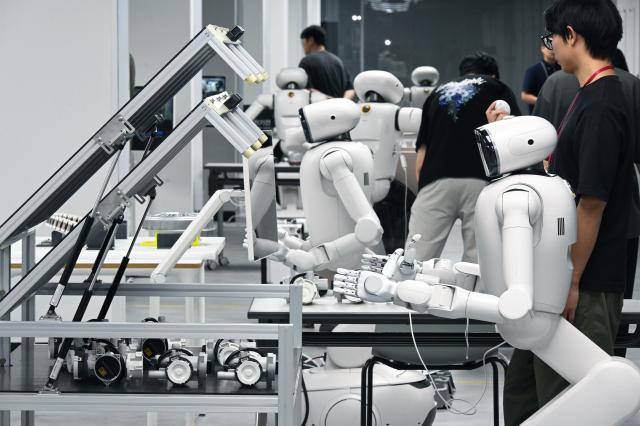
SEOUL, November 16 (AJP) - LG Electronics is moving to establish safety testing and certification standards for humanoid robots ahead of the planned unveiling of its bipedal robot in the first quarter of next year, as the South Korean electronics maker expands into physical artificial intelligence.
LG said Monday it had signed a memorandum of understanding with the Korea Institute for Robot Industry Advancement (KIRIA) on Nov. 13 to develop safety, reliability and usability assessment systems for humanoid robots.
Under the agreement, LG will participate in developing testing infrastructure at KIRIA's humanoid robot safety certification center and contribute to national and international standards for the emerging technology.
The company also plans to pursue pilot safety certification in South Korea for its humanoid robots, including LG CLOiD.
The initiative comes as LG develops a bipedal robot based on Nvidia's reference platform, with an unveiling targeted for the first quarter of 2027.
Unlike conventional industrial robots operating in controlled environments, humanoid robots are designed to work alongside people in homes and workplaces, raising additional challenges for safety testing and reliability.
LG is seeking to expand its robotics business by combining hardware development, AI software and operational data, including information collected through its LG Data Factory.

Candice Kim
Candice Kim is a dedicated business and technology reporter specializing in the intersection of high-tech innovation and fast-paced consumer trends. Her core beats span the semiconductor, IT, cosmetics, and retail sectors, where she provides in-depth coverage of industry titans including Samsung Electronics, SK hynix, and LG Electronics, alongside leading consumer brands like Olive Young and Musinsa. Whether analyzing complex silicon supply chains or tracking the latest shifts in beauty and fashion retail, Candice is committed to delivering sharp, accurate reporting that keeps readers informed on the forces shaping today's most dynamic markets.
Copyright ⓒ Aju Press All rights reserved.
Related News
-
 Naver Launches 'Naver Plus Business Mall' to Enter B2B Commerce Market
Naver is expanding its business-to-consumer (B2C) ecosystem, centered around its Smart Store platform, into the business-to-business (B2B) sector. The company aims to support existing Smart Store sellers in broadening their sales channels while attracting new customers with high demand for bulk and repeat purchases, thereby enhancing its commerce business growth.Naver announced on November 16 that it launched a dedicated B2B online mall, 'Naver Plus Business Mall (N+ Business Mall),' on November 11.The Naver Plus Business Mall offers a comprehensive platform that includes product offerings tailored for businesses, business certification, and order and payment functionalities necessary for B2B transactions. The company stated that it has applied some of the lowest commission rates in the industry to reduce cost burdens for sellers.Smart Store sellers, who have primarily operated in the B2C space, can now expand their sales to business customers. Brands such as 'Munid,' a stationery brand, 'Nongjindam,' a handmade syrup manufacturer, and 'Babam Danhobak,' a pumpkin processed food seller, are participating by showcasing products and pricing tailored to B2B demand.Naver believes it can also attract offline store operators using Naver Place as potential customers. Since businesses often require bulk orders or regular repeat purchases, sellers can secure stable revenue streams.To meet this demand, major domestic brands such as Shinsegae Food, Maeil Dairy, Ourhome, Office Depot, and LG Electronics have also joined the platform, offering a variety of products ranging from food ingredients to office supplies and digital devices.Prior to the official launch, Naver conducted a month-long closed beta test (CBT) involving over 30,000 products. During the testing period, one in four buyers made repeat purchases.Naver has established a shopping environment specialized for B2B transactions. It recommends products needed by various industries, such as restaurants, cafes, and shopping malls, and has created a special pricing section targeting bulk purchase demands.In conjunction with Naver Pay (Npay), the platform supports business certification, payments, and purchase management. Buyers can authenticate their business through 'Npay Biz' before purchasing products. By creating payment groups, administrators can share payment methods and delivery addresses with employees and set approval methods and limits. Features for viewing purchase history and processing documentation are also provided.Shin Jun-ho, leader of Naver Shopping New Business Planning, stated, "The Naver Plus Business Mall is expected to create new growth opportunities for sellers by connecting the Smart Store ecosystem that Naver has built with a broad base of business users. We aim to enhance product competitiveness to meet the needs of various-sized businesses, from sole proprietors to small and medium enterprises, and expand the B2B commerce ecosystem alongside sellers."* This article has been translated by AI.
-
Korean Version of Inflation Reduction Act Heads to National Assembly Amid Industry Concerns
Samsung Electronics and SK Hynix are unlikely to gain substantial benefits from the upcoming Korean version of the Inflation Reduction Act (IRA), which will be reviewed by the National Assembly on the 16th. Analysts suggest that the companies' export-oriented production structure and the exclusion clause for investment tax credits will limit the actual amount of credits they can claim. In contrast, LG Electronics, which is set to begin mass production of robot actuators, is expected to qualify for significant tax credits depending on the designation of specific items.According to the National Assembly and industry sources on the 15th, the National Assembly's Finance and Economy Planning Committee's tax subcommittee will discuss a proposed amendment to the Tax Special Cases Restriction Act, which aims to establish domestic production tax credits. The proposal would allow companies that manufacture and sell designated items domestically to receive reductions in corporate taxes based on their production and sales performance.The government has designated six sectors for tax incentives in its tax reform plan this year: solar power, wind power, secondary batteries, semiconductors, key materials, and AI robot components. This initiative aims to prevent the relocation of production bases in high-tech industries that hold strategic value, while also reducing reliance on foreign supply chains through tax support in response to U.S. subsidy and tariff pressures.However, the production structure of the memory industry poses challenges. Samsung Electronics and SK Hynix supply most of their DRAM and NAND products to overseas clients, making it difficult to meet the 'domestic sales' requirement. Additionally, items produced in facilities that have received integrated investment tax credits are generally ineligible for domestic production tax credits.The concentration of new semiconductor fabs in the Yongin semiconductor cluster and the southwestern region means that preferential treatment for non-capital region metropolitan cities (1.1 times) or areas experiencing population decline (1.5 times) may not yield immediate benefits. Yongin overlaps with existing tax credits, and the southwestern region will not have any eligible production until new fabs are operational in 2-3 years. Furthermore, the method for calculating domestic expenditure ratios and production costs has been postponed to implementation regulations, which could raise the bar for companies if detailed criteria are set strictly.In anticipation of the tax subcommittee's review, the business community is calling for improvements to the system. The Korea Chamber of Commerce and Industry submitted a legislative proposal to the National Assembly last month, requesting that eligible items produced domestically be exempt from sales area restrictions and that the limitations on overlapping integrated investment tax credits be eased. They also urged that companies suffering losses due to large-scale investments be allowed to receive direct refunds or third-party transfers.On the other hand, LG Electronics, which is focusing on the AI robot components sector, has high expectations for benefits. The company plans to produce nine types of actuators for robots at its facility in Changwon, Gyeongnam, and supply them to domestic robotics and logistics companies starting next year. This aligns perfectly with the core requirement of 'domestic production and domestic sales.' Since these actuators account for 60% of robot costs, receiving tax benefits could reduce initial mass production costs and enhance price competitiveness.An industry insider stated, "Considering the export proportion of key industries like semiconductors, it is urgent to readjust the requirements. While it is encouraging that the robot sector, a new growth driver, is included, we need to see how many core components will be included in the detailed items set by presidential decree."* This article has been translated by AI.
-
Jensen Huang's Departure Shakes AI Strategies of Major Korean Firms
Jensen Huang, CEO of NVIDIA, has abruptly resigned, causing significant shifts in the artificial intelligence (AI) business strategies of major South Korean companies such as Samsung, SK, Hyundai, and LG. While the impact on existing contracts is expected to be limited, the prioritization of future investments and AI technology collaborations may change, complicating profit calculations for these companies.According to industry sources, NVIDIA announced Huang's resignation on November 12, along with the appointment of Colette Kress as interim CEO. The South Korean government held a meeting with NVIDIA the following day to reaffirm the supply of 260,000 graphics processing units (GPUs) and the continuation of existing collaborative projects.However, while existing plans will continue, new investments and the development of next-generation products will depend on the judgment of the new management. Concerns have arisen that Kress, the interim CEO, has been cautious about Huang's aggressive investment strategies, which could slow down AI infrastructure investments due to reduced customer investments and guarantees from NVIDIA.Samsung Electronics is supplying high-bandwidth memory (HBM) to NVIDIA while also importing over 50,000 GPUs to establish an AI semiconductor factory. The pace of NVIDIA's AI semiconductor development is directly linked to memory demand. However, the expanded customer base, including AMD and Broadcom, may serve as a buffer against NVIDIA's management uncertainties.SK Group is intertwined with NVIDIA as both a supplier and customer. SK Hynix is a key supplier of HBM to NVIDIA, and the group is building an AI factory with a scale of 50,000 GPUs while also pursuing a manufacturing AI cloud business through SK Telecom. Although NVIDIA's investment slowdown poses challenges, there is a perspective that the expansion of competing AI chip companies could create new HBM supply opportunities.Hyundai Motor Group is collaborating with NVIDIA on autonomous driving, robotics, and smart factories. They are also working on an AI factory based on 50,000 GPUs and a physical AI investment of approximately $3 billion. Industry experts believe that maintaining the pace of joint development for autonomous driving software and robotic learning technologies is crucial, alongside efforts to secure in-house AI technology capabilities.LG Group signed a strategic business agreement with NVIDIA in August to collaborate in the fields of robotics, AI factories, and mobility. The goal is to unveil a humanoid robot in the first quarter of next year and establish an 80 MW AI factory by 2028. LG Electronics has reportedly secured NVIDIA's approval for cooling equipment for data centers. While entering the NVIDIA ecosystem may favor global order expansion, companies must also prepare for potential changes in technology standards and investment strategies.Industry insiders view maintaining existing partnerships while reducing dependency on specific companies for technology and business as a common challenge. If NVIDIA's dominance continues, the current collaboration structure may remain advantageous, but as competing AI platforms grow, companies that diversify their customers and technologies may find new opportunities.Shin Jin-woo, a member of the National AI Strategy Committee's Technology Innovation and Infrastructure Subcommittee, stated, "Collaboration with NVIDIA should continue unchanged, but we must enhance the utilization and operational capabilities of the secured GPUs and broaden our options for computing resources, including domestic AI semiconductors."* This article has been translated by AI.