
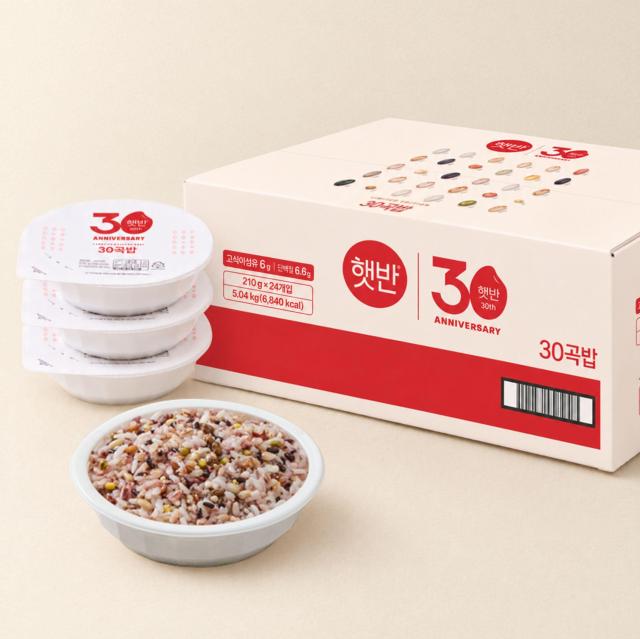
The product blends 30 grains, including brown rice, glutinous rice, black rice, oats and barley, with soaking times tailored to each grain. Each serving contains 6 grams of dietary fiber and 6.6 grams of protein, the company said.
Only 6,000 boxes of 24 packs each have been produced. Pre-orders opened on Monday, and sales begin Dec. 1 exclusively through CJ The Market, the company's official online mall.
The launch comes as South Korea's per-capita rice consumption fell 3.4 percent to 53.9 kilograms last year, about half the 1995 level. Rice use by food manufacturers, however, jumped 12.6 percent, partly offsetting the slide at home.
"Hetbahn will go beyond simple rice and set a new standard for wellness food culture," a CJ CheilJedang official said, adding the company will keep rolling out products built on diverse grains and nutritional design.

Kim Dong-young
Kim Dong-young is a bilingual journalist at AJU Press (AJP), covering Korean tech, energy, and bio/pharma.
He reports from the field at events like CES and APEC, runs AJP's YouTube channels,
and is pursuing a master's at Sogang's MOT program.
Copyright ⓒ Aju Press All rights reserved.
Related News
-
 CJ CheilJedang Introduces 'Physical AI' in Food Manufacturing for Autonomous Production
CJ CheilJedang is set to develop technology that utilizes artificial intelligence (AI) to automatically manage and control food production processes. The company plans to enhance productivity and quality competitiveness by applying AI throughout the manufacturing site, including real-time detection of product defects and predictive maintenance of equipment.On November 11, CJ CheilJedang announced its participation as a representative company in the food sector for the Ministry of Trade's 'AI Factory Support Project.'The core of this initiative is the development of 'Physical AI' technology that controls actual equipment and processes. CJ CheilJedang will collaborate with WonPredict, Ivex, and the Korea Institute of Industrial Technology to create autonomous manufacturing and integrated predictive maintenance technologies tailored for the food and beverage (F&B) industry.Initially, the company will establish a foundation for real-time data collection and analysis from various equipment in the manufacturing environment. Based on this, it plans to apply 'Physics-Informed Neural Networks (PINN)' technology to learn the physical characteristics of processes and sensor data, predicting optimal equipment operating conditions and automatically controlling production processes.AI will also be utilized in quality management. By combining machine vision that assesses product conditions with robotics and edge AI technology that processes data on-site, the system will detect foreign substances, product damage, and packaging defects in real time. If anomalies are identified, the system will respond by coordinating with equipment control to address defects.In equipment management, AI will analyze the operational status of machinery to detect signs of failure in advance, establishing a predictive maintenance system that minimizes unexpected production line shutdowns.AI CCTV will respond to situations where workers collapse or enter hazardous areas. The technology will develop safety control measures that automatically slow down or stop production equipment upon detecting dangerous situations in real time, thereby preventing industrial accidents.CJ CheilJedang plans to integrate these technologies using the digital transformation (DX) foundation established through its existing smart factory and production automation systems. The goal is to implement an autonomous manufacturing system where AI recognizes the state of the production site, predicts anomalies, and determines necessary actions, including equipment control.Kang Min-soo, Vice President of Production at CJ CheilJedang, stated, "In food manufacturing, the characteristics of raw materials and changes in the production environment directly affect product quality. Therefore, AI technology that understands both on-site data and process characteristics is crucial. We aim to secure Physical AI technology optimized for F&B manufacturing to enhance productivity, quality, and safety competitiveness, while also strengthening the global competitiveness of K-food."* This article has been translated by AI.
-
CJ CheilJedang Reports Increased Sales and Operating Profit in Q3 Driven by Global Expansion
CJ CheilJedang reported increased sales and operating profit for the third quarter of this year, driven by expanded overseas sales of its key products, including dumplings and Hetbahn, as well as growth in its bio-materials business. However, the technology materials segment recorded a loss despite increased sales due to investment burdens.On November 10, CJ CheilJedang announced that its operating profit, excluding CJ Logistics, reached 203 billion won, a 6.9% increase compared to the same period last year. During the same period, sales rose to 4.23 trillion won, up 5.7%. Operating profit also increased by 25.4% compared to the previous quarter.Including CJ Logistics, the consolidated operating profit was 309.1 billion won, a 7.4% decrease year-on-year, while sales increased by 7.0% to 7.39 trillion won.By business segment, the lifestyle food division maintained operating profit at 118.7 billion won, consistent with the same period last year, while sales grew by 3.8% to 2.57 trillion won. Despite ongoing pressures from raw material prices and logistics costs, profitability was sustained through expanded sales of key overseas products, growth in domestic distribution channels, and cost efficiencies.Overseas food sales reached 1.51 trillion won, a 3.7% increase from the previous year, supported by rising sales of global strategic products (GSP) such as dumplings and Hetbahn.Regionally, sales in Europe saw the highest growth rate at 26%, driven by the expansion of distribution channels for new dumpling products. Vietnam experienced a 14% increase due to higher sales of rolls, seaweed, and noodles. Sales in China rose by 8%, bolstered by increased dumpling and frozen rice sales through warehouse discount stores and online channels. The Americas region grew by 3%, despite reduced currency translation effects due to exchange rate declines, thanks to demand for dumplings and Hetbahn.Domestic food sales increased by 3.9% to 1.07 trillion won, with rising sales of key products like Hetbahn and soba noodles, alongside growth in new product lines. Sales of Bibigo grilled fish surged by 69%, while Baeksul's one-minute rice increased by 24%.In the technology materials segment, despite increased sales, a loss was recorded. Third-quarter sales reached 232.6 billion won, a 20.2% increase year-on-year, but operating losses totaled 24.2 billion won.Sales of natural fermented seasoning materials, such as Taste & Rich (TNR), and health and wellness (H&W) products expanded. Revenue from biodegradable bio-material PHA also increased due to securing major demand sources. However, strategic pricing operations for nucleic acid products and increased investment costs for expanding the market for future growth products burdened profitability.The core materials segment showed significant improvement, with operating profit rising by 36.0% to 108.5 billion won, and sales increasing by 7.0% to 1.42 trillion won.Growth in high-value amino acid products, such as arginine, and expanded lysine sales in the North American market supported the performance. Although prices in the materials business were reduced in line with government price stabilization policies, increased sales of amino acids for animal feed improved profitability.CJ CheilJedang plans to continue expanding the overseas distribution network for its global strategic products, including dumplings and Hetbahn, in the fourth quarter. The company aims to enhance Hetbahn's competitiveness in the North American market and broaden sales channels in key regions like Europe.In the technology materials segment, the company will work to recover performance in response to peak demand for nucleic acids. Sales of future growth products, such as TNR and PHA, will also be expanded. The core materials segment will focus on improving profitability for amino acid products like lysine and arginine.A CJ CheilJedang representative stated, "We will accelerate the expansion of K-food territory in key regions based on the growth of global strategic products like dumplings and Hetbahn, while enhancing competitiveness in each business segment through responses to peak demand for nucleic acids, increased sales of amino acids for animal feed, and improved profitability of future growth products."* This article has been translated by AI.
-
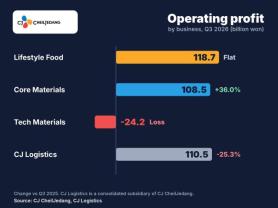 AJP Factbox: CJ CheilJedang's Q3 2026 earnings by business
Edited and compiled by AJP. Graphics AI Assisted CJ CheilJedang on Nov. 10 posted a third-quarter operating profit of 309 billion won ($229.6 million) in its preliminary earnings filing, down 7.4 percent from a year earlier on a restated basis, as a 25.3 percent fall at logistics subsidiary CJ Logistics weighed on results. Revenue rose 7.0 percent to 7.40 trillion won. Excluding CJ Logistics, operating profit rose 6.9 percent to 203 billion won. The core materials division increased operating profit 36.0 percent to 108.5 billion won and the lifestyle food division held steady at 118.7 billion won, while the tech materials division posted an operating loss of 24.2 billion won. For the full quarterly results, read our earlier report.