
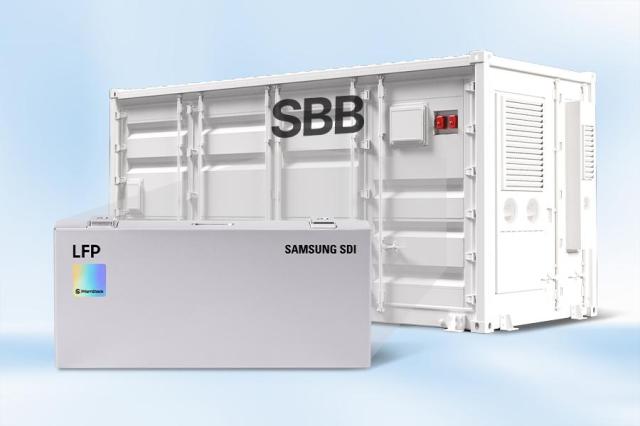
The contract, signed by its US unit Samsung SDI America and estimated at several trillion won, lifts the two companies' combined deals to about 27 GWh.
The batteries will be made at StarPlus Energy, Samsung SDI's joint venture plant with Stellantis in Indiana.
"Securing reliable, domestically manufactured equipment is central to how Jupiter Power plans and de-risks our build program," said Andy Bowman, chief executive of Jupiter Power, which holds one of the largest storage development pipelines in the United States.
LFP cells, cheaper and longer-lasting than nickel-based batteries, are widely used in grid storage, a segment where Chinese suppliers have long held sway.
Under the One Big Beautiful Bill Act, US projects starting construction this year must curb Chinese-linked content to claim federal tax credits.
Samsung SDI, which describes itself as the only non-Chinese maker of prismatic storage batteries in North America, began LFP mass production at the Indiana plant in October on converted EV lines.
It has also lined up LFP cathode supplies from Korea's L&F and POSCO Future M.
US energy storage installations hit a record 20.2 GWh in the second quarter, according to the Solar Energy Industries Association and Benchmark Mineral Intelligence, which raised their forecast for cumulative capacity by 2030 to 683 GWh.
Kim Dong-young
Kim Dong-young is a bilingual journalist at AJU Press (AJP), covering Korean tech, energy, and bio/pharma.
He reports from the field at events like CES and APEC, runs AJP's YouTube channels,
and is pursuing a master's at Sogang's MOT program.
Copyright ⓒ Aju Press All rights reserved.
Related News
-
 Spain shortlisted for BYD's second passenger-car plant in Europe
The BYD logo is displayed at a car show in China. The Chinese electric vehicle maker has put Spain on its shortlist for a new European factory. (File photo: P. L. / Unsplash) ZURICH, November 15 (AJP) -Spain is on the shortlist for a new BYD car factory in Europe, as the Chinese electric vehicle giant looks for a reliable base after setbacks elsewhere on the continent. BYD, based in Shenzhen in southern China, is one of the world’s biggest makers of electric and plug-in hybrid cars. It wants to build more cars inside Europe to serve a growing customer base and avoid the extra import duties the European Union (EU) imposed on Chinese-made electric cars in 2024. The company accounted for 2.7 percent of new passenger-car registrations across the EU, Britain and the European Free Trade Association in the first nine months of 2026, up from 1.2 percent a year earlier. Registrations reached 283,997 vehicles, according to figures from the European Automobile Manufacturers’ Association (ACEA). BYD Executive Vice President Stella Li told Spanish news agency Europa Press on Nov. 11 that Spain was among the countries preselected for the plant. In separate remarks reported by business daily Expansión, she said competitively priced electricity was the company’s top priority in choosing a site. BYD is considering taking over an existing factory as well as building a new one. Acquiring and refurbishing a plant could help it start production more quickly. The search comes as its other manufacturing plans in the region face delays. Its first European passenger-car plant, in Szeged in southern Hungary, is expected to begin mass production by the end of 2026, about a year behind the original schedule. BYD also put a planned factory in Türkiye on hold in June, before construction had begun, Reuters reported. BYD already operates an electric-bus factory in Komárom, Hungary, which opened in 2017. The proposed Spanish facility would be its second passenger-car plant in the EU. Hungary courted Chinese investment for years under former Prime Minister Viktor Orbán. His successor, Péter Magyar, took office in May and has promised tougher enforcement of environmental and labor rules. The Szeged project has also faced scrutiny over soil removed from the construction site. Hungarian authorities fined BYD for breaching environmental permit requirements, a penalty the company is challenging. Police are separately investigating suspected environmental damage, according to Hungarian news outlet Telex. Spain offers an established automotive industry and abundant renewable power. It is Europe’s second-largest vehicle producer after Germany, with factories that built 2.27 million vehicles in 2025. Renewables supplied 55.5 percent of its electricity that year, according to grid operator Red Eléctrica. Spain has also sought to attract Chinese carmakers. It abstained when EU countries voted in 2024 on additional duties of up to 35.3 percent on Chinese-made electric cars, and has used EU pandemic recovery funds to support electric-vehicle and battery investment. Other Chinese groups have already committed to Spanish projects. Chery and Spanish brand Ebro have invested more than 150 million euros to revive a former Nissan factory in Barcelona, with plans to reach annual production of up to 50,000 vehicles by the end of 2026. Chinese battery maker CATL and Stellantis, the group behind Peugeot, Fiat and Jeep, have announced a battery plant in Zaragoza involving investment of up to 4.1 billion euros. Geely Auto has also agreed to form a manufacturing joint venture with Ford at its Valencia plant, with production scheduled to begin in 2028. China was Spain’s second-largest foreign supplier of cars in the first half of 2026, behind Germany. Sino Auto Insights founder Tu Le has called Spain “the new Detroit of the EU,” a nod to the U.S. auto capital. Spanish buyers are already warming to BYD. The company has sold nearly 40,000 cars in the country so far this year, Europa Press reported. A Spanish plant would still face hurdles. Li has acknowledged that suitable existing sites are hard to find. She also said BYD is “not very good at joint ventures,” suggesting it would prefer to operate its own factory. No decision has been announced. For Spain, winning the plant would strengthen its role as a European manufacturing base for Chinese carmakers. For BYD, it would add production capacity inside the EU as its share of the region’s car market grows. Tags: BYD, Stella Li, Spain, China, electric vehicles, Hungary, Szeged, Viktor Orbán, Péter Magyar, Türkiye, Chery, Ebro, CATL, Stellantis, Geely, European Union
-
 Volvo's ES90: A Versatile Sedan with Sporty Appeal
Volvo's flagship sedan, the ES90 (Single Motor ER), is well-suited for professionals in their 30s and 40s. Its sporty exterior captures attention, while its smooth driving experience and high-performance driving assistance features enhance its appeal. The spacious interior leaves a strong impression, making the ES90, launched in July this year as a battery electric vehicle (BEV), stand out with its multifaceted charm.On November 10, the ES90 was driven along the coast for approximately 58 kilometers from Gangneung to Sokcho, utilizing routes such as the Donghae Expressway and Donghae Road.The ES90's exterior is striking, breaking away from traditional sedan designs to present a sporty vibe. It combines the advantages of a sedan, an SUV, and a fastback, characterized by a smoothly sloping roofline that extends to the rear.The spaciousness is evident upon entering the rear seats, where passengers can comfortably cross their legs without worrying about their feet touching the front seats, creating an SUV-like feel. The trunk is also surprisingly roomy, offering up to 1,445 liters of space when the second row is folded down.The driving experience emphasizes smoothness. The steering wheel operates effortlessly, and the ride quality is exceptional, allowing for acceleration that passengers may not even notice. The vehicle remains stable over bumps without significant body movement.During high-speed driving, the 'Pilot Assist' feature was tested. This driving assistance function adjusts speed and braking based on the driver's set speed and the distance to the vehicle ahead.As the vehicle entered a straight road, the right gear stalk was gently pulled down to activate the Pilot Assist. The feature performed reliably even at relatively high speeds. However, it seemed less effective on curved roads compared to straight ones.When the speed exceeded a certain threshold, a message appeared on the dashboard indicating that the steering assistance feature could not be used due to high speed. This limitation appears to be a precaution against relying solely on driving assistance in sudden situations at high speeds.The audio performance was also noteworthy. By setting the 'Voice Amplification' feature to 'high' on the central display, even normal conversation voices were enhanced. This feature helps facilitate communication with passengers in other seating rows.However, as a software-defined vehicle (SDV), many functions being software-based proved somewhat inconvenient. Adjusting the side mirrors, for instance, required accessing the settings app on the central display.* This article has been translated by AI.
-
SK Group Completes Debt Reduction and Announces Portfolio Rebalancing 2.0
SK Group has completed over three years of debt reduction and is moving to the next phase of portfolio rebalancing. The company is shifting its management direction from securing liquidity through the sale and consolidation of existing businesses and affiliates to determining how to allocate the cash obtained to core businesses and artificial intelligence (AI).According to SK Group, Chairman Chey Tae-won and over 50 CEOs from major affiliates gathered at the SKMS Research Institute in Icheon, Gyeonggi Province, from November 12 to 14 for the '2026 CEO Seminar' to discuss the implementation of 'Portfolio Rebalancing 2.0.'The principles of Rebalancing 2.0 focus on balancing financial health and future investments by allocating capital based on cash generation capabilities.SK Group's transition to Rebalancing 2.0 comes as the financial improvement efforts from the previous phase have effectively concluded. A key indicator of this progress is the group's debt reduction. Over the past two years, SK Group has reduced its net borrowings by 43.77 trillion won, and the number of affiliates has decreased from 219 to 151. The debt ratio of the holding company, SK Inc., has dropped to 69.5%, down 16.8 percentage points from the previous year.The company has streamlined its business structure, which had become unwieldy due to excessive liquidity during the pandemic, and is now focused on enhancing profitability in its core businesses and developing a capital allocation strategy as part of Rebalancing 2.0.The most promising area identified by Chairman Chey at the CEO seminar is the AI flywheel, which leverages the competitiveness of AI semiconductors to expand AI data center and AI factory operations. This expansion is expected to create a positive cycle that generates demand for energy and AI services. Analysts note that this structure is similar to the growth model proposed by Amazon founder Jeff Bezos.Funding for these initiatives is expected to come from SK Hynix. The company reported a record quarterly revenue of 104.62 trillion won in the third quarter, surpassing the 100 trillion won mark for the first time, which supports the group's investment capacity. As of the end of the third quarter, SK Hynix had 98.7 trillion won in cash, excluding borrowings. A generational shift in its core products is also set to occur in the fourth quarter, with HBM4 (6th generation) expected to surpass HBM3E (5th generation) in both shipments and revenue.The data center initiative is led by SK Telecom's affiliates, which established a two-company system dividing roles between business development (SK Hyper) and infrastructure operation (SK Horizon) this past summer. The goal is to have the Ulsan AI data center operational by the second half of 2029, with three to four global cloud providers identified as potential business partners.Energy initiatives will be managed by SK Innovation, which plans to sell energy packages for data centers that include liquefied natural gas (LNG), renewable energy, energy storage systems (ESS), and small modular reactors (SMR). Construction and materials support will come from the construction affiliate, SK Ecoplant. Notably, 82% of the company's revenue in the first half of the year was derived from AI and semiconductor-related businesses.However, challenges remain as SK Group pursues Rebalancing 2.0. The company must first address the burdens posed by its battery and petrochemical sectors, which continue to weigh on its financial structure. As of the first half of this year, SK Innovation reported a consolidated net borrowing of 26 trillion won.A business insider remarked, "How the funds secured during the semiconductor supercycle are linked to affiliate operations will determine the success of Rebalancing 2.0. The resignation of Jensen Huang has also increased uncertainty in the global AI and semiconductor markets, which poses additional risks."* This article has been translated by AI.