
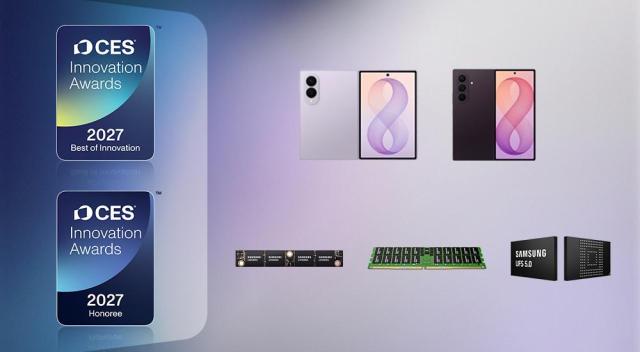
SEOUL, November 15 (AJP) - Samsung Electronics has secured 19 CES 2027 Innovation Awards, including four top honors, with its foldable smartphones, displays and AI-related memory products among the winners.
The Consumer Technology Association (CTA), which organizes the annual technology exhibition in Las Vegas, announced the winners on Nov. 9, ahead of CES 2027 in January.
Samsung received 13 awards in video displays, three in semiconductors, two in mobile devices and one in home appliances. Its four Best of Innovation awards, up from three last year, went to two display products and two foldable smartphones.
The Galaxy Z Fold8 and Galaxy Z Fold8 Ultra received the top honors in the mobile category. The Ultra model, Samsung's first foldable to carry the Ultra branding, features an 8-inch main display and a 5,000mAh battery.
In semiconductors, the company won awards for three memory products: LPDDR5X SOCAMM2 and DDR5 RDIMM modules designed for AI servers, and UFS 5.0 storage for on-device AI applications.
The Bespoke AI Combo all-in-one washer-dryer also received an award in the home appliance category.
The winning products are scheduled to be showcased at Samsung's CES 2027 exhibition in Las Vegas in January.

Candice Kim
Candice Kim is a dedicated business and technology reporter specializing in the intersection of high-tech innovation and fast-paced consumer trends. Her core beats span the semiconductor, IT, cosmetics, and retail sectors, where she provides in-depth coverage of industry titans including Samsung Electronics, SK hynix, and LG Electronics, alongside leading consumer brands like Olive Young and Musinsa. Whether analyzing complex silicon supply chains or tracking the latest shifts in beauty and fashion retail, Candice is committed to delivering sharp, accurate reporting that keeps readers informed on the forces shaping today's most dynamic markets.
Copyright ⓒ Aju Press All rights reserved.
Related News
-
 Gwangju-Jeonnam Integrated City Advocates for Strategic Relocation of Public Institutions
The Gwangju-Jeonnam Integrated City is advocating for the prioritization of public institutions ahead of the second phase of their relocation. Academics have joined the call, emphasizing the need for the relocation of the National Agricultural Cooperative Federation, the National Federation of Fisheries Cooperatives, the headquarters of five power companies, and IBK Industrial Bank. Experts argue that the relocation of public institutions should not merely be a distribution among regions but should be approached as a strategic placement aimed at enhancing industrial competitiveness and achieving national balanced development. This perspective raises questions about how it may influence the government's selection and placement of relocating institutions. According to the Gwangju-Jeonnam Integrated City, the Korean Regional Development Association held its 2026 Fall Academic Conference on November 13 in Naju, focusing on the theme of 'Second Phase of Public Institution Relocation and Balanced Development Strategies for Integrated Metropolitan Areas.' The conference attracted over 200 participants, including academic experts, local government officials, and representatives from related organizations, who discussed strategies for attracting public institutions to the Gwangju-Jeonnam Integrated City and plans for regional balanced development. In his keynote speech, Go Kwang-wan, a special professor at Chosun University, emphasized the need for the government to reflect the special consideration for prioritizing the integrated city in the relocation of public institutions as outlined in the 'Special Law for the Establishment of Gwangju-Jeonnam Integrated City.' Professor Go proposed that the headquarters of the National Agricultural Cooperative Federation, the National Federation of Fisheries Cooperatives, and the five power companies should be located in the integrated city, citing the region's largest agricultural and fishery production base and abundant renewable energy resources. He also highlighted the necessity of prioritizing the relocation of IBK Industrial Bank, a specialized financial institution for small and medium-sized enterprises, to build an industrial ecosystem linked to the planned investment of 800 trillion won by Samsung Electronics and SK Hynix in semiconductor production facilities. Practical execution plans regarding securing office buildings and improving living conditions due to the relocation of public institutions were also presented. Yu Chang-ho, a senior researcher at the Regional Development Institute of Chonnam National University, suggested constructing a modular joint rental office building within the innovation city to accommodate 2,200 people for the swift relocation of smaller institutions. Kim Kyung-ae, CEO of K Research and Consulting, emphasized that based on surveys of relocating institution employees and local residents, there should be simultaneous efforts to enhance cultural and medical facilities and improve regional transportation networks to create a stable living environment. Im Hyung-baek, a professor at Sungkyul University, argued that the relocation of public institutions should be pursued in a manner that enhances regional industries and national productivity, rather than framing it as a conflict between the capital region and local areas. He introduced the 'Nash equilibrium' policy model, which seeks to find a reasonable balance while adjusting the interests of different regions. Additionally, discussions and presentations continued on topics such as addressing regional development disparities, strengthening the role of local governments, residential mobility and regional settlement, improving the quality of life in rural areas, and changes in regional vitality and living environments. Jeon Han-seong, head of the Financial Planning Division of Gwangju-Jeonnam Integrated City, stated, "The second phase of public institution relocation is a crucial opportunity to expand the region's future growth base and establish a new turning point for national balanced growth. We will concentrate all our efforts to ensure that the government's promise of preferential treatment for integrated regions is practically reflected in the relocation policy." Ki Jeong-hoon, president of the Korean Regional Development Association, remarked, "The launch of Gwangju-Jeonnam Integrated City holds significant meaning as it connects the region's industries, talents, universities, research institutions, and living areas into a single metropolitan development system beyond administrative boundaries." He further emphasized, "The second phase of public institution relocation and the reorganization of the metropolitan administrative system present an important policy opportunity to redesign the region's future." Meanwhile, Gwangju-Jeonnam Integrated City views the second phase of public institution relocation as a key task for enhancing the regional industrial structure and balanced development. It is responding to ensure that the preferential treatment outlined in the special law for integrated cities is reflected in the actual selection and placement of relocating institutions. The necessity for relocation of specific institutions, securing office buildings, and improving living conditions, as presented at this academic conference, is expected to become a major focus in the government's public institution relocation policy.* This article has been translated by AI.
-
 After Jensen Huang, Nvidia faces a test of leadership
Graphics AI assisted SEOUL, November 15 (AJP) - A remarkable fracture has emerged within the company that helped make the artificial intelligence revolution possible. One executive wanted to move faster toward the future. Another was responsible for examining the financial risks of that acceleration. One was Jensen Huang, the visionary co-founder of Nvidia. The other was Colette Kress, the chief financial officer who had helped guide the company's finances through thirteen years of extraordinary growth. Their reported disagreements, followed by Huang's departure and Kress's appointment as interim chief executive, raise questions far larger than the leadership of a single corporation. How fast can artificial intelligence advance? How much capital can the world commit to its development? Who ultimately bears the risks of the extraordinary financial structures supporting that growth? And, most importantly, can human beings develop the wisdom and institutions necessary to govern the technological power they have created? These are not merely questions of corporate finance. They are questions about the future of civilization. A Deer in the Headlights On November 12, 2026, Nvidia announced that Jensen Huang had resigned as president, chief executive officer and a member of its board. Colette Kress, who had served as CFO since 2013, became interim CEO while retaining her financial responsibilities. Harvey C. Jones was appointed chairman of the board. The departure marked an extraordinary transition for a company whose identity had been inseparable from its founder for thirty-three years. The following day, the New York Post reported on tensions between Huang and Kress, drawing on reporting by The Wall Street Journal and Reuters. According to those accounts, Huang had interrupted Kress during an August management meeting and compared her to a deer caught in the headlights of an approaching car. The remark remains a reported account rather than an independently established statement acknowledged by both executives. Yet the conflict it symbolizes deserves serious consideration. Huang was a leader who imagined the future before much of the world recognized its possibilities. He helped transform graphics processing technology into the computational foundation of modern artificial intelligence. Through hardware, software, networking and data-center systems, he built an industrial ecosystem that reshaped the global technology economy. Kress represented another indispensable dimension of that achievement: financial discipline. A visionary chief executive must recognize opportunities that others cannot yet see. A responsible financial executive must ask whether the organization can afford the risks required to pursue those opportunities. These responsibilities are not enemies. They are complementary forms of intelligence. The accelerator moves a vehicle forward. The brake allows it to reach its destination safely. A car equipped with only one of them cannot fulfill its purpose. The same is true of a great corporation. Innovation requires courage. Sustainability requires restraint. Leadership requires the judgment to reconcile the two. It would be misleading to portray Kress as an opponent of Nvidia's growth. She was a central participant in building and financing that growth. The more important question is whether a company can preserve genuine disagreement and independent risk assessment when its founder has become an almost mythic figure. The Money Behind the AI Revolution The artificial intelligence revolution is often described through the language of technological breakthroughs. We hear about increasingly powerful processors, sophisticated reasoning models, autonomous machines and data centers capable of performing extraordinary calculations. But behind every technological breakthrough lies an economic reality. Advanced chips must be designed and manufactured. Data centers must be constructed. Electricity must be generated and delivered. Cooling systems, networks, land and specialized equipment must be financed. The cost is immense. Where does the money come from? Some comes from corporate profits. Some comes from shareholders. Some comes from banks, bonds and institutional investors. Increasingly, another arrangement has attracted attention: suppliers of AI infrastructure helping to finance the customers who purchase that infrastructure. A semiconductor company may invest in a customer or support its borrowing. The customer uses the resulting financial capacity to build data centers and purchase more chips. Those purchases generate additional revenue for the supplier, potentially strengthening its ability to support further expansion. This is the structure often discussed under the term circular financing. It is important to understand what that term does—and does not—mean. Circular financing is not automatically illegal, fraudulent or economically irrational. Supplier financing has existed in industries ranging from aviation to telecommunications. In emerging markets, such arrangements can accelerate investment and help create genuine demand. The critical question is whether the financial structure supports independent, sustainable economic activity or merely brings forward purchases that cannot ultimately be justified by the customer's own revenue. A company may record legitimate sales while its customers remain dependent on continued outside financing. A data center may be fully constructed while its long-term profitability remains uncertain. Investors may celebrate rapid growth while overlooking the financial obligations required to sustain it. The existence of demand is not the same as proof of its durability. This distinction lies at the heart of the current debate over the AI economy. The $105 Billion Question In August 2026, Reuters reported that Nvidia had agreed to provide a guarantee of up to $105 billion in connection with an OpenAI data-center project in Ohio being developed by SB Energy. The company also agreed to invest $1.5 billion in SB Energy. The figures are extraordinary, but they require careful interpretation. The $105 billion was a maximum guarantee, not an amount Nvidia had already paid in cash, nor a confirmed financial loss. The actual exposure would depend on contractual conditions, the project's performance and the value recoverable from the underlying assets. Huang argued that the arrangement should not be characterized simply as circular financing. Nvidia's stated objective was to secure long-lived infrastructure capable of supporting successive generations of AI computing. That strategic rationale deserves consideration. So does the financial risk. If AI data centers generate sufficient revenue, supplier-backed infrastructure financing may prove to be a successful means of expanding productive capacity. If demand disappoints, however, the consequences may extend beyond the data-center operator to lenders, investors and companies providing financial guarantees. What appears to be a virtuous cycle of growth could, under adverse conditions, become a mechanism for transmitting financial stress. Neither blind optimism nor premature declarations of an AI bubble are adequate responses. The world needs a more demanding form of analysis: one that distinguishes genuine productivity from financial engineering, and long-term demand from investment driven primarily by expectations of future demand. In August, Nvidia also disclosed plans involving financial partners to mobilize more than $500 billion in third-party capital for AI infrastructure. Such a target should not be confused with money already invested or obligations fully committed. The difference between an ambition, an agreement, a guarantee and an actual expenditure is fundamental to sound financial journalism. It is equally fundamental to sound corporate governance. Why an Internal Dispute Became a Global Question Nvidia is no ordinary semiconductor company. Its technology sits at the center of a global network of research institutions, cloud providers, AI developers and industrial enterprises. Its decisions influence investment plans across North America, Europe, East Asia and the Middle East. When such a company expands aggressively, the benefits can spread throughout the global economy. New research becomes possible. New services emerge. Businesses improve productivity. Scientific discoveries may accelerate. But deep interconnection also creates vulnerability. If a major AI infrastructure project fails to achieve its expected returns, the effects may travel through suppliers, financial institutions, energy providers and other participants in the industrial ecosystem. The greater the concentration of technological and financial power, the greater the need for independent judgment. This is why the reported disagreements between Huang and Kress matter. They are not simply a story about personality. They illuminate a structural tension between the desire to accelerate technological progress and the responsibility to manage its economic consequences. A founder's extraordinary confidence can create a great enterprise. But confidence cannot replace accountability. A mature corporation must be capable of questioning its most successful leader. Indeed, the more powerful the leader becomes, the more important that capacity becomes. The Dragon That Climbed Too High More than two thousand years before artificial intelligence, the ancient Chinese I Ching, or Book of Changes, offered a warning about the limits of power. Its Qian hexagram contains the phrase: 亢龍有悔 — Kang Long You Hui. The dragon that rises too high will have cause for regret. In East Asian tradition, the dragon represents immense power, transformation and ascent. Yet even the dragon must understand its limits. The teaching does not condemn ambition. Without ambition, civilization would not advance. Rather, it warns that ascent without self-awareness can become the beginning of decline. Jensen Huang was, in many respects, a technological dragon. He helped build a company whose products transformed the world's capacity to compute, learn and innovate. His black leather jacket became an emblem of confidence, engineering audacity and independence from corporate convention. But no symbol of success can eliminate human limitations. A leader who has climbed to extraordinary heights needs more than encouragement to climb higher. He also needs people who can identify danger, question assumptions and recommend restraint. A chief financial officer is one of the people entrusted with that responsibility. The lesson of the I Ching is not that powerful people should be humiliated when they stumble. It is that humility becomes more necessary as power increases. The Strongest Person Is the One Who Masters Himself The ancient Chinese philosopher Laozi expressed an even deeper insight in Chapter 33 of the Tao Te Ching: 知人者智,自知者明。 To know others is wisdom; to know oneself is enlightenment. He continued: 勝人者有力,自勝者強。 One who conquers others possesses strength; one who conquers himself is truly powerful. These words seem remarkably relevant to the age of artificial intelligence. Huang understood how to outperform competitors, attract extraordinary engineers, organize complex technologies and persuade global markets. Yet the ability to win in the marketplace is not identical to the ability to question one's own judgment. Acknowledging the possibility of error is not weakness. Listening to dissent is not a surrender of authority. Reconsidering an ambitious strategy is not necessarily a retreat from innovation. True leadership requires the courage to examine one's own convictions. The central question is not how much power a leader possesses. It is whether that power remains accountable to conscience, evidence and the institutions entrusted with protecting the broader community. Technological acceleration is an achievement. The ability to govern that acceleration is wisdom. An Ancient Korean Insight: Heaven and Earth Within the Human Being There is another philosophical tradition that deserves a place in this global conversation. It comes from Korea. The Cheon Bu Gyeong (天符經), often rendered as the Heavenly Symbol Scripture, is a short text preserved within Korean spiritual and philosophical traditions. Its historical origins, transmission and interpretation remain subjects of scholarly debate. It would therefore be inappropriate to present any single interpretation as an undisputed historical truth. Nevertheless, its symbolic language offers a profound framework for reflecting on humanity's relationship with the universe. The text begins: 一始無始一 — Il Si Mu Si Il. And concludes: 一終無終一 — Il Jong Mu Jong Il. These phrases invite reflection on a cosmic unity that transcends conventional ideas of beginning and ending. At the center of the present discussion stands another expression: 人中天地一 — In Jung Cheon Ji Il. It may be interpreted philosophically as: Within the human being, heaven and earth become one. In this reading, heaven represents moral aspiration, principles and humanity's highest ideals. Earth represents material reality, work, resources and the conditions of survival. The human being stands between them, capable of reconciling the two. Technological innovation begins with a dream. Semiconductors, electricity, data centers and financial capital provide the material means of realizing that dream. But neither dreams nor material resources can determine their own moral purpose. That responsibility belongs to human beings. A technological vision detached from economic reality cannot remain sustainable. A financial system concerned only with safety, and indifferent to human aspiration, may become incapable of supporting progress. Civilization requires a reconciliation between the two. This is one possible contemporary meaning of In Jung Cheon Ji Il. The reported conflict between Huang and Kress illustrates precisely why such reconciliation matters. It is not necessary to declare one executive virtuous and the other misguided. The more important question is whether their different responsibilities can coexist within a system of accountable leadership. A true leader must be able to imagine the heavens. But that leader must also understand the realities of the earth. And above all, the leader must recognize the human consequences of bringing those two worlds together. Humanity, Culture and Nature Artificial intelligence may become one of the most transformative technologies in human history. It can accelerate scientific discovery, improve medical research, broaden access to education and reduce dangerous forms of labor. Yet its success cannot be measured solely by semiconductor sales, data-center capacity or rising stock prices. We must ask whether AI improves the lives of ordinary people. Does it expand opportunity or concentrate wealth and power? Does it strengthen human creativity or weaken the capacity for independent judgment? Does it help societies become more peaceful, or does it intensify competition and conflict? And can its development remain compatible with the natural world on which all human life depends? Data centers require electricity, cooling and physical resources. Advanced semiconductor manufacturing consumes energy and materials. The expansion of computing power therefore carries environmental responsibilities as well as economic opportunities. Humanity, culture and nature cannot be separated. Humanity is the purpose of technology. Culture provides the values through which technology is understood and used. Nature is the foundation that makes every technological and economic activity possible. A civilization that expands computational power while undermining human dignity or exhausting its ecological foundations cannot call itself truly advanced. Food, Work and Dreams Three simple Korean words express another dimension of this philosophy: 밥 · 일 · 꿈 — Bap, Il, Kkum. Food. Work. Dreams. Food represents the material foundation of life: sustenance, economic security and the basic conditions of human dignity. Work represents creation, contribution and responsibility. Through meaningful work, people connect their abilities with the needs of society. Dreams represent imagination, culture and hope. They give human existence a purpose beyond mere survival. A human life requires all three. Food without dreams can become an existence without meaning. Dreams without material security can become impossible to sustain. And prosperity without meaningful work may leave people disconnected from their own creative potential. The same principle applies to the AI economy. Selling semiconductors and generating revenue concerns the material foundations of prosperity. Using AI to improve production and transform labor concerns the world of work. Building a more peaceful, creative and dignified civilization concerns humanity's dreams. The danger is that the global AI industry may become preoccupied with the first of these while neglecting the other two. How many chips have been sold? How much has a company's market value increased? How many billions of dollars have been committed to new data centers? These numbers matter. But numbers cannot substitute for human purpose. The ultimate achievement of artificial intelligence should be judged by the extent to which it advances health, education, security, freedom, creativity and peace. Technology must serve human life. Human life must not become merely an instrument for technological growth. What South Korea Must Learn The questions raised by Nvidia's transition are particularly important for South Korea. Samsung Electronics and SK hynix occupy significant positions in the global supply chain for advanced memory, including high-bandwidth memory used in AI accelerators. The expansion of AI infrastructure creates major opportunities for Korean industry. But Korean companies must look beyond the growth of any single customer. They must understand the financial structures supporting AI infrastructure investment, the strength of underlying demand and the long-term profitability of data-center projects. It is not enough to count the number of facilities being built. Companies must also ask how fully those facilities will be utilized, how customers will finance their purchases and whether future revenues can support the capital invested. Technological competitiveness must be accompanied by financial intelligence, diversified customer relationships and resilient supply chains. Governments face similar responsibilities. Public investment in AI should be based on credible economic assessments and transparent risk management. National ambition must be reconciled with fiscal responsibility and the interests of citizens. Becoming a technological power and becoming a mature civilization are not competing goals. They should be pursued together. What Kind of Leaders Does the AI Age Require? Jensen Huang will remain a consequential figure in the history of artificial intelligence. His contributions to accelerated computing and the modern AI ecosystem cannot be erased by a leadership crisis. Colette Kress, too, has played a significant role in the company's financial development and now faces the difficult responsibility of leading it through a transition. Their reported conflict should not be reduced to a morality play in which one person is entirely right and the other entirely wrong. It should instead encourage a deeper examination of institutions. Can technological visionaries respect the people responsible for managing risk? Can corporate boards exercise independent judgment when a founder becomes extraordinarily powerful? Can investors distinguish sustainable growth from growth dependent on increasingly complex financial arrangements? Can governments pursue technological leadership without abandoning the rule of law, environmental responsibility and the common interests of humanity? These are among the defining questions of the AI age. The I Ching warns of the dragon that rises beyond its limits. The Tao Te Ching teaches that mastery of oneself is greater than victory over others. The Korean Cheon Bu Gyeong, through the phrase In Jung Cheon Ji Il, invites us to imagine a human being capable of reconciling moral aspiration with material reality. Together, these traditions suggest a principle that reaches beyond any single culture. Power without restraint is incomplete. Knowledge without self-knowledge is incomplete. Innovation without responsibility is incomplete. And economic growth without human purpose is incomplete. The future of artificial intelligence will not be determined solely by how quickly machines calculate, how much information they process or how many industries they transform. It will also depend on whether human beings can create institutions wise enough to govern the power of those machines. We need more than powerful AI. We need responsible corporations, sound financial systems, mature leaders and a more peaceful world. The fracture within Nvidia's AI empire therefore presents a question to all of humanity: Having acquired the power to transform the world, have we acquired the wisdom to govern ourselves? 人中天地一 — In Jung Cheon Ji Il. Within the human being, heaven and earth become one. Perhaps the future of leadership begins with that recognition. Perhaps the true spirit of an AI civilization lies there as well. Greater than the semiconductors that move the world is the human conscience. Greater than the power to command the world is the strength to govern oneself. And only when technology and capital serve humanity, culture and nature can artificial intelligence become a genuine advance in human civilization. * The author, Abe Kwak, is the Chairperson of the Asia-Pacific Media Association based in Seoul. ** The views expressed in this article are solely those of the author and do not necessarily reflect the editorial position of AJP.
-
KOSPI Plummets 42%, High-Yield ELS at Risk as Maturities Approach
Short-term equity-linked securities (ELS) issued during the stock market boom in the first half of this year are now exposed to principal loss risks. The KOSPI, which was above 9,000 in June, has recently dropped to the 5,000 range, causing the prices of some underlying assets to fall into the knock-in zone. As maturities begin next month, investor concerns about losses are growing.According to the Korea Securities Depository on November 15, there are a total of 94 ELS with maturities of less than one year issued in June, excluding one product that has already matured, with a total issuance amount of 180.2 billion won. This represents about 1.5% of the total issuance of approximately 12 trillion won from the top 10 securities firms in the first half of this year.Among these, 76 products are based on domestic assets, totaling 178.6 billion won. By underlying asset, there are 48 linked to the KOSPI 200, 38 to Samsung Electronics, and 42 to SK Hynix, with some products including multiple underlying assets leading to double counting.The maturity schedule is also approaching. In December, 12 products worth 19.7 billion won are set to mature. From January to early July next year, 64 products worth 153.9 billion won will mature.The growing concern over principal loss is attributed to the steep decline in the stock market. The KOSPI, which reached a closing price of 9,114.55 on June 22, closed at 5,290.53 on November 13, marking a decline of about 42% from its peak.ELS are products that pay a predetermined return if the price of the underlying asset, such as a stock index or individual stock, meets certain conditions. However, if the price of the underlying asset falls significantly, there is a risk of failing to meet early redemption conditions or falling into the knock-in condition, leading to potential principal loss.For instance, the 'NH Investment & Securities 24866' issued on June 26 is set to mature on December 24. This product, based on SK Hynix and the KOSPI 200, offered an annual return of 27.45% but failed to meet early redemption conditions in September.As of November 13, the stock price of SK Hynix was 1,224,000 won, down to 45.7% of the initial reference price of 2,673,000 won. The KOSPI 200 also fell to 824.78, which is 60.3% of its initial reference price of 1,366.49. The knock-in level for SK Hynix is set at 935,550 won, which is 35% of the initial reference price.Other securities products also require caution. The 'Mirae Asset Securities 37903', set to mature on December 30, offers an annual return of around 20%. It is based on Samsung Electronics and SK Hynix, with knock-in levels set at 102,150 won and 774,000 won, respectively.There have already been instances of falling below the knock-in level. The 'N2 ELS 321st' issued by NH Investment & Securities on June 18, worth 7 billion won, promised an annual return of 47.1% but saw the stock price of the underlying asset, SK Hynix, drop below 120,825,000 won, which is 45% of the initial reference price.The 'Samsung Securities 31165' issued on June 25 also poses a risk of principal loss. This product, based on the KOSPI 200, offers an annual return of 15.2% and is set to mature on June 28 next year. It will be redeemed early if the KOSPI 200 does not fall below 684.81 by December 24, but if it falls below the knock-in level of 479.36, principal loss may occur depending on the redemption conditions of the product.* This article has been translated by AI.