
ZURICH, November 18 (AJP) - Switzerland welcomed the Emir of Qatar with full military honors on Wednesday, deepening ties with a Gulf state that has become a key partner in peace mediation, even as some Swiss diplomats warn of the risks.
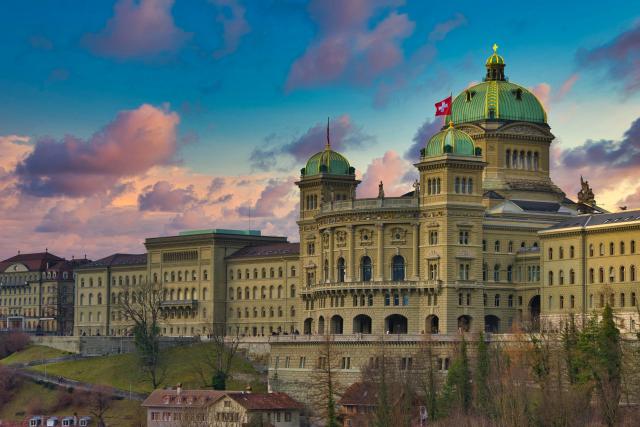
Swiss President Guy Parmelin received Sheikh Tamim bin Hamad Al Thani on the Federal Square in Bern at the start of a two-day state visit. The emir then held talks with Parmelin, Foreign Minister Ignazio Cassis, Finance Minister Karin Keller-Sutter and Energy Minister Albert Rösti.
The two sides signed two letters of intent, one on development aid and one on tourism, according to Swiss news site watson. On Thursday, the emir and Parmelin are due to meet business leaders.
Both countries have built reputations as go-betweens in other people’s wars, and that shared role was at the heart of the visit.
Parmelin said both are relatively small countries, and that what counts is openness to the world and the ability to build bridges, rather than size. Their experience in mediation complements each other, he added.
The partnership is already active. Switzerland and Qatar have mediated together in Colombia and between the United States and Iran, Swiss public broadcaster Schweizer Radio und Fernsehen (SRF) reported. Qatar, working with the United States, also mediates between the government and rebels in eastern Congo.
The Iran war has added urgency to that work. Qatar and Pakistan have acted as mediators in the conflict, Parmelin said. In June, US and Iranian officials held talks at the Bürgenstock resort above Lake Lucerne, which is owned by Qatar’s state-backed Katara Hospitality.
For Switzerland, Qatar brings things it lacks. Doha offers political will and financial resources and has better access to some parties, said Tim Enderlin, who heads the peace and human rights division at the Swiss foreign ministry.
Not everyone is comfortable. Former Swiss ambassador Günther Bächler, who once mediated on Darfur in Doha, told SRF that Qatar pursues its own interests and favors groups close to it ideologically. He cited Sudan, Somalia, Lebanon and Syria.
In the Darfur talks about 15 years ago, Qatar leaned toward the Sudanese government, and a deal was signed without the main rebel groups, Bächler said. He urged Switzerland not to let itself be used and to work closely with like-minded countries such as Norway or Austria.
The relationship has grown quickly. The two countries have had diplomatic ties since Qatar’s independence in 1973 but opened embassies in each other’s capitals only in 2013, the Swiss government said.
Money is a key pillar. An investment protection agreement has been in place since 2004, and the European Free Trade Association (EFTA), which includes Switzerland, signed a free trade deal with the Gulf Cooperation Council (GCC) in 2014. Qatar has since made considerable direct investments in Switzerland, the government said.
The two countries also work together on labor migration, education and research.
Energy supply was also on the agenda. Qatar is one of the world’s leading exporters of liquefied natural gas, much of it shipped to Asia.
Parmelin said Swiss companies still have room to expand their investment in Qatar, and that Doha wants the same.
For Switzerland, which prides itself on neutrality, the challenge is to gain from Qatar’s money and reach without losing its own reputation as an honest broker.
Tags: Switzerland, Qatar, Sheikh Tamim bin Hamad Al Thani, Guy Parmelin, Ignazio Cassis, Karin Keller-Sutter, Albert Rösti, mediation, Iran, Bürgenstock, Katara Hospitality, Günther Bächler, Tim Enderlin, EFTA, GCC, LNG
Copyright ⓒ Aju Press All rights reserved.
Related News
-
 Iran, U.S., and Qatar Begin Tripartite Talks in Switzerland
Iranian Foreign Minister Seyyed Abbas Araghchi and Iranian Parliament Speaker Mohammad Bagher Ghalibaf are seen at the Bürgenstock Resort near Lucerne, Switzerland. Iran, the United States, and Qatar have commenced tripartite talks in Switzerland. The discussions are expected to focus on a comprehensive ceasefire plan for Lebanon and the release of Iran's frozen assets abroad. According to Iran's state broadcaster IRIB, delegations from Iran, the U.S., and Qatar are currently engaged in negotiations at a Swiss venue. Earlier, the Iranian Foreign Ministry confirmed the meeting schedule for the U.S. and Iranian delegations, stating that Pakistan would also participate as a mediator alongside Qatar. Both sides have reportedly dispatched a significant number of high-ranking officials to the talks. The Iranian delegation includes Parliament Speaker Mohammad Bagher Ghalibaf, Foreign Minister Seyyed Abbas Araghchi, and Ali Bagheri Kani, the Deputy Secretary of the Supreme National Security Council for international affairs. Economic officials such as Abdolnaser Hemmati, the Governor of the Central Bank, and Hamid Borde, Deputy Minister of Oil, are also part of the team. On the U.S. side, key negotiators Jared Kushner and Steve Witkoff have completed preliminary technical arrangements, and Vice President JD Vance has joined the negotiations.* This article has been translated by AI.
-
 Qatar Secures First World Cup Points with Last-Minute Equalizer Against Switzerland
Qatar has achieved its first-ever points in a World Cup tournament at the 2026 FIFA North America World Cup. On June 14, Qatar (ranked 56th in the world) drew 1-1 with Switzerland (19th) in their opening Group B match at the Bay Area Stadium in San Francisco, California. Previously, Qatar participated in the 2022 World Cup as the host nation but lost all three of its matches. However, this time, they secured a point against a strong Swiss team, marking a significant milestone. Switzerland dominated the early stages of the match, taking the lead with a penalty goal from Breel Embolo in the 17th minute. They continued to apply pressure, outshooting Qatar 27 to 6. Despite being down 0-1 and facing defeat, Qatar refused to give up. In the fourth minute of stoppage time, a cross from Huam Ahmed was headed in by Boualam Rufi, resulting in a dramatic equalizer. The match ended in a 1-1 draw, allowing Qatar to celebrate its first-ever World Cup points. Meanwhile, Group B also saw Canada and Bosnia end their match in a 1-1 draw, leaving all four teams with one point each.* This article has been translated by AI.