
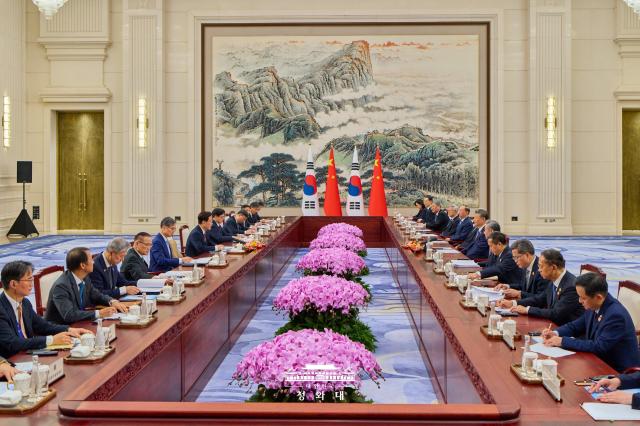
President Lee Jae Myung and Xi announced the substantive conclusion of follow-up negotiations on services and investment under their free trade agreement at a summit in Shenzhen on Wednesday. The breakthrough capped eight years and eight months of talks.
China agreed to grant most-favored-nation treatment to Korean films and games and apply a nondiscrimination principle when prescreening Korean content. According to the Ministry of Trade, Industry and Resources, this is the first time Beijing has included those commitments in a trade agreement.
Lee said on X the deal "will lay the foundation for building a new future for Korea-China relations, beyond a full and substantive restoration of ties."
Industry Minister Kim Jung-kwan called it "a stable institutional foundation to enter the Chinese market."
The agreement offers the clearest indication yet that Beijing may loosen "hanhallyeong," the unofficial restrictions on Korean entertainment that followed Seoul's 2016 decision to deploy the U.S. THAAD missile defense system. China has never acknowledged the ban, but K-pop acts with Korean members have been largely shut out of mainland concert stages.
A full reopening, however, remains unconfirmed. Neither side's published summit documents explicitly authorize K-pop concerts on the mainland.
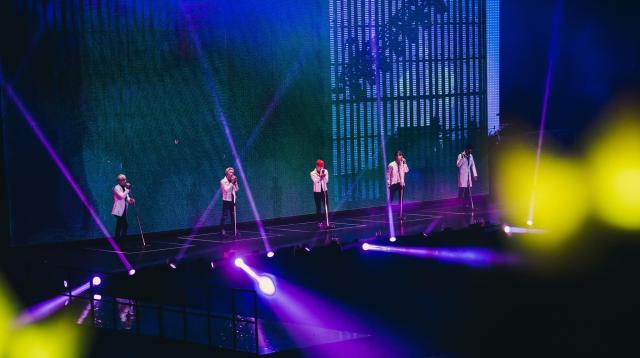
BIGBANG's 2016 tour remains the last large-scale K-pop concert held in mainland China, following a tour that drew about 250,000 fans across 13 Chinese cities the previous year. A roughly 1,000-seat show by the all-Korean boy band EPEX, approved for May 2025 in Fuzhou, was postponed over "local circumstances" and never held.
At least 15 events featuring Korean stars, mostly fan meetings, have been canceled or postponed in China since May.
Korean titles accounted for nine of the 36 imported games approved through late July. The Korean tally reached 12 by late August, including Netmarble's "Solo Leveling: Arise" and Devsisters' "Cookie Run: Tower of Adventures."
Once in force, the agreement would give Korean publishers a treaty basis to challenge treatment less favorable than that afforded to other foreign studios. Analysts have singled out Krafton, which earns royalties from Tencent's "Game for Peace," the Chinese version of "PUBG Mobile," and Wemade, owner of the "Legend of YMIR" franchise.
Chinese studios, meanwhile, already have a firm foothold in Korea. HoYoverse, the Shanghai-based developer of "Genshin Impact," returns to G-Star in Busan on Thursday with a 100-booth presence, its first appearance in four years. Nexon, NC and Netmarble are foregoing large booths.
"Korea has always been an important pillar of our global community," said Sam, HoYoverse's global PR communications lead, as the studio prepared the first offline Korean showings of "Honkai: Nexus Anima" and "Petit Planet."
Broadcasters and film studios could also gain substantially. The two countries agreed to extend co-production status, previously limited to films, to dramas, animation, variety shows and documentaries.
China treats qualifying co-productions as domestic content, exempting them from import quotas, according to the Ministry of Culture, Sports and Tourism.
The potential opening is significant for sectors with limited access to Chinese audiences. Korea's game exports to China reached $1.9 billion in 2024, while broadcasting and film exports earned just $15 million and $7 million, respectively, according to the Korea Creative Content Agency.
More licensed deals could also provide an alternative to imitation. Tencent Video's cooking contest "Yi Fan Feng Shen" drew plagiarism accusations in 2025 for mirroring Netflix's "Culinary Class Wars," whose format rights Netflix said it had never sold in China.
Game stocks joined the rally, with Netmarble up 5.29 percent at 32,850 won, NCSoft 4.01 percent at 191,900 won and Krafton 3.20 percent at 203,000 won, while Tokyo-listed Nexon rose 2.68 percent to 3,147 yen.
"As the possibility that performances will visibly resume in some form has become real, a rerating of the entertainment sector as a whole will gain momentum," said Lee Hwa-jung, an analyst at NH Investment & Securities.
Other analysts cautioned that the agreement does not immediately authorize concerts or guarantee more game approvals. At their January summit, Lee and Xi agreed to expand cultural exchanges gradually, starting with areas acceptable to both sides.
The agreement still requires signing and completion of domestic approval procedures before taking effect. For entertainment companies and investors, the next test will be whether the diplomatic opening translates into licenses, distribution deals and performances.
The deal takes effect only after both sides sign the text and it is ratified by Korea's National Assembly and the Standing Committee of China's National People's Congress.
Copyright ⓒ Aju Press All rights reserved.
Related News
-
 Chinese Ambassador: 'Hot Pot and Tteokbokki in Daily Life'... China Promotes Korea-China Cooperation
The People's Daily, the official newspaper of the Chinese Communist Party, published an op-ed by the Diving Ambassador to South Korea on November 19, expressing optimism for Korea-China friendship and cooperation. The front page of the People's Daily also featured articles and photos related to the Korea-China summit held the previous day during the Asia-Pacific Economic Cooperation (APEC) leaders' meeting. Chinese state media have been consistently promoting messages of improving Korea-China relations and expanding cooperation in economic and cultural fields in conjunction with the Shenzhen APEC.In the op-ed titled 'From Gyeongju to Shenzhen, We Must Leap to a New Stage of Korea-China Friendship and Cooperation,' the Diving Ambassador assessed that there is great potential for the development of Korea-China relations as the two countries approach the 35th anniversary of diplomatic ties next year.The ambassador stated, 'Currently, a transformation not seen in a century is rapidly unfolding globally, and various challenges are constantly emerging,' emphasizing that in the new international situation, both countries must work together to eliminate external obstacles and elevate their friendship and cooperation to a new level.He particularly noted, 'China's development and progress are not a threat to Korea but an opportunity,' asserting that the two countries should solidify their strategic cooperative partnership and respect each other's core interests to become 'long-term neighbors and reliable partners.'The ambassador also evaluated that Korea-China cooperation has encountered new opportunities amid the ongoing technological and industrial revolutions. While it is true that competition between the two countries has somewhat intensified, the strategic importance of cooperation and mutual benefit remains unchanged. He emphasized that China possesses a vast market, a complete industrial supply chain, abundant talent, and extensive application fields, indicating significant potential for expanding cooperation areas and innovating cooperation models.The importance of expanding people-to-people and cultural exchanges was also highlighted. The ambassador noted that thanks to visa facilitation measures, a convenient living zone across the Korea-China border is being formed. He mentioned that Chinese-style hot pot and Korean-style grilled pork belly, as well as Chinese-style mala soup and Korean-style tteokbokki, are increasingly becoming a natural part of daily life for the citizens of both countries. He also expressed hope that active exchanges in various fields such as think tanks, media, sports, and culture will bring the two peoples closer together.Regarding the situation on the Korean Peninsula, he stated, 'China has consistently worked to safeguard peace and stability on the Korean Peninsula and will continue to play an active and constructive role.' He emphasized that Korea and China should jointly oppose protectionism and practice genuine multilateralism. He argued that being vigilant against 'new military imperialism' would help protect the legitimate rights and interests of both countries and uphold fairness and justice in the international community.The front page of the People's Daily prominently featured articles and photos related to the Korea-China summit between President Lee Jae-myung and Chinese President Xi Jinping, alongside articles on the China-Russia summit and U.S. President Donald Trump's visit to China.The main headlines on the front page included Xi's keynote speech at the APEC CEO Summit and his welcoming remarks at the APEC welcome dinner, while the article on the Korea-China summit was published as a major diplomatic agenda alongside the China-Russia summit and Xi's meeting with President Trump.According to reports, during the Korea-China summit, the leaders of both countries evaluated the achievements in the development of Korea-China relations and discussed practical cooperation measures that citizens can feel, including expanding mutually beneficial economic cooperation in trade and investment, revitalizing people-to-people exchanges, and enhancing cultural and content exchanges. Notably, President Xi expressed his willingness to 'gradually promote healthy and beneficial cultural exchanges,' raising expectations for a substantial easing of the Korean cultural content ban and the resumption of exchanges.Chinese state media are highlighting the potential for Korea-China cooperation not only in economic and diplomatic areas but also in culture and advanced technology, in light of the Shenzhen APEC. The previous day, the Chinese state-run Global Times introduced a physical artificial intelligence (AI) fashion show called 'Maha 33' held in Hong Kong on November 16. This event featured participation from Korean and Chinese companies, and Chinese humanoid robots drew attention by dancing to K-Pop music.The Global Times noted the business model that combines Korea's entertainment content with China's humanoid robot manufacturing technology, evaluating that this event showcased new possibilities for technological cooperation between Korea and China.* This article has been translated by AI.
-
China's Airport Reception for Leaders at APEC Shows Disparities
China is drawing global attention for providing varying levels of airport receptions to leaders attending the Asia-Pacific Economic Cooperation (APEC) summit. Notably, Japanese Prime Minister Sanae Takaichi received a simple welcome without a dedicated reception team, prompting complaints from Japan.According to reports from Japanese media such as NHK on November 18, upon arriving at Shenzhen Bao'an International Airport in Guangdong Province, Takaichi was greeted by around 10 members of the Chinese honor guard and officials from the Ministry of Foreign Affairs. The reception was led by Zhang Jiwai, the ambassador in charge of protocol, and there were no crowds or musical performances that had been present for the arrivals of leaders from other countries.In contrast, U.S. President Donald Trump, who arrived on the same day, was personally welcomed at the airport by Chinese President Xi Jinping. The two leaders exchanged handshakes and hugs. The airport reception included a welcoming group with flowers and flags from both countries, and military aircraft performed a welcoming flyover as the two leaders moved.The special reception for President Trump has diplomatic implications. President Xi mentioned during his visit to the U.S. in September that Trump and his wife personally welcomed him at the airport, highlighting a tradition of mutual respect in China. This airport reception is seen as a reciprocation of that hospitality.Russian President Vladimir Putin was welcomed by Cai Qi, a member of the Standing Committee of the Political Bureau of the Communist Party of China. A welcoming event was also held for President Putin.South Korean President Lee Jae-myung and his wife were also greeted by a welcoming group. Upon their early morning arrival at Shenzhen Airport on November 18, a reception team with decorations was prepared.Japanese media have also noted these differences. NHK pointed out that while there were music and cheers for the arrivals of leaders from countries like South Korea and Thailand, there was no similar welcoming event for Prime Minister Takaichi. TBS also highlighted the contrast between the welcoming group for President Lee and the airport arrival of Prime Minister Takaichi.Discontent has emerged within the Japanese government as well. According to the Mainichi Shimbun, an official from the Japanese Ministry of Foreign Affairs criticized the airport reception, stating, "There was not even the minimum diplomatic courtesy, and it is truly rude."These disparities in reception are drawing attention amid deteriorating China-Japan relations. Prime Minister Takaichi had stated last November that Japan could exercise collective self-defense in the event of a Taiwan crisis, which has drawn strong backlash from China.However, unlike the airport reception, the two leaders did shake hands during the official welcoming ceremony. President Xi held hands with Prime Minister Takaichi at the APEC welcoming event held at the Shenzhen International Exchange Center, and the two leaders also took commemorative photos together.* This article has been translated by AI.
-
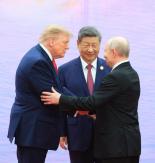 An odd trio steals the limelight at APEC in Shenzhen
U.S., Chinese, and Russian leaders shake hands upon arrival in Shenzhen for the APEC summit. Courtesy of the Chinese Ministry of Foreign Affairs SEOUL, November 19 (AJP) -Red carpets, Cantonese dim sum and the glitter of China’s high-tech showcase city: the trappings of summit diplomacy were all there. But as Asia-Pacific leaders gathered in Shenzhen, the spotlight narrowed to an unusual trio — two authoritarian leaders and a U.S. president eager to demonstrate that he can still command the world’s attention. Donald Trump and Chinese President Xi Jinping are scheduled to meet first on Thursday at 1:45 p.m. Korean time, or 12:45 p.m. in Shenzhen. Russian President Vladimir Putin will join them for three-way talks at 3:30 p.m. Korean time at Shenzhen Kylin Villa. The sequence moves the day from a meeting between the world’s two largest economies to a gathering of three nuclear powers whose ambitions reach well beyond the Asia-Pacific. The setting is the Asia-Pacific Economic Cooperation (APEC) summit, a forum built around trade and economic cooperation. Yet the smaller gathering threatens to eclipse the wider one, with attention shifting to nuclear weapons, war and the influence the three men seek over the international order. Group photo of participating leaders at the APEC summit Shenzhen before a welcome banquet on Nov. 18, Courtesy of Ministry of Foreign Affairs People’s Republic of China The choreography began Wednesday. Xi greeted Trump at the airport with a handshake that became a hug. At the welcome banquet’s group photograph, Trump and Putin stood on either side of their Chinese host. South Korean President Lee Jae Myung and his wife stood beside Trump. South Korea had a front-row seat for the photograph, but it won't likely get a seat at Thursday’s three-way table. Neither will Ukraine or European governments, although any discussion of Russia’s war could touch directly on their security. The distinction between appearing in the picture and participating in the decisions is part of what gives this meeting its weight. Inside the banquet hall, the presentation was more inclusive. Cantonese dishes and wine from China’s Ningxia region offered a taste of the host country, while Xi presented Shenzhen’s transformation from a small border town into a technology center as an argument for openness and cooperation. “To see 50 years of China, come to Shenzhen,” he told his guests. “Openness is in Shenzhen’s DNA. Innovation is the wellspring of Shenzhen’s vitality. Cooperation is the source of Shenzhen’s strength,” the foreign ministry quoted Xi as saying. Xi presented the city’s transformation as a reflection of China’s reform and opening up and an example of Asia-Pacific cooperation. After dinner, the leaders and their spouses attended a gala performance celebrating the region’s cultural diversity, the ministry said. Trump has said he wants to discuss nuclear arms control and ending the war in Ukraine. His aides have offered a narrower account of the agenda, leaving uncertainty over how much of the conflict will enter the three-way talks. A separate Trump-Putin meeting is also planned, according to White House officials. The gathering has invited comparisons with Yalta, where Franklin D. Roosevelt, Winston Churchill and Joseph Stalin met in 1945 to shape the postwar settlement. The analogy has limits. Those leaders were wartime allies approaching a shared victory and negotiated over eight days. The Shenzhen meeting is expected to last roughly an hour, bringing together governments divided over wars, trade, technology and military power and produce little more than photographs for the history books. The political balance is also different. Two of the three leaders at Yalta represented democracies. In Shenzhen, Trump will sit alongside two authoritarian rulers whose partnership is rooted partly in opposition to U.S. dominance. For Xi, hosting offers a chance to present China as a convening power. For Putin, standing alongside the American and Chinese presidents challenges Western efforts to isolate him over Ukraine. For Trump, bruised by the U.S. midterm elections, the gathering offers a chance to reclaim the international spotlight. Those interests can produce a striking photograph. Whether they can produce a common position will become clearer when Putin joins the room. Tags: APEC 2026, Shenzhen summit, Donald Trump, Xi Jinping, Vladimir Putin, U.S.-China relations, China-Russia relations, trilateral summit, nuclear arms control, Ukraine war, Lee Jae Myung, South Korea