

Journalist
Kim Yeon-jae김연재
duswogmlwo77@ajupress.com
ReporterBank of Korea & Market, Macroeconomics
Kim Yeon-jae is a journalist at AJU Press (AJP's English platform),
covering macroeconomics, international finance, and geopolitics.
He closely tracks central bank monetary policies, global energy supply chains,
and the Korean defense industry. "Peering into the risks behind the euphoria."
covering macroeconomics, international finance, and geopolitics.
He closely tracks central bank monetary policies, global energy supply chains,
and the Korean defense industry. "Peering into the risks behind the euphoria."
Latest by Kim Yeon-jae
-
 Kim Jong-un visits China via newly opened Yalu River bridge SEOUL, October 24 (AJP) — North Korean leader Kim Jong-un visited China on Saturday, arriving in the border city of Dandong via a newly opened bridge in his first trip there in more than a year. South Korea's Ministry of Unification said Kim entered Dandong in China's northeastern Liaoning Province through the New Yalu River Bridge earlier in the day. The bridge connects Dandong with the North Korean border city of Sinuiju across the Yalu River, known as the Amnok River in Korea. Neither North Korea nor China had announced Kim's itinerary or the purpose of the visit as of Saturday afternoon. It was also not immediately clear whether Kim would travel beyond Dandong or meet Chinese President Xi Jinping. The visit comes a day before the 76th anniversary of China's entry into the 1950-53 Korean War, when Beijing sent the Chinese People's Volunteers to fight alongside North Korean forces. Kim last visited China in September 2025, when he attended a military parade in Beijing marking the 80th anniversary of the end of World War II and held talks with Xi. Xi made a state visit to Pyongyang in June this year, his first trip to North Korea in seven years. The two leaders agreed during the June summit to elevate bilateral ties to a strategic level and expand exchanges in areas including trade, agriculture, construction and technology. Kim's latest trip comes just nine days after North Korea and China formally opened the New Yalu River Bridge on Oct. 15, ending a delay of more than a decade. The four-lane bridge was completed in 2014 but remained unused for 12 years as connecting roads, customs facilities and other infrastructure on the North Korean side remained unfinished. The Unification Ministry described the bridge's opening last week as the first tangible implementation of agreements reached at the June summit, saying it would closely watch whether the move leads to further steps to deepen strategic ties. Relations between Pyongyang and Beijing have strengthened since Kim's September 2025 trip after a period of relative strain as North Korea rapidly expanded military cooperation with Russia. High-level exchanges have accelerated this year, including Xi's June visit to Pyongyang and reciprocal visits by senior officials marking the 65th anniversary of the China-North Korea Treaty of Friendship, Cooperation and Mutual Assistance. Xi reaffirmed Beijing's commitment to strengthening relations with Pyongyang in a message released earlier this week, saying the two countries had long supported each other. Kim's visit also comes days after unsubstantiated rumors about his death circulated on overseas social media. South Korea's National Intelligence Service told lawmakers Friday that the claims were false, while North Korean state media reported Saturday that Kim had presided over a two-day meeting of military commanders in Pyongyang on Thursday and Friday. 2026-10-24 16:27:09
 -
 North Korea's growth may have exceeded BOK estimate SEOUL, October 24 (AJP) — North Korea's economy may have grown faster last year than the Bank of Korea estimated as wartime income from Russia, closer trade with China and cybercrime generated unusually strong external inflows, a U.S. expert said. Troy Stangarone, co-chair of the North Korea Economic Forum at George Washington University's Institute for Korean Studies, said at a forum in Washington on Thursday that the external economic environment facing North Korean leader Kim Jong Un was the most favorable of his rule. The Bank of Korea (BOK) estimated in July that North Korea's real gross domestic product expanded 3.5 percent in 2025, following growth of 3.7 percent in 2024 and 3.1 percent in 2023. Stangarone said the actual rate may have been higher. He argued that even if only part of the money believed to be flowing from Russia were reflected in available estimates, the sums would still represent a substantial source of income for an economy as small and closed as North Korea's. The BOK produces annual estimates of North Korea's economy because Pyongyang does not publish internationally comparable national accounts. Its calculations use information on economic activity collected by South Korean authorities and apply South Korean prices and value-added ratios, making them estimates of broad economic trends rather than conventional national accounts based on data released by the country itself. Stangarone identified North Korea's rapidly expanding relationship with Russia as one of the main reasons its economic conditions may be stronger than official estimates suggest. Pyongyang has deepened military and economic cooperation with Moscow during the war in Ukraine, providing troops and military supplies while gaining access to revenue and other forms of assistance. Stangarone said those benefits may continue even after the war ends because Russia would still need to replenish ammunition and military equipment. North Korea could continue receiving significant income from Russia for another two or three years after the conflict, he said. Closer economic ties with China and proceeds from cybercrime have also strengthened Pyongyang's access to foreign currency, according to Stangarone. The combination could help explain why North Korea's recent recovery appears relatively strong despite sanctions, limited access to foreign investment and longstanding weaknesses in domestic infrastructure. The BOK estimated that North Korean manufacturing output increased 6.6 percent in 2025, while construction grew 6.3 percent and agriculture, forestry and fisheries expanded 3.6 percent. The economy has now grown by more than 3 percent for three consecutive years after contracting 4.5 percent in 2020, 0.1 percent in 2021 and 0.2 percent in 2022. North Korea's estimated growth rate also exceeded South Korea's over the same three years, compared with South Korean growth of 1.5 percent in 2023, 2.2 percent in 2024 and 1.1 percent in 2025. The comparison, however, does not mean the North Korean economy is approaching South Korea in size or living standards. A smaller economy can post a higher percentage growth rate from a much lower base, while North Korea remains only a fraction of South Korea's economic size. The BOK estimated North Korea's nominal gross national income at 48.5 trillion won ($36.7 billion) in 2025, equivalent to just 1.8 percent of South Korea's 2,717.1 trillion won. Per capita GNI stood at an estimated 1.87 million won in the North, compared with 52.57 million won in South Korea, leaving the South's figure about 28 times larger. The central bank also cautions that its North Korean figures should not be interpreted with the same precision as statistics produced from conventional national accounts. The larger question is whether Pyongyang can turn its current influx of external income into sustainable domestic growth. Electricity, gas and water supply declined 0.4 percent in 2025 even as manufacturing and construction expanded, underscoring persistent weaknesses in the infrastructure needed to support industrial growth. Stangarone said North Korea could continue building factories and industrial facilities but would struggle to translate them into lasting increases in production without enough electricity to operate them. Pyongyang therefore faces a limited window to use the economic benefits of its ties with Russia, China and other external income sources to strengthen its productive capacity before the unusually favorable conditions begin to fade. 2026-10-24 14:49:26
 -
 KEPCO bond cap revives Korea's electricity rate dilemma SEOUL, October 24 (AJP) — South Korea's long-running electricity rate debate is resurfacing as state utility Korea Electric Power Corp. (KEPCO) faces a looming borrowing limit that could constrain investment in the country's rapidly expanding power grid. KEPCO could exceed its statutory bond issuance ceiling by about 19.2 trillion won ($14.5 billion) once a temporary exemption expires at the end of 2027, according to estimates based on the utility's medium-term financial plan. Its outstanding bonds are projected to reach about 76 trillion won by the end of next year, compared with an estimated statutory ceiling of 56.8 trillion won when the normal limit returns in 2028. The problem dates back to 2021, when global fuel prices began rising faster than KEPCO was allowed to pass through to customers. The state utility buys electricity from generators and resells it to households and businesses at regulated prices, leaving it exposed when coal, liquefied natural gas and other fuel costs rise sharply. Korea introduced a fuel-cost adjustment system in 2021, but calculated increases were repeatedly withheld as the government sought to shield households and businesses from the economic effects of the COVID-19 pandemic and rising inflation. The imbalance worsened after Russia invaded Ukraine in 2022, pushing KEPCO from a consolidated operating loss of 5.8 trillion won in 2021 to a record 32.7 trillion won loss the following year. As losses mounted, KEPCO increasingly relied on bond issuance to fund operations. The Yoon Suk Yeol administration responded with a series of electricity rate increases beginning in 2022 and accelerating in 2023, including hikes of 13.1 won per kilowatt-hour in January 2023 and another 8 won in May. Lawmakers also temporarily raised KEPCO's bond issuance ceiling at the end of 2022, allowing the company to borrow up to five times its capital and reserves through 2027, while the utility launched asset sales, investment adjustments and other cost-cutting measures. Falling fuel prices, higher electricity rates and restructuring gradually restored profitability, with KEPCO's operating loss narrowing to 4.5 trillion won in 2023 before swinging to profits of 8.4 trillion won in 2024 and 13.5 trillion won last year. Its balance sheet recovered much more slowly because years of losses had already been financed largely through borrowing. In October 2024, the government raised industrial electricity rates by an average 9.7 percent but froze residential and general-use rates, citing inflation and pressure on household finances. The Lee Jae Myung administration has so far focused more on restructuring industrial tariffs than on a broad household increase, lowering some daytime industrial rates while raising evening charges and preparing regional pricing aimed at making electricity cheaper in areas closer to major power generation sources. Those changes may redistribute costs among businesses but do little by themselves to reduce KEPCO's accumulated debt, even as the utility faces rising investment needs for the power grid. KEPCO's latest long-term transmission plan calls for about 72.8 trillion won in grid investment through 2038 as semiconductor clusters, artificial intelligence data centers and wider electrification sharply increase power demand. KEPCO President Kim Dong-cheol told lawmakers this month that the company would need to discuss at least a minimal electricity rate increase with the government as grid investment continues to climb. Allowing the temporary bond ceiling to expire without sharply reducing debt could leave KEPCO above its legal borrowing limit, while extending it again would postpone rather than solve the underlying financial problem. Raising electricity rates would strengthen KEPCO's finances and help fund new infrastructure, but would also increase costs for households and businesses — the same trade-off that has defined Korea's electricity policy since the energy shock began. 2026-10-24 13:21:27
 -
 Suspected North Korea-linked hackers target Korean banks, government SEOUL, October 24 (AJP) — A suspected North Korea-linked hacking operation is preparing cyberattacks against government agencies and financial institutions, including those in South Korea, by exploiting newly discovered weaknesses in software widely used to run websites. Singapore-based cybersecurity firm CYFIRMA said it detected Korean-speaking operators discussing targets and attack preparations on a closed anonymous network on Thursday. The firm said it was highly confident that an attack campaign was being prepared, but assessed only with moderate confidence that the operators were linked to North Korea's Lazarus Group. At the center of the threat are two serious security flaws collectively known as PHP2Shell. PHP is a programming language used behind the scenes by a large share of the world's websites. It handles tasks such as processing information sent through websites and communicating with servers and databases. The newly discovered flaws can, under certain conditions, allow an attacker to send a specially crafted request to a vulnerable website and make its server carry out commands without first logging in. That could give hackers a foothold to steal information, install malicious software or move deeper into a company's network. The flaws received a severity score of 9.2 out of 10, and emergency fixes were released on Oct. 21. CYFIRMA said the suspected attackers were no longer simply looking broadly for vulnerable websites but were sorting potential targets by country and industry. Government agencies, banks and other financial institutions were listed as the highest priorities, followed by manufacturers, logistics and shipping companies, airports, online transaction services, trading firms and construction companies. South Korea was among the countries singled out, along with the United States, Japan, Australia, Taiwan, India, Singapore, the United Arab Emirates, Saudi Arabia and several other markets. The operators had already prepared 15 pieces of online infrastructure to support the campaign and were expected to complete an initial list of selected targets by Sunday, Oct. 25, according to CYFIRMA. No specific date for an attack has been identified. The security firm also detected 17 internet addresses on Friday attempting techniques similar to those expected in attacks using the PHP flaws. It cautioned that those addresses have not been proven to belong to the same suspected North Korea-linked group. Artificial intelligence also appears to be playing a role in the preparations. CYFIRMA said the operators were collecting attack methods that had already been published by security researchers and using an AI model to decide which were most promising before testing them in a controlled environment. Rather than inventing an entirely new hacking method, the group appeared focused on quickly turning publicly available information about the new security flaws into a usable attack. The operators also discussed avoiding large-scale scans that could draw attention before their targets had been selected, the firm said. CYFIRMA said the campaign was significant because government and financial organizations appeared to be deliberately targeted, rather than becoming random victims of hackers searching the internet for any vulnerable server. Still, the firm stressed that the connection to Lazarus has not been proven. Its assessment is based on the use of Korean in the intercepted discussions, the choice of government and financial targets and similarities to methods previously associated with Lazarus. CYFIRMA said it had not found malware or online infrastructure that directly matched known Lazarus operations. The warning comes as South Korean companies and financial institutions are already on heightened alert after a separate wave of hacking incidents. Shinhan Bank, KB Kookmin Bank and Hana Bank were among financial firms that reported customer data leaks after attacks beginning in late September, while several other lenders detected and blocked intrusion attempts. U.S. cybersecurity firm CrowdStrike assessed with moderate confidence that those attacks were carried out by a financially motivated actor likely to be a Chinese speaker. AI-assisted hacking tools were also found to have been used during the attacks. There is no evidence connecting those incidents to the suspected North Korea-linked PHP campaign. But the emergence of a separate possible state-linked threat adds to cybersecurity concerns among Korean companies and public institutions already dealing with repeated attempts to break into their systems. South Korea raised its private-sector cyber crisis alert level from "Attention" to "Caution" this week after the PHP vulnerabilities became public. The Ministry of Science and ICT and the Korea Internet & Security Agency (KISA) have urged companies and institutions operating websites to install the latest PHP security updates immediately. Older versions that no longer receive official security updates should be replaced, while servers that cannot be updated promptly should be isolated or have outside access restricted, authorities said. The government has warned that the flaws could affect a large number of websites because PHP is so widely used. CYFIRMA similarly advised organizations in the industries and countries identified by the suspected attackers to update their systems immediately and check whether there have been signs of intrusion since Oct. 17. 2026-10-24 12:26:39
 -
 Korea cuts red tape to speed chip fab construction SEOUL, October 24 (AJP) — South Korea plans to cut semiconductor industrial complex development times to within five years by fast-tracking permits, compensation and design, the government said Friday. The plan would reduce the period from industrial complex planning to fab operations from more than 10 years by allowing approvals, land compensation and design procedures that are largely carried out sequentially to proceed simultaneously. The measure is part of 13 regulatory changes unveiled at a meeting of the Presidential Regulatory Rationalization Committee as the government seeks to accelerate semiconductor investment amid intensifying competition over artificial intelligence chips and advanced manufacturing capacity. An amendment to the Industrial Sites and Development Act enabling the fast-track process was introduced in July, while additional infrastructure approvals could be handled together if a semiconductor cluster is designated as a super-regional strategic industry special zone under legislation being pursued by the government. Customs and bonded-zone procedures will also be streamlined across fab construction, equipment maintenance and exports. The government plans to expand the designation of entire advanced industrial complexes as comprehensive bonded zones, reducing procedures currently handled separately by individual fabs. About 95 percent of Korea's semiconductor exports are manufactured or processed at bonded factories, according to the industry ministry. Foreign equipment used during fab construction would become eligible for deferred customs payments, while repair parts for overseas-made chipmaking equipment could be stored at bonded factories in advance to reduce production disruptions when machinery breaks down. Qualified bonded factories located far from airports or ports would also be allowed to transport pre-approved export goods before completing export declarations and file them while shipments are in transit. Regulations covering high-pressure gases used in semiconductor manufacturing will be revised to allow technical reviews and permit changes for multiple gas cabinets to be processed together and non-reactive gases to be stored together. The government will also consider special working-hour arrangements for key semiconductor R&D personnel in super-regional special zones, subject to compensation, worker health protections and consultations with labor and management. Procedures for moving R&D prototypes out of qualified bonded factories for testing and inspection will be simplified, while tax exemptions will be introduced for equipment donated to nonprofit semiconductor test-bed operators to expand testing opportunities for domestic materials, parts and equipment suppliers. Industry Minister Kim Jung-kwan said speed had become increasingly important in global semiconductor competition, with delays in infrastructure, construction or technology development potentially affecting companies' investment schedules and ability to secure markets. The government plans to use a presidential semiconductor competitiveness committee as a cross-government coordinating body and a new industry ministry support unit to track corporate investment schedules from fab construction through operation. The system is intended to resolve issues spanning multiple ministries and local governments before they delay investment projects. The broader regulatory initiative also calls for legislation establishing super-regional special zones offering more than 320 regulatory exemptions and government support covering financing, infrastructure, tax incentives and talent. 2026-10-24 11:34:12
 -
 Oil jumps to nearly 6-month high, reviving Korea's inflation risks SEOUL, October 24 (AJP) — Global oil prices surged to nearly six-month highs Friday as attacks on Saudi Arabia and mounting shipping risks around the Gulf deepened supply fears, adding fresh pressure to South Korea's inflation outlook. Brent crude futures settled at $116.72 a barrel, up $3.55, or 3.14 percent, their highest close since April 29. U.S. West Texas Intermediate crude rose $3.80, or 3.8 percent, to $103.27 a barrel. Brent gained 6 percent for the week, while WTI advanced 2.3 percent. The rally followed a series of attacks by Yemen's Iran-aligned Houthis across Saudi Arabia, including energy infrastructure, as fighting intensified between the group and a Saudi-led coalition. Saudi Aramco ordered staff to evacuate its headquarters in Dhahran on Thursday amid the escalation. Supply concerns were compounded by an oil spill detected from a tanker off the coast of Umm Al Quwain in the United Arab Emirates, while attacks and other security incidents involving commercial vessels have intensified around the Strait of Hormuz and nearby waterways. The renewed surge in energy prices spilled into U.S. financial markets, where the S&P 500 energy sector climbed 2.5 percent to a record high on Friday. Broader Wall Street indexes ended lower, with the Dow Jones Industrial Average falling 1.23 percent, the S&P 500 losing 0.52 percent and the Nasdaq Composite slipping 0.21 percent. The benchmark U.S. 10-year Treasury yield rose 3.7 basis points to 4.99 percent as persistent inflation concerns offset some of the safe-haven demand that had driven yields sharply lower a day earlier. The latest increase in crude prices comes as major economies are already grappling with renewed energy-driven inflation pressures. The U.S. Department of Energy on Friday authorized an emergency exchange of up to 400,000 barrels of crude from the Strategic Petroleum Reserve to address a supply disruption affecting Phillips 66's Lake Charles refinery in Louisiana. Germany's oil stockpiling agency has also moved to sell crude and refined products from strategic reserves, while production at two Libyan oilfields was reduced after a pipeline valve leading to the Zawiya export terminal was shut. For South Korea, which depends heavily on imported energy, the latest oil surge adds to price pressures that were already building before Friday's rally. Won-denominated import prices rose 1.7 percent in September from August and 17.6 percent from a year earlier, according to the Bank of Korea (BOK), as a sharp increase in crude prices outweighed the impact of a stronger won. Dubai crude averaged $113.71 a barrel in September, up 28.1 percent from $88.75 in August. Consumer inflation stood at 2.9 percent in September, while core inflation excluding food and energy was 2.8 percent. The BOK on Thursday kept the base rate unchanged at 3.00 percent after two consecutive increases in July and August, but said inflation was likely to remain above its 2 percent target for a considerable period. The central bank expects this year's headline inflation to remain broadly in line with its August forecast of 2.7 percent, while next year's rate is now expected to exceed the previous 2.3 percent projection. It identified global oil prices and the exchange rate among the main uncertainties surrounding the inflation outlook. Governor Shin Hyun-song said after Thursday's rate decision that the pass-through of cost pressures from rebounding oil prices was strengthening even as the won appreciated. The Monetary Policy Board said it would determine the timing and pace of any further rate increases after assessing inflation, growth and financial stability. The next rate decision is scheduled for Nov. 26, when the BOK will also release updated economic forecasts. 2026-10-24 09:03:32
 -
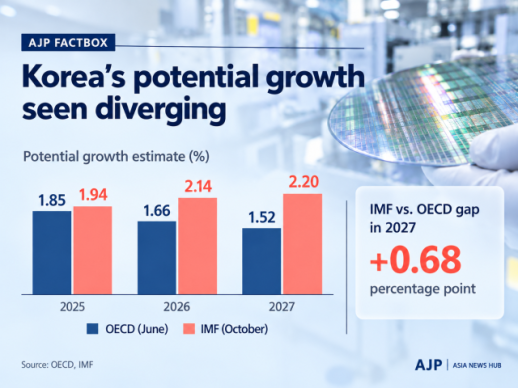 AJP Factbox: Korea's growth potential gains AI traction South Korea's potential growth outlook is becoming less clear-cut as the AI and semiconductor boom boosts investment and raises hopes of stronger productivity. OECD estimates point to a decline from 1.85 percent in 2025 to 1.52 percent in 2027, while calculations based on the IMF's latest GDP and output-gap forecasts imply a rise from 1.94 percent to 2.20 percent over the same period. Whether the improvement lasts will depend on how widely the gains spread. IMF research suggests broader AI adoption and more efficient allocation of labor and capital could offset a significant part of the drag from population aging, while the Bank of Korea says lasting gains will require higher productivity beyond the semiconductor sector. Its year-end reassessment of potential growth will offer an important test of whether the current boom is cyclical or structural. 2026-10-23 17:10:27
 -
 AI halo may warm South Korean economy longer than expected SEOUL, October 23 (AJP) — The extraordinary AI windfall may be strong enough to lift South Korea’s long-term growth potential, suggesting the AI halo over Asia’s fourth-largest economy could be broader and longer-lasting than previously expected. Bank of Korea Governor Shin Hyun-song on Friday suggested the economy could be at an inflection point as the central bank prepares to reassess its underlying growth capacity. “I think this is a very important turning point,” he said during a parliamentary audit. The BOK last estimated potential growth at around 2 percent for 2024–2026 and plans to publish an updated estimate before year-end. Before the chip bonanza, expectations had increasingly pointed toward a decline into the 1 percent range. Potential growth is the pace at which an economy can sustainably expand without generating accelerating inflation. It depends on the supply of labor and capital and how efficiently they are used. Korea’s rate stood at around 5 percent in the early 2000s before slowing to the mid-3 percent range in the 2010s as contributions from all three weakened. The BOK now expects actual growth this year and next to run “well above” its August forecasts of 3.3 percent and 2.9 percent, respectively. A prolonged expansion could strengthen the case for a higher potential-growth estimate if the windfall translates into lasting investment and productivity gains. The distinction is between an economy enjoying a powerful upswing and one becoming capable of sustaining faster growth. The central bank said in May that the impact would depend on whether the semiconductor boom represented a permanent change or remained part of a cyclical upswing. The latter would have a much more limited effect on potential growth. “Historically, structural changes often become apparent only in hindsight,” said Lee Ji-ho, now a BOK deputy governor and then head of its Research Department. He cautioned that it was too early to conclude that the expansion represented such a shift. International estimates already suggest different trajectories. The Organization for Economic Co-operation and Development (OECD) estimated in June that Korea’s potential growth would decline from 1.85 percent in 2025 to 1.66 percent in 2026 and 1.52 percent in 2027. Calculations based on real GDP and output-gap forecasts in the International Monetary Fund’s (IMF) October World Economic Outlook, however, imply potential growth of about 1.94 percent in 2025, 2.14 percent in 2026 and 2.20 percent in 2027. The estimates are not directly comparable. The OECD uses a production-function approach, while the IMF figures are derived from its GDP and output-gap projections rather than published as a standalone potential-growth forecast. Timing also matters: the IMF’s October outlook incorporates a much stronger semiconductor cycle than the OECD’s June projections. The BOK combines several methods, including models of productive capacity and statistical estimates of underlying trends, rather than relying on a single measure. For Shin, productivity will ultimately determine whether the investment boom changes Korea’s long-term trajectory. “Total factor productivity itself may rise, but sustaining a higher growth rate requires further gains through innovation,” he told lawmakers. That remains an unfinished transition. A June BOK study found that generative AI reduced working time by an average of 3.8 percent, or about 1.5 hours a week. It estimated a potential productivity gain of around 1 percent if all the saved time were redirected toward productive activity. Yet the study found essentially no relationship between time saved and actual output growth. Researchers concluded that AI had reached an “efficiency stage” but not yet a “productivity stage.” Broader gains would require changes in workflows, organizational structures, task allocation and incentives. Such gains could help counter the demographic forces weighing on Korea’s growth capacity. IMF economists led by Korea mission chief Rahul Anand estimated that population aging could reduce average annual potential growth by 0.67 percentage point between 2023 and 2050, while broader AI adoption could raise it by as much as 0.44 percentage point. “Accelerating structural reforms remains crucial to boost Korea’s potential growth,” Anand said in an IMF statement last year. He called for a narrower productivity gap between large companies and smaller firms and greater use of innovation and AI. More efficient allocation of labor and capital could add another 0.22 percentage point, while greater participation by women and older workers could offset about one-fifth of the drag from aging. The BOK’s long-term simulations similarly point to productivity as the strongest lever. Higher total factor productivity growth could lift potential growth in the late 2040s by around 0.7 percentage point, compared with 0.1 to 0.2 percentage point from higher fertility. Taiwan offers an illustration of how AI demand can spread beyond export earnings. Its statistics agency expects growth of 11.05 percent in 2026 and 6.04 percent in 2027. Real private fixed capital formation is projected to rise 11.58 percent this year as AI demand drives capacity expansion across the semiconductor supply chain. The island’s central bank forecasts growth of 11.48 percent this year and 5.82 percent in 2027, with AI and high-performance computing demand supporting exports and investment while stronger wages and domestic activity underpin consumption. Those forecasts do not establish a permanent increase in potential growth. They do, however, illustrate how an export windfall can spread through investment, supply chains and household spending. For Korea, the durability of the chip halo will depend on how far those gains reach. Productivity improvements across manufacturing and services could help pull the economy away from a sub-2 percent potential-growth path. Gains concentrated in chip prices, factory utilization and a handful of large exporters would leave it more exposed when the cycle turns. The BOK’s year-end estimate will offer an official assessment of whether the boom has simply made Korea grow faster for a time — or begun to raise the speed it can sustain. 2026-10-23 17:08:51
 -
 AI boom may lift Korea's growth potential, BOK chief says SEOUL, October 23 (AJP) —South Korea may have to revisit its growth potential to better reflect the economy's newfound traction from AI boom, said Bank of Korea Governor Shin Hyun-song said Friday. “I think this is a very important turning point” Shin said of the country's growth potential during a parliamentary audit. South Korea’s potential growth rate — the pace at which the economy can expand without generating excessive inflation — has been estimated to have fallen below 2 percent after the economy underperformed its potential for the last four years. The Bank of Korea (BOK) plans to publish a new estimate of Korea's potential growth rate in a working paper before the end of the year. The central bank last estimated potential growth at around 2 percent for 2024 to 2026, down from around 5 percent in the early 2000s and the mid-3 percent range in the 2010s. Shin said total factor productivity (TFP), rather than labor input alone, would be critical to determining whether the recent AI and semiconductor investment boom could lift Korea's underlying growth capacity. The assessment comes as the BOK prepares to raise its forecasts for both economic growth and inflation. “We are looking at growth this year and next year as higher than our August forecasts,” Shin said. The BOK forecast in August that South Korea's economy would expand 3.3 percent in 2026 and 2.9 percent in 2027. It said after Thursday's monetary policy meeting that growth in both years would “considerably exceed” those projections, supported by strong semiconductor exports and investment and their growing spillover into domestic demand. Shin said the stronger growth outlook would also put upward pressure on next year's inflation forecast and would be reflected in the central bank's monetary policy. The BOK held the base rate at 3.00 percent on Thursday in a unanimous decision after quarter-percentage-point increases in July and August. Shin said Friday that the board would assess the effects of those two increases before deciding whether further adjustments were needed. He did not endorse market estimates that the terminal rate could reach between 3.50 percent and 3.75 percent. The central bank will release updated growth and inflation forecasts alongside its final monetary policy decision of the year on Nov. 26. Shin also said the recent appreciation of the won partly reflected an unwinding of its earlier weakness and stronger confidence in the Korean economy. Despite the gains, the won remained weaker than its historical average on a real effective exchange-rate basis, he said. Shin declined to give a specific level for the dollar-won exchange rate but said a stronger currency could help contain import prices and improve household purchasing power. He also said this year's current account surplus was likely to exceed the BOK's August forecast as semiconductor exports remained strong. On the government's petroleum price cap, Shin said the measure had lowered inflation by about 0.6 percentage point this year by limiting the pass-through of higher fuel costs to other goods and services. He said the measure had produced a significant short-term effect but should not be maintained indefinitely because prolonged price controls could distort prices and increase the fiscal burden. Shin also supported investment aimed at raising Korea's long-term growth rate while warning that permanent spending programs financed by temporary revenue could weaken fiscal sustainability. The remarks reinforced the BOK's view that stronger AI-led growth could improve Korea's longer-term economic capacity while keeping near-term inflation pressure high enough to delay any shift toward monetary easing. 2026-10-23 15:28:31
 -
 BOK chief's inflation outlook hints rates unlikely to come down before '28 SEOUL, October 22 (AJP) - Bank of Korea Governor Shin Hyun-song on Thursday credited the board’s two successive summer rate hikes with helping cool inflation and steady currency and debt markets while signaling that rates won't likely come down before 2028. Speaking after the monetary policy board unanimously held the base rate at 3.00 percent, Shin described the pause as the payoff from acting early. The BOK raised rates by a quarter percentage point in both July and August after holding them at 2.50 percent for more than a year. “At the August increase, I said we had dealt with a hoe with what would otherwise have required a spade. This hold is the fruit of that hoeing,” he said, invoking a Korean proverb about addressing a problem before it demands a bigger intervention. Shin said the unanimous decision reflected “considerable agreement on economic conditions, including inflation and growth, and on the overall assessment of our preemptive monetary policy.” “Our preemptive response helped keep domestic financial markets stable despite the U.S. Federal Reserve’s rate increase in September, and the (dollar-won) exchange rate also stabilized,” he said. The pause nevertheless came with a firm commitment to maintain a restrictive policy stance. “Growth and inflation appear likely to be stronger than projected in August, so we need to maintain the current restrictive policy stance,” Shin said. “We will respond until we are confident that inflation will settle sustainably at the target level of 2 percent.” That did not mean forcing inflation back to target next year regardless of other economic conditions, he added. “The principle is to achieve the inflation target within the monetary policy horizon while taking other conditions into account, rather than achieving it immediately next year,” he said. “We expect inflation to approach the target level in the year after next.” His remarks point to a prolonged period of policy restraint as inflation remains above target through 2027, with a return toward 2 percent expected around 2028. They do not, however, set a fixed timetable for further increases. Shin said the earlier hikes had given the board room to wait for more evidence before deciding its next move. “Upside risks to growth and inflation appear to have increased compared with the August forecasts, but we judged that it would not be too late to assess them further through incoming data, including third-quarter real GDP and October inflation,” he said. The unanimous pause and Shin’s measured tone supported the won and government bonds. The won strengthened 4.3 won to 1,323.2 per U.S. dollar at around 2 p.m., while government bond yields edged lower. The three-year yield fell 2.4 basis points to 3.808 percent and the 10-year yield declined 3.2 basis points to 4.135 percent. The BOK did not release an updated board interest-rate dot plot in October. The next update is expected in November, at its final rate-setting meeting of the year. An AJP poll suggests economists see further tightening ahead, with 3.50 percent emerging as the most widely expected peak. Four of the six economists who provided a terminal-rate forecast expected 3.50 percent. One forecast 3.75 percent, while another saw scope for rates to reach that level if strong semiconductor-led growth persists. NH Investment & Securities analyst Kang Seung-won also views 3.50 percent as an important threshold, although his assessment of the current policy stance differs from the governor’s. “Rates would need to rise to 3.50 percent before monetary policy can be considered restrictive under the current economic conditions,” Kang said. “A rate cut would only be possible once it is clear that the semiconductor cycle has turned down,” he added. JPMorgan economist Park Seok-gil is among those placing the peak at 3.75 percent. He expects three further quarter-point increases through the second quarter of 2027. Whether the cycle stops around 3.50 percent or extends toward 3.75 percent will depend largely on the durability of Korea’s growth momentum and the inflationary pressure accompanying it. The BOK said Thursday that growth this year and next would “considerably exceed” its August forecasts of 3.3 percent and 2.9 percent, respectively. Strong exports and investment are driving the expansion, while improving income conditions are expected to gradually broaden the recovery in consumption. Recent trade data show little sign of a slowdown in the semiconductor-led expansion. Exports surged 105.4 percent from a year earlier to $61.6 billion in the first 20 days of October, with semiconductor shipments reaching a record $27.5 billion for the period. Inflation, meanwhile, has eased but remains above target. Consumer prices rose 2.9 percent from a year earlier in September, while core inflation excluding food and energy stood at 2.8 percent. Upstream cost pressures remained substantial: producer prices increased 7.7 percent and won-denominated import prices rose 17.6 percent. The BOK expects this year’s headline and core inflation rates to remain broadly in line with its August forecasts of 2.7 percent and 2.5 percent, respectively. The outlook for next year is less favorable. Both measures are now expected to exceed the previous forecasts of 2.3 percent and 2.5 percent as accumulated cost increases feed through to prices and demand-side pressures strengthen. That combination of stronger growth and persistent inflation leaves little room for an early shift toward easing. A sustained slowdown in semiconductors or the broader economy would weaken the case for additional hikes, but Thursday’s pause offered no indication that the tightening cycle was over. The BOK holds its final policy meeting of the year on Nov. 26, when it will also release updated growth and inflation forecasts. 2026-10-22 15:57:38