

Journalist

Kim Yeon-jae김연재
duswogmlwo77@ajupress.com
ReporterBank of Korea & Market, Macroeconomics
Kim Yeon-jae is a journalist at AJU Press (AJP's English platform),
covering macroeconomics, international finance, and geopolitics.
He closely tracks central bank monetary policies, global energy supply chains,
and the Korean defense industry. "Peering into the risks behind the euphoria."
covering macroeconomics, international finance, and geopolitics.
He closely tracks central bank monetary policies, global energy supply chains,
and the Korean defense industry. "Peering into the risks behind the euphoria."
Latest by Kim Yeon-jae
-
 Korea's chip boom to bolster consumption in 2027: BOK SEOUL, October 22 (AJP) — South Korea's semiconductor boom could spread more broadly to household consumption in 2027 through bonuses, dividends, fiscal transfers and a stronger won, although the benefits remain uneven, the Bank of Korea (BOK) said Thursday. Private consumption has recovered from a trough in early 2025 but has lagged the broader expansion, rising 2.6 percent from a year earlier in the first half of 2026. Services, nondurable and semidurable goods led the recovery, while durable-goods spending remained weak amid a prolonged housing construction slump. The BOK said the recovery also remained narrow, with its consumption diffusion index still below levels seen before the pandemic and during the subsequent rebound. Wage and income gains have been uneven across industries and households. Wages have risen sharply in information technology manufacturing since the semiconductor cycle began recovering in 2024, while gains in construction and many domestic service industries have been much weaker. Income growth among lower-income households has also lagged that of higher-income households when public transfers are excluded. Manufacturing employment rose by 16,000 from a year earlier in September, ending a 26-month decline, but employment among people aged 15 to 29 fell by 147,000. Retail sales also fell 1.8 percent from the previous month in August, underscoring the gap between export-led growth and household demand. The BOK expects the benefits of the semiconductor boom to reach households more broadly next year through income, fiscal and exchange-rate channels. Major companies in the semiconductor, automobile and shipbuilding industries are estimated to pay between 60 trillion won and 70 trillion won in special bonuses in 2027, roughly six times this year's amount. Most of the increase is expected to come from semiconductors, with Samsung Electronics and SK hynix accounting for about 60 trillion won of bonuses expected to be paid early next year. The estimates are based on projected 2026 earnings and existing bonus formulas, and the BOK said the actual size and form of the payments remain uncertain. Household panel data suggest that every additional 1 million won in temporary income generates about 110,000 won in additional spending. Higher bonus payments could therefore add about 0.1 to 0.15 percentage point to private consumption growth in 2027, with most of the impact concentrated in the first half. The spending could support durable goods, transportation, dining, accommodation and leisure services that have so far lagged the broader recovery, although the immediate benefits would largely accrue to employees of large companies and higher-income households. Broader spillovers could therefore take time. Higher dividend payments by Samsung Electronics and SK hynix could provide another boost, with the BOK estimating that about 11 trillion won in dividend income could accrue to households. The increase could lift private consumption growth by about 0.05 percentage point in 2027, mainly through discretionary spending by higher-income stockholders. Fiscal policy could spread more of the gains beyond households directly tied to the semiconductor industry. Corporate tax payments by Samsung Electronics and SK hynix totaled 11.2 trillion won in the first half of 2026, accounting for 22.7 percent of overall corporate tax revenue, compared with 1.3 trillion won and 2.2 percent in 2024. The BOK estimates that household transfers under the government's 2027 budget plan will increase by around 20 trillion won from this year's budget including supplementary spending. Because much of the increase is directed toward groups with a higher propensity to consume, larger transfers could add about 0.2 to 0.25 percentage point to private consumption growth next year. The increase amounts to about 3.7 percent of disposable income for the lowest income quintile, compared with 0.6 percent for the highest. A stronger won could provide another channel by reducing import costs. The BOK estimates that a 10 percent decline in the dollar-won exchange rate would improve household real purchasing power by about 0.35 percent through lower prices for imported final goods and intermediate inputs. The estimated gain amounts to 0.46 percent of disposable income for the lowest income quintile, more than twice the 0.20 percent gain for the highest quintile. While bonuses and dividends would mainly benefit higher-income households, transfers and a stronger won could spread more of the gains to middle- and lower-income groups. The BOK did not combine the individual estimates into a single forecast because the channels differ in timing, beneficiaries and transmission. Household debt remains a major constraint, with debt relative to disposable income among borrowing households rising to 196.1 percent in 2025 from 189.0 percent a year earlier. Weak housing construction could also restrain demand for furniture and appliances while weighing on employment and income in construction and related industries. Further stock-market corrections could generate a negative wealth effect, particularly in department-store and leisure spending, and slow the broader recovery in household consumption. 2026-10-22 15:40:14
 -
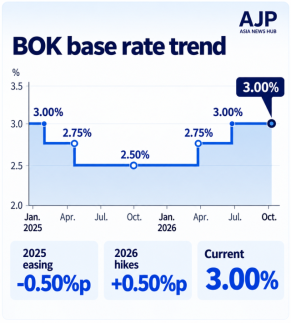 AJP Factbox: BOK keeps key rate at 3% for Oct 2026 The Bank of Korea (BOK) kept South Korea's base rate unchanged at 3.00 percent on Oct. 22, marking the first hold since May after back-to-back hikes in July and August. The rate had stayed at 2.50 percent for about a year before the BOK raised it to 2.75 percent in July and 3.00 percent in August. 2026-10-22 10:28:23
 -
 UPDATE: Bank of Korea stands pat, bonds rally on unanimous pause *Updated with Governor Shin Hyun-song’s remarks, central bank statement, data and market response. SEOUL, October 22 (AJP) - The Bank of Korea (BOK) on Thursday kept its key rate steady at 3.00 percent to assess the effects of a half-percentage-point increase across its last two summer meetings, while maintaining a clear restrictive bias. “Since growth and inflation data appear stronger than predicted in August, we should keep up tightening policy stance,” Governor Shin Hyun-song said at a post-meeting briefing, adding the bias would remain until annual inflation rate comes down to the target range of around 2 percent. He projected that goal would be reached in 2027, indicating rates could stay above 3 percent through next year. The economy has kept up a robust growth pace on strong exports and investment, with inflation running around 3 percent, but policymakers unanimously decided to wait it out as upward price pressure from accumulated inflationary factors and downside risks to growth from geopolitical tensions coexist, according to the post-meeting statement. The BOK started lifting the key rate held at 2.50 percent since May last year in July and delivered the second in August. Government bonds rose as investors read hawkish tone from the governor. The two-year government bond yield fell 1.2 basis points to 3.771 percent, while the 10-year yield declined 1.2 basis points to 4.148 percent. The benchmark KOSPI and junior KOSDAQ both fell more than 3 percent on the prosect of higher rates. The won also remained resilient, trading at 1,323.9 per U.S. dollar. The pause follows a stronger assessment of the economy. Shin said the July and August hikes had given the central bank more room to maneuver, allowing it to focus on domestic economic conditions rather than react to market volatility. He described Thursday’s pause as “the payoff” from the BOK’s earlier preemptive tightening. Growth this year and next is expected to “substantially exceed” the BOK's August forecasts of 3.3 percent and 2.9 percent, respectively, as the semiconductor boom is expected to stretch and support exports and investment. Improving incomes should gradually broaden the recovery in consumption, the bank projected. Exports surged 83.7 percent from a year earlier in September, accelerating from 68.9 percent in August. Exports adjusted for working days more than doubled, rising 105.0 percent. The staggering external demand has yet to warm the local economy. Retail sales fell 1.8 percent from the previous month in August, while facilities investment dropped 9.5 percent and manufacturing output declined 5.1 percent. Employment rose by 113,000 from a year earlier in September, with the BOK describing job growth as modest and concentrated in services. Inflation remains a constraint on how long policymakers can wait. Consumer prices rose 2.9 percent from a year earlier in September, easing from 3.1 percent in August. Core inflation, excluding food and energy, slowed to 2.8 percent from 3.4 percent. Households’ expectations for inflation over the next year held at 2.7 percent. The bank warned that accumulated cost increases would continue to feed through to prices while demand-side pressure gradually builds, keeping inflation above its target for a considerable period. This year’s headline and core inflation rates are expected to broadly match the August forecasts of 2.7 percent and 2.5 percent. Next year, however, both are likely to exceed the previous projections of 2.3 percent and 2.5 percent, respectively. Escalating Middle East tensions are pushing up energy costs and disrupting supply chains, even as resilient artificial intelligence investment supports global growth. Financial stability concerns also argued against declaring the tightening cycle over. Household lending had turned lower as repayments of other loans outweighed new borrowing, but housing-related lending continued to grow and home-price gains in the Seoul metropolitan area had accelerated again, the bank noted. Policymakers would continue to watch the housing market and household debt closely as they weigh when, and how quickly, to raise rates further, the bank added. 2026-10-22 09:50:47
 -
 KOSPI rebounds over 3% ahead of BOK's rate decision SEOUL, October 21 (AJP) - South Korean stocks rose 3.3 percent on Wednesday as chipmakers gained and foreign investors returned to the main market. The won also strengthened, while government bond yields fell, just a day ahead of the Bank of Korea's rate decision. The benchmark KOSPI gained 182.92 points or 3.29 percent to close at 5,735.66, recovering most of the previous day's 3.73 percent drop. It opened 2.05 percent higher at 5,666.34 and climbed as much as 4.75 percent to 5,816.43 before giving back part of the gains. Foreign investors bought a net 660 billion won (US$498 million) of shares, while retail investors sold about 1.13 trillion won. The surge triggered a buy-side sidecar at around 10:50 a.m., temporarily suspending program buy orders for five minutes after KOSPI 200 futures rose more than 5 percent. Samsung Electronics jumped 5.67 percent to 223,500 won, while SK hynix gained 5.81 percent to 1,294,000 won. SK Square rose 5.13 percent and Samsung Biologics added 1.87 percent, while LG Energy Solution fell 0.60 percent and Hyundai Motor slipped 0.16 percent. The rebound remained concentrated in large-cap stocks despite the sharp gain. Only 372 KOSPI-listed stocks advanced, compared with 488 decliners, highlighting the outsized contribution from semiconductor heavyweights. Sentiment toward chip shares improved as concerns over returns on heavy artificial intelligence investment eased and strong semiconductor exports offered support to the sector. Semiconductor exports in the first 20 days of October surged 222.5 percent from a year earlier. The tech-heavy KOSDAQ rose 10.79 points or 1.38 percent to close at 792.76. The won strengthened for a fourth consecutive session ahead of the BOK meeting, closing up 2.9 won at 1,325.2 per dollar from 1,328.1 on Tuesday. The close marked its strongest level since October 2, 2024, when it finished at 1,319.3 per dollar. The currency opened at 1,325.5 and strengthened as far as 1,322.8 in early trading. Strong semiconductor exports supported expectations of continued dollar selling by exporters, while the return of foreign equity buying eased some of the dollar demand seen during the recent stock selloff. Most South Korean government bond yields also fell ahead of Thursday's rate decision. The three-year yield dropped 1.8 basis points to 3.822 percent, while the 10-year yield declined 1.6 basis points to 4.160 percent. The five-year yield fell 2.5 basis points to 3.965 percent, while the 30-year yield dropped 1.3 basis points to 4.251 percent. The 20-year yield bucked the broader move, rising 1.8 basis points to 4.197 percent. The BOK is widely expected to keep the base rate unchanged at 3.00 percent on Thursday after consecutive quarter-point increases in July and August. An AJP poll of seven economists found unanimous expectations for a hold, while five of six respondents who specified the timing of the next move expected another quarter-point increase in November. 2026-10-21 17:16:00
 -
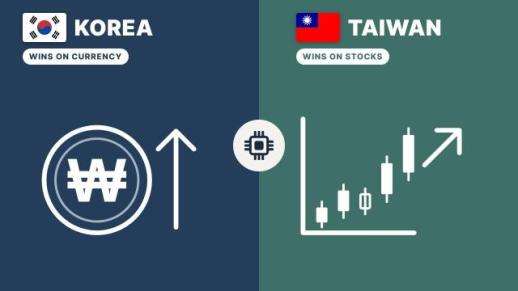 Korea and Taiwan reap chip bounty, but currencies split the harvest SEOUL, October 21 (AJP) — Chip powerhouses South Korea and Taiwan have been enjoying a bumper harvest, but their stock and currency markets have shared unevenly in the bounty in the second half. Samsung Electronics and SK hynix, which powered a stock-buying frenzy that nearly doubled the KOSPI earlier this year, have surrendered much of their gains. The Korean benchmark’s remaining advance is now roughly half Taiwan’s 60-percent surge. In the currency market, however, Korea has pulled ahead. The won has outpaced the Taiwan dollar since August as back-to-back Korean rate hikes coincided with exporter dollar selling. Taiwan held rates steady, while its exporters kept most of their foreign-currency proceeds unconverted. The won strengthened 2.9 won to close at 1,325.2 per dollar on Wednesday, extending its advance from 1,328.1 in the previous session. Using Tuesday’s closes for both currencies, the dollar-won rate had fallen 6.1 percent from about 1,414.5 on Aug. 6. Over the same period, the U.S. dollar rose 1.1 percent against the Taiwan dollar, from NT$32.261 to NT$32.617. The August starting point excludes most of the won’s initial recovery from its unusually weak July level, showing that its outperformance extends beyond that early rebound. Measured by changes in their U.S. dollar value, the won had gained about 8.4 percent since the end of 2025 through Tuesday, while the Taiwan dollar had lost about 3.6 percent. The divergence reflects more than the size of the two economies’ chip windfalls. It also turns on interest rates and what exporters do with the dollars they earn. The Bank of Korea raised its policy rate from 2.50 percent to 3.00 percent through consecutive quarter-point increases in July and August. Taiwan kept its discount rate at 2.00 percent through September despite higher energy costs, doubling Korea’s rate advantage to one percentage point. Taiwanese exporters received $61.96 billion in foreign-currency export proceeds in September but converted only $1.06 billion, or about 1.7 percent, into Taiwan dollars, according to central bank data cited in the figures. About $60.89 billion remained in foreign currency at receipt. Those funds can be converted later or used to repay foreign-currency debt, pay for imports and meet other overseas obligations. An export dollar earned, in other words, is not automatically a dollar sold for the local currency. “Korean exporters now seem to have greater confidence in bringing money back to the won,” ING economists wrote in an October report. The bank said the Taiwan dollar faced pressure from widening interest-rate differentials with the United States and corporate investment abroad, even as Taiwan’s trade surplus reached new highs. That distinction matters for two economies among the biggest beneficiaries of the global AI spending binge. “Heavy overseas investment by residents and foreign selling of domestic equities have recycled much of the export windfall abroad,” MUFG strategist Lee Hardman wrote in a July report. Those flows, he said, had restrained both currencies despite sharply improved external balances. The two central banks have also drawn different conclusions about how much tightening their economies need. The BOK said its July increase reflected stronger export- and investment-led growth, above-target inflation and financial stability risks. In August, it argued that another preemptive increase was needed to prevent price pressures from spreading. Taiwan’s central bank judged inflation to be contained despite rapid economic growth. In September, it raised its 2026 growth forecast to 11.48 percent but projected headline inflation of 2.03 percent this year and 1.83 percent in 2027, supporting its decision to hold rates steady. The currency contrast is sharper when measured from early July. From July 2 through Tuesday, the dollar-won rate fell 14.6 percent from 1,555.8, while the U.S. dollar rose 2.2 percent against the Taiwan dollar from NT$31.910. The comparison does not establish that higher rates alone produce a stronger currency. Overseas investment, equity flows, energy bills and expectations for U.S. monetary policy can outweigh their support. For Korea, however, higher rates and exporter conversions have been pulling in the same direction, helping sustain the won’s recovery even as enthusiasm for its chip stocks has faded. The BOK is widely expected to hold its policy rate on Thursday. A pause would leave exporter dollar selling and Korea’s external surplus in sharper focus as supports for the won, although the currency’s response will also depend on the bank’s guidance and global market conditions. 2026-10-21 17:04:45
 -
 Nonregular workers make up the bulk of Korea's wage job gains SEOUL, October 21 (AJP) -Nearly four in 10 of South Korea’s 22.5 million wage earners are nonregular workers, adding 103,000 from a year earlier as of August to account for almost all of the 113,000 net increase in wage employment. Worse, the monthly pay gap between nonregular and regular workers widened to 1.94 million won, feeding inequalities on the job front. Nonregular workers increased 103,000 and its share to the work force 38.5 percent - the highest on record - while that of regular payroll increased 10,000 to 13.86 million, according to data released Wednesday by the Ministry of Data and Statistics. Regular workers earned an average of 4.052 million won ($3,060) a month during the June–August period, up 4.0 percent from a year earlier. Nonregular workers earned 2.112 million won, up just 1.1 percent. The gap widened to 1.94 million won from 1.808 million won a year earlier. The comparison, however, does not adjust for differences in working days or hours. Excluding part-time workers, average monthly pay for nonregular employees stood at 3.098 million won, narrowing the gap with regular workers to 954,000 won. Older workers accounted for much of the increase in nonregular employment. The number aged 60 or older rose by 135,000 to 3.18 million, representing 36.7 percent of all nonregular workers. Within that group, those aged 70 or older increased by 85,000 to 1.29 million. The number aged 29 or younger fell by 64,000 to 1.48 million. Temporary and part-time employment also expanded. Temporary workers increased by 187,000 to 6.04 million, while part-time workers rose by 152,000 to 4.38 million. These categories overlap and therefore do not add up to the total number of nonregular workers. Part-time workers accounted for 50.5 percent of nonregular employees, up 1.1 percentage points from a year earlier. By contrast, the number classified as atypical workers fell by 48,000 to 1.79 million. Health and social welfare services had the largest nonregular workforce at 1.87 million, or 21.5 percent of the total, after adding 112,000 workers from a year earlier. Accommodation and food services added 43,000 nonregular workers, while information and communications shed 24,000 and public administration lost 22,000. Other measures of working conditions were mixed. The share of nonregular workers who said they voluntarily chose their employment type edged up by 0.2 percentage point to 68.0 percent. Their average tenure increased by one month to three years, while average weekly working hours rose by 1.3 hours to 29.5 hours. Employment insurance coverage increased by 0.3 percentage point to 54.0 percent. National Pension coverage, however, fell by 0.6 percentage point to 36.5 percent, while health insurance coverage edged down by 0.2 percentage point to 53.0 percent. Access to retirement benefits, bonuses, overtime pay and paid holidays also declined from a year earlier. Under the narrower definition used by the OECD for international comparisons, temporary workers accounted for 28.2 percent of South Korea’s wage workforce in August, up from 27.5 percent a year earlier. 2026-10-21 14:41:08
 -
 Korea's profit recovery mostly led by big corporate names: BOK ◆ SEOUL, October 21 (AJP) — South Korea's corporate profitability improved in 2025 mostly for large companies and chip- and shipbuilding-related industries, widening gap with smaller firms. The operating margin of nonfinancial for-profit corporations rose to 5.2 percent from 4.6 percent a year earlier, the highest since 2021, according to annual data released Wednesday by the Bank of Korea (BOK). Sales growth, meanwhile, slowed to 2.4 percent from 3.7 percent, highlighting a year in which companies earned more from each unit of revenue even as top-line expansion lost momentum. Pretax profit margins also improved to 5.2 percent from 4.3 percent. The annual dataset covers 982,767 nonfinancial for-profit corporations, a far broader universe than the BOK's preliminary June assessment of 34,456 externally audited companies. The broader results showed a sharp divide by company size. Large companies' operating margin climbed to 6.7 percent from 5.6 percent, while the margin for small and medium-sized enterprises slipped to 2.8 percent from 3.0 percent. Within SMEs, the margin for medium enterprises edged down to 3.8 percent from 3.9 percent, while that of small enterprises fell further to 1.5 percent from 1.8 percent. The split came even as sales growth weakened across both groups. Revenue growth at large companies slowed to 2.0 percent from 3.4 percent, while SME sales growth eased to 3.0 percent from 4.1 percent. The improvement in overall profitability was also concentrated in several industries. The operating margin for manufacturing rose to 6.3 percent from 5.1 percent, led by electronic, video and communications equipment and shipbuilding-related industries. The margin for electronic, video and communications equipment surged to 14.0 percent from 8.3 percent as sales of high-value semiconductor products expanded and chip prices increased. Shipbuilding and other transport equipment saw its margin rise to 11.6 percent from 6.4 percent, helped by greater recognition of high-value vessel sales and easing cost pressure from steel plates. In the nonmanufacturing sector, the operating margin edged up to 4.3 percent from 4.1 percent, with electricity and gas companies benefiting from lower fuel costs. Revenue growth, however, slowed across several major industries. Manufacturing sales growth eased to 2.4 percent from 4.6 percent. Sales at coke and refined petroleum companies contracted 7.6 percent after growing 1.4 percent a year earlier as lower international oil prices pulled down petroleum product prices. Nonmanufacturing sales growth slowed to 2.3 percent from 2.9 percent. Transportation and storage growth fell to 2.6 percent from 11.6 percent amid lower sea freight rates, while construction sales declined 7.6 percent, widening from a 2.8 percent contraction in 2024 amid continued weakness in the sector. Corporate debt-servicing capacity improved on average, but financial weakness remained widespread. The interest coverage ratio, which measures operating profit relative to interest expenses, rose to 292.7 percent from 244.1 percent as operating margins improved and the financial-cost burden eased. Yet 42.9 percent of companies had an interest coverage ratio below 100 percent, meaning their operating earnings were insufficient to cover interest expenses. That was up from 42.8 percent a year earlier and the highest since comparable data began in 2009. The share of companies with a negative interest coverage ratio also increased to 34.4 percent from 33.9 percent. Balance sheets improved overall. The debt-to-equity ratio fell to 116.2 percent from 119.9 percent, its lowest since 2019, while reliance on borrowings declined to 30.4 percent from 31.0 percent. Large companies' debt ratio fell to 99.6 percent from 101.5 percent, while the ratio for SMEs declined to 155.2 percent from 162.7 percent. Borrowing dependence also fell to 25.1 percent among large companies and 40.0 percent among SMEs. The figures show that stronger earnings at large manufacturers lifted overall corporate profitability in 2025 even as weaker margins and elevated debt-servicing strains persisted among a large share of smaller businesses. 2026-10-21 12:00:00
 -
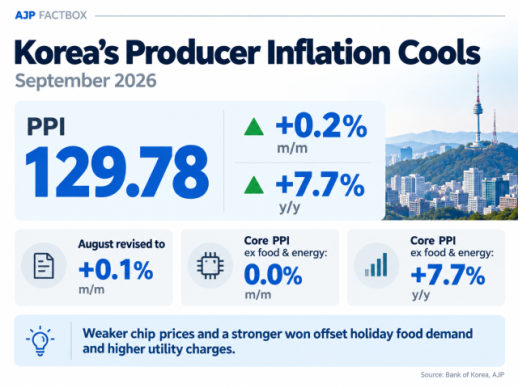 AJP Factbox: Korea's producer inflation cools in September South Korea’s producer prices rose 0.2 percent in September, but annual inflation eased to 7.7 percent from 7.9 percent in August. Weaker semiconductor and memory-chip prices, helped by a stronger won, offset higher food and utility costs, while the index excluding food and energy was unchanged on month. Holiday demand pushed agricultural and livestock prices higher, while residential electricity prices jumped after a summer tariff discount expired. Upstream costs in petroleum, chemicals and energy remained elevated, leaving inflation pressures mixed ahead of the Bank of Korea’s policy meeting, where economists broadly expect rates to stay unchanged for now. 2026-10-21 10:53:05
 -
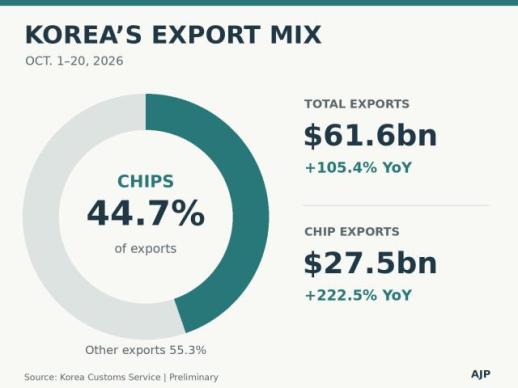 AJP Factbox: Korea keeps up red-hot export streak Oct 2026-10-21 10:28:21
 -
 Korea's mid-October exports double at fresh high SEOUL, October 21 (AJP) — South Korea's chip-led export boom remained firmly intact through the first 20 days of October, with monthly outbound shipments more than doubling from a year earlier to a record $61.6 billion. Exports jumped 105.4 percent from a year earlier, while imports rose 42.8 percent to $47.1 billion, leaving a trade surplus of $14.5 billion, according to preliminary data from the Korea Customs Service (KCS). The headline increase was amplified by greater working days, with 13 days during the period this year compared with 10.5 days a year earlier. Even after adjusting for the difference, average daily exports surged 65.9 percent to $4.74 billion, the highest ever for the first 20 days of a month and keeping up close to record average of $4.75 billion in the first 10 days of October. Semiconductor exports more than tripled from a year earlier, surging 222.5 percent to $27.5 billion, the highest ever for the October 1-20 period. Chips accounted for 44.7 percent of total exports, up 16.2 percentage points from a year earlier. The increase also extended beyond semiconductors. Exports of computer peripherals surged 424.0 percent to $2.43 billion, while petroleum product shipments rose 68.3 percent to $3.95 billion. Passenger car exports increased 40.9 percent to $3.36 billion, while steel products rose 42.6 percent and auto parts gained 40.4 percent. Shipments to major trading partners also increased sharply. Exports to China jumped 154.4 percent to $16.7 billion, while shipments to the United States rose 154.9 percent to $10.8 billion. Exports to Vietnam increased 74.6 percent to $5.01 billion, while shipments to the European Union climbed 78.2 percent to $4.46 billion. China, the United States and Vietnam together accounted for 52.7 percent of total exports. Imports also rose across major categories, though at a slower pace than exports. Semiconductor imports increased 78.4 percent to $7.57 billion, while crude oil imports rose 42.9 percent to $7.45 billion. Gas imports more than doubled, rising 112.4 percent to $2.82 billion. Combined imports of crude oil, gas and coal increased 53.5 percent from a year earlier. 2026-10-21 09:56:47