

Journalist
Kim Yeon-jae김연재
duswogmlwo77@ajupress.com
ReporterBank of Korea & Market, Macroeconomics
Kim Yeon-jae is a journalist at AJU Press (AJP's English platform),
covering macroeconomics, international finance, and geopolitics.
He closely tracks central bank monetary policies, global energy supply chains,
and the Korean defense industry. "Peering into the risks behind the euphoria."
covering macroeconomics, international finance, and geopolitics.
He closely tracks central bank monetary policies, global energy supply chains,
and the Korean defense industry. "Peering into the risks behind the euphoria."
Latest by Kim Yeon-jae
-
 BOK chief Shin to attend G20, IMF-World Bank meetings SEOUL, October 12 (AJP) — Bank of Korea Gov. Shin Hyun-song will leave for Bangkok on Tuesday to attend G20 finance chiefs' meetings and the IMF-World Bank annual meetings, the central bank said Monday. Shin will attend the G20 Finance Ministers and Central Bank Governors Meeting to discuss the global economy, economic growth and global imbalances with counterparts and officials from international financial institutions. He will also take part in the International Monetary Fund-World Bank Group Annual Meetings, where discussions will cover the global economic outlook and financial stability. During the trip, Shin is scheduled to hold talks with senior officials from major central banks including the U.S. Federal Reserve and European Central Bank, as well as the IMF, to exchange views on recent international developments and their economic impact. Shin will participate in the IMF's Governor Talks session on Tuesday, discussing monetary policy in Asia and South Korea amid the global artificial intelligence boom and uncertainty surrounding the Middle East war. On Wednesday, he will join CNN's "Global Perspectives" panel moderated by Richard Quest alongside World Trade Organization Director-General Ngozi Okonjo-Iweala and Bank of America International Chairman Bernard Mensah. Shin is scheduled to return to South Korea on Sunday. The trip comes ahead of the BOK's October 22 monetary policy meeting, with the central bank weighing the timing and pace of further rate increases after back-to-back hikes in July and August. AJP Takeaways - BOK Gov. Shin Hyun-song will attend G20 and IMF-World Bank meetings in Bangkok from October 13 to 18. - Shin is scheduled to meet senior officials from the Federal Reserve, ECB and IMF and discuss global economic and financial conditions. - He will also speak at an IMF Governor Talks session on Asian and Korean monetary policy and join a CNN panel with global economic leaders. 2026-10-12 14:15:53
 -
 Earlier rate hikes preemptive, next moves data-dependent: BOK chief SEOUL, October 12 (AJP) —Preemptive interest-rate hikes in July and August had bought South Korean monetary policymakers time and room to maneuver as they weigh incoming data and financial risks before deciding their next move, Bank of Korea Governor Shin Hyun-song said. “We will determine the timing and pace of further rate increases while closely monitoring inflation, growth and financial stability,” Shin said Monday in opening remarks at his first parliamentary audit. The Bank of Korea (BOK) raised its base rate by 25 basis points in July and August to 3.00 percent. Its next monetary policy meeting is scheduled for Oct. 22. Shin said inflation was likely to remain above the central bank’s 2 percent target for a considerable period as accumulated cost pressures continued to feed through to prices and demand-side pressures gradually strengthened. Lawmakers challenged whether domestic demand was strong enough to justify the back-to-back increases. Democratic Party lawmaker Kim Young-hwan argued that recent inflation had been driven mainly by oil prices, exchange-rate effects and other cost factors rather than broad-based demand. Shin acknowledged that higher energy costs had contributed significantly to inflation but said improving incomes were expected to strengthen demand. He stressed the need to act before those pressures materialized and higher inflation expectations became entrenched. Democratic Party lawmaker Kim Tae-nyeon separately questioned whether the semiconductor-led expansion was spreading sufficiently to employment, production and domestic demand to justify tighter monetary policy. Higher borrowing costs were weighing on regional economies, small businesses and households, Kim said, even as much of the country’s growth came from the semiconductor boom. Shin rejected the view that economic strength was confined to chips. “Even excluding semiconductors, the GDP gap is close to the threshold at which it can generate inflationary pressure,” Shin said, adding that the central bank should set monetary policy based on the economy as a whole. Shin also defended the timing of the BOK’s tightening when questioned by Democratic Party lawmaker Moon Jin-seok. Raising rates before the U.S. Federal Reserve moved in September gave Korea more time for the adjustment to be reflected in market prices, he said. It also imposed a smaller economic cost than being forced into defensive tightening later. The tightening nevertheless carries costs for weaker parts of the economy. Shin acknowledged that higher rates hit vulnerable borrowers particularly hard and stressed the importance of targeted fiscal support, while maintaining that monetary policy should remain independent. Housing prices in the Seoul metropolitan area, household debt and the potential deterioration in vulnerable borrowers’ finances remain risks complicating the BOK’s next decision. The interaction between fiscal and monetary policy drew further scrutiny. People Power Party lawmaker Park Soo-young questioned whether expansionary fiscal policy could work against the BOK’s efforts to restrain liquidity and inflation. “Fiscal sustainability is absolutely important,” Shin said, adding that the central bank would continue to express its views to help coordinate fiscal and monetary policies. Government bond yields fell and the won strengthened as Shin largely reiterated his earlier policy stance. The three-year government bond yield fell 4.0 basis points to 3.943 percent in morning trading, while the benchmark 10-year yield dropped 7.1 basis points to 4.324 percent. The five-year yield declined 4.0 basis points to 4.118 percent. The won traded around 1,334 per dollar at about 1:30 p.m., strengthening by about 8.8 won from the previous session. Shin gave no clear signal that another increase would come as early as October, while keeping further tightening on the table. His emphasis on having acted preemptively suggested the BOK retains room to decide whether to move at its Oct. 22 meeting or wait until Nov. 26. AJP Takeaways - BOK Gov. Shin Hyun-song defended the July and August rate hikes as preemptive moves that gave policymakers more room before the U.S. Federal Reserve tightened policy. - Shin pushed back against claims that inflation and growth were driven mainly by external costs and semiconductors, saying underlying demand pressures remained significant. - The BOK has kept further tightening on the table but has not committed to a third consecutive rate hike at its October 22 meeting. 2026-10-12 14:15:26
 -
 Korea's early-October exports doubled from a year ago at fresh high SEOUL, October 12 (AJP) — South Korea's chip-led export sizzle remains robust, with outbound shipments doubling from a year earlier to $26.1 billion in the first 10 days of October, with chips filling nearly half of them. Exports rose 102.0 percent from a year earlier, while imports increased 65.5 percent to $22.3 billion, leaving a trade surplus of $3.8 billion, according to preliminary data from the Korea Customs Service (KCS). The headline increase was amplified by two additional working days, with 5.5 working days during the period this year compared with 3.5 days a year earlier. Even after adjusting for the difference, average daily exports rose 28.5 percent to a record $4.75 billion. Semiconductor exports jumped 170.9 percent to $12.2 billion, the highest ever for the first 10 days of October. Chips accounted for 46.7 percent of total exports, up 11.9 percentage points from a year earlier. Exports of passenger cars rose 82.7 percent, while petroleum products increased 45.6 percent and wireless communication devices gained 62.6 percent. Ship exports fell 13.4 percent. Shipments to major trading partners also increased sharply. Exports to China surged 167.3 percent to $7.6 billion, while shipments to the United States rose 159.9 percent to $3.7 billion. Exports to Vietnam increased 89.7 percent, while shipments to the European Union climbed 127.3 percent. China, the United States and Vietnam together accounted for 52.3 percent of total exports. Imports also increased across major categories, with crude oil shipments rising 56.2 percent to $4.3 billion and semiconductor imports gaining 66.7 percent to $3.3 billion. Gas imports more than doubled, rising 125.5 percent to $1.4 billion. Combined imports of crude oil, gas and coal increased 64.8 percent from a year earlier. The KCS cautioned that the figures cover only the first 10 days of the month and can be significantly affected by changes in the number of working days. AJP Takeaways - South Korea's exports reached $26.1 billion in the first 10 days of October, the highest ever for the period, as semiconductor shipments surged. - Average daily exports rose 28.5 percent to a record $4.75 billion even after adjusting for two additional working days. - Semiconductor exports jumped 170.9 percent to $12.2 billion and accounted for 46.7 percent of total exports. 2026-10-12 13:17:43
 -
 Korea corporate loan delinquencies more than triple over 5 yrs SEOUL, October 12 (AJP) — Corporate loan delinquencies at South Korean banks topped 10 trillion won ($7.5 billion) for the first time at the end of June as unpaid debt grew far faster than overall lending over the past five years. Outstanding corporate loans at domestic banks rose 30.7 percent to 1,400.5 trillion won at the end of the second quarter from 1,071.1 trillion won at the end of 2021, according to data the Bank of Korea submitted to lawmaker Ahn Do-geol. Over the same period, delinquent corporate loans jumped 248.3 percent to 10.1 trillion won from 2.9 trillion won, while the delinquency rate climbed to 0.68 percent from 0.26 percent. The deterioration was sharper at nonbank financial institutions. Corporate loan delinquency rates at savings banks, mutual financial institutions, insurers and credit finance companies rose to 6.28 percent in the second quarter from 1.32 percent at the end of 2021. The share was more than nine times the 0.68 percent delinquency rate recorded by banks. Bank corporate loan delinquencies have risen each year, increasing from 3.2 trillion won at the end of 2022 to 5.3 trillion won in 2023, 6.9 trillion won in 2024 and 8.4 trillion won in 2025 before exceeding 10 trillion won this year. Corporate lending across banks and nonbank financial institutions reached 2,000.1 trillion won ($1.49 trillion) in the second quarter, up 29.8 percent from 1,540.9 trillion won at the end of 2021. Nonbank corporate lending increased to 599.6 trillion won from 469.8 trillion won over the same period. Signs of strain were also visible among self-employed borrowers. Loans to individual business owners increased 20.8 percent to 722.3 trillion won in the second quarter from 597.9 trillion won at the end of 2021, while their delinquency rate rose nearly fivefold to 2.22 percent from 0.45 percent. About 1.64 million self-employed borrowers held loans from multiple financial institutions as of the second quarter, with their combined debt reaching 645.7 trillion won. The Bank of Korea has estimated that a 1 percentage point increase in lending rates would raise annual household interest payments by 13.4 trillion won and add 4.4 trillion won to the annual interest burden of self-employed multiple borrowers. Ahn called for financial policy to focus not only on controlling total lending but also on identifying where delinquencies are accumulating and which borrowers are struggling to absorb higher interest costs. AJP Takeaways - Corporate loan delinquencies at South Korean banks reached 10.1 trillion won in the second quarter, up 248.3 percent from the end of 2021. - The nonbank corporate loan delinquency rate rose to 6.28 percent, more than nine times the 0.68 percent rate at banks. - Total corporate lending across banks and nonbank financial institutions exceeded 2,000 trillion won, while delinquency indicators also worsened among self-employed borrowers. 2026-10-12 10:01:52
 -
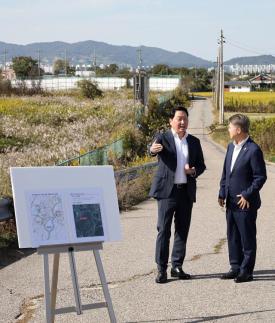 SK chief Chey visits Gwangju site, eyes faster fab build SEOUL, October 9 (AJP) — SK Group Chairman Chey Tae-won said Friday SK hynix would move as quickly as possible on its planned Gwangju semiconductor base after inspecting the site, citing rapidly rising memory demand. Chey, making his first visit to the planned fab site at Gwangju Military Airport, said SK hynix had already brought forward the full buildout of its Yongin semiconductor cluster by 12 years but increasingly believed even that expansion might not be enough. “If we determine that we can build here, we will move as quickly as possible,” Chey told reporters after inspecting the site. Chey said semiconductor demand was continuing to increase at a rapid pace, requiring SK hynix to accelerate capacity expansion and potentially develop the Gwangju site in parallel with Yongin. He also said construction work could begin before all planned water and electricity infrastructure is completed if the schedules can be aligned, adding that the company would prioritize speed rather than seek to minimize construction costs. Chey stopped short of giving a groundbreaking date, saying SK hynix still needed to coordinate its construction schedule with government plans for water, electricity and other infrastructure. The company’s current Gwangju plan is roughly two-thirds the size of its Yongin project, Chey said, without specifying whether he was referring to land, production capacity or another measure. He added that the Gwangju project could become larger if more land is available and semiconductor demand continues to grow. Chey surveyed the site from an observation tower and received a briefing on planned electricity and water supplies. Min Hyung-bae, mayor of the Jeonnam-Gwangju Integrated Special City, said SK working-level officials had already visited the area about 10 times before Chey’s trip. SK hynix said in its June 29 mid-to-long-term investment strategy that it plans to invest about 400 trillion won ($299 billion) in a new semiconductor cluster in South Korea’s southwestern region as part of a broader 1,100 trillion won investment program spanning Yongin, Cheongju and the southwest. The company said at the time that rapidly growing AI memory demand meant Yongin and Cheongju would not provide enough production capacity after reaching full-scale operation, making another large manufacturing base necessary. SK hynix also said it had moved forward the target for completing construction of all four Yongin fabs to 2033 from 2045, a 12-year acceleration intended to respond to rising DRAM demand. Cheong Wa Dae said after a July 6 public-private review meeting that Gwangju Military Airport had been selected for the Honam semiconductor industrial complex after participating companies identified it as the most suitable site. The government cited the airport’s roughly 2.5 million pyeong of largely flat land, proximity to central Gwangju and a KTX station, and access to road, airport and port infrastructure as key advantages. At a second review meeting on August 10, Cheong Wa Dae said the government planned to complete the relocation or temporary dispersal of military facilities by the second half of 2028 while advancing site preparation around the ammunition depot. First-stage power supply is planned by the end of 2028, with water supplies to be secured by 2030. SK hynix said in June that its southwestern investment would be carried out in phases and that the specific scale and timetable could change depending on market demand and would be finalized through board approval. AJP Takeaways - SK Group Chairman Chey Tae-won said SK hynix would move as quickly as possible on its planned Gwangju semiconductor base once construction conditions allow. - Chey said SK hynix may need additional production capacity even after bringing the full buildout of its Yongin semiconductor cluster forward by 12 years. - The government has designated Gwangju Military Airport for the Honam semiconductor cluster and said it will accelerate military relocation, site preparation, power and water infrastructure. 2026-10-09 15:36:43
 -
 Coupang restores services after overnight outage SEOUL, October 9 (AJP) — South Korean e-commerce giant Coupang restored shopping, delivery and streaming services early Friday after an overnight system outage disrupted orders and logistics, with the company launching compensation for affected users and partners. The disruption began around midnight and affected Coupang, food delivery platform Coupang Eats and streaming service Coupang Play, along with systems used for logistics and deliveries. Services were restored at around 2:30 a.m. “A temporary error occurred across Coupang’s services during a service upgrade, but it has been resolved and services are now available normally,” Coupang said in a notice, apologizing for the disruption. Users reported difficulties accessing the Coupang app and website, logging in and opening product pages. Some customers were also unable to place or check orders during the outage. The disruption extended beyond consumer services. Coupang Eats customers and restaurant operators faced problems processing orders, while delivery riders temporarily lost access to information needed to complete deliveries. Coupang’s logistics operations were also affected as workers encountered problems accessing systems used for sorting, scanning and confirming deliveries. Some orders that could not be processed normally were canceled. Coupang said customers whose shopping orders were canceled because of the outage would receive 5,000 won ($3.70) in Coupang Cash. The credit can be used for six months after it is issued. Coupang Eats will provide a 3,000 won coupon to customers whose orders were canceled after payment and a 1,000 won coupon to users who attempted but failed to place an order during the disruption. Delivery riders will receive 1,000 won when they had arrived at a restaurant before an order was canceled. Riders who had already picked up food will receive the full delivery fee for the canceled order. The payments for eligible riders will be processed automatically after verification, while restaurant operators will also receive compensation for accepted orders that were later canceled. Coupang said it was examining the exact cause of the error after attributing the disruption to the service upgrade. AJP Takeaways - Coupang restored its shopping, food delivery and streaming services at around 2:30 a.m. Friday after an outage lasting more than two hours. - Coupang attributed the disruption to an error during a service upgrade, which also affected logistics and delivery operations. - Coupang and Coupang Eats are compensating affected customers, riders and restaurant operators, including 5,000 won in Coupang Cash for canceled shopping orders. 2026-10-09 13:26:48
 -
 Nuri-launched DaejeonSAT-1 makes contact on sixth attempt SEOUL, October 9 (AJP) — South Korea’s DaejeonSAT-1 established two-way communication with a ground station on its sixth attempt after five failed contacts, with key satellite systems confirmed to be operating normally. The CubeSat made its first successful two-way contact at around 11:20 p.m. Wednesday and communicated again at about 12:46 a.m. Thursday, according to the Daejeon city government. DaejeonSAT-1 had separated normally from the Nuri rocket and entered its target orbit but failed to secure a stable signal during its first five communication attempts through Wednesday afternoon. Possible causes of the earlier communication failures included the satellite’s elevation angle, radio-frequency interference and noise at the ground station, according to the city. Checks following the successful contact showed the satellite’s battery, attitude-control system, rotational speed and GPS reception were operating normally. The city also confirmed that the satellite’s electro-optical camera was pointing toward Earth, indicating that DaejeonSAT-1 was operating stably. Further communication sessions will be used to check solar-power generation and other systems before the satellite begins full-scale operations, including Earth observation. DaejeonSAT-1 was carried into orbit aboard South Korea’s fifth Nuri launch, which lifted off from the Naro Space Center in Goheung on October 7. The Korea AeroSpace Administration said Nuri reached its target altitude and successfully deployed five primary microsatellites and nine CubeSats into their planned orbits. DaejeonSAT-1 was jointly developed by the Daejeon city government and five local space companies — Step Lab, CSO, EPSTech, MID and CONTEC. The satellite carries technologies developed by the participating companies, including an electro-optical camera, solar panels, a power-control unit and space-grade memory. The mission is designed to verify those components in the space environment and give participating companies flight heritage for future satellite and space-component projects. Daejeon plans to begin full operations once communications, power and attitude-control systems are fully checked. AJP Takeaways - DaejeonSAT-1 established its first two-way communication with a ground station on its sixth attempt after five earlier attempts failed. - Daejeon city said key systems including battery power, attitude control, GPS reception and camera orientation were operating normally. - The CubeSat was developed with five Daejeon-based space companies and carries locally developed components for in-orbit verification. 2026-10-09 10:59:35
 -
 Kakao Golf leak hits 34,000; data breach reports near annual record SEOUL, October 9 (AJP) — Personal information belonging to about 34,000 Kakao Golf Reservation users was exposed in the latest breach to hit South Korea as reported data leaks approach last year’s annual record. Kakao VX said it discovered on October 7 that an unauthorized outsider had accessed and removed customer information from the golf reservation service. The breach affected customers who booked domestic golf tour packages between January 2025 and October 2026. The leaked information included names, phone numbers, reservation details and round dates. Accommodation information, payment amounts, order numbers and virtual account numbers were also exposed. Credit card numbers and resident registration numbers were not included, according to the company. Official figures show the Kakao Golf incident came during a sharp increase in reported data breaches across South Korea. The Personal Information Protection Commission (PIPC) received 432 personal-data breach reports in the first half of 2026, nearly matching the record 447 reports filed during all of 2025. Cyber incidents also increased from a year earlier. The Korea Internet & Security Agency (KISA) received 1,236 incident reports in the first half, up 19.5 percent from 1,034 a year earlier, according to the Ministry of Science and ICT. The latest breach also came as financial companies reported a series of cyber intrusions and information leaks. Financial regulators began an on-site investigation after receiving a breach report from Shinhan Bank on September 30 and later confirmed additional attacks involving KB Kookmin Bank and other financial companies. The Financial Services Commission (FSC) subsequently ordered financial companies to inspect externally connected systems and strengthen authentication and access controls. A separate breach at streaming platform TVING illustrated the scale of personal-data exposure this year. An earlier tally put the number of affected TVING users at about 19.53 million, while a subsequent government investigation found information from 39.54 million accounts had been compromised. The latter figure included duplicate accounts and therefore did not represent 39.54 million individual people, with the final number of affected TVING users yet to be determined. The investigation found that an attacker stole an access key and penetrated TVING’s internal systems. Exposed data included names, birth dates, phone numbers and email addresses, as well as linked identification data. The Kakao Golf Reservation incident added another consumer-facing service to a series of information leaks spanning digital platforms and financial institutions in 2026. AJP Takeaways - Kakao Golf Reservation said personal information belonging to about 34,000 customers was exposed after unauthorized access to its service. - The PIPC received 432 personal-data breach reports in the first half of 2026, nearly matching the record 447 reports filed during all of 2025. - KISA recorded 1,236 cyber incidents in the first half, up 19.5 percent from a year earlier, as breaches also spread across financial companies and major digital platforms. 2026-10-09 10:10:24
 -
 Korea showcases hypersonic strike capability amid tensions with North SEOUL, October 9 (AJP) — South Korea publicly showcased the successful first test of a domestically developed hypersonic glide vehicle amid heightened tensions with North Korea. President Lee Jae Myung observed Thursday’s test and called for the weapon’s rapid development and deployment before inspecting the Hyunmoo-5 high-power missile, according to Cheong Wa Dae. “Our security must be secured through our own strength,” Lee said, adding that the government would support the development and operational deployment of advanced weapons. The public display came amid heightened tensions following recent North Korean military activity, including a land mine incident in the Demilitarized Zone and Pyongyang’s own hypersonic missile test days earlier. Cheong Wa Dae did not explicitly link Thursday’s event to North Korea. The hypersonic glide vehicle, or HGV, rose to its target altitude before separating successfully and completing its planned flight under hypersonic conditions. After separation, the vehicle descended and carried out irregular low-altitude gliding maneuvers, changing its trajectory vertically and horizontally before accurately striking its designated target. The test was designed to verify key technologies including ultra-high-temperature heat-resistant materials, guidance and control capabilities and irregular low-altitude maneuvering. An HGV is accelerated toward the upper atmosphere by a booster before separating and gliding toward its target at lower altitudes, allowing it to follow a less predictable trajectory than a conventional ballistic missile. Cheong Wa Dae described the system as a potential strategic asset capable of striking key targets through high speed and unpredictable flight paths. It said the successful test marked progress toward securing a new deterrence capability suited to the operational environment of the Korean Peninsula. Lee received a briefing on the launch plan from a senior researcher at the Agency for Defense Development and asked whether launching from a barge was intended to address safety concerns. After being informed that the test had succeeded, Lee praised researchers for helping strengthen the country’s defense capabilities. Lee also urged officials to further refine the HGV and accelerate its development and deployment, saying the government should not remain satisfied with the initial success. After observing the test, Lee inspected the Hyunmoo-5 high-power missile operated by the South Korean military and said stronger independent defense capabilities would help safeguard peace and stability. Officials from the Agency for Defense Development attended the event along with the defense minister, the head of the Defense Acquisition Program Administration and a senior presidential national security official. AJP Takeaways - South Korea publicly showcased the first successful test of a domestically developed hypersonic glide vehicle amid heightened tensions with North Korea. - President Lee Jae Myung called for faster development and operational deployment of the hypersonic glide vehicle after observing the test. - Lee also inspected the Hyunmoo-5 high-power missile, while Cheong Wa Dae did not explicitly link the weapons display to recent North Korean activity. 2026-10-09 08:33:59
 -
 U.S. bond yields above 5% tempt Korean investors, but buying slows SEOUL, October 8 (AJP) — U.S. bond yields near multidecade highs are drawing South Korean investors seeking a safer alternative to volatile stocks, but the prospect of further price declines is tempering their appetite. With 10-year U.S. Treasury yields around 5.3 percent, investors can secure income rarely available over the past two decades. The dilemma is whether to buy now or wait for yields to climb further, pushing bond prices lower. Recent investment flows reflect that tension. Korean residents’ net purchases of foreign debt securities reached a record $6.44 billion in August, more than five times July’s $1.24 billion, according to preliminary balance-of-payments data released Thursday by the Bank of Korea (BOK). The central bank attributed the increase to improved investment appeal in overseas bond markets. Yet more recent settlement figures suggest investors have become more cautious. Net purchases of U.S. government and corporate bonds through the Korea Securities Depository (KSD) fell 25.2 percent to $1.36 billion in September from $1.82 billion in August, according to its SEIBRO database. Gross purchases declined more sharply, falling 30.6 percent to $1.77 billion from $2.55 billion. September nevertheless marked a third straight month of net buying. Korean investors turned net buyers of U.S. bonds with $889 million in July before purchases climbed to $1.82 billion in August and eased to $1.36 billion in September. Buying continued into October, with net purchases totaling $433.2 million over Oct. 1–7. The two datasets cover different markets and investor activity. The BOK measures residents’ investment in debt securities worldwide, while the KSD figures cited here capture U.S. bond transactions settled through the depository. September’s slowdown therefore offers an early indication of caution rather than confirmation that the broader overseas buying surge has reversed. “The latest run in yields could have scared some and appetite for both Korean government bonds and U.S. Treasuries has declined,” said a bond trader who requested anonymity. Short-term trading in shorter-dated bonds has accounted for a greater share of activity as long-term yields surged, the trader said. Separate KSD data point to a similar preference for shorter-duration exposure. From Sept. 1 through 23, Korean investors net bought $241.9 million of the iShares 0-3 Month Treasury Bond ETF, or SGOV, making it their most heavily purchased overseas security during the period. Net purchases of the iShares 20+ Year Treasury Bond ETF, or TLT, totaled just $14.3 million. The ETF figures are separate from the U.S. bond settlement data above. Hedging offered some support for purchases but was insufficient on its own to sustain demand, the trader said. Higher yields improve the income available to new buyers, but they do not shield investors from losses if market rates keep rising. Longer-dated bonds are particularly sensitive to such moves, while exchange-rate changes also affect the won value of unhedged overseas investments. Even August’s record buying did not erase the weakness earlier in the year. Residents’ net purchases of overseas debt totaled $3.25 billion in January–August, far below $21.74 billion a year earlier. The pressure is also being felt in Korea’s bond market. Foreign investors reduced their Korean debt holdings by $4.38 billion in August after adding $2.19 billion in July. The BOK cited weaker arbitrage incentives, or reduced returns from exploiting differences between markets. Foreign debt investment nevertheless remained positive at $15.34 billion for the first eight months. Rising market rates are meanwhile increasing the burden on borrowers. Mortgage News Daily’s index for top-tier U.S. 30-year fixed-rate mortgages reached 7.59 percent on Oct. 7, illustrating how the bond selloff is feeding through to household financing costs. In Korea, the government announced on Oct. 2 that it would cut planned government bond issuance for the month by about 5 trillion won and consider further reductions or emergency buybacks if necessary. It also warned that persistently high rates could increase refinancing pressure on companies with weaker credit ratings. September’s balance-of-payments figures will show whether the broader shift into overseas bonds endured. For now, the attraction of yields above 5 percent is competing with investors’ reluctance to buy before the selloff has run its course. AJP Takeaways - Korean investors remained net buyers of U.S. bonds for a third straight month in September, although net purchases fell 25.2 percent from August’s level. - Short-duration exposure drew stronger interest as long-term yields surged, with ultra-short Treasury ETF SGOV attracting far more net buying than long-duration TLT in September. - August’s record $6.44 billion in overseas debt investment did not reverse the broader weakness, with January–August purchases remaining far below a year earlier. 2026-10-08 17:27:35