Government bond yields, by contrast, ended little changed as the prospect of further monetary tightening was offset by buying interest after their recent climb.
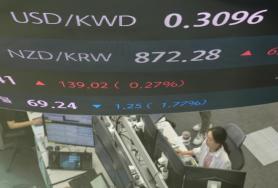
The won gained 13.3 won to close daytime trading at 1,466.8 per dollar, its strongest level in about two and a half months.
The currency opened near 1,477 per dollar and briefly weakened before reversing direction and advancing into the mid-1,460s later in the session.
Foreign investors purchased a net 2.136 trillion won (US$1.46 billion) of shares on the main Kospi market, adding to demand for the won and accelerating the currency's rise.
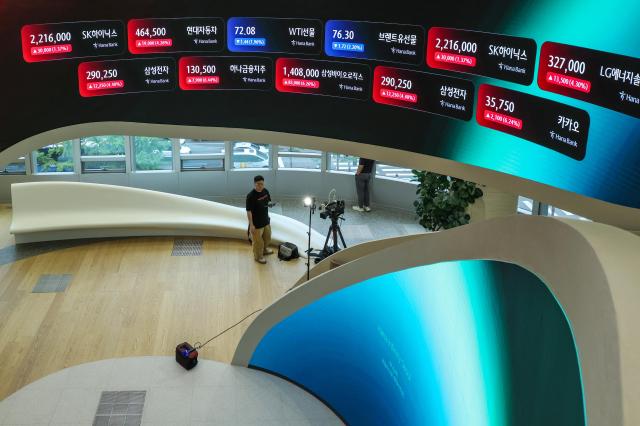
The benchmark KOSPI climbed 4.40 percent to 7,096.89 as overseas investors concentrated their purchases in large-cap stocks, including semiconductor companies.
The scale of foreign buying strengthened expectations of equity-related dollar selling, while exporters also sold dollars as the exchange rate extended its decline.
The market rally followed data showing that South Korea's real gross domestic product expanded 0.6 percent in the second quarter from the previous three months, exceeding the 0.4 percent median forecast in a Reuters poll.
The economy grew 3.7 percent from a year earlier, also beating expectations, as exports increased 1.4 percent on strong shipments of semiconductors, machinery and equipment.
The figures eased concern that economic momentum would fade sharply after 1.8 percent growth in the first quarter and reinforced expectations that the Bank of Korea will raise its annual growth forecast next month.
They also strengthened the case for at least one more interest-rate increase, improving the won's relative yield outlook despite continued strength in the broader dollar.
Renewed optimism over global artificial intelligence (AI)-related investment provided additional support, lifting South Korean chipmakers and drawing foreign funds back into a market that had recently experienced sharp volatility.
Government bonds showed a much more restrained response to the GDP surprise, with yields ending on opposite sides of their previous closes.
The yield on the three-year government bond rose 0.4 basis point to 3.917 percent, while the benchmark 10-year yield declined 0.8 basis point to 4.392 percent.
The stronger growth figures kept expectations for another BOK rate increase intact, but the possibility had already been largely reflected in short-term yields after their recent advance.
The central bank raised its benchmark interest rate by 25 basis points to 2.75 percent on July 16, and economists broadly expect at least one additional increase to 3.00 percent by the end of the year.
Buying interest emerged as the three-year yield approached 3.9 percent and the 10-year yield neared 4.4 percent, limiting further losses in bond prices despite the stronger-than-expected GDP data.
The decline in the longer-dated yield slightly flattened the yield curve, indicating that investors were reluctant to extend the bond sell-off without clearer evidence that stronger growth would generate persistent inflation.
Thursday's trading highlighted a divergence across South Korean financial markets, with the won and equities responding strongly to foreign inflows and the chip-led growth surprise while bonds remained caught between additional rate-hike risks and perceptions that yields were near a short-term peak.
Copyright ⓒ Aju Press All rights reserved.