

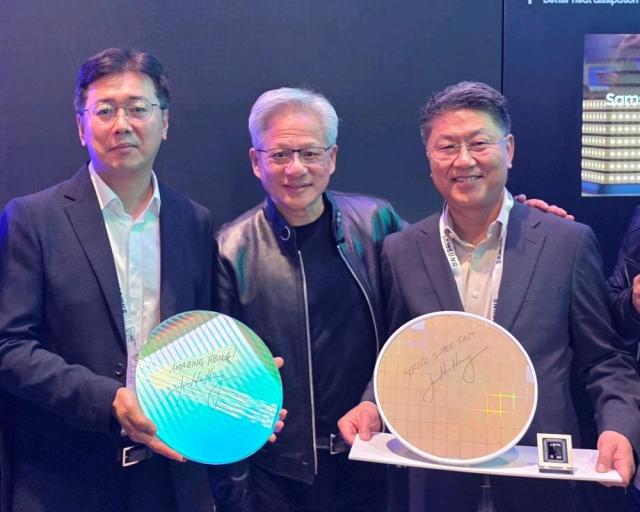
SEOUL, September 07 (AJP) - "AGI has arrived,” Nvidia CEO Jensen Huang declared as he congratulated OpenAI on the release of GPT-6 Astra, which the ChatGPT creator calls its most intelligent and aligned model yet.
AGI stands for artificial general intelligence, a loosely defined concept generally referring to AI capable of performing intellectual tasks across a broad range of domains at or beyond human levels. Whether Astra has actually crossed that threshold remains disputed, but the race toward it among frontier AI developers including OpenAI, Anthropic, Meta and Google is intensifying.
Huang said Astra was trained using more than 100,000 Nvidia Grace Blackwell GPUs across NVL72 systems, with another 400,000 GPUs coming online.
Whether or not the AGI label sticks, the economic implication for the semiconductor industry is clearer.
More capable AI models, increasingly autonomous agents and heavier competition for users and enterprise workloads mean greater demand for computing power. Greater computing power means more GPUs — and more high-bandwidth memory, or HBM, feeding data into them.
South Korea's two memory giants and their investors cheered the prospect Monday. Samsung Electronics shares jumped 5.68 percent to close at 270,000 won, while SK hynix surged 8.26 percent to 1,783,000 won.
The next battlefield for HBM supremacy is taking shape in Gyeonggi Province, home to the advanced chipmaking complexes of Samsung and SK hynix.
Samsung Electronics and SK hynix are preparing to go head-to-head using sixth-generation 10-nanometer-class, or 1c, DRAM in HBM4E after taking sharply different process strategies for HBM4.
The confrontation is becoming more consequential as Samsung closes the gap with the longtime HBM leader.
Samsung's share of global HBM revenue jumped to 33 percent in the second quarter from 21 percent three months earlier, while SK hynix's share fell to 50 percent from 58 percent, according to Counterpoint Research.
The gap between the two Korean memory makers narrowed to 17 percentage points from 37 points in just three months.
A year earlier, SK hynix held 64 percent of the market against Samsung's 15 percent, leaving a 49-point gap.
Micron ranked third with an 18 percent share in the second quarter, down from 21 percent in the first.
The figures do not yet represent the balance of power in HBM4.
Most HBM revenue still comes from HBM3E, while HBM4 shipments are expected to become increasingly visible in market revenue during the second half of this year.
The narrowing gap nevertheless comes as Samsung and SK hynix pursue markedly different manufacturing strategies for the new generation.
Samsung took the more aggressive route in DRAM process technology.
The company began mass-producing and commercially shipping HBM4 in February using 1c DRAM, breaking with the industry's conventional practice of applying a more mature process to HBM products.
Samsung's HBM4 combines 1c DRAM with a 4-nanometer logic base die and delivers a sustained data-transfer speed of 11.7 gigabits per second per pin, with speeds of up to 13 Gbps.
A Samsung Electronics official said yields for its 1c-based HBM4 have stabilized and that the product has been supplied smoothly to customers since mass production began in February.
SK hynix took the opposite approach.
Rather than immediately adopting 1c for HBM4, the company retained its proven fifth-generation 10-nanometer-class, or 1b, process while initially applying 1c to conventional DRAM products.
An SK hynix official said the company took the reverse approach to Samsung, which deployed 1c first in higher-value HBM products while retaining an older process for conventional DRAM.
Using the already proven 1b process for HBM4 also offered an advantage in securing stable yields, the official said, describing the decision as part of the company's broader process strategy rather than the result of a single technical factor.
The distinction matters because a more advanced DRAM process alone does not determine HBM performance.
Lee Jong-hwan, professor of system semiconductor engineering at Sangmyung University, said 1c has a performance advantage over 1b, but the difference between the two processes is only one component of the overall HBM architecture.
"DRAM performance is important, but the connection technology that links each DRAM die is also critical," Lee said. "The DRAM itself and packaging technologies all have to perform well together to achieve strong overall HBM performance."
Lee said the difference between 1b and 1c alone is not large enough to determine the competitiveness of the finished HBM product because both are successive refinements within the same 10-nanometer-class generation.
The two companies' strategies are now set to converge with HBM4E.
SK hynix is moving its broader DRAM production toward 1c as it prepares to use the newer process in HBM4E, bringing its core DRAM process in line with Samsung's.
SK hynix has confirmed that shipments of products based on its 1c process began in earnest in the second quarter.
Moving to the newer process gives chipmakers room to improve performance and power efficiency. The economic payoff, however, depends heavily on whether they can stabilize yields as manufacturing complexity increases.
"Better performance makes it harder to secure yields," Lee said. "In semiconductors, yield directly translates into money. If yields are poor, you cannot supply the volume customers want."
"Performance and yield have to improve together. That is what creates real competitiveness," he added.
The trade-off is particularly important for HBM because the product stacks multiple DRAM dies and requires sophisticated bonding, packaging and thermal-management technologies in addition to the underlying memory process.
HBM4E will put those capabilities to a tougher test.
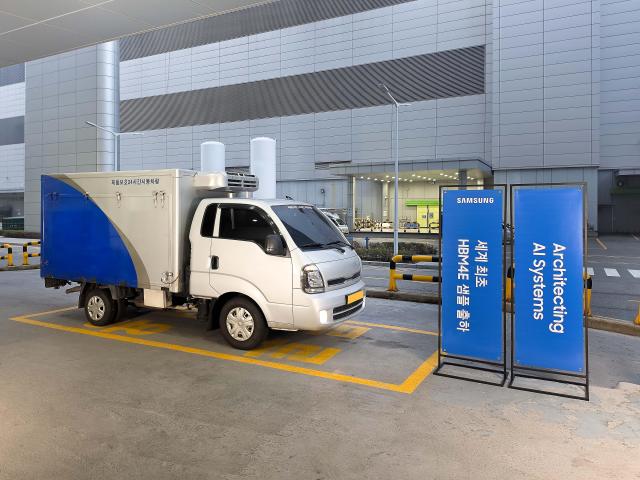
Samsung shipped samples of its 12-layer HBM4E to major global customers in May.
The product combines 1c DRAM with a 4-nanometer logic base die and supports data-transfer speeds of up to 16 Gbps per pin.
The company argues that experience mass-producing HBM4 with the same 1c DRAM and 4-nanometer base-die combination could give it an advantage as HBM4E moves toward commercial production.
"Because we have already mass-produced HBM4 based on 1c and 4-nanometer technology, we expect to provide HBM4E with more stable performance and quality," a Samsung Electronics official said.
Samsung said the key advantage lies less in headline specifications than in having already validated the underlying manufacturing combination through HBM4 mass production.
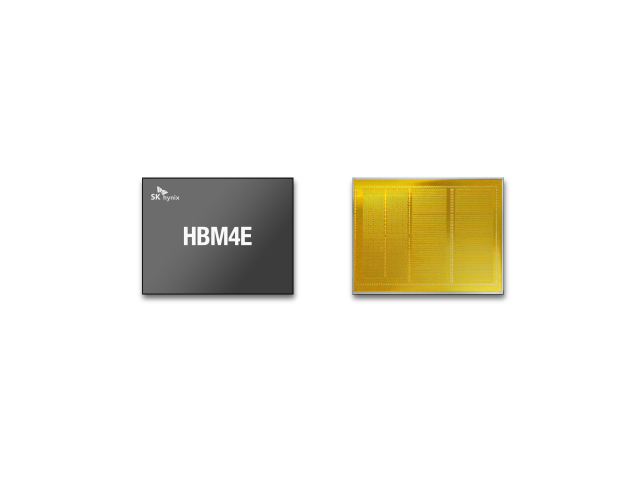
SK hynix supplied samples of its own 12-layer HBM4E to major customers in June.
The product also supports speeds of up to 16 Gbps per pin and offers more than 20 percent higher power efficiency than the preceding generation, according to the company.
HBM4E remains at the sample-supply stage for SK hynix, with mass production dependent on customer schedules. The company is seeking to move forward within this year, although precise timing has not been fixed.
SK hynix said the biggest improvement expected from moving to the newer DRAM node is performance, particularly data-transfer speed.
The convergence on 1c changes the nature of the rivalry.
The HBM4E contest is unlikely to be decided simply by which company uses the more advanced DRAM process. Both must prove they can combine high-performance 1c DRAM with stable yields, advanced packaging and bonding, efficient thermal management and large-volume production aligned with customers' schedules.
The two companies therefore enter the HBM4E era from different positions.
SK hynix brings the larger HBM market share and customer and manufacturing experience accumulated during its HBM3E leadership. Samsung brings experience mass-producing 1c-based HBM one generation earlier and a sharply rising HBM revenue share.
Investor expectations are rising alongside the technological competition.
Consensus estimates for Samsung Electronics' third-quarter operating profit stood at 114.2 trillion won ($84.8 billion) as of Sept. 4, up 12 percent from three months earlier, according to FnGuide.
SK hynix's third-quarter operating-profit estimate rose 4 percent over the same period to 78.8 trillion won.
AJP Takeaways
- Samsung's global HBM revenue share jumped to 33% in Q2, narrowing SK hynix's lead to 17 percentage points.
- Samsung adopted advanced 1c DRAM for HBM4, while SK hynix prioritized yield stability with proven 1b technology.
- HBM4E resets the race: Both companies are moving to 1c for HBM4E, shifting competition toward yield, packaging, performance and volume production.
- AI demand raises the stakes: More powerful AI models and agents are driving demand for GPUs and HBM, lifting expectations for both Korean memory giants.
SK hynix said the HBM market remains in an absolute supply shortage even as more suppliers enter a business that had previously been centered more heavily on the company.

Copyright ⓒ Aju Press All rights reserved.
