

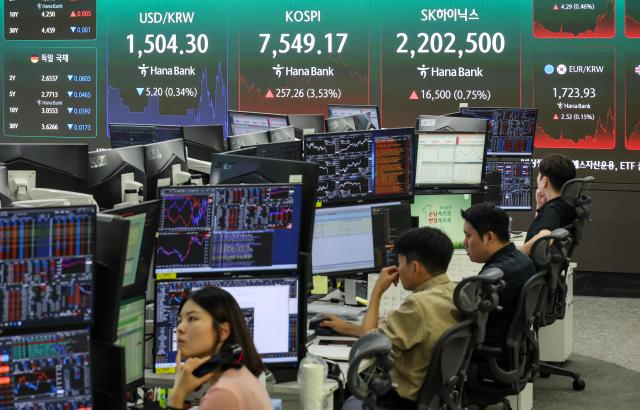
The benchmark KOSPI closed at 6,869.83 points, down 1.55 percent from the previous session, ending a five-session winning streak. The index opened at 7,127.77 and surged more than 3 percent to an intraday high of 7,216.62 before reversing course and falling as low as 6,788.78.
Foreign investors remained net buyers for a fifth consecutive session, purchasing a net 91.4 billion won (US$64.7 million) of KOSPI shares, but that marked a sharp pullback from the morning, when their net purchases reached as much as 1.52 trillion won. They also bought a net 52.4 billion won in KOSPI 200 futures.
Retail investors bought a net 741.5 billion won of KOSPI shares, while institutions sold a net 795.1 billion won, adding to the downward pressure later in the day.
The strong start was driven by gains in U.S. chip shares during the Korean market holiday, which carried over to semiconductor heavyweights in Seoul. But the buying lost steam later in the day, and the index erased its gains to finish lower for the first time in six trading days.
The sharp reversal came as trading remained thin. Although the KOSPI has recovered substantially from its late-July rout, market activity has continued to retreat from the elevated levels seen during the first-half rally.
Average daily KOSPI turnover stood at 26.47 trillion won so far in August, down from 36.88 trillion won in July and the lowest monthly level this year, according to Korea Exchange data.
The drop is particularly stark compared with May and June, when daily turnover averaged 50.22 trillion won and 50.35 trillion won, respectively. Activity this month is down about 47 percent from June.
Trading volume has weakened even further. An average 332 million shares changed hands each day this month, also the lowest level this year and the weakest since August 2025, when the daily average stood at about 318 million shares. It is also well below the 2025 daily average of roughly 445 million shares.
The divergence has left the KOSPI recovering without the broad participation that characterized its earlier rally. Foreign buying of Samsung Electronics and SK hynix has provided much of the recent support, while retail investors, a major source of liquidity during the first half, have remained cautious after heavy losses from the market plunge.
The market initially shrugged off heightened Middle East tensions and a jump in international oil prices before giving up its early gains.
Oil had surged after a 60-day negotiating period between the United States and Iran expired without a final agreement, while tensions intensified after U.S. President Donald Trump warned Oman, a mediator in the talks, of possible strikes.
Pressure intensified as bond yields rose across major markets. Japanese long-term government bond yields climbed to their highest levels in about three decades, raising concerns that Japanese institutional investors could shift funds from U.S. Treasurys into higher-yielding domestic debt.
Only two of the KOSPI's 10 largest stocks by market capitalization finished higher. Samsung Life Insurance gained 3.16 percent to 310,500 won, while SK hynix edged up 1.03 percent to 1,662,000 won.
Samsung Electronics and SK hynix had risen to around 280,000 won and 1.79 million won, respectively, in early trading. Samsung Electronics reversed course to finish 2.19 percent lower at 268,500 won.
Samsung Electro-Mechanics plunged 7.57 percent to 1,440,000 won, LG Energy Solution fell 5.01 percent to 351,000 won and Hyundai Motor lost 3.97 percent to 435,000 won. Samsung Electronics preferred shares dropped 3.73 percent to 188,300 won, SK Square declined 1.65 percent to 1,135,000 won and Samsung Biologics slipped 1.10 percent to 1,531,000 won.
Analysts said the decline in trading partly reflects a normalization from unusually heated conditions earlier this year, though weaker participation by retail investors has also contributed to the slowdown.
The junior KOSDAQ fared even worse, snapping its own five-session winning streak. The junior index closed at 834.20, down 3.52 percent.
Retail investors bought a net 389.2 billion won and foreigners purchased 36.6 billion won, while institutions sold a net 416.4 billion won.
Among major KOSDAQ stocks, semiconductor laser equipment maker EO Technics gained 2.48 percent to 414,000 won, while chip equipment maker Jusung Engineering rose 0.84 percent to 179,300 won.
Losses, however, were widespread across battery, biotechnology and growth stocks. Battery materials holding company EcoPro plunged 6.94 percent to 87,100 won, while cathode materials maker EcoPro BM fell 6.51 percent to 109,100 won. Robot maker Rainbow Robotics dropped 6.19 percent to 470,000 won.
Biotech firms ABL Bio and Alteogen lost 5.11 percent to 79,800 won and 5.10 percent to 298,000 won, respectively. Semiconductor component maker Leeno Industrial declined 4.24 percent to 67,800 won, while chip equipment maker Wonik IPS shed 3.60 percent to 112,400 won.
The Korean won strengthened slightly against the U.S. dollar, trading at 1,412.30 won, compared with 1,418.30 won at the previous session's close on Aug. 14.
Across Asia, Japan's Nikkei 225 fell 2.54 percent to 67,460.73, while China's Shanghai Composite edged up 0.19 percent to 3,990.30. Hong Kong's Hang Seng Index was little changed, rising 0.07 percent to 25,471.15.
AJP Takeaways
• South Korea's benchmark KOSPI closed at 6,869.83 on Aug. 18, 2026, down 1.55 percent, after surging above 7,200 earlier in the session as an initial semiconductor-led rally reversed.
• Foreign investors remained net buyers of KOSPI shares for a fifth consecutive session, purchasing 91.4 billion won, but their net buying fell sharply from as much as 1.52 trillion won during morning trading.
• KOSPI trading activity remained thin despite the recent market rebound, with average daily turnover at 26.47 trillion won in August through Aug. 18, about 47 percent below the 50.35 trillion won average recorded in June 2026.
• Rising global bond yields weighed on sentiment, while heightened tensions between the United States and Iran and higher international oil prices added to market uncertainty.

Copyright ⓒ Aju Press All rights reserved.
