
Journalist

HAN Joon ho
-
 Daegu and Gyeongbuk Join Forces to Boost Regional Tourism To address the concentration of foreign tourists in Seoul and the surrounding areas, Daegu and Gyeongbuk have partnered to enhance regional tourism. The government aims to revitalize local economies and combat population decline by promoting tourism, with plans to develop Daegu International Airport as a gateway for foreign visitors. Government Promotes Local Tourism to Combat Population Decline Recently, the Ministry of Culture, Sports and Tourism has focused on creating specialized tourism hubs to attract 20 million foreign tourists, aiming to distribute tourism demand nationwide and invigorate local economies. In line with this initiative, the Korea Tourism Organization's Daegu-Gyeongbuk branch convened a meeting on May 7 at the Daegu Inter-Burgo Hotel to establish a regional tourism network. The organization aims to facilitate global connections and expand air routes, addressing the limitations of individual local governments. About 40 representatives from Daegu, Gyeongbuk, Gyeongju, Andong, local tourism agencies, Korea Airports Corporation, and the travel industry participated. Enhancing Accessibility for Tourists Arriving at Daegu Airport The meeting focused on strengthening the international competitiveness of Daegu International Airport. Plans include significantly increasing flights from nearby countries to facilitate easier access for international tourists. Efforts will be made to secure airport slots for incoming flights and to enhance transportation networks, ensuring seamless travel from the airport to Daegu and major attractions in Gyeongbuk. Additionally, the region will develop accommodation infrastructure to promote extended stays and launch tailored campaigns to kickstart travel experiences upon arrival. Developing Unique 'K-Heritage' Tourism Routes In the afternoon, discussions shifted to creating unique cross-regional tourism products that blend local resources to attract foreign visitors. A notable proposal combines Andong's traditional culture, Gyeongju's World Heritage sites, and the significance of hosting the Asia-Pacific Economic Cooperation (APEC) summit next year, alongside trendy attractions like K-pop from Daegu. This initiative, dubbed 'K-Heritage,' aims to offer distinctive travel experiences that merge tradition and modernity. The tourism organization plans to leverage its global network and online travel platforms to support tailored marketing strategies for different countries. Park Soo-hyun, head of the Korea Tourism Organization's Daegu-Gyeongbuk branch, emphasized the need for regional collaboration to transform Daegu and Gyeongbuk into key destinations for foreign tourists. He stated, "Breaking down barriers between local governments is essential for effective cooperation, and we will work together with airports, airlines, and the travel industry to create substantial demand for inbound tourism."* This article has been translated by AI. 2026-05-07 16:28:45
 -
 Internet Banks Struggle to Find Sustainable Growth Amidst Competition Concerns are growing that internet banks, since their inception, have focused solely on superficial growth without establishing sustainable growth drivers. Their business models heavily rely on household loans, and their interest rates are less competitive than those of traditional banks. Initially aimed at reducing costs through online operations, these banks are now caught in a fierce competition for customer acquisition, neglecting the development of differentiated revenue models.As of the first quarter of this year, Kakao Bank has attracted 27 million customers, capturing 78% of the customer base of the largest traditional bank, KB Kookmin Bank, which has 34.7 million customers. K Bank, the first internet bank in South Korea, has 16.07 million customers, while Toss Bank has 14.23 million, surpassing Shinhan Bank's mobile platform, SOL, which has 10.42 million users.While these banks initially gained customers with low interest rates, they are now losing their competitive edge in interest rates compared to traditional banks. According to the Korea Federation of Banks, the interest rate spread for household loans in the first quarter was 2.02% for Kakao Bank, 2.28% for K Bank, and 2.09% for Toss Bank, compared to just 1.77% for the five major traditional banks (KB Kookmin, Shinhan, Woori, Hana, and NH Nonghyup).In the realm of general credit loans, Kakao Bank's interest rate spread is 2.78%, K Bank's is 2.29%, and Toss Bank's is 3.20%, all exceeding the average rate of 1.76% for traditional banks. Unlike traditional banks, internet banks do not operate physical branches, allowing them to focus on household loans and easily generate interest income.The high interest rate spreads have resulted in increased profitability. In the first quarter, Kakao Bank reported a net interest margin (NIM) of 2%, surpassing the average of 1.69% for the five major banks, while K Bank recorded 1.57%. Last year, Toss Bank achieved a high margin of 2.55%. However, the initial goal of providing differentiated digital services with lower costs is now being overshadowed by a focus on superficial growth.Critics warn that a business structure fixated on growth could ultimately harm customers. The banks are perceived as vulnerable in terms of long-term risk management and profitability compared to traditional banks, raising concerns that their current strategies may not be sustainable. With household loans making up 90% of their portfolios, their offerings are limited to personal loans and advertising revenue from platforms, leading to questions about their original mission.A financial industry insider stated, "The focus on expanding interest rate spreads and short-term funding strategies clearly has limitations in terms of sustainability. Given the high proportion of so-called cherry-picking customers who move based on interest rates or promotions, it will be challenging to secure a stable funding base. Ultimately, the risk of passing unfavorable conditions onto consumers during interest rate fluctuations cannot be ignored, so a competition model based on soundness and sustainability needs to be explored."* This article has been translated by AI. 2026-05-07 16:27:29
 -
 Shinhan Financial Group Leads in Inclusive Finance Initiatives Shinhan Financial Group is gaining attention as the fastest-moving financial group in response to the government's inclusive finance initiatives. Under Chairman Jin Ok-dong, the group has revived the 'microfinance' program, previously used as a policy finance tool, to differentiate itself in the market.As of May 7, Shinhan Financial has actively integrated microfinance into its inclusive finance strategy, enhancing its presence. Microfinance provides low-interest startup and operational funds to low-income individuals without requiring collateral or guarantees, aimed at supporting financially vulnerable groups. Although launched during the Lee Myung-bak administration and expanded under the Moon Jae-in administration, its significance had diminished in recent years.The current government had not considered utilizing microfinance, but Shinhan Financial has adopted it as a tool for inclusive finance. Chairman Jin recognized its potential during a review of existing inclusive finance systems, suggesting, "Let’s use existing systems efficiently" instead of creating new ones.This approach has been praised for balancing speed and effectiveness, reducing the time needed to design new systems while clearly defining the support targets. Following Shinhan Financial's proposal, other financial groups are reportedly exploring similar models.The proactive efforts of Chairman Jin and Vice Chairman Ko Seok-hun have been noted, with the group quickly generating ideas in response to messages from financial authorities. Shinhan Financial was the first to propose debt forgiveness for disabled individuals, reflecting this trend.Shinhan Financial plans to contribute 100 billion won to the Shinhan Microfinance Foundation to support diligent repayers and develop new policy loan products. Additionally, it aims to convert all diligent repayment customers from savings banks to bank products within the first half of the year and operate cooperative finance loan products using its platform, distinguishing itself from other financial groups.A financial authority official stated, "Shinhan Financial is notably quick in its responses and frequently proposes ideas, making it one of the active players in inclusive finance."* This article has been translated by AI. 2026-05-07 16:25:37
 -
 Internet Banks Face 'Cherry-Picking' Controversy Amid Lending Criticism Internet banks are facing renewed scrutiny over their lending practices, particularly regarding their role in inclusive finance. Critics argue that these banks primarily serve higher-credit borrowers, contradicting their founding purpose. According to a report from the Korea Federation of Banks on May 7, the three internet banks—K-Bank, Kakao Bank, and Toss Bank—had a combined 33.1% of their credit loan balances allocated to borrowers in the bottom 50% of credit scores as of the end of last year, down from 33.8% the previous year. Individually, K-Bank and Kakao Bank saw declines of 2.8 and 0.1 percentage points, respectively, with figures of 32.5% and 32.1%. Toss Bank, however, increased its share to 34.9%, a rise of 0.9 percentage points. Overall, the proportion of loans to low- and mid-credit borrowers remains just above the government guideline of 30%, showing little sign of significant growth. The share of new loans to low- and mid-credit borrowers reflects a similar trend, with K-Bank and Kakao Bank barely exceeding the 32% threshold at 34.5% and 35.7%, respectively. This raises concerns that the banks are prioritizing target fulfillment over genuine expansion of inclusive finance. While internet banks cite soundness management as a reason for their cautious approach to expanding loans to low-credit borrowers, critics argue that this stance undermines their intended role in promoting inclusive finance. They warn that limiting supply under the guise of risk management blurs the distinction between internet banks and traditional banks. Kim Yong-beom, head of the Presidential Policy Office, recently criticized this trend on social media, stating, "Household loans should not be confined to high-credit borrowers in a safe bubble. Cherry-picking is not the mission of internet banks." He condemned the practice of selectively serving only financially stable customers. Kim also challenged financial authorities, questioning whether they have inadvertently strengthened existing power structures under the pretext of maintaining soundness. This has led to speculation that authorities may intensify their oversight of internet banks' lending to low-credit borrowers and consider adjustments to related policies. Seo Ji-yong, a professor at Sangmyung University, noted that internet banks have focused on higher-credit borrowers to avoid deteriorating financial soundness. He acknowledged that even with demands to expand loans to low-credit borrowers, the inherent selection process raises barriers. He added that authorities should consider providing incentives and policy adjustments to support internet banks in this area.* This article has been translated by AI. 2026-05-07 16:24:14
 -
 HUG to Release Villa Prices and Quality Jeonse Listings to Prevent Rental Fraud The Housing and Urban Guarantee Corporation (HUG) is set to introduce new services that provide price information for villas and multi-family homes, along with a certification system for quality jeonse listings. This initiative aims to reduce information asymmetry in the non-apartment market, where rental fraud has been prevalent. HUG plans to expand its role beyond a guarantee institution to a public platform that encompasses housing supply, financial services, and data offerings. During a press briefing marking his 100 days in office on May 7, Choi In-ho, HUG's president, stated, "We will utilize our 700 billion data points to enhance housing stability for the public." He emphasized the need to provide reliable price information for villas and multi-family homes, which are often difficult to verify compared to apartments, to protect low-income renters. HUG's 'Safe Villa Price' initiative will combine appraisal data and actual transaction information to calculate appropriate prices by region and property age. This information will be presented through a map-based visualization service. The non-apartment market has faced challenges due to limited transaction examples and significant price variations, making it hard for tenants to assess fair rental prices. Additionally, HUG plans to implement a certification service for quality jeonse listings. This will involve evaluating properties based on deposit amounts, priority claims, and regional average debt ratios to assign a certification mark to lower-risk listings. Collaborations with proptech platforms like Naver Real Estate and Zigbang will allow tenants to assess risks before signing contracts. The Safe Jeonse app will also be enhanced. HUG intends to strengthen its AI-based risk assessment service by integrating data from six agencies, including the Ministry of Land, Infrastructure and Transport and the National Tax Service. Currently, the app offers risk assessments, landlord information checks, and guarantee applications, with over 1 million downloads and 2.8 million uses. Changes to the jeonse guarantee review process are also anticipated. HUG is considering a pre-review system that would allow for guarantee eligibility checks after the deposit is paid but before the final payment. Choi noted, "Implementing pre-reviews will significantly increase accident prevention rates." However, the direct incorporation of landlord credit ratings into the guarantee review process is not currently under consideration, as HUG focuses on making it easier for tenants to obtain guarantees. HUG also announced plans to support housing supply. This year, it aims to increase the supply of its Dundeun Jeonse housing from 1,800 units last year to 3,000. The scope of purchases will expand from non-apartment properties to include apartments with over 150 units. Choi mentioned that discussions are ongoing to further increase Dundeun Jeonse acquisitions in response to rising rental pressures in Seoul. The corporation is also enhancing support for youth housing and construction rental housing. HUG has improved the rental guarantee system for youth housing in collaboration with Seoul City, aiming to expedite occupancy for about 2,000 units across 10 projects that have not yet secured tenants. It anticipates facilitating the supply of approximately 18,000 units in Seoul by 2028. For construction rental housing, HUG has revised guarantee extension criteria and appraisal methods. Previously, exceeding debt ratios required additional collateral for guarantee extensions, but this has been improved to allow extensions without extra financial burdens. HUG expects this will enhance conditions for around 1,000 projects, totaling 260,000 units of construction rental housing. HUG also unveiled measures to stabilize the project financing (PF) market. It plans to raise the guarantee limit for PF special guarantees from 50% to 70% and eliminate construction ranking restrictions. HUG aims to provide 2 trillion won in special guarantees for small construction firms by 2027, having already achieved 90% of this goal as of late April. Choi affirmed, "We will strive to expand PF special guarantees beyond our targets." Addressing unsold properties in local areas is another priority. HUG plans to expand its pre-completion unsold property purchase program and enhance mortgage guarantee support for unsold properties post-completion. Choi reported that there are currently about 30,000 unsold units in local areas, with 10,000 under review, and expressed commitment to achieving this year's goals based on previous successes in supporting 3,000 units with 850 billion won in guarantees. Additionally, HUG plans to launch four new products this year, including guarantees for relocation costs in housing regeneration, public maintenance project loans, rental guarantees for senior welfare housing, and securitization of trust fee claims. Choi emphasized the importance of establishing a comprehensive and robust guarantee system to promote housing supply.* This article has been translated by AI. 2026-05-07 16:22:12
 -
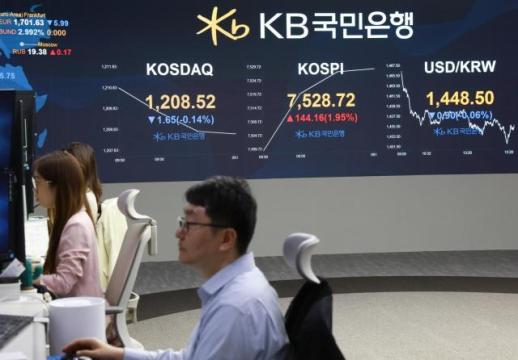 SK Hynix Doubles in Four Months, But Bank Stocks Lag in KOSPI Rally The KOSPI index surged past 7500, driven by a spike in semiconductor stocks, but bank shares remain sidelined in the market rally. Analysts attribute the limited upward momentum to concerns over financial stability and policy uncertainties despite record earnings. On May 7, Samsung Electronics closed at 271,500 won, up 5,500 won (2.07%) from the previous day, marking a 111.2% increase since the start of the year. Similarly, SK Hynix rose from 677,000 won to 1,654,000 won, a 144.3% jump. The semiconductor sector is leading the KOSPI's overall rise, fueled by expectations of increased demand for artificial intelligence and foreign investment. In contrast, bank stocks have lagged behind. While the KOSPI has risen 73.7% this year, the KRX Bank Index has only increased by 25.1%. Major financial groups saw limited gains, with KB Financial rising 30.7% from 123,300 won to 161,200 won, and Shinhan Financial increasing 29.1% from 76,600 won to 98,900 won, falling short of the KOSPI's growth. Despite the recent strong performance of the four major financial groups (KB, Shinhan, Hana, and Woori), which reported a combined net profit of 5.33 trillion won in the first quarter—an 8.1% increase year-on-year—analysts note that the growth in stock prices has been muted. This is partly due to the market already pricing in the banks' shareholder return strategies, including stock buybacks and increased dividends, as investor interest shifts toward high-growth sectors like AI and semiconductors. Concerns over rising delinquency rates and increased loan loss provisions have also heightened worries about financial stability, while the management of household loans poses additional challenges to bank profitability. Recent comments from President Yoon Suk Yeol and Kim Yong-beom, head of the Presidential Policy Office, criticizing the current credit rating system and interest rate structure have further dampened investor sentiment. However, analysts maintain that the fundamentals of bank stocks remain solid. Given the trends in market interest rates and lending regulations, there is a strong likelihood of continued improvement in net interest margins (NIM) in the second quarter. While short-term underperformance may persist, a reduction in market concentration could highlight the undervalued appeal of bank stocks. Hana Securities analyst Choi Jeong-wook stated, "If concerns about interest rates grow, the defensive appeal of bank stocks may resurface, and we expect them to outperform the market this month."* This article has been translated by AI. 2026-05-07 16:20:19
 -
 Financial Sector Supports Yeocheon NCC with Increased $300 Million Naphta Import Credit The financial sector is stepping in to support Yeocheon NCC amid increased supply challenges for naphta due to the prolonged conflict in the Middle East. On May 7, the Financial Services Commission announced that it would hold a meeting of the "Self-Regulatory Council of Bond Financial Institutions" to discuss a financial support plan that includes raising the naphta import letter of credit (L/C) limit to $300 million. A letter of credit is a payment method where banks guarantee payment to sellers on behalf of importers. This support plan is set to be approved by the Self-Regulatory Council on May 15 and implemented on May 18. Previously, Yeocheon NCC had requested an expansion of the L/C limit from its main creditor, Industrial Bank of Korea. In response, the bank expedited the usual six-week process for increasing the L/C limit to about two weeks, in line with a joint support system for naphta imports amid the Middle East situation. The Korea Trade Insurance Corporation also plans to provide $50 million in import insurance to bolster financial support. The Financial Services Commission stated, "This financial support will enable Yeocheon NCC to import naphta smoothly even in emergencies like price surges," adding that the financial sector will continue to provide prompt support to ensure no disruptions in naphta imports for the petrochemical industry. Meanwhile, Yeocheon NCC's operating rate had dropped to 55% due to supply disruptions from the blockade of the Strait of Hormuz, but it has recently adjusted the rate to 65% considering government support policies.* This article has been translated by AI. 2026-05-07 16:18:45
 -
 Tight Race for Daegu Mayor: Kim Boo-kyum vs. Choo Kyung-ho "Daegu needs to change now" "But the Democratic Party can't win" Public sentiment in Daegu, traditionally a conservative stronghold, is shifting. A visit by Aju Economy on May 7 revealed a tight race between Kim Boo-kyum of the Democratic Party and Choo Kyung-ho of the People Power Party for the mayoral position. Voices calling for change clashed with those insisting on preserving conservative values. Kim, the first Democratic lawmaker elected from Daegu, is leveraging his connection to the Lee Jae-myung administration to garner support, emphasizing the need for government budget allocations for the city. An 80-year-old man in Dongseongro, a former People Power supporter, remarked, "Isn't it time for Kim Boo-kyum to have a chance?" He argued that despite Choo's experience as a former economy minister, he questioned what could be achieved in the current political climate. A 20-something woman from Suseong District, where Kim has lived his entire life, noted, "It seems like more young people support the Democratic Party compared to older generations." A taxi driver traveling from East Daegu to West Daegu observed, "There seems to be a mood for change in Daegu, especially among the youth who are struggling to find jobs." The impact of the recent emergency measures is also influencing local sentiment, benefiting Kim. A 30-something professional expressed support for Kim, citing lingering loyalty to former President Yoon Suk-yeol as a drawback for Choo. Another professional woman in her 30s echoed this sentiment, expressing discomfort with Yoon. Choo, a three-term lawmaker from Dalseong-gun, is also receiving significant support. Residents believe he should be elected as mayor, having previously garnered 75.31% of the vote in the last general election. At the Hyunpoong Baeknyeondokgaebi Market, a 70-year-old man expressed his desire to see Choo as mayor, while another 73-year-old firmly stated, "We are definitely for Choo Kyung-ho." They also mentioned their support for former KCC chairman Lee Jin-sook, who is running for a parliamentary seat after being cut off from the mayoral race. An 80-year-old criticized President Lee's support policies, stating, "Offering 600,000 won will just burden the young people," and declared, "No matter what, I won't vote for the Democratic Party." Supporters in their 20s and 30s also expressed discontent with Lee's universal welfare policies. Many criticisms were directed more at the president than at Kim. While Choo's support is strong in Dalseong-gun, opinions suggest younger voters may differ. A taxi driver noted that Dalseong-gun has the youngest average age in the country at 44, indicating that the preferences of newcomers could be a significant factor. Some citizens expressed cynicism about the election, stating, "Neither candidate appeals to me," or "It doesn't matter who wins." Some even admitted they were unaware of the election. Recent polls indicate a close race, with Kim at 45.9% and Choo at 42.4%, a margin of just 3.5%. The survey, conducted by Daegu MBC and Ace Research from May 2-3, included 1,004 respondents aged 18 and older, with a margin of error of ±3.1 percentage points. More details can be found on the Central Election Survey Deliberation Commission's website. 2026-05-07 16:00:13
 -
 KB Asset Management Reclaims No. 3 ETF Market Share as Korea Stocks Surge South Korea’s stock market has climbed at an unusual pace, reshaping the exchange-traded fund landscape. Asset managers with heavier exposure to domestic equity ETFs have seen net assets rise quickly, while firms that emphasized U.S. big tech and other overseas-stock products have lagged. As of May 7, KB Asset Management’s ETF net assets totaled 32.4668 trillion won, according to the Korea Financial Investment Association. Korea Investment Management posted 32.4552 trillion won. Both had a 7.18% market share, but KB edged ahead on assets to retake third place. The two firms have traded the No. 3 spot for years. At the end of 2024, Korea Investment Management surpassed 13 trillion won in ETF net assets and closed in on KB, and the rankings continued to flip. By the end of last year, the gap widened: KB stood at 21.0866 trillion won with a 7.10% share, while Korea Investment Management rose to 25.3505 trillion won and an 8.53% share. The picture shifted this year as South Korean stocks surged. The Kospi has risen 191.49% over the past year, far outpacing the S&P 500’s 30.79% and the Nasdaq’s 45.67%. Since the start of the year, the Kospi is up 74.21%, compared with 7.39% for the S&P 500 and 11.20% for the Nasdaq. With money flowing into domestic stocks, related ETF assets expanded rapidly, helped by gains in the value of existing holdings. Analysts say managers with a larger share of domestic equity ETFs benefited most. Korea Investment Management has aggressively expanded a U.S. big tech-focused lineup. Among its flagship ETFs with more than 1 trillion won in net assets are ACE U.S. S&P 500 (3.6310 trillion won), ACE U.S. 30-Year Treasury Active (H) (1.8130 trillion won), ACE Global Semiconductor TOP4 Plus (1.3710 trillion won) and ACE Tesla Value Chain Active (1.2180 trillion won), all with significant exposure to U.S. stocks and technology shares. KB Asset Management, by contrast, has built a more balanced mix of domestic index and bond ETFs. Its flagship RISE 200 has 4.2780 trillion won in net assets. Other major products include RISE Korea Value Up (1.0010 trillion won), RISE Money Market Active (2.7240 trillion won), RISE Total Bond (A- or higher) Active (2.1070 trillion won) and RISE Samsung Electronics-SK Hynix Bond Mixed 50 (1.6110 trillion won), underscoring its domestic-asset tilt. The domestic rally is also affecting the battle for the top two spots. At the end of 2024, Samsung Asset Management and Mirae Asset Management held ETF market shares of 38.17% and 36.09%, a gap of 2.08 percentage points. By the end of last year, the gap widened to 5.39 points, and as of May 7 Samsung’s share had climbed to 40.08%, extending the lead over Mirae Asset to 8.64 points. Mirae Asset, which has also pursued an overseas-investment strategy, is seen as facing a relatively tougher environment during the domestic surge. An official in the financial investment industry said launching ETF products requires time and staffing, meaning an asset manager’s market outlook is reflected in its lineup. That lineup difference, the official said, becomes part of each firm’s brand identity and shapes investor choice. * This article has been translated by AI. 2026-05-07 15:56:26
 -
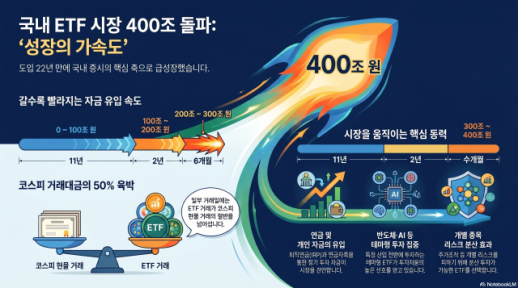 South Korea ETF Assets Top 400 Trillion Won as KOSPI Rally Fuels Shift From Stock Picking "We used to look for which stock would rise. Now we watch which ETF the money is flowing into." That line is increasingly common in Seoul’s Yeouido financial district as South Korean stocks extend a rally and the exchange-traded fund market expands quickly. Rather than picking individual names, more money is moving into ETFs that track indexes or broad sectors, shifting the market’s center of gravity. Industry officials say the domestic ETF market is accelerating even as external uncertainty, including war in the Middle East, persists. As of May 7, Korea Exchange data and other sources show domestic ETF net assets topped 400 trillion won last month. After ETFs were introduced in South Korea in 2002, it took 11 years for net assets to exceed 100 trillion won. It then took two years to reach 200 trillion won and six months to reach 300 trillion won. Net assets have now surpassed 400 trillion won within a few months, underscoring the faster pace of growth. ETF trading jumps with KOSPI rally Demand has risen as the KOSPI has repeatedly set record highs. Investors are increasingly favoring ETFs that provide exposure to the broader market and industries, rather than trying to manage volatility in individual stocks. A brokerage official said inflows are rising sharply as investors use ETFs to bet on the overall market trend in a rising market. Trading has also surged. On some sessions, ETF turnover has grown to more than half the value traded in the KOSPI cash market. Inflows have continued into semiconductor, artificial intelligence and secondary-battery ETFs, and trading has been active in leveraged ETFs that bet on bigger gains. Pensions and retail inflows reshape the market Retail investors and pension money are key drivers. ETF investing has expanded rapidly in individual retirement pension (IRP) and pension savings accounts, bringing steady long-term funds into the market. Analysts also point to financial regulators’ moves to strengthen responses to stock manipulation. As caution grows about risks tied to single-stock investing, some investors are leaning more toward ETFs for their diversification benefits. Competition among asset managers is intensifying. Major firms are rolling out a range of thematic ETFs, including semiconductors, AI, high-dividend and covered-call products, to capture demand. An industry official said ETFs have shifted from a supplementary tool to a core product for retail investors. "ETFs influence market direction" — and raise overheating concerns Some market participants say ETF inflows are now helping support the broader stock-market rise. A brokerage official said that when money enters ETFs, liquidity providers and authorized participants buy the underlying shares, improving supply-and-demand conditions in the cash market. Still, some warn about crowding into certain thematic ETFs. A sharp rise in leveraged and inverse ETF trading could increase market volatility. Even so, industry officials expect the ETF market’s growth to continue for the time being alongside the stock-market uptrend.* This article has been translated by AI. 2026-05-07 15:52:34