
Journalist

HAN Joon ho
-
 DP Floor Leader Han Byung-do Meets Senior Presidential Aide, Vows to Finish Key Bills by December Democratic Party floor leader Han Byung-do met Thursday with Hong Ik-pyo, the presidential senior secretary for political affairs, and pledged to complete legislation tied to the government’s already identified policy agenda by December to support stable state administration. Han also stressed a “one-team” approach among the party, government and presidential office, saying he would work to deliver results and help drive the success of the Lee Jae-myung administration in the National Assembly. Hong visited the National Assembly to congratulate Han on his new post. Han said the next year would be a “golden time” for the administration’s success and called the meeting a milestone to reaffirm the one-team spirit aimed at government success and economic recovery. Han was elected floor leader Wednesday at a party lawmakers’ meeting with majority support. He is the first in the Democratic Party to win a second term as floor leader. Han said that since becoming floor leader in January, 396 bills have been passed at plenary sessions, with about 115 more expected to be handled Thursday. That would bring the total to more than 500 bills in about four months, he said. He added that the party would serve as a reliable backer through responsible legislation and budgeting so the government can focus on managing external crises and protecting national interests. Hong said President Lee asked him to convey congratulations and expectations for Han’s role as floor leader. Hong added that the next year would likely determine the fate of the administration’s reform agenda, and said the Democratic Party — particularly under Han’s leadership — would play an important role, including in passing bills and fostering a cooperative political culture in the National Assembly.* This article has been translated by AI. 2026-05-07 14:41:54
 -
 Haesung DS jumps 11% to record high as brokerages raise price targets Haesung DS surged more than 11% on a wave of brokerage price-target upgrades, hitting an intraday record high. According to the Korea Exchange, shares were up 9,000 won, or 11.54%, at 87,000 won as of 2:16 p.m. on Thursday. The stock climbed as high as 87,700 won during the session, setting a new all-time high. Investor sentiment appeared to improve after multiple brokerages raised their targets. Since the start of this month, Samsung Securities, BNK Investment & Securities, iM Securities, Meritz Securities, Kyobo Securities and Eugene Investment & Securities have all lifted their price targets for Haesung DS. The revised targets range from 92,500 won to about 100,000 won. The company’s first-quarter profitability, however, temporarily weakened due to higher raw material costs. First-quarter revenue totaled 188.7 billion won, up 37% from a year earlier and 5% from the previous quarter. Operating profit was 11.0 billion won, down 50% from the prior quarter, with an operating margin of 5.8%. Analysts said profitability was temporarily hurt by a lag between a sharp rise in London Metal Exchange prices and increases in product selling prices, but they expect results to normalize starting in the second quarter as price hikes take fuller effect. Eugene Investment & Securities analyst Lee Ju-hyung said, “The weak first-quarter results are disappointing, but considering that most of the gap between estimates and actual operating profit was due to the sharp rise in LME prices, we expect the company’s performance to normalize from the second quarter, when the impact of higher selling prices will be reflected in earnest.” Eugene forecast second-quarter revenue of 195.5 billion won and operating profit of 24.3 billion won, up 24% and 196%, respectively, from a year earlier. Expectations for a stronger second half are also growing, as mass-production sales of heat spreaders for a new North American customer are expected to be reflected, and supply of new package (PKG) products to a Chinese plant of a domestic IDM company is expected to expand. Kyobo Securities analyst Park Hee-cheol said, “Although one-off profit deterioration occurred, considering the visible expansion of new product lines for big-tech customers in the lead-frame business and the smooth progress of qualification tests for package substrates, this is a section with high investment appeal compared with peers.”* This article has been translated by AI. 2026-05-07 14:35:55
 -
 Pros’ CFD Buying Surges in Samsung Electronics, SK Hynix as Chip Stocks Rally Professional investors have been concentrating money in large semiconductor stocks that have been leading recent gains in South Korea’s market. Their buying has also been evident in contracts for difference, or CFD, positions, with Samsung Electronics and SK Hynix showing the clearest rise in balances. As of the end of April, both the number of shares and the value of CFD balances in Samsung Electronics and SK Hynix rose sharply among the top CFD holdings, according to the financial investment industry on May 7. CFDs are leveraged products that settle only price differences without owning the underlying shares, and they are available only to professional investors. Samsung Electronics posted the biggest jump. Its CFD balance increased by 296,277 shares from the end of March, up 38%. The balance value rose by 72.123 billion won, a 78% surge. SK Hynix also climbed: its CFD balance increased by 21,689 shares, up 9.9%, while the balance value expanded by 42.456 billion won, up 34%. The inflows were attributed to strong share prices amid expectations for AI semiconductors and high-bandwidth memory, or HBM. Outside semiconductors, Seojin System stood out. Over the past month, its CFD balance saw a net inflow of 1,378,511 shares, and the balance value increased by 69.512 billion won. By balance value, it rose from around the top 20 to about seventh. The move was linked to growth expectations tied to data centers and power infrastructure. Some growth stocks, however, showed profit-taking. APR’s CFD balance fell by 151,248 shares, while its balance value dropped by 28.839 billion won, declines of 37.68% and 38.95%, respectively. Market watchers said recent CFD flows reflect a leadership rally centered on AI and semiconductors. With professional investors rapidly increasing exposure to Samsung Electronics and SK Hynix, they said the concentration of demand in chip stocks could persist for some time. Brokerages have also argued that a re-rating of the memory cycle is still in its early stages, saying there is room for further gains even after Samsung Electronics and SK Hynix broke past record highs. SK Securities on May 7 raised its target price for Samsung Electronics to 500,000 won from 400,000 won a month earlier, about 87% above the current price. It also lifted its target for SK Hynix to 3,000,000 won from 2,000,000 won, implying about 87% upside from the current share price.* This article has been translated by AI. 2026-05-07 14:34:54
 -
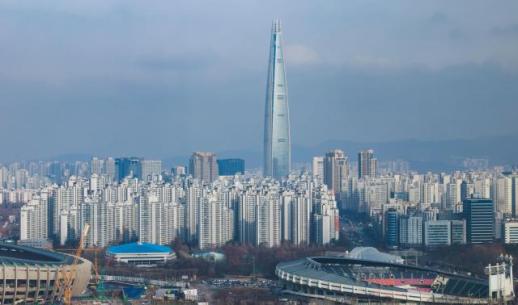 South Korea Weighs Capital Gains Tax Break Shift to Favor Owner-Occupiers The government has repeatedly signaled a tax overhaul that would shift the long-term holding special deduction on capital gains tax from rewarding simple ownership to prioritizing owner-occupancy. The move increasingly targets single-home owners who do not live in the property, aiming to curb speculative demand and encourage more homes to come onto the market. Critics, however, say it will be difficult to design rules precise enough to ensure the policy works as intended. According to government officials on Wednesday, the government and the ruling party are reviewing options including scrapping the current deduction based on holding period (up to 40%) and recognizing only a deduction tied to the period of residence. The review reflects criticism that the benefit is concentrated among owners of high-priced homes. Kim Yong-beom, policy chief at the presidential office, recently reiterated the need for changes, saying it is worth reconsidering whether applying the same 40% to both holding and residence fits a housing market centered on actual residents. Separately, Choi Hyuk-jin, an independent lawmaker, last month introduced an amendment to the Income Tax Act aimed at restructuring the deduction around owner-occupiers, accelerating efforts to legislate the change. Under the current law, a one-household, one-home owner with a sale price exceeding 1.2 billion won can receive a 40% deduction for holding the home for at least 10 years and another 40% for living in it for at least 10 years, for a maximum 80% capital gains tax deduction. If the overhaul is implemented, the tax burden for single-home owners who do not live in the property is expected to rise sharply. In a simulation by Woo Byung-tak, a specialist adviser at Shinhan Bank’s Premier Pathfinder, a homeowner who held a home for 10 years and lived in it for two years would see capital gains tax on a 3 billion won profit rise about 70%, to 799.40 million won from 466.76 million won. A key challenge is enforcement. The enforcement decree and rules for the Income Tax Act list “unavoidable reasons” such as job transfers and schooling for meeting capital gains tax exemption requirements for one-household, one-home sales. Practitioners say real-life living arrangements are far more complex, making it hard to set detailed standards that distinguish speculative buyers from a broad range of “separated households” who live apart for work or education reasons. Limits on administrative capacity are also cited. While the National Tax Service uses indicators such as utility usage and credit card spending, critics say it cannot fully screen out evasive cases such as partial household occupancy or partial leasing. As rules become more complex, concerns are growing that administrative costs will rise while loopholes multiply. In an analysis based on 2020 Population and Housing Census data, Lee Chang-moo, a professor at Hanyang University, found that in Seoul, 6.4% of all households fell into the category of separated households. Experts also warn that overly strict rules could restrict housing moves by end-users and accelerate a shift in the rental market toward monthly rent. If exceptions are narrowly defined, nonresident single-home owners may move into their homes to qualify for the deduction, potentially pushing existing tenants into the monthly rental market. Lee, a professor of urban engineering at Hanyang University, said it is difficult to draw a uniform line on residency and that long-term holding itself is not generally treated as speculative behavior in major countries such as Germany. He warned that tougher taxation on nonresident single-home owners could increase social costs and induce unnecessary moves, ultimately reducing the share of rental housing in city centers. * This article has been translated by AI. 2026-05-07 14:33:44
 -
 CJ ENM Q1 Operating Profit Rises 107% to 1.5 Billion Won on Film, Drama Rebound CJ ENM said growth at streaming platform TVING and stronger overseas content sales lifted first-quarter revenue in 2026, though profitability was mixed as the TV advertising market weakened and music investment increased. The company said May 7 that, on a consolidated basis, it posted first-quarter revenue of 13.297 trillion won and operating profit of 1.5 billion won. That was up 16.8% and 107.2%, respectively, from a year earlier. The entertainment division reported revenue of 9.511 trillion won, up 22.6%. It remained in the red with an operating loss of 19.0 billion won, but the loss narrowed by 7.2 billion won from a year earlier. The media platform division posted revenue of 3.268 trillion won, up 11.6% on TVING’s growth, but recorded an operating loss of 21.2 billion won as TV advertising revenue fell amid an economic slowdown. Results improved sharply in film and drama. Revenue rose 44.8% to 4.573 trillion won, and operating profit was 8.0 billion won, swinging to a profit. CJ ENM attributed the gains to expanded supply of global series including “American Classic,” “The Good Daughter” and “East of Eden,” which it said improved both sales and profitability. The music division posted revenue of 1.670 trillion won, down 0.1%. It recorded an operating loss of 5.8 billion won, citing fewer large events by label artists including at Lapone Entertainment and increased infrastructure investment for Mnet Plus. The commerce division extended revenue growth but saw weaker profitability. Revenue rose 4.5% to 3.785 trillion won, while operating profit fell 7.6% to 23.9 billion won. CJ ENM said it expanded intellectual property-based content commerce and strengthened short-form social media marketing to boost mobile competitiveness. It said mobile live commerce transaction volume jumped 137% from a year earlier, while app downloads and monthly active users each rose 11.8% on increased mobile investment. Subsidiary Studio Dragon reported first-quarter revenue of 155.3 billion won, up 16%, and operating profit of 6.4 billion won, up 50.1%. The company said broader TV scheduling, including terrestrial channels, and increased supply of global OTT originals supported growth. CJ ENM said it plans from the second quarter to focus on strengthening local platform partnerships and building a base for overseas co-productions; boosting integrated advertising competitiveness around anchor IP; expanding its artist lineup and improving concert-based earnings; and widening its commerce IP universe while strengthening premium product competitiveness. A CJ ENM official said, “We continued top-line growth in the first quarter on steady increases in TVING subscribers and advertising revenue and strong overseas content sales,” adding, “In the second quarter, we will focus on restoring profitability by improving business fundamentals by division and strengthening platform competitiveness.”* This article has been translated by AI. 2026-05-07 14:32:16
 -
 Airline Stocks Rise in Seoul on Oil Price Drop, Hopes for U.S.-Iran Deal; Korean Air Up 6% Airline shares rose in early trading as the Kospi moved above the 7,500 level. Korean Air Lines was up 6.31%, or 1,550 won, at 26,100 won as of 2:09 p.m., according to the Korea Exchange. Hanjin KAL gained 3.01%, or 3,300 won, to 113,000 won. Jeju Air climbed 5.21%, and Trinity Aviation rose 3.01%. The gains were seen as tied to falling global oil prices and easing war-related tensions. Foreign media reported that the United States and Iran are seeking to sign a memorandum of understanding that would bundle an agreement to keep the Strait of Hormuz open, limit Iran’s nuclear program and lift sanctions on Iran. The plan calls for 30 days of intensive talks immediately after the MOU is signed to work out detailed implementation steps. U.S. President Donald Trump told PBS in an interview that a deal could be reached before his planned visit to China on the 14-15. Iran said it is reviewing the U.S. proposal and will convey its position to mediator Pakistan. Expectations that Washington and Tehran are nearing an agreement sent oil prices sharply lower, the biggest drop since mid-April. On ICE Futures, Brent crude for July delivery settled at $101.27 a barrel, down 7.83% from the previous session. On the New York Mercantile Exchange, WTI crude for June delivery settled at $95.08 a barrel, down 7.03%. Brent and WTI posted their lowest levels since April 21 and April 24, respectively, and both recorded their largest one-day declines since April 17.* This article has been translated by AI. 2026-05-07 14:28:06
 -
 Poll: President Lee Jae-myung approval at 67%; Democrats 46%, PPP 18% President Lee Jae-myung’s job approval rating stood at 67%, down 2 percentage points from the previous survey, according to results released May 7 by the National Barometer Survey (NBS). The poll, conducted May 4-6 among 1,001 adults ages 18 and older by Embrain Public, Kstat Research, Korea Research and Hankook Research, found 67% rated Lee’s performance positively, 2 points lower than two weeks earlier. By age, positive ratings topped 50% in every group except those in their 20s and younger. In that youngest group, 37% approved, 27% disapproved and 36% said they did not know or gave no answer. By ideology, approval was 92% among progressives and 69% among moderates, while 48% of conservatives disapproved. In party support, the Democratic Party was at 46% and the People Power Party at 18%. Compared with the prior survey, Democratic support fell 2 points while the People Power Party rose 3 points. The Cho Kuk Innovation Party stood at 3%, the New Reform Party at 2% and the Progressive Party at 1%. Asked about the character of the June 3 local elections, 54% said the ruling party should be strengthened for stability, compared with 32% who said the opposition should be strengthened to keep the government in check. From the previous poll, support for boosting the ruling party fell 4 points, while support for boosting the opposition rose 2 points. On a recently discussed plan to hold a constitutional referendum at the same time, 59% supported it and 27% opposed it. Another 14% said they did not know or gave no answer. The NBS survey was conducted through telephone interviews using mobile phone virtual numbers (100%). The margin of error was plus or minus 3.1 percentage points at the 95% confidence level. The response rate was 19.8%. More details are available on the website of the National Election Survey Deliberation Commission. * This article has been translated by AI. 2026-05-07 14:27:10
 -
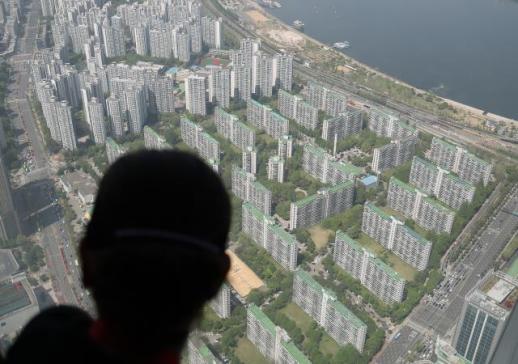 Seoul Apartment Prices Rise 0.15% as Yongsan Turns Up Ahead of Capital Gains Tax Change As bargain listings in high-priced apartment districts thinned out ahead of the end of a temporary suspension of heavier capital gains taxes, apartment prices in Seoul’s Yongsan district turned higher. The shift follows earlier turnarounds in Songpa two weeks ago and Seocho last week. According to the Korea Real Estate Board’s weekly apartment price trend report released on the 7th, Seoul’s weekly apartment sale prices rose 0.15% from the previous week. Seoul prices held a similar pace of gains amid mixed moves by district. They rose 0.15% in the third week of April and 0.14% in the fourth week. Dobong, Geumcheon, Nowon and Gwanak saw slower increases. Gwanak rose 0.17%, easing from 0.28% in the fourth week of April and 0.21% in the third week. Dobong rose 0.11%, down from 0.13% a week earlier and 0.19% two weeks earlier. Key areas along the Han River posted bigger gains. Mapo (0.10%→0.15%), Seongdong (0.14%→0.17%), Gwangjin (0.13%→0.15%) and Gangdong (0.08%→0.09%) all accelerated. The report attributed some of the widening gains to move-up demand from sellers in outlying districts that share the same living areas. Songpa, Seocho and Yongsan also strengthened. Yongsan rose 0.07% in the first week of May, turning positive. After declines began in the last week of February, Yongsan briefly turned up in late March before slipping again. Songpa and Seocho rose 0.17% and 0.04%, respectively, up from 0.13% and 0.01% the previous week. Gangnam fell 0.04%, extending its decline to an 11th straight week. Nam Hyuk-woo of Woori Bank’s real estate research center said that as many bargain listings were absorbed, slightly higher asking prices were reflected in some transactions. But he said Gangnam still showed a price-adjustment trend as additional last-minute bargain listings, centered on redevelopment apartments, came onto the market. In Gyeonggi province, prices rose mainly in areas with strong access to Seoul as end-users moved to buy homes amid tighter regulations. Examples included Anyang’s Manan district (0.12%) and Yongin’s Giheung district (0.21%), as well as Dongtan in Hwaseong (0.25%), Gwangmyeong (0.31%) and Yeongtong in Suwon (0.13%). Nam said tenants continued to opt for purchases in areas where rental listings for jeonse and monthly leases were shrinking faster. He added that districts with many apartments priced under 1 billion won benefited from easier access to policy loans, and from a relatively small gap between jeonse and sale prices. * This article has been translated by AI. 2026-05-07 14:25:42
 -
 HD Korea Shipbuilding & Offshore Q1 Operating Profit Jumps 58% to 1.356 Trillion Won HD Korea Shipbuilding & Offshore Engineering, HD Hyundai’s intermediate holding company for its shipbuilding business, said it extended strong results in the first quarter of 2026 on favorable conditions in its shipbuilding and engine businesses. In a regulatory filing on Thursday, the company reported consolidated first-quarter revenue of 8.1409 trillion won and operating profit of 1.3560 trillion won. That was up 20.2% and 57.8%, respectively, from a year earlier. Despite fewer operating days due to seasonal factors, revenue and profitability rose across all business lines as the share of high-margin eco-friendly ships increased, productivity improved and offshore earnings strengthened, the company said. Shipbuilding led the gains. Integrated HD Hyundai Heavy Industries, launched through a merger with HD Hyundai Mipo on Dec. 1 last year, posted revenue of 5.9163 trillion won and operating profit of 905.4 billion won. In the first quarter of last year, HD Hyundai Heavy Industries reported revenue of 3.8225 trillion won and operating profit of 433.7 billion won. HD Hyundai Samho reported revenue of 2.1245 trillion won and operating profit of 395.2 billion won, each up 8% from a year earlier. HD Hyundai Marine Engine said revenue and profit rose on higher engine selling prices, increased deliveries and stronger parts sales. It posted revenue of 133.5 billion won and operating profit of 32.6 billion won, up 60.8% and 216.5%, respectively, from a year earlier. HD Hyundai Energy Solutions reported revenue of 159.9 billion won, up 87.6% on higher module sales at home and abroad and price increases. Operating profit was 29.0 billion won, returning to the black. By segment, the shipbuilding division posted revenue of 6.6963 trillion won and operating profit of 1.1107 trillion won, up 14.6% and 42.1% from a year earlier on higher productivity and an improved product mix. The engine and machinery division reported revenue of 717.0 billion won and operating profit of 218.1 billion won, up 7.5% and 41.3%, respectively, as tighter global environmental rules boosted demand for dual-fuel engines. The offshore plant division posted revenue of 457.8 billion won and operating profit of 86.6 billion won, up 183.8% and 1212.1%, respectively, on higher project progress-based revenue recognition and cost cuts. An HD Korea Shipbuilding & Offshore Engineering official said newbuilding orders have continued, led by large tankers, with orders for gas carriers and container ships also steady. The official said bidding for major LNG projects in the United States is expected to ramp up in the second half, likely expanding demand for LNG carriers, and the company will continue selective orders focused on high value-added ships. The company said it has been winning orders for high value-added vessels since the start of the year. It recently won an order from KSS Line for three very large gas carriers, or VLGCs, worth a combined 504.8 billion won, bringing year-to-date orders to 86 ships totaling $9.35 billion (about 13.76 trillion won).* This article has been translated by AI. 2026-05-07 14:24:32
 -
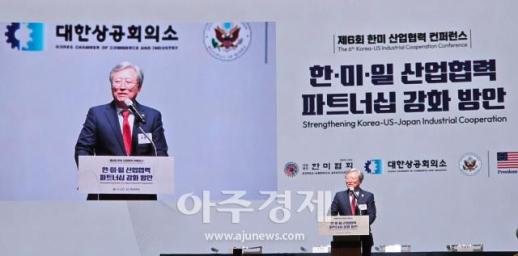 South Korea urges U.S.-Japan AI and energy alliance to strengthen supply chains The Korea Chamber of Commerce and Industry and the Korea-U.S. Association held the sixth Korea-U.S. Industrial Cooperation Conference on Wednesday at the KCCI building in Seoul, calling for closer South Korea-U.S.-Japan coordination on artificial intelligence and energy security. Speakers said surging power demand driven by AI and growing energy instability tied to the Middle East underscore the need to deepen cooperation in semiconductors, liquefied natural gas and small modular reactors. Choi Joong-kyung, chairman of the Korea-U.S. Association, said in opening remarks that the world has entered an era in which “security is industry, and industry is security.” He said trilateral industrial cooperation could become “the most powerful industrial alliance in human history” and reshape global industry. Lee Hyung-hee, vice chairman of the Seoul Chamber of Commerce and Industry and vice chairman of SK, said South Korea should build strategic ties with U.S. big tech companies around its strengths in semiconductors. In energy, he cited joint South Korea-Japan investment in U.S. LNG and cooperation on SMRs as practical steps that could improve supply stability and industrial competitiveness. Lee said companies would be better positioned if the government more boldly laid the groundwork for cooperation and provided targeted support. “The government needs to open barriers that are difficult to overcome through private-sector efforts alone,” he said. Yeo Han-koo, trade minister at the Ministry of Trade, Industry and Energy, said the Middle East crisis shows energy volatility can threaten industrial stability and national security. With AI driving “explosive” growth in electricity demand, he said securing a stable power supply is critical. Yeo said South Korean companies are expanding investment in key U.S. industries such as semiconductors, batteries and electric vehicles, making bilateral cooperation “no longer a choice but a necessity.” He said that cooperation could also help drive a broader rebound in U.S. manufacturing, including shipbuilding, civilian nuclear power and energy. He called on the three countries to build a successful model in advanced manufacturing, forge an innovation partnership for the AI era and strengthen an energy security alliance. In a keynote address, Sung Yun-mo, a distinguished professor at Chung-Ang University, said U.S.-China competition is unlikely to end soon and that South Korea must secure “irreplaceable” core technologies in semiconductors, AI and future vehicles. Sung said China is expanding its ecosystem around homegrown AI, and argued South Korea needs cooperation that combines its hardware capabilities with U.S. data platforms, financial investment and talent, along with Japan’s global supply chains. On energy, he said South Korea and Japan face instability in energy supply and therefore need supply cooperation with the United States, which has greater energy autonomy. He said South Korea should strengthen core technology and manufacturing competitiveness in the energy industry to exercise strategic autonomy. During a panel discussion, Kwon Seok-jun, a professor of chemical engineering at Sungkyunkwan University, said the first step in trilateral cooperation should be resolving a “memory bottleneck.” He said South Korea has a strong base in memory manufacturing, Japan has strengths in packaging and manufacturing, and combining those with U.S. design technologies and AI-specialized models could create a powerful shared platform. Cho Hong-jong, a professor of economics at Dankook University, said trilateral coordination is needed in energy security to prevent “China’s monopoly and productivity.” He proposed a fast-track system for cooperation on rapid licensing and permitting for SMRs. Cho said cooperation should combine U.S. foundational technology, Japan’s precision parts and finance, and South Korea’s construction and equipment capabilities, adding that regulations are an obstacle and that a fast track could support joint entry into third countries. About 120 people attended, including Choi; Lee; Yeo; James Heller, chargé d’affaires at the U.S. Embassy in Seoul; James Kim, chairman of the American Chamber of Commerce in Korea; Sung; and Ahn Se-hyun, dean of the College of Economics and Public Affairs at the University of Seoul.* This article has been translated by AI. 2026-05-07 14:19:13