

Journalist

Imran Khalid
-
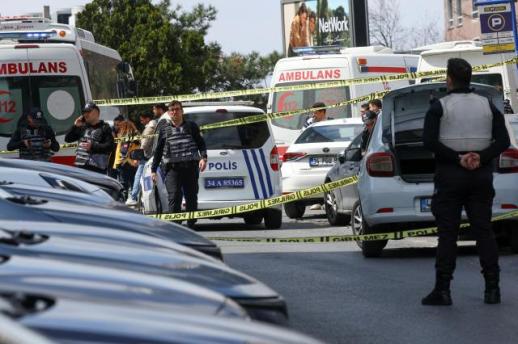 Turkish police neutralize three gunmen as Istanbul attack targets financial district SEOUL, April 07 (AJP) - Turkish security forces killed three gunmen in a high-stakes shootout outside Yapi Kredi Plaza in Istanbul, on Tuesday, thwarting what authorities described as a treacherous assault on the heart of the metropolitan commercial district. The engagement, which left two officers with minor injuries, marks the most direct threat to the financial hub of Besiktas since the regional security environment fractured in late February. This disruption of the status quo on Buyukdere Street signals an aggressive shift in militant tactics as instability from the nearby conflict begins to penetrate the nation's primary economic corridor. The incident began when the assailants, who traveled from the neighboring province of Izmit in a rental vehicle, opened fire on police units stationed near the plaza blocks. The Minister of Interior Mustafa Çiftçi confirmed that investigators have identified the suspects, noting that one maintained ties to a group that exploits religion, while another, a member of a pair of brothers involved in the cell, had a prior criminal record involving narcotics. Istanbul Governor Davut Gul characterized the daytime gunfight as a provocative act aimed at the stability of the city. This security breach arrives as the Eastern Mediterranean grapples with a series of shocks stemming from the war in Iran, which escalated following the initiation of major combat operations on February 28. Since the start of the hostilities, the region has seen a marked increase in militant activity and cross-border tensions that have rattled markets from Washington to South Korea. While Seoul has focused on the safety of energy corridors, Ankara has been forced to bolster its own urban defenses against the ripple effects of the Iranian conflict. The targeting of a major landmark in Istanbul is viewed by security analysts as a direct consequence of the heightened regional friction triggered by the ongoing combat operations to the east. "In the treacherous attack carried out against our police officers on duty in front of Yapı Kredi Plaza Blocks in İstanbul, three assailants were neutralised," said Burhanettin Duran, the presidency's head of communications. Duran emphasized that the "swift and decisive response" of security forces prevented a potentially larger catastrophe. "This heinous attack will never undermine our faith or determination in achieving our goal of a 'Terror-free Türkiye' and a 'terror-free region'," he added, asserting that the state would continue its fight against all threats and provocations with steadfast resolve. Justice Minister Akin Gurlek assigned a deputy chief prosecutor and two assisting prosecutors to oversee the multi-faceted investigation into the cell's origins and potential handlers. Forensic teams remained at the scene to collect ballistic evidence and process the rental vehicle used in the transit from Izmit. Coordination between the prosecutor's office and law enforcement units continues as they attempt to identify potential local support networks associated with the neutralized gunmen. 2026-04-07 22:06:48
 -
 Newspapers Must Ask ‘Good Questions’ to Create Fresh Perspectives, Korea Newspaper Association Chief Says "Asking good questions and creating new perspectives through public debate is both the duty and the right of newspapers." Park Jang-hee, chairman of the Korea Newspaper Association, made the remarks on 7일 at the Korea Press Center during the 70th Newspaper Day ceremony. He said machines cannot raise doubts on their own or empathize with the values of the times and the pain of neighbors. The ceremony was co-hosted by the Korea Newspaper Association, the Korea Newspaper and Broadcasting Editors Association and the Journalists Association of Korea. In his address, Park said artificial intelligence can produce answers instantly from vast data, while biased claims spread through algorithms on platforms “as if they were the correct answer.” He called the current moment “an era of answers.” He said high-quality journalism grounded in facts and balance is “a journey with no final destination.” Citing this year’s Newspaper Day slogan — “Beyond the algorithm, read the real world” — he urged newspapers to dig into truths that cannot be reduced to calculation and to build spaces for unity and public discussion. Lee Tae-gyu, president of the editors association, stressed responsibility in his opening remarks. “Technology cannot judge and verify what is true, nor does it take responsibility for results,” he said, adding that newspapers exist to put accuracy over speed, trust over sensationalism and responsibility over trends. He said the power to read the real world lies in journalism — in reporters’ on-the-ground verification, editors’ standards and the media’s sense of duty to the community. Park Jong-hyeon, president of the journalists association, also emphasized rebuilding trust in a message to readers. “AI and algorithms deliver information quickly, but they do not guarantee the truth,” he said. He called on the media to ask more questions, verify more and keep records more responsibly, pledging to choose substance over breaking news and accuracy over speed while staying in the field. A reception followed the ceremony, drawing about 300 guests including National Assembly Speaker Woo Won-shik; Jeong Cheong-rae, Democratic Party leader; Jang Dong-hyeok, People Power Party leader; Seoul Mayor Oh Se-hoon; and Lee Gyu-yeon, senior presidential secretary for public relations and communication. In welcoming remarks, Park said that when the world is unsettled, society needs clearer standards of truth, and that newspapers have the strength to push back against falsehoods and extremism. He said that strength comes from trained reporters in the field and rigorous fact-checking. Park added that while the AI era is unlike the past, AI is built on learning, and learning depends on refined accumulations over time — meaning the standing of original journalism and the value of carefully produced works will rise. * This article has been translated by AI. 2026-04-07 19:54:19
 -
 U.S. Leads Global Biotech for 15 Years as China Gains; South Korea Expands CDMO Footprint The number of publicly listed biotech companies and biotech patent filings has continued to rise worldwide, with the United States holding the top spot for 15 years. With expectations that Asia led by China will expand, South Korean biotech companies are accelerating efforts to secure global production hubs, led by contract development and manufacturing (CDMO). Data released Tuesday by the Korea Institute of Science and Technology Information (KISTI) showed the number of biotech companies listed on stock exchanges worldwide rose to 2,787 in 2022 from 1,542 in 2009, an average annual increase of 4.68%. By country over the past 15 years from 2009 to 2023, U.S.-based companies accounted for the largest share at 28.86%, followed by China, India and Canada. South Korea ranked fifth with 5.18%. Companies listed on the Nasdaq made up the biggest portion at 18.46%, while firms listed on South Korea’s KOSDAQ and KOSPI accounted for 6.1%. The United States also led biotech patent filings over the past 15 years, with a 17.54% share, followed by China at 12.51% and Japan at 9.74%. China’s share more than doubled over the period and ranked first in 2021 at 15.5%. South Korea held fifth place at 4.99%. As the market remains heavily weighted toward the United States, some analysts expect Asia’s market — centered on China — to expand over the medium to long term. South Korean companies are responding with large investments, including in U.S. production facilities to build global footholds. Samsung Biologics, Celltrion and Lotte Biologics have been expanding U.S. manufacturing bases. Samsung Biologics said it completed the acquisition of GlaxoSmithKline’s plant in Rockville on March 31 local time. Celltrion said it completed the acquisition of a Branchburg, New Jersey, facility from Eli Lilly on Dec. 31 and began full operations in January. Lotte Biologics was the first among them to secure a U.S. production base, acquiring a 40,000-liter facility in Syracuse, New York, from Bristol Myers Squibb in 2022 and operating it. Combined, the three companies’ U.S. biologics production capacity totals 166,000 liters. An industry official said U.S. facilities would play key roles by easing tariff risks, strengthening responses to global clients and diversifying supply chains. Some have called for policy support, including expanded institutional investment and government incentives to encourage sustained capital inflows from overseas. In its report, KISTI said, “Especially for patent filings, a strategy appears necessary to respond to U.S. technological leadership and China’s quantitative expansion,” adding that companies should be guided to shift R&D toward “qualitative innovation” so they can move from quantity to quality in technology development. * This article has been translated by AI. 2026-04-07 18:34:01
 -
 Korean Biotech CDMOs Expand From Manufacturing to Integrated Services Korean biotech companies are tightening their grip on the contract development and manufacturing (CDMO) market, reinforcing South Korea’s standing as an Asian bio hub. As global drugmakers expand outsourcing, Korean firms are moving beyond basic production into higher-value work that includes process development and regulatory support. BioPlan, a biopharmaceutical market research firm, said on the 7th that Samsung Biologics’ Songdo Bio Campus in Incheon was selected as the world’s largest single facility by production capacity. It held the No. 1 spot again after a 2022 survey, a result seen as validating the company’s “super-gap” strategy. Celltrion also gained ground. Operating Plants 1, 2 and 3 in Incheon, Celltrion ranked seventh in the survey, joining the global top 10. China’s CL Biologics’ Shenzhen facility ranked second, and a Genentech facility in the United States acquired by Switzerland’s Lonza in 2024 ranked third. In revenue, Korean companies are also closing in on global leaders. Jefferies said Samsung Biologics ranked fourth in global CDMO sales in 2024, posting $3.27 billion (about 4.9458 trillion won), behind Lonza, Thermo Fisher and Catalent. The report cited surging demand as CDMOs shift from small-molecule drugs toward more complex products such as cell and gene therapies. The shift is reflected in business models. Samsung Biologics is expanding modalities such as antibody-drug conjugates, while extending into contract research through “Samsung Organoid,” building an integrated service system that spans research and development. It has also strengthened its production base. After securing 17 of the world’s top 20 pharmaceutical companies as clients, it completed the acquisition of a biopharmaceutical manufacturing facility in Rockville, Maryland, on March 31 local time. With a 60,000-liter drug substance plant capable of supporting clinical through commercial production, its total capacity expanded to 845,000 liters. Celltrion is also upgrading its structure on the back of growing orders. After signing a contract manufacturing (CMO) deal worth about 678.7 billion won with Eli Lilly early this year, it added further contracts, pushing its cumulative CMO order backlog past 1 trillion won within the first quarter. The company is also shifting weight toward higher-value services. It is pursuing a CMO strategy aimed at boosting clients’ competitiveness through formulation changes, seeking differentiation with its own subcutaneous (SC) formulation conversion technology. A key example is its “formulation-change CMO” business, applying know-how built through products such as Remsima SC and Herzuma SC to external clients. Celltrion is accelerating its overseas footprint as well. It recently completed the relocation of a biopharmaceutical production facility in Branchburg, New Jersey, and set its expansion scale at 75,000 liters. That would raise its drug substance capacity from 316,000 liters to 571,000 liters. The company aims to secure CMO revenue through local production while broadening into CDMO and cutting costs to expand supply to the U.S. market. Lotte Biologics said it signed a CDMO contract on the 1st with a U.S. oncology-focused biotech company to produce antibody drug substance and develop processes. It plans to produce late-stage clinical samples and optimize processes at its Syracuse, New York, campus, while linking with its Songdo campus to strengthen integrated CDMO capabilities. As companies broaden their scope, the basis of competition is changing. A production-only model is showing limits, and integrated capabilities that include clinical support and regulatory approvals are emerging as a key factor. Jung Yoon-taek, head of the Korea Pharmaceutical Industry Strategy Research Institute, said, “The market is being reshaped from CMO to CDMO and to CRDMO,” referring to contract research, development and manufacturing organizations. “Competition is shifting toward companies that can provide customized, integrated services,” he said. The trend is also feeding into expanded investment by global drugmakers in South Korea. Roche signed a memorandum of understanding with the Ministry of Health and Welfare last month on strengthening global competitiveness in the biohealth industry and agreed to pursue $500 million (about 750 billion won) in investment over five years. Eli Lilly also announced a plan this year to invest a total of $500 million over five years. Even as South Korea emerges as a new hub, companies still face the task of proving both capacity and technology. Lee Seung-gyu, vice chairman of the Korea Bio Association, said the CDMO market requires not only scale but also quality control, skilled operating staff and the ability to respond to regulatory approvals to win sustained orders. “The key is building global competitiveness that matches market demand,” he said.* This article has been translated by AI. 2026-04-07 18:33:00
 -
 LG Energy Solution sinks deeper into red with second straight quarterly loss SEOUL, April 07 (AJP) - LG Energy Solution posted a widening operating loss for the first quarter of 2026, marking its second consecutive quarterly deficit as a prolonged slump in global electric vehicle demand and a sharp drop in U.S. tax credits eroded profitability at the world's No. 2 battery maker. The company said in a preliminary regulatory filing on Tuesday that it logged a consolidated operating loss of 207.8 billion won ($138.7 million) for the January to March period, swinging from a 374.7 billion won profit a year earlier and deepening from a 122 billion won loss in the preceding quarter. Revenue slipped 2.5 percent on-year to 6.555 trillion won, dragged down by sluggish North American EV sales and production halts at Ultium Cells, the company's joint-venture plants with General Motors, whose first two facilities suspended operations in early January. ‘ A shift in accounting treatment compounded the decline. LG Energy Solution said it began sharing a portion of the Advanced Manufacturing Production Credit proceeds with customers at standalone and formerly joint-venture plants this year, booking only the net figure as other revenue — a change that effectively reduced the recognized subsidy relative to actual production volumes. Rising costs tied to the ramp-up of five North American energy storage system production sites and elevated expenses stemming from the U.S.-Iran conflict also weighed on results. Industry analysts nonetheless expect the first half to mark the trough. Surging demand for grid-scale and data center-linked ESS batteries, fueled by the global build-out of artificial intelligence infrastructure and power grids, is widely seen as the catalyst for a second-half turnaround. LG Energy Solution has been channeling resources toward the segment, aiming to more than triple ESS-related revenue and to expand global ESS battery production capacity to over 60 gigawatt-hours by the end of 2026. "We plan to raise the combined share of ESS and new businesses from about 20 percent today to the mid-40 percent range, building a more stable and balanced portfolio," CEO Kim Dong-myung said at the company's annual shareholders' meeting in late March. Shares of LG Energy Solution closed at 408,500 won, 0.97 percent lower than the day before. 2026-04-07 17:54:06
 -
 LG Arts Center Stages ‘Uncle Vanya’ as Rival National Theater Company Mounts Its Own LG Arts Center and the National Theater Company of Korea will both stage Anton Chekhov’s ‘Uncle Vanya’ in the first half of this year, setting up another close-timed matchup after last year’s dueling productions of ‘Hedda Gabler.’ Director Son Sang-gyu, who is leading LG Arts Center’s version, said at a production news conference on April 7 in Seoul that he welcomed the overlap. “I think it’s a good thing that we interpret the same work differently,” he said. Son said he watched last year’s ‘Hedda Gabler’ faceoff with interest and, after seeing both productions, came away thinking it could be worthwhile to mount the same classic at the same time. He said that after news spread of another head-to-head, he initially brushed off concerns from people asking if he was worried, but has since felt a sense of camaraderie. “They’re working hard, and we’re working hard,” he said. “I find myself cheering them on.” Son said his production will reimagine the play without locking it to a specific era or place, unlike the original set on a 19th-century Russian country estate. He said the staging aims to help audiences connect with a story written about 130 years ago by infusing Chekhov’s text with contemporary emotions and language. Actor Lee Seo-jin will play Vanya, and actor Go A-sung will play his niece, Sonya, in her first stage play since debuting as an actor. Son highlighted a clear difference from the National Theater Company’s approach. “They changed the setting to Korea,” he said. “We didn’t. Even if it’s not radical, we’re looking for ways to express it freshly, without strain, and as freely and effectively as possible.” LG Arts Center Director Lee Hyun-jung said she was surprised to hear the National Theater Company would stage the same work. She said audiences could find it more engaging to watch the two productions back-to-back and compare how each interprets the classic. Son said he saw echoes of his father in Vanya, a man who complains but shoulders responsibility until he finally erupts in anger. He also said Lee Seo-jin’s on-screen persona — grumbling yet reliably completing tasks — made him a strong fit for the role. “My father worked late and retired,” Son said. “Because he had to support the family, he used to say, ‘I’ve never even been able to take a trip.’ Who can judge that kind of life?” He added that ‘Uncle Vanya’ portrays regret over not doing what one wanted and the humiliation that follows, but said it would be wrong to declare the character lived incorrectly. Son said he hopes the production offers comfort by encouraging people to be more forgiving about their own lives, much as one accepts a tree as it is. He said he recently cried while watching the cast rehearse, but described the play as a comedy. “It’s a comedy, but I want to include sadness and emotion, too,” he said. “I want audiences to laugh.” He recalled once seeing a young couple arguing on the street and finding it funny from the outside, even if it was not funny for them. The production runs May 7-31 at LG Arts Center Seoul’s LG Signature Hall. 2026-04-07 17:42:23
 -
 KPGA Union Alleges Retaliatory Isolation of Reinstated Workers After Unfair Dismissal Ruling The Korea Professional Golfers' Association, or KPGA, and its labor union are clashing over the return to work of three employees after a provincial labor panel ruled their dismissals were unfair. In a statement Monday, the union said two of the three employees were assigned not to their previous office on the building’s ninth floor but to a separate area set up in a vacant space on the second floor, calling it a “retaliatory isolation placement.” “Reinstatement is not merely a formal act of showing up to work; it requires a normal workplace and working environment to be a real restoration,” the union said. It argued that placing the employees in a separate space amounts to a failure to reinstate them and could constitute additional disadvantageous treatment and “secondary harm.” The union also said the third employee has not been given normal duties and is effectively being excluded from work. The dispute stems from a workplace harassment case involving a senior KPGA executive that surfaced in late 2024. The three employees who were dismissed had provided statements or testimony related to that case, the union said. The executive was sentenced at a first trial to eight months in prison on charges including verbal abuse and personal attacks against an employee. The Gyeonggi Provincial Labor Relations Commission ruled in January that the three dismissals were unfair, and the association carried out reinstatement measures effective March 9, the deadline for compliance. KPGA rejected the union’s claims, saying the ninth-floor office is “extremely cramped” due to existing staffing and cannot physically accommodate all three reinstated employees on the same floor. It said it arranged a seat for one employee on the ninth floor and set up temporary workspaces for the other two in the second-floor vacant area. “The measure was not intended for isolation or retaliation,” KPGA said. On the allegation of work exclusion, KPGA said it has given the reinstated employees routine tasks as well as specific instructions, including securing naming partners. It added that because departments have already completed work assignments for preseason preparations, it is carefully reviewing the best placement for some of the reinstated employees and will put a plan on the board agenda in mid-April. The two sides also dispute whether KPGA Chairman Kim Won-seop refused representative bargaining. The union criticized Kim for declining talks, citing international duties. KPGA said it had legally delegated bargaining authority in advance to the secretary-general and the relevant team leader under labor laws, and said talks attended by the delegated representatives do not amount to avoiding negotiations. With positions hardening, the labor dispute shows signs of dragging on. A proposed written agreement sought by the union, premised on “substantive reinstatement,” fell through, and both sides are pursuing an appeal process at the National Labor Relations Commission. KPGA is also facing internal turmoil. At a regular general meeting held March 31, the 2025 business settlement was rejected and a special audit was approved. The union urged KPGA to stop what it called discrimination and exclusion of reinstated employees, engage in responsible representative bargaining, and take follow-up steps after the unfair dismissal ruling. It also called on the association to ensure fairness and transparency in its operations and resolve internal conflict quickly.* This article has been translated by AI. 2026-04-07 17:39:00
 -
 Lee urges bipartisan unity, defends extra budget in meeting with party leaders SEOUL, April 7 (AJP) - President Lee Jae Myung met with leaders of both the ruling and opposition parties on Tuesday, urging bipartisan cooperation and national unity as South Korea faces a major crisis amid the prolonged conflit in the Middle East. At a luncheon meeting at Cheong Wa Dae in central Seoul, Lee said, "Internal unity is especially important when a country faces a crisis." He added that South Korea is in a "major crisis" caused by external factors beyond its control, making it difficult to respond effectively. It was the first time Lee sat down with Jung Chung-rae of the ruling Democratic Party (DP)and PPP leader Jang Dong-hyeok of the main opposition People Power Party (PPP) since their last meeting in September last year. "When we have different views, it's better to meet and talk often," Lee said, adding, "We're not doing this just for a photo-op." Lee then emphasized the need for a supplementary budget, saying it would help ease the burden on those hit hardest by soaring fuel prices. Under the government's 26 trillion won (about US$17 billion) proposal, cash handouts would be provided to those in the bottom 70 percent of the income bracket. He said the funding would come not from new debt or tax hikes, but from higher-than-expected tax revenue. Mindful of criticism that the cash handouts are a populist move to woo voters ahead of local elections scheduled for early June, he said taxpayers' money should be used "fairly and reasonably," adding that the government considers them the most effective form of support. Ahead of the meeting, presidential policy chief Kim Yong‑beom said the proposal was prepared urgently to cope with the Middle East crisis that began with U.S.‑led airstrikes against Iran in late February, but dismissed the possibility of another extra budget. 2026-04-07 17:37:43
 -
 Asian stocks edge up as markets brace for Trump's Iran deadline SEOUL, April 07 (AJP) - Asian equities ended mostly higher Tuesday, though gains were limited as investors held back ahead of U.S. President Donald Trump’s self-imposed nighttime deadline for Iran. South Korea’s benchmark KOSPI rose 0.82 percent to 5,494.78 after swinging between gains and losses through the session. The rebound was helped by renewed foreign buying following Samsung Electronics’ blockbuster first-quarter earnings, which placed it among the world’s four most profitable tech companies alongside Apple, Nvidia and Microsoft. Still, hopes for a diplomatic off-ramp faded as Iran showed no sign of yielding despite Trump’s sharpest warning yet, threatening to strike power plants and bridges unless Tehran complies by 8 p.m. U.S. Eastern Time. Reports of Israeli strikes on Iranian infrastructure added to concerns over broader regional escalation and possible energy supply disruptions. Oil prices climbed on those fears. Brent crude rose 1.37 percent and West Texas Intermediate gained 2.3 percent, while the CBOE Volatility Index rose to 24.17, underscoring growing market unease. Foreign investors led late-session buying in Seoul, purchasing a net 406.9 billion won ($270.4 million) worth of shares. Institutions and retail investors were net sellers, offloading 414.1 billion won and 342.6 billion won, respectively. The shift in flows helped the KOSPI recover from earlier weakness. Among major stocks, Samsung Electronics gained 1.8 percent to 196,500 won, while SK hynix climbed 3.4 percent to 916,000 won on continued strength in memory-chip prices. Defense shares also advanced, with Hanwha Aerospace jumping 6 percent amid rising geopolitical tensions. Battery makers were mixed. LG Energy Solution fell 1 percent to 408,500 won after posting a preliminary operating loss of 207.8 billion won, while other secondary battery stocks were comparatively resilient. Automakers edged lower, with Kia slipping 0.5 percent. The tech-heavy KOSDAQ fell 1.02 percent, reversing early gains as retail and institutional investors turned into heavy sellers. Biotech shares dragged on sentiment, with Sam Chun Dang Pharm plunging 16 percent. Global semiconductor sentiment remained firm, with the Philadelphia Semiconductor Index rising 1.2 percent to 7,916.1, reflecting continued optimism over AI-driven chip demand. Elsewhere in Asia, Japan’s Nikkei 225 ended little changed at 53,429.56, while China’s Shanghai Composite added 0.2 percent to 3,886.19. Hong Kong markets remained closed for an extended Easter holiday. The won traded at around 1,504.5 per dollar. 2026-04-07 17:36:32
 -
 Samsung vaults into global top tier as AI-driven memory boom turbocharges profits SEOUL, April 07 (AJP) - Its record-smashing first-quarter earnings that nearly matched the full-year income of its previous peak in 2018 place Samsung Electronics among the world’s top five big tech firms and suggest it could even challenge Nvidia in operating profit if the memory supercycle extends into next year. The company on Tuesday estimated its first-quarter operating profit at 57.2 trillion won ($38.0 billion), nearly tripling its previous quarterly high in the October–December period and surpassing its full-year 2025 income of 43.6 trillion won. Revenue reached 133 trillion won. The latest figures place Samsung alongside the world’s most dominant tech firms. Based on recent quarterly results, Apple leads with operating profit of $50.9 billion, followed by Nvidia with $44.3 billion and Microsoft with $38.3 billion. At current exchange rates, Samsung outperforms Google’s parent Alphabet, which reported quarterly operating profit of $35.93 billion. "Samsung is enjoying a dual effect in the memory market," said Lee Jong-hwan, a professor of system semiconductor engineering at Sangmyung University. "As the company shifted its production capacity toward High Bandwidth Memory (HBM), the supply of legacy DRAM naturally decreased, driving up prices significantly amid strong demand." Analysts projected that the bulk of first-quarter profit would come from semiconductors, or the Device Solutions (DS) division, even before the results overwhelmingly beat expectations. Daishin Securities had projected DS operating profit at 41.8 trillion won, out of a total estimated company profit of 45.2 trillion won. Kiwoom Securities offered a similar outlook, estimating the chip division’s profit at 41.3 trillion won. Meritz Securities presented the most bullish domestic forecast, expecting the DS unit to generate 48.9 trillion won in profit—driven by 50.3 trillion won from the memory sector alone—out of a total projected profit of 53.9 trillion won. Citi projected Samsung’s total operating profit to reach 51 trillion won in early April, a sharp increase from Goldman Sachs’ earlier estimate of 40.3 trillion won in March. The rush into high-bandwidth memory (HBM) to train AI systems and run hyperscale data centers has fueled demand across both premium and legacy chips, sending prices sharply higher and giving suppliers stronger pricing power in long-term contracts. DRAM contract prices soared 90 to 95 percent quarter-on-quarter in the first quarter, while NAND prices rose around 60 percent, according to TrendForce, which estimates 58 to 63 percent on-quarter gains in the second quarter and 70 to 75 percent for NAND flash. Samsung is the dominant supplier of both DRAM and NAND flash. "As global big tech companies seek to develop their own custom AI chips, TSMC’s limited capacity will inevitably lead to spillover orders for Samsung," Lee said. "As the only tech giant handling both memory and foundry businesses, Samsung is entering a phase where both sectors can expand simultaneously." Analysts emphasize that this surge is a direct result of explosive growth in AI infrastructure. "We assume that the year-on-year growth rate of capital expenditure by big tech companies will be revised upward to 92 percent, in which case DRAM demand growth this year will reach 20.3 percent," said Song Myung-sup, an analyst at iM Securities. This immense profitability provides a critical buffer for Samsung’s aggressive investment strategy, with capital expenditure projected to reach 114.3 trillion won by 2026. Even amid geopolitical tensions, the structural stability of the company’s core projects remains intact. "Considering the stability of payment collection for group captive projects, the actual risk of bad debt is limited," said Ryu Tae-hwan, an analyst at Eugene Investment & Securities. According to market consensus data from FnGuide, Samsung’s total annual operating profit for 2026 is projected to reach 227.3 trillion won. Some estimates have been revised upward following the first-quarter results. KB Securities projected Samsung’s operating profit at 327 trillion won this year and 488 trillion won in 2027, closely chasing Nvidia’s 357 trillion won and 485 trillion won, respectively, in the brokerage's estimate. Paled in comparison, Korea’s home appliance rival LG Electronics also reported stronger-than-expected first-quarter results, highlighting the resilience of the country’s tech sector. The company estimated operating profit at 1.67 trillion won ($1.24 billion), up 32.9 percent on-year and well above market consensus. Revenue rose 4.4 percent to a quarterly record of 23.73 trillion won, supported by demand for premium home appliances and steady growth in its vehicle components division. Both Samsung and LG will release finalized results later this month. Shares of Samsung Electronics closed Tuesday up 1.45 percent at 195,900 won on Tuesday. Cross-town memory rival SK hynix also saw strong gains, jumping 3.16 percent to finish at 914,000 won. 2026-04-07 17:31:09