

Journalist

Jack L. Rozdilsky
-
 Samsung Electronics Unveils AI Healthcare Vision at VivaTech 2026 Samsung Electronics will showcase its vision for AI-based healthcare at VivaTech 2026, Europe’s largest tech and startup event. The company emphasizes a "Connected Care" experience that manages health at home through a network of mobile devices, wearables, and home appliances. According to industry sources, Samsung will participate in VivaTech 2026, taking place from June 17 to 20 in Paris, France. This year's exhibition theme is "An Invitation to a Healthier Tomorrow." VivaTech is a major European technology fair featuring global big tech companies and startups. This year, the event will focus on the practical applications of AI across various sectors, including productivity, AI ethics, green technology, cybersecurity, health, and longevity. At the event, Samsung will introduce an integrated health management service centered around Samsung Health. This service will connect sleep and health status analysis with family and pet care. The company plans to unveil services related to aging management and pet health care in collaboration with partners. Additionally, VivaTech has highlighted "Health and Longevity" as one of its key themes this year, focusing on digital health technologies such as AI-based drug development, brain-computer interfaces, and bioprinting. Samsung aims to present a proactive approach to health management through its ecosystem of mobile devices, wearables, and home appliances. New features of Samsung Health will also be revealed at the event. On June 19, a panel discussion will focus on AI-based personalized health and wellness experiences. Samsung plans to explain the role of connected device ecosystems in health management services during this session. An industry insider noted, "Digital healthcare is evolving beyond simple exercise tracking to encompass sleep, lifestyle habits, and home care. Given its extensive device distribution, Samsung will focus on expanding healthcare services into everyday living spaces."* This article has been translated by AI. 2026-05-29 08:02:00
 -
 South Korean Government Increases Tax-Free Fuel Subsidy for Farmers and Fishermen In response to rising international oil prices that have increased fuel costs for farmers and fishermen, the South Korean government has decided to raise the tax-free fuel subsidy to 176.2 won per liter. On May 29, during a meeting at the Government Seoul Building led by Deputy Prime Minister and Minister of Economy and Finance Ku Yun-cheol, officials announced a plan to expand support for fuel costs for farmers and fishermen. The government has been providing a fuel subsidy of up to 70% of the excess price above a set standard for tax-free fuel, funded by an additional budget of 118.8 billion won, to assist farmers and fishermen who are vulnerable to rising production costs due to the increase in oil prices stemming from the Middle East conflict. However, the ongoing high oil prices have made it impossible to support the increases that exceed the subsidy limit. As of May 26, the prices for tax-free diesel and kerosene were 1,512 won and 1,424 won per liter, respectively, marking increases of 34.7% and 27.7% compared to pre-war levels. Additionally, the subsidy limit for fuel price adjustments for freight and passenger vehicles has risen from 183.2 won to 280 won per liter, raising concerns about fairness. To address these issues ahead of the busy farming and fishing seasons, the government has decided to increase the subsidy limit from 138.4 won to 176.2 won per liter. A government official stated, "We plan to implement the increased subsidy limit immediately for purchases made from today." * This article has been translated by AI. 2026-05-29 08:02:00
 -
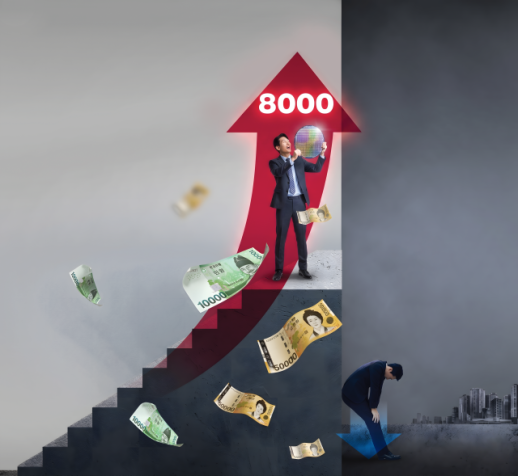 KOSPI Hits Record 8,228.70, But Many Stocks Remain Stagnant On May 27, the KOSPI index reached a record high of 8,228.70. Despite this unprecedented bull market, only 75 stocks saw gains that day, while 826 stocks either fell or remained unchanged. This means that 92% of the listed companies on the KOSDAQ were left behind, leading to complaints from investors like, "The KOSPI is at 8,000, but my stocks aren't rising." Since last year, there has been a noticeable concentration of funds in specific stocks, creating distortions and illusions in the market. While the index continues to set new records, many investors do not feel the upward momentum. This concentration also leads to a 'bandwagon' effect, where funds rapidly flow into certain stocks, such as semiconductors, exacerbating market volatility. "Index at 8,000, My Stocks in the Red" According to the Korea Exchange, the KOSPI surpassed the 8,200 mark on May 28, setting a new all-time high. Just earlier this month, the index was below 7,000, but it surged over 1,600 points in just a month, driven by gains in semiconductor and artificial intelligence (AI) stocks. However, the overall performance of the market remained lackluster. Statistics reveal the disparity. On May 27, when the KOSPI hit its peak, only 75 stocks recorded gains. This indicates that a small number of stocks were responsible for the index's rise. The increase in prices of major stocks like Samsung Electronics and SK Hynix gave the illusion of a booming market. Expanding the timeframe, from May 4 to May 27, the KOSPI rose from 6,598.87 to 8,228.70, yet only 140 stocks increased in value, while 778 stocks declined. The average gain for the rising stocks was 21.7%, while the average loss for the declining stocks was 13.87%. Since the outbreak of the Middle East conflict in March until May 27, only 171 stocks had increased in value. The trend of concentration is evident when examining the KOSPI index's performance across different sectors. Among 24 sectors, only six recorded gains: electrical and electronics (44.69%), manufacturing (30.63%), insurance (25.42%), retail (12.40%), IT services (10.09%), and finance (10.02%). Notably, the electrical and electronics sector's growth rate was 1.8 times higher than the KOSPI's overall increase of 24.70%. In contrast, 18 sectors, including construction (-18.06%), paper and wood (-16.67%), and machinery and equipment (-13.29%), experienced declines. Additionally, the KOSPI 50 (36.58%), KOSPI 100 (33.04%), and KOSPI 200 (30.91%) showed higher growth rates, indicating that the upward trend is primarily concentrated in large-cap stocks. Market analysts suggest that excessive capital concentration in leading stocks, such as Samsung Electronics and SK Hynix, particularly in AI semiconductors and power infrastructure, is distorting the overall market. The recent surge in global AI investments and expectations for increased demand for high-bandwidth memory (HBM) have led to a concentration of investor funds in large-cap semiconductor stocks. Since the outbreak of the Middle East conflict in March, funds have increasingly flowed into globally competitive large technology stocks, while small and mid-cap growth stocks and domestic stocks have been relatively neglected, widening the gap between perceived market conditions and the index. "Concentration is a Typical Phenomenon in the Later Stages of a Bubble" Interpretations of this concentration phenomenon vary. Some analysts believe that the surge in AI-related semiconductors will last for 2 to 3 years, making the concentration of funds in specific sectors a natural occurrence. A securities industry insider explained, "Since half of the KOSPI market capitalization is made up of large-cap semiconductor stocks, it is natural for their prices to rise and for funds to follow." However, others argue that the current concentration resembles typical patterns seen in the later stages of a bubble. Lee Eun-taek, a researcher at KB Securities, recently noted in a report that the current semiconductor-driven market is showing trends similar to past bubble phases. According to the report, during the 1929 U.S. stock market bubble, funds were concentrated in new technology consumer goods companies like aviation, telephony, and radio. Similar concentration was observed in the early 1970s with the 'Nifty Fifty' and during the 2000 dot-com bubble, where a few key growth stocks accounted for most of the market returns. Particularly, just before the collapse of the dot-com bubble in 1999, the U.S. stock market exhibited extreme polarization, with funds heavily concentrated in the information technology (IT) sector. The researcher stated, "In the later stages of a bubble rally, the concentration of leading stocks tends to strengthen, and a reduction in concentration may signal not a 'welcome spread' but rather a precursor to a bubble collapse." Applying this analysis to the second quarter of this year, concerns about the Korean stock market are growing. An analysis of relative returns compared to the KOSPI revealed that the IT sector has surged 31 percentage points above the market average, solidifying its dominance. In contrast, most other industries, excluding IT, remained in negative territory. The healthcare sector recorded a -61 percentage point performance compared to the KOSPI average, while utilities (-57 percentage points), telecommunications services (-54 percentage points), and consumer staples (-46 percentage points) also faced significant declines.* This article has been translated by AI. 2026-05-29 07:54:00
 -
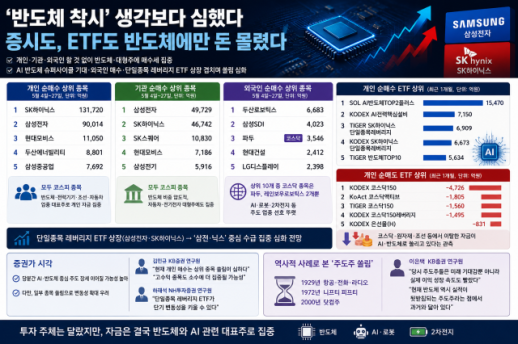 Market Focus on Semiconductors Creates Illusion of Broader Gains The flow of funds in the stock market this year can be summarized as a "semiconductor black hole." Analysts suggest that the buying frenzy for semiconductors among individual, institutional, and foreign investors has intensified the phenomenon of "semiconductor illusion," making the overall market gains appear larger than they are. According to the financial investment industry on May 28, the trading volume of Samsung Electronics and SK Hynix has rapidly increased, now accounting for nearly half of the total trading volume on the KOSPI. The expectation of a supercycle in AI semiconductors, combined with foreign buying, has led to a concentration of funds in specific stocks. The listing of single-stock leveraged ETFs for Samsung Electronics and SK Hynix has further intensified this trend of concentration around these two companies. The Korea Exchange reported that both individual and institutional investors have focused their funds on large-cap stocks in the semiconductor sector. From May 4 to May 27, SK Hynix topped the list of net purchases by individuals with 13.172 trillion won, followed by Samsung Electronics with 9.014 trillion won. Other notable stocks included Hyundai Mobis (1.105 trillion won), Doosan Enerbility (880.1 billion won), and Samsung Heavy Industries (769.2 billion won). During the same period, institutional investors also heavily purchased Samsung Electronics (4.9729 trillion won) and SK Hynix (4.6742 trillion won), with SK Square (1.083 trillion won), Hyundai Mobis (718.6 billion won), and Samsung Electro-Mechanics (591.6 billion won) following. While foreign capital showed some diversification with investments in Doosan Robotics (668.3 billion won), Samsung SDI (402.3 billion won), and Pado (354.6 billion won), a clear preference for leading sectors such as AI, robotics, and secondary batteries was evident. Analysts noted that despite differing investment entities, funds ultimately concentrated on semiconductor and AI-related stocks. The ETF market also reflects a severe concentration on AI and semiconductor themes. According to Koscom ETF CHECK, the top net purchase by individuals in the past month was the SOL AI Semiconductor TOP2 Plus, which attracted 1.547 trillion won. Other top performers included KODEX AI Power Core Facilities (3rd, 715 billion won), TIGER SK Hynix Single Stock Leverage (4th, 690.9 billion won), KODEX SK Hynix Single Stock Leverage (5th, 667.3 billion won), and TIGER Semiconductor TOP10 (7th, 563.4 billion won). More than half of the top 10 ETFs were semiconductor-related products. In contrast, there was a noticeable outflow of funds from KOSDAQ and commodity-related ETFs. KODEX KOSDAQ 150 (472.6 billion won), KoAct KOSDAQ Active (180.5 billion won), TIGER KOSDAQ 150 (156 billion won), and KODEX KOSDAQ 150 Leverage (149.5 billion won) were among the top net sales by individuals. Additionally, selling pressure was observed in ETFs related to silver futures, gold bullion, and shipbuilding. Market analysts believe that the dominance of AI and semiconductor stocks is likely to continue for the foreseeable future. There are concerns that the concentration of funds in a few stocks like Samsung Electronics and SK Hynix could increase market volatility. Kim Min-kyu, a researcher at KB Securities, stated, "Currently, individual buying is heavily concentrated on top stocks," adding that high-return stocks are also likely to become concentrated among a few. NH Investment & Securities researcher Ha Jae-seok also predicted, "Single-stock leveraged ETFs could amplify short-term volatility."* This article has been translated by AI. 2026-05-29 07:50:00
 -
 Anthropic Valuation Reaches $965 Billion, Surpassing OpenAI The valuation of the U.S. artificial intelligence startup Anthropic has soared to $965 billion, surpassing that of OpenAI among private AI companies. On May 28, local time, Reuters and The Wall Street Journal reported that Anthropic secured $65 billion in a Series H funding round. Following this investment, its valuation was recognized at $965 billion, marking a more than 2.5-fold increase from $380 billion just three months earlier when it raised $30 billion in February. The key driver behind this valuation surge is rapid growth in revenue. According to Reuters, Anthropic's annualized revenue has exceeded $47 billion. The Wall Street Journal anticipates that the company's second-quarter revenue will more than double to $10.9 billion compared to the previous quarter, with a possibility of posting its first quarterly operating profit. This growth has been fueled by demand for enterprise services and coding tools. Anthropic's model, Claude, is utilized for task automation and as a support tool for developers. Notably, the rapid adoption of Claude Code, a tool for developers, has allowed Anthropic to expand its customer base among businesses. Domestic companies have also participated in this investment. Samsung Electronics and SK Hynix have joined Micron as strategic infrastructure partners, although individual investment amounts have not been disclosed. This move is seen as a strategy to secure memory and semiconductor supply chains necessary for large-scale AI facilities. The competition for computing resources has intensified as well. Anthropic has committed to spending over $100 billion on Amazon Web Services (AWS) technology over the next decade. Amazon has also announced plans to invest up to $25 billion in Anthropic. According to Reuters, citing The Information, Anthropic is set to spend $200 billion over five years on Google Cloud and chips. However, costs remain a variable. Continued investments in semiconductors, power, and data centers are necessary for model development. Even as revenue grows rapidly, computing expenses are expected to increase concurrently. The fact that Anthropic's valuation has surpassed that of OpenAI signals strong market expectations. Industry insiders interpret this as an indication that the company must demonstrate profitability while managing its expenditure burdens.* This article has been translated by AI. 2026-05-29 07:44:00
 -
 U.S. and Iran are "within reach" of a deal, news that may uplift Asian markets SEOUL, May 29 (AJP) -The United States and Iran are “within reach” of an agreement to end the three-month war that has rattled global energy markets, and the prospect of a reopening of the Strait of Hormuz may help lift Asian stocks Friday after a broad retreat the previous session. U.S. Treasury Secretary Scott Bessent said Washington and Tehran “perhaps have the makings of a deal,” with negotiations centering on a 60-day framework that would gradually unwind blockades in the Strait of Hormuz, reopen one of the world’s most critical oil chokepoints and set the stage for broader nuclear negotiations. Asian markets had pulled back Thursday amid renewed military exchanges between the two sides and uncertainty over whether President Donald Trump would approve the framework. But investors are expected to welcome any sign that Gulf energy flows may stabilize after nearly three months of disruption. The prospect of easing oil prices and lower geopolitical risk helped Wall Street benchmarks return to record highs overnight, led again by AI and technology shares. That may lift the market sentiment in Seoul, dampened by rate hike signal from the central bank. In addition, Nvidia CEO Jensen Huang is expected to visit South Korea next week after attending GTC Taipei 2026, sparking expectations of another round of high-level talks with Samsung Electronics, SK hynix and major Korean conglomerates over high-bandwidth memory (HBM), AI accelerators, foundry cooperation and physical AI ecosystems. The visit comes at a critical moment for Korea’s semiconductor sector as Nvidia’s AI dominance increasingly shapes the fortunes of Asian chipmakers. SK hynix, currently Nvidia’s key HBM supplier, has emerged as one of the biggest beneficiaries of the global AI boom, and chasing closely Samsung Electronics in top market valuation after joining the $1 trillion club earlier this week. Huang is also expected to meet LG Group Chairman Koo Kwang-mo to discuss expanding cooperation in physical AI, cloud infrastructure and robotics, while possible meetings with Samsung Chairman Lee Jae-yong, SK Group Chairman Chey Tae-won and Hyundai Motor Group Chairman Chung Euisun are drawing attention from investors seeking new AI partnerships. The upside from the Gulf remains fragile. Iran and the United States exchanged strikes again this week, including Tehran’s ballistic missile launch toward Kuwait and fresh U.S. attacks on Iranian drone infrastructure. 2026-05-29 07:36:12
 -
 Kiwoom Securities Enters Retirement Pension Market with No-Fee Policy for Low Returns ◆ Ajou Economic News ▷ Kiwoom Securities announces entry into retirement pension market... "No fees if returns are low" - Kiwoom Securities held a press conference on May 28 at TP Tower in Yeouido, Seoul, to unveil its roadmap for entering the retirement pension market. - The company will begin its retirement pension business on June 1. It plans to implement a policy where it will not charge management fees if returns do not meet its own benchmarks, which are currently being set slightly above deposit interest rates. - Additionally, it will waive management and asset management fees for the first year across all retirement pension systems, including defined benefit (DB) and defined contribution (DC) plans, in line with the government's efforts to reduce fee burdens and to accelerate the acquisition of initial subscribers. - Kiwoom Securities will also be the first retirement pension provider to offer foreign RP products to all clients, including individuals and corporations. The company plans to introduce a variety of products, starting with foreign RP, followed by bonds and ELS based on the size of contributions, leveraging the fact that foreign products are permissible under retirement pension regulations. ◆ Major Reports ▷ Market fluctuations and shifts in the KOSPI - The KOSPI and KOSDAQ fell by 0.5% and 2.5%, respectively, the previous day. In the U.S., the three major indices reached all-time highs despite a pause in semiconductor stocks. - Under pressure from discount rates, the KOSDAQ, which is centered on growth stocks, saw a decline of around 6%. However, IT leaders like SK Hynix (+2.1%) and Samsung Electro-Mechanics (+13.4%) performed well, helping the KOSPI recover to the 8,100-point range in the afternoon. - The KOSPI is showing signs of significant shifts amid volatility. Recently, as investor sentiment has been dampened by noise surrounding Samsung Electronics' strikes and profit distribution, SK Hynix has been closing the gap. Even on a day when large-cap stocks generally struggled, SK Hynix rose, nearing 93% of Samsung Electronics' market capitalization. - Samsung Electronics, benefiting from a boom in multi-layer ceramic capacitors (MLCC) and high-value flip-chip ball grid arrays (FC-BGA), has surged 623% year-to-date, surpassing Hyundai Motor to become the fourth-largest company by market cap during trading hours. ◆ Major Announcements After Market Close (May 28) ▷ Lotte Group reports 181% increase in operating profit for Q1 amid portfolio restructuring. ▷ Samsung Securities resolves to acquire 4% stake in SDS and Card and Dunamu. ▷ Samsung Securities announces acquisition of 306.4 billion won in Dunamu shares, representing a 2% stake. ◆ Fund Trends (as of May 27, excluding ETFs) ▷ Domestic equity funds: -1.594 trillion won ▷ Foreign equity funds: +152 billion won ◆ Key Schedule for Today (May 29) ▷ South Korea: Industrial Production (April), Retail Sales (April) ▷ Japan: Tokyo Core Consumer Price Index (May), Industrial Production (April), Retail Sales (April) ▷ United States: Chicago Fed Index (May)* This article has been translated by AI. 2026-05-29 07:34:00
 -
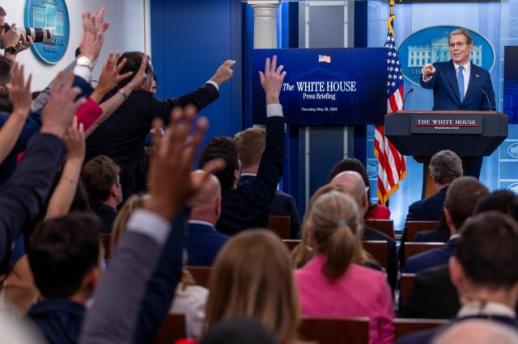
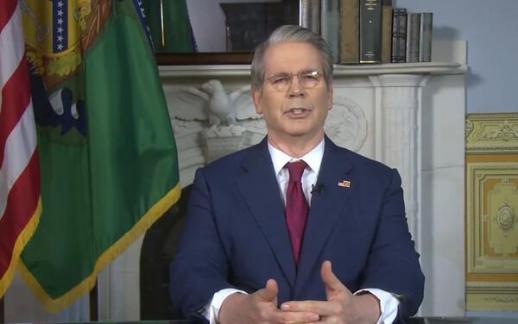 U.S. Treasury Secretary Signals Possible Agreement with Iran Scott Vesant, the U.S. Treasury Secretary, has indicated the possibility of an agreement in negotiations for an extension of the ceasefire with Iran. However, he clarified that this should not be interpreted as a definitive agreement. The U.S. is keeping the door open for negotiations while insisting on key conditions, including a ban on tolls for passage through the Strait of Hormuz and the initiation of nuclear talks. On May 28, Vesant responded positively to questions from reporters regarding the potential for an agreement with Iran, stating, "The final decision rests with President Donald Trump." He emphasized that Trump would not accept a 'bad deal.' Vesant's comments came shortly after reports emerged that the negotiating teams from both countries were nearing a temporary agreement for a 60-day ceasefire extension. This proposal reportedly includes the resumption of commercial shipping through the Strait of Hormuz and the commencement of negotiations addressing Iran's nuclear program. However, neither the White House nor Iranian officials have officially confirmed the final agreement. The key conditions set by the U.S. include free passage through the Strait of Hormuz and the initiation of nuclear negotiations. The issues at stake regarding the Strait involve a ban on tolls, while the nuclear discussions focus on limiting Iran's nuclear activities and verification methods. On the same day, Vesant stated on X that any attempts to impose tolls in the Strait of Hormuz would not be tolerated. He also warned Oman, which has played a mediating role, against involvement in or support for such plans. He made it clear that individuals and entities involved could face sanctions from the Treasury Department. Washington has also implemented additional sanctions, targeting eight vessels and international companies linked to Iran's military-related oil sales. This move signals that while discussions on extending the ceasefire and easing sanctions are ongoing, the U.S. aims to prevent oil imports from being used to fund military activities.* This article has been translated by AI. 2026-05-29 07:30:00
 -
U.S. Treasury Secretary Signals Possible Agreement with Iran Scott Vesant, the U.S. Treasury Secretary, has indicated the possibility of an agreement in the ongoing negotiations for an extension of the ceasefire with Iran. However, he clarified that this does not imply a definitive agreement. The U.S. is keeping the door open for negotiations while insisting on key conditions, including the prohibition of tolls in the Strait of Hormuz and the initiation of nuclear talks. On May 28, Vesant responded positively to questions from reporters regarding the potential for an agreement with Iran. He stated, "The final decision rests with President Donald Trump," emphasizing that Trump would not accept a 'bad deal.' Vesant's comments came shortly after reports emerged that the negotiating teams from both countries were nearing a preliminary agreement for a 60-day ceasefire extension. This proposal reportedly includes the resumption of commercial shipping in the Strait of Hormuz and the commencement of negotiations addressing Iran's nuclear program. However, both the White House and Iranian officials have yet to officially confirm the final agreement. The key conditions set by the U.S. focus on ensuring free passage in the Strait of Hormuz and starting nuclear negotiations. The issues at stake include the prohibition of tolls in the Strait and the limitations and verification methods concerning Iran's nuclear activities. On the same day, Vesant stated on X that any attempts to impose tolls in the Strait of Hormuz would not be tolerated. He also warned Oman, which has played a mediating role, against involvement in or support for such plans, indicating that the Treasury could impose sanctions on relevant individuals and entities. Washington has also taken additional sanctions measures. On the same day, the Treasury targeted eight vessels and international companies linked to Iran's military-related oil sales. This move signals that while discussions about extending the ceasefire and easing sanctions are ongoing, the U.S. remains committed to preventing oil imports from being used to fund military activities.* This article has been translated by AI. 2026-05-29 07:30:00
-
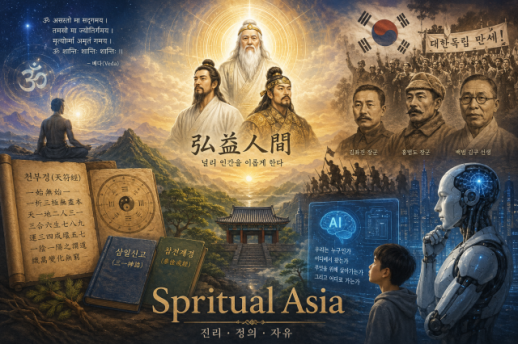 The Spiritual Legacy of the Korean People in the Age of AI Humanity in the 21st century is once again confronted with the oldest questions. Artificial intelligence (AI) learns human language, robots replace human labor, and algorithms encroach upon human judgment. Yet, as technology advances, people find themselves asking more fundamental questions. Who are we?Where do we come from?What are we living for?And where are we going? In the previous four parts, we explored the vast roots of Asian spirituality through Hinduism in India. The Vedas sang of the universe's origins, the Upanishads delved into human inner divinity, and the Bhagavad Gita presented a path to practice truth in life. What answers have the Korean people provided? For thousands of years, they too have pondered the same questions. Their responses are preserved in the unique spiritual traditions of Korea, including the Cheonbugyeong (Heavenly Symbol Scripture), the Samil Singo (Three-One Divine Revelation), and the Chamjeongyeong (Scripture of the True Path). Notably, the Daejonggyo (Great Religion) has revived this spirit in modern times. Today, many view Daejonggyo merely as a religion, but it is, in fact, a cultural movement aimed at restoring the primordial spirit of the Korean people. On January 15, 1909, the patriot Na Cheol reestablished the Dangun religion and renamed it Daejonggyo. At that time, the Korean Empire was on the brink of losing its sovereignty, and Japanese imperialism sought to obliterate the history and spirit of the Korean people. Na Cheol believed that the first thing to fall was the spirit of the nation, even before political independence. He asserted that spiritual independence was necessary before political freedom. Thus, he reestablished Dangun not merely as a founding ancestor but as a symbol of the Korean spirit, aiming to help the people rediscover the answer to the question, "Who are we?" The central scriptures of Daejonggyo are the Cheonbugyeong, Samil Singo, and Chamjeongyeong. Among them, the Cheonbugyeong is a brief text consisting of 81 characters. However, it is regarded as encapsulating the principles of the universe's creation, the meaning of human existence, and the laws of nature and life. While there are various scholarly opinions on the exact date of its establishment, it has long been respected as a spiritual heritage of the Korean people within Daejonggyo and the national religious community. The first line of the Cheonbugyeong is well-known:"Ilsi Musil Il (一始無始一)" This translates to "One is both the beginning and the absence of a beginning." It implies that all existence in the universe originates from one and ultimately returns to one. Interestingly, this concept bears some resemblance to the idea of Brahman in the Upanishads, which states that all existence comes from a single source and eventually returns to it. The Cheonbugyeong continues:"Ilseok Samgeuk Mujinbon (一析三極無盡本)" This means that one divides into three, and these three become the infinite source of all things. This is connected to the Korean cosmology of Hwanin (the Heavenly Source), Hwanung (the embodiment of heavenly will who descended to the human world), and Dangun (the figure who connected heaven and humanity to establish a nation for the benefit of all). To put it simply, up to the 47th Dangun, he can be likened to the Pope in Catholicism. The narrative of Hwanin, Hwanung, and Dangun is not merely a myth; it embodies the unique worldview of the Korean people, where heaven, nature, and humanity are interconnected within a single order. This belief leads to the idea that the essence of heaven resides within humanity, similar to the concepts of Brahman and Atman in India. However, Korean spirituality takes a step further. While Indian spirituality emphasizes personal enlightenment and liberation (Moksha) as key goals, Korean spirituality places greater emphasis on living for the benefit of the community and the world. The core of this belief is Hongik Ingan (弘益人間), which means to broadly benefit humanity. This succinct phrase encapsulates the essence of Korean spiritual culture. A person does not achieve completeness in isolation; rather, one fulfills their existence's meaning by playing their role within the community and contributing to the world. The Samil Singo asserts that divinity exists within humanity, while the Chamjeongyeong outlines the ethics and virtues that humans should uphold. Hongik Ingan explains the purpose of all these teachings. In short, Korean spirituality is a mindset that seeks the heavens while not turning away from the world. In fact, Daejonggyo became one of the spiritual centers of the independence movement during the Japanese colonial period. During the March 1st Movement in 1919, while other religions like Cheondogyo, Christianity, and Buddhism played central roles, Daejonggyo also actively participated in independence declarations and anti-Japanese movements across the country and in Manchuria. Notably, the independence army organizations in Manchuria and North Gando maintained close ties with Daejonggyo. General Kim Jwa-jin, a hero of the Cheongsanri Battle, closely collaborated with Daejonggyo leaders to train independence fighters and lead armed resistance. General Hong Beom-do also interacted with Daejonggyo forces, sharing the national spirit. For the independence fighters, Daejonggyo was not just a religion; it was the answer to the question, "Who are we?" It provided a spiritual foundation that reminded them of their identity as descendants of Dangun and as a free nation before they took up arms. Kim Gu also engaged extensively with Daejonggyo figures during the independence movement and highly valued the importance of the national spirit centered around Dangun. Baekbeom emphasized the spirit of the nation and historical consciousness, forming a deep resonance with the spiritual world pursued by Daejonggyo. Looking back, Daejonggyo was not merely a religion; it was a spiritual movement aimed at preserving the national spirit during a time of lost sovereignty. The ideals symbolized by Hwanin, representing the heavenly source, Hwanung, symbolizing the harmony of heaven, earth, and humanity, and Dangun, embodying the principle of Hongik Ingan, became a source of spiritual strength for independence activists, stronger than any weapon. Today, we find ourselves once again living in an era of significant civilizational transformation. AI mimics human intelligence, but it cannot fully replace human conscience, love, responsibility, and sacrifice. It is at this juncture that the spirit of the Cheonbugyeong, Samil Singo, Chamjeongyeong, and Daejonggyo comes alive once more. These teachings are not relics of the past; they are questions directed toward the future. The inquiries posed by sages in India through the Vedas 5,000 years ago and by the ancestors of the Korean people through the Cheonbugyeong are ultimately the same. Who are we?Why do we exist?And what does it mean to be human? As the age of AI deepens, the ancient wisdom questioning the human soul will become increasingly valuable. This is why we must revisit the Cheonbugyeong, reflect on Daejonggyo, and contemplate the heavenly spirit of the Korean people today. Truth, justice, and freedom will always outlast technology. The quest for that truth began thousands of years ago with the Vedas and the Cheonbugyeong and continues to resonate in our lives today.* This article has been translated by AI. 2026-05-29 07:22:00