

Journalist

Jack L. Rozdilsky
-
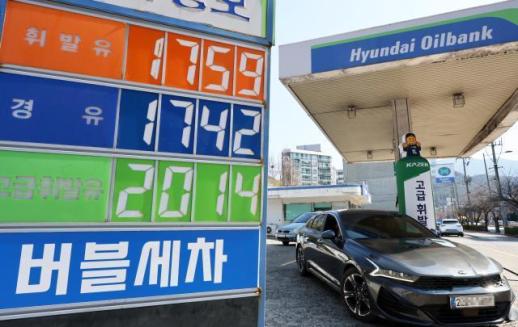 Fuel prices decline a day after government price cap begins SEOUL, March 14 (AJP) - Average fuel prices at gas stations across South Korea continued to fall on Saturday, a day after the government’s oil price cap took effect. According to the Korea National Oil Corp.’s price information system Opinet, the nationwide average price of gasoline stood at 1,851.9 won ($1.24) per liter as of 9 a.m., down 12.2 won from the previous day. Diesel prices fell more sharply to 1,856.1 won per liter, down 16.6 won. Diesel remained slightly more expensive than gasoline, though the price gap narrowed significantly. Domestic fuel prices have been declining since peaking on March 10 following the outbreak of the U.S.-Iran war, according to industry data. Dubai crude, the benchmark for imported oil in South Korea, rose by $34.6 from the previous week to $123.5 per barrel. International gasoline prices climbed $25.3 to $126.3, while international automotive diesel rose $37.5 to $176.5. An official from the refining industry said that changes in global oil prices typically take about two to three weeks to be reflected at domestic gas stations, but the recent introduction of the price cap has made it difficult to predict short-term price movements. Industry sources added that uncertainty among gas station operators is growing as most refiners have yet to announce whether settlement prices will be applied retroactively to Friday, the day the price cap took effect. 2026-03-14 14:10:08
 -
 Hyundai Halts Sales of Some Palisade Models, Plans Recall After U.S. Seat Incident Hyundai Motor Co. said it has identified a safety issue in its large SUV, the All New Palisade, and has temporarily stopped selling certain configurations. The automaker said it plans a voluntary recall for vehicles already sold and will file reports next week with South Korea’s Transport Ministry and the U.S. National Highway Traffic Safety Administration. Hyundai said Saturday that when the second- and third-row power-folding seats operate under certain conditions, the system may fail to detect contact with an occupant or an object. It said sales of vehicles with the affected specification will be suspended for now. Reuters reported that a 2-year-old girl died March 7 in Ohio in an incident involving a Palisade power seat. Hyundai said it will resume sales after improving the seat’s anti-pinch function. The company said it will increase the sensitivity for detecting occupants and objects and restrict the power-folding function to situations when the rear door is open, among other steps to strengthen overall system safety. The recall scope is still being tallied, Hyundai said, and will cover vehicles produced through March 11 this year. It estimated about 57,474 vehicles in South Korea and 74,965 in North America could be affected. The All New Palisade exported about 100,000 vehicles worldwide last year, and 59,506 were sold in South Korea, the company said. Hyundai apologized for the inconvenience and said it will continue to put customer safety first and thoroughly review all issues to improve trust and satisfaction.* This article has been translated by AI. 2026-03-14 11:33:16
 -
 South Korea Routed 10-0 by Dominican Republic in WBC Quarterfinal, Cold-Rule Loss Ends Semifinal Bid South Korea’s run on the World Baseball Classic’s knockout stage ended in the quarterfinals, dashing its hopes of reaching the semifinals for the first time in 17 years. South Korea, managed by Ryu Ji-hyun, lost 10-0 to the Dominican Republic by the mercy rule in seven innings on Saturday (Korea time) at loanDepot park in Miami in the 2026 WBC quarterfinals. Starter Ryu Hyun-jin of the Hanwha Eagles gave up three runs in the second inning. In the third, four South Korean pitchers combined to allow four hits and three walks, leading to four more runs. Trailing 7-0, South Korea surrendered a three-run homer to Austin Wells of the New York Yankees with two outs in the seventh, putting the game out of reach. The tournament uses a mercy-rule format through the quarterfinals: a 15-run lead after five innings or a 10-run lead after seven. At the plate, South Korea was held scoreless on two hits and struck out eight times through five innings against left-hander Cristopher Sanchez of the Philadelphia Phillies, who finished second in last year’s National League Cy Young voting. ▲ World Baseball Classic (WBC) quarterfinal result (14th · loanDepot park, Miami) Korea 000 000 0XX - 0 Dominican Republic 034 000 3XX - 10 <7-inning mercy rule> △ Winning pitcher = Cristopher Sanchez (1-0) △ Losing pitcher = Ryu Hyun-jin (0-1) △ Home runs = Austin Wells, 2 (three-run, 7th · Dominican Republic) 2026-03-14 10:15:00
 -
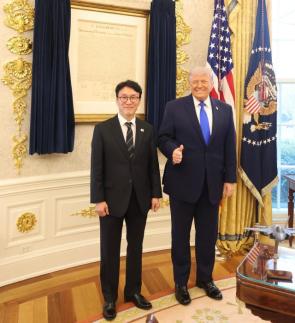 PM Kim holds surprise meeting with Trump at White House SEOUL, March 14 (AJP) - South Korean Prime Minister Kim Min-seok held a brief, surprise meeting with U.S. President Donald Trump at the White House on Friday, the Prime Minister’s Office said. Kim, who is visiting Washington, met Trump briefly and exchanged remarks after holding talks the previous day with U.S. Vice President JD Vance, according to the office. Details of the conversation were not disclosed. Observers believe the two may have discussed pending Korea-U.S. issues, including South Korea’s Special Act on Investment in the United States, which was passed by the National Assembly a day earlier. Trump is scheduled to visit China from March 31 to April 2 for talks with Chinese President Xi Jinping, raising the possibility that Kim and Trump also exchanged views on North Korea-related matters, officials said. 2026-03-14 09:59:39
 -
 Automakers, Defense Firms Enter ‘Super AGM Week’ With Focus on Shareholder Value and New Businesses Automakers and defense contractors are heading into the heart of annual shareholders meeting season, with companies expected to spotlight new business expansion as they navigate global uncertainty. Firms are also expected to advance measures tied to revisions to South Korea’s Commercial Act, including steps to strengthen shareholder value such as electronic voting and bigger dividends, while also shoring up defenses of management control. Industry officials said meetings will run nationwide from March 17 to 31, starting with Hyundai Mobis on March 17. Other scheduled annual general meetings include Kia (March 20), Poongsan (March 20), Hanwha Systems (March 23), Hanwha Aerospace (March 24), Hyundai Motor (March 26), Korea Aerospace Industries (March 26), Hyundai Rotem (March 27) and LIG Nex1 (March 31). At Hyundai Motor Group companies, key agenda items are expected to include reappointing inside directors, expanding into new businesses and strengthening board independence. Hyundai Mobis will vote on reappointing Hyundai Motor Group Chairman Chung Eui-sun as an inside director and appointing Sung Nak-seop, head of FTCI at Hyundai Mobis, as a new inside director. For outside directors, the company will consider reappointing James Kim, chairman of the American Chamber of Commerce in Korea, and appointing Park Hyun-joo, a former Korea representative at BNY Mellon Bank, as a new outside director. Hyundai Mobis will also put forward items including expanding directors’ duty of loyalty, renaming outside directors as independent directors, deleting a clause that excludes cumulative voting, and introducing electronic shareholders meetings. The company is also set to seek approval to pay year-end dividends of 5,000 won per common share and 5,050 won per preferred share. Hyundai Motor will propose adding a car rental business as a new line of business, aiming to expand vehicle rental operations that already include short-term rentals. Since 2019, Hyundai Motor has operated “Hyundai Genesis Selection,” a monthly subscription service for Hyundai and Genesis vehicles. If expanded, the company expects to broaden the models used for rentals and the service areas. With its certified used-car business already in place, the company expects to strengthen a vehicle life-cycle ecosystem spanning new-car sales, rentals and used-car distribution, improving customer service conditions. Hanwha Aerospace will also propose adding new business purposes. The additions include: energy resource development, production, export-import, distribution and trading for natural gas, hydrogen, ammonia and biofuels; investment, development and operation of energy distribution infrastructure and related equipment; power, district energy and zone electricity businesses, power brokerage, and related investment, construction and operations; aircraft and spacecraft launch services; mechanical facilities and gas construction; and industrial environmental facilities construction. Most of the proposed new businesses align with Hanwha Aerospace’s stated future direction, including energy development, distribution infrastructure and space-related areas. The fields have largely been led by other group affiliates such as Hanwha Energy and Hanwha Solutions, and the industry views the move as an effort to expand its future business base by leveraging group synergies. In growth areas such as defense, aviation and space, topics include shifting to cleaner energy and power infrastructure and developing reusable launch vehicles. “Across groups, this year’s shareholders meetings are seeing a push for greater governance transparency and stronger shareholder value in line with the intent of the Commercial Act revisions,” an industry official said. “At the same time, expanding into new businesses to find future growth engines is also a major trend.” * This article has been translated by AI. 2026-03-14 05:03:28
 -
 InterBattery 2026 Draws Record 77,250 Visitors as Battery Uses Expand Beyond EVs InterBattery 2026, South Korea’s largest battery exhibition, ended after setting records for both participation and attendance. The Korea Battery Industry Association said Friday that the 14th edition of the event, held at COEX in Seoul’s Gangnam district, featured 667 companies from 14 countries across 2,382 booths, the largest lineup in the show’s history. Total attendance over the three-day event reached 77,250, also a record. The exhibition highlighted battery applications beyond electric vehicles, including energy storage systems, AI data centers, robotics, drones and urban air mobility. Companies showcased next-generation technologies such as all-solid-state batteries, higher-performance and safer battery designs, strategic upgrades to lithium iron phosphate (LFP) batteries, and manufacturing innovations including dry electrode processes. Organizers said interest from abroad was strong, with visits by overseas government agencies and global companies. Joint national pavilions were organized by the U.S. Embassy in Seoul and the embassies of the Netherlands, Australia and Canada, among others. A total of 182 foreign companies set up large booths to present key mineral resources and advanced battery technologies. The show also featured discussions on cross-border cooperation in technology and supply chains, along with presentations of future technology road maps by South Korea’s three major battery makers: LG Energy Solution, Samsung SDI and SK On. At the third InterBattery Awards 2026, 12 innovations were selected, including LG Energy Solution’s “JF2 DC LINK 5.0 power-grid ESS,” Samsung SDI’s “700Wh/L high-energy prismatic battery,” and SK On’s “prismatic on-vent cell.” “InterBattery 2026 showed that battery technology is a core foundational technology for the AI era, beyond electric vehicles,” said Park Tae-seong, executive vice chairman of the Korea Battery Industry Association. He said the association will work to help InterBattery grow into a platform for next-generation battery technology, supply chain security and global business. * This article has been translated by AI. 2026-03-13 21:06:23
 -
 Citi Korea, Yanolja Expand Global B2B Payments Partnership With Virtual Cards Korea Citibank said Friday it is strengthening cooperation with global travel tech company Yanolja on business-to-business payments and will expand the use of Citi’s virtual card solution to Yanolja’s enterprise solution member companies. The companies formalized the partnership at the “Citi Asia Digital Leaders Summit 2026” in Shenzhen, China, with senior executives attending, including Mark Luet, Citi’s head of cluster and banking for Japan, North Asia and Australia, and Lee Soo-jin, Yanolja’s group co-CEO. Yanolja will integrate Citi’s global B2B payment framework across its enterprise solution members, allowing them to maintain consistent operating processes and control standards in multi-country transactions, the bank said. Citi said its virtual card solution helps companies expand into new markets without major system overhauls, while keeping existing operations in place. It also enables clients to manage transactions by country, legal entity and business unit, while centrally overseeing global payment flows. “This partnership is a key example of how Citi supports the global growth strategies of mid-sized companies worldwide,” said Gunjan Kalia, Citi’s head of commercial banking for Japan, North Asia, Australia, South Asia and the region. He said it underscores the importance of an integrated global payments infrastructure that supports both stability and speed in international expansion. The two companies said they plan broader cooperation to support overseas expansion, including stronger risk management using artificial intelligence for suspicious-transaction detection, automated settlement and cost optimization, as well as expanded global finance and payments infrastructure.* This article has been translated by AI. 2026-03-13 17:51:45
 -
 Korean bond yields soar as if in tightening cycle amid widening Gulf war SEOUL, Mar. 13 (AJP) — South Korean government bond yields are climbing sharply as investors demand higher risk premiums amid intensifying conflict in the Middle East and a renewed rise in global interest rates. Yields on sovereign debt have followed a steep upward trajectory since the beginning of the year, reflecting both external shocks and shifting global capital flows. According to the Korea Financial Investment Association (KOFIA) on Friday, the three-year government bond yield rose 6.7 basis points to close at 3.338 percent, while the 10-year yield gained 5.2 basis points to finish at 3.701 percent. The benchmark 10-year yield has breached the 3.7 percent threshold four times this year, including a sharp 12.3 basis point surge on March 9. The pace of the increase has been striking. From the market close on Jan. 2 to the March 9 peak, three-year and 10-year yields rose by 48.5 basis points and 35.3 basis points, respectively — a rapid adjustment even by the standards of recent global tightening cycles. The March 9 jump marked the largest single-day spike since Sept. 26, 2022, when global bond markets were roiled by the United Kingdom’s ill-fated “mini-budget.” At that time, Korean yields surged by 34.9 basis points for the three-year tenor and 22.3 basis points for the 10-year bond in a single session. Market participants say the current move is less about domestic growth optimism and more about rising geopolitical risk and inflation concerns as the Middle East conflict pushes oil prices back toward the $100-per-barrel mark. The yield spread between South Korea and the United States has also narrowed considerably. As of March 9, the gap between the U.S. 10-year Treasury yield, at 4.13 percent, and Korea’s 10-year government bond yield stood at roughly 39.5 basis points. Under normal circumstances, a narrowing differential would lend support to the Korean won by making local assets relatively more attractive. The currency’s continued weakness, however, suggests that investors are demanding additional compensation for risk rather than expressing confidence in the domestic outlook. In other words, the market is repricing geopolitical uncertainty rather than rewarding growth prospects — a dynamic that could accelerate the global shift toward traditional safe-haven assets. Foreign capital flows remain a critical variable. According to the Bank of Korea (BOK), overseas investment in South Korean government bonds recorded seven consecutive months of net inflows through February. But traders say the heightened volatility in yields and the exchange rate this month raises the risk of a reversal. The pressure is compounded by a renewed climb in U.S. Treasury yields. The U.S. 10-year benchmark has recently risen to 4.277 percent, potentially widening the yield gap again and drawing global liquidity back toward dollar assets. Even so, policymakers stress that the current market turbulence bears little resemblance to the systemic stress seen during the 1997 Asian Financial Crisis. Bank of Korea Governor Rhee Chang-yong noted that South Korea’s macroeconomic fundamentals remain significantly stronger today. The country now holds more than $400 billion in foreign exchange reserves, compared with roughly $20 billion at the height of the 1997 crisis, and has since become a net external creditor. “If you are referring to the risk of national sovereign default, I do not agree,” Rhee said during a press briefing on inflation at the Bank of Korea on Dec. 17 last year, dismissing alarmist interpretations of rising yields. Still, with oil prices surging, shipping routes through the Strait of Hormuz under strain and global bond markets resetting higher, Korean debt markets are likely to remain sensitive to external shocks in the weeks ahead. 2026-03-13 17:34:51
 -
 Asian stocks fall as oil nears $100 and tensions loom large in the second war week SEOUL, March 13 (AJP) — Asian stock markets ended lower Friday as oil prices climbed back toward the $100 mark and tensions in the Middle East continued to unsettle investors across the region with little sign of easing in the second week. The Strait of Hormuz remained severely disrupted, raising alarms about Asian economies relying heavily on crude imports from the Gulf. U.S. benchmark West Texas Intermediate crude traded around $95 per barrel, while global benchmark Brent crude hovered near $100, keeping inflation risks firmly in focus. The cautious mood followed losses on Wall Street overnight. The Dow Jones Industrial Average fell 1.6 percent, the S&P 500 dropped 1.5 percent and the Nasdaq Composite slid 1.8 percent as investors reacted to rising energy costs and prolonged geopolitical uncertainty. Technology shares led the decline. The Philadelphia Semiconductor Index fell 3.4 percent, reflecting concerns that escalating tensions in the Gulf could disrupt supply chains and global demand. In Tokyo, the Nikkei 225 slid 1.4 percent to 53,693, with exporters and technology stocks under pressure following weakness in U.S. equities. Chinese and Hong Kong markets also closed lower. The Shanghai Composite Index fell 0.9 percent to 4,090.2, while Hong Kong’s Hang Seng Index lost 0.9 percent. Taiwan’s TAIEX slipped 0.5 percent. Malaysia was among the few regional markets to avoid the broader decline. In Seoul, the benchmark KOSPI fell 1.7 percent to close at 5,487.24 after swinging sharply during the session. The index briefly dropped to an intraday low of 5,392.52 before trimming some losses later in the day. Investor flows showed a clear divergence. Foreign investors sold 1.46 trillion won ($980 million) worth of KOSPI shares and institutions offloaded 1.03 trillion won, while retail investors stepped in aggressively, purchasing a net 2.45 trillion won and helping cushion the decline. The tech-heavy KOSDAQ edged up 0.4 percent to 1,152.96 after recovering from early losses. Institutions were net buyers of 275.6 billion won, while foreign and retail investors sold 108.2 billion won and 131.2 billion won, respectively. Trading activity remained heavy as investors repositioned portfolios amid global uncertainty. Turnover reached 22.97 trillion won ($15.4 billion) on the KOSPI and 14.25 trillion won on the KOSDAQ. South Korean equities have swung sharply in recent sessions as investors reacted to developments in the Middle East and rapid moves in energy markets. The KOSPI plunged 6 percent Monday to 5,251.87 as geopolitical tensions rattled markets, before rebounding to 5,532.59 Tuesday and climbing further to 5,609.95 on Wednesday. Among Seoul heavyweights, Samsung Electronics fell 2.34 percent to 183,500 won and SK hynix declined 2.2 percent to 910,000 won, reflecting weakness in global semiconductor shares. Battery maker LG Energy Solution dropped 3.9 percent to 369,000 won, while automakers Hyundai Motor and Kia slipped 0.8 percent and 1.6 percent, respectively. Samsung Biologics also fell about 2 percent, adding pressure on the index. Internet platform operator Naver bucked the broader market trend, rising 0.5 percent to 223,000 won. Energy markets remained a key driver of sentiment. West Texas Intermediate crude rose from around $81 per barrel at the start of the week to about $96.7 by Friday, after briefly spiking as high as $115.4 during intraday trading. Brent crude climbed from roughly $85.1 to about $101, touching a weekly peak of $117. The surge revived concerns about inflation and potential disruptions to global supply chains, particularly for energy-importing economies across Asia. The Korean won weakened to 1,496.5 per dollar Friday, revisiting levels last seen in the aftermath of the global financial crisis. The U.S. dollar index rose from 99.17 to 99.89, underscoring stronger demand for safe-haven assets. 2026-03-13 17:30:11
 -
 T’way Air, Catalonia Tourism Board Launch Barcelona Flight Promotion T’way Air said Friday it will offer limited-time promotional fares and a discount code of up to 5% for its Incheon-Barcelona route through March 29 on its website and mobile app (web). Under a first-come, first-served deal, one-way tickets start at 391,600 won, including fuel surcharges and airport taxes. The travel period runs from March 13 through Oct. 24 this year. Customers who miss the special fare can still receive up to 5% off by entering the discount code “MAR26.” The code applies to both one-way and round-trip tickets and can be used for bookings at the Smart fare level or higher. T’way Air will also provide a 60,000-won coupon, on a first-come basis, that can be used for an additional discount when paying for a round-trip ticket. The airline currently operates the Incheon-Barcelona route four times a week on Monday, Wednesday, Friday and Saturday. It is also posting travel information on its website for Catalonia destinations including Barcelona, Tarragona, Figueres, Sitges and Montserrat. Details on flight schedules and the promotion are available on T’way Air’s website and mobile app (web). A T’way Air official said the joint promotion is intended to help more customers experience the appeal of Catalonia, including Barcelona, and added that the airline will continue to prioritize safe operations while improving travel satisfaction through convenient schedules and various benefits. * This article has been translated by AI. 2026-03-13 17:06:18