

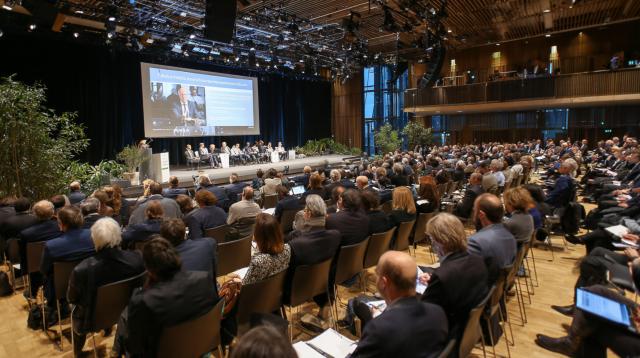
Automakers and defense contractors are heading into the heart of annual shareholders meeting season, with companies expected to spotlight new business expansion as they navigate global uncertainty. Firms are also expected to advance measures tied to revisions to South Korea’s Commercial Act, including steps to strengthen shareholder value such as electronic voting and bigger dividends, while also shoring up defenses of management control.
Industry officials said meetings will run nationwide from March 17 to 31, starting with Hyundai Mobis on March 17. Other scheduled annual general meetings include Kia (March 20), Poongsan (March 20), Hanwha Systems (March 23), Hanwha Aerospace (March 24), Hyundai Motor (March 26), Korea Aerospace Industries (March 26), Hyundai Rotem (March 27) and LIG Nex1 (March 31).
At Hyundai Motor Group companies, key agenda items are expected to include reappointing inside directors, expanding into new businesses and strengthening board independence. Hyundai Mobis will vote on reappointing Hyundai Motor Group Chairman Chung Eui-sun as an inside director and appointing Sung Nak-seop, head of FTCI at Hyundai Mobis, as a new inside director. For outside directors, the company will consider reappointing James Kim, chairman of the American Chamber of Commerce in Korea, and appointing Park Hyun-joo, a former Korea representative at BNY Mellon Bank, as a new outside director.
Hyundai Mobis will also put forward items including expanding directors’ duty of loyalty, renaming outside directors as independent directors, deleting a clause that excludes cumulative voting, and introducing electronic shareholders meetings. The company is also set to seek approval to pay year-end dividends of 5,000 won per common share and 5,050 won per preferred share.
Hyundai Motor will propose adding a car rental business as a new line of business, aiming to expand vehicle rental operations that already include short-term rentals. Since 2019, Hyundai Motor has operated “Hyundai Genesis Selection,” a monthly subscription service for Hyundai and Genesis vehicles. If expanded, the company expects to broaden the models used for rentals and the service areas. With its certified used-car business already in place, the company expects to strengthen a vehicle life-cycle ecosystem spanning new-car sales, rentals and used-car distribution, improving customer service conditions.
Hanwha Aerospace will also propose adding new business purposes. The additions include: energy resource development, production, export-import, distribution and trading for natural gas, hydrogen, ammonia and biofuels; investment, development and operation of energy distribution infrastructure and related equipment; power, district energy and zone electricity businesses, power brokerage, and related investment, construction and operations; aircraft and spacecraft launch services; mechanical facilities and gas construction; and industrial environmental facilities construction.
Most of the proposed new businesses align with Hanwha Aerospace’s stated future direction, including energy development, distribution infrastructure and space-related areas. The fields have largely been led by other group affiliates such as Hanwha Energy and Hanwha Solutions, and the industry views the move as an effort to expand its future business base by leveraging group synergies. In growth areas such as defense, aviation and space, topics include shifting to cleaner energy and power infrastructure and developing reusable launch vehicles.
“Across groups, this year’s shareholders meetings are seeing a push for greater governance transparency and stronger shareholder value in line with the intent of the Commercial Act revisions,” an industry official said. “At the same time, expanding into new businesses to find future growth engines is also a major trend.”
* This article has been translated by AI.
Copyright ⓒ Aju Press All rights reserved.