

Journalist

Jack L. Rozdilsky
-
 Yeocheon NCC Weighs Halting Butadiene Unit as Naphtha Supply Tightens Yeocheon NCC, which declared force majeure after disruptions in raw-material supplies linked to U.S. and Israeli strikes on Iran, may halt its butadiene (BD) production facilities at its Yeosu No. 2 plant, industry sources said. With the Strait of Hormuz blocked and Middle East naphtha supplies disrupted, the company is expected to suspend output first for products with weaker customer demand. The move could push already strained operating rates — which had fallen below 70% due to supply uncertainty — down into the 50% range, heightening concerns across the Yeosu industrial complex. Industry officials said Tuesday that Yeocheon NCC began cutting naphtha feedstock input last week to lower the operating rate at its BD2 plant. Some in the industry say the company could gradually reduce feedstock further and ultimately suspend the facility temporarily. The review reflects difficulties securing naphtha from Middle Eastern countries such as the United Arab Emirates amid the war involving Iran, the officials said. South Korean petrochemical companies typically source about half of their naphtha from domestic refiners and import the rest from the Middle East and elsewhere. Companies with vertically integrated refining and petrochemical operations can draw on crude inventories to better withstand supply disruptions from the Hormuz blockade, but firms focused solely on petrochemicals face immediate constraints on producing basic petrochemical feedstocks such as ethylene. Yeocheon NCC was established as a 50-50 venture between Hanwha Solutions and DL Chemical to refine basic feedstocks used to make petrochemical products including ethylene, aromatics and butadiene. It supplies most of its output to Hanwha Solutions and DL Chemical, while exporting some to Germany’s BASF and other customers. The force majeure notice was sent to BASF, and the disclosure is said to have leaked through foreign media reports. Petrochemical industry officials warn that naphtha shortages could lead companies at South Korea’s three major petrochemical complexes to suspend operations or sharply cut run rates, starting with Yeocheon NCC. If the war drags on, they said, companies already suffering prolonged losses from structural downturn conditions tied to oversupply from China and the Middle East could see sales and customer networks erode further. Yeocheon NCC is also under pressure to produce a voluntary cutback plan for its naphtha cracking center (NCC), as requested by the government and creditors, industry officials said. The Ministry of Trade, Industry and Energy and creditor groups led by the Korea Development Bank have asked petrochemical companies in the Yeosu complex — including Hanwha Solutions, DL Chemical, Lotte Chemical, GS Caltex and LG Chem — to submit voluntary reduction plans by no later than the end of March, the officials said. Lee Deok-hwan, an emeritus professor of chemistry at Sogang University, said diversifying crude oil and naphtha supply chains is difficult. “Because of U.N. sanctions, imports from Russia are impossible, and most Canadian supplies are already pre-purchased,” he said. “The crisis in the refining and petrochemical industries caused by the war involving Iran is only beginning, and the situation is very serious. Government authorities need to recognize that.” A Yeocheon NCC official said, “As of now, there are no plans to shut down the BD2 plant.” 2026-03-10 18:03:43
 -
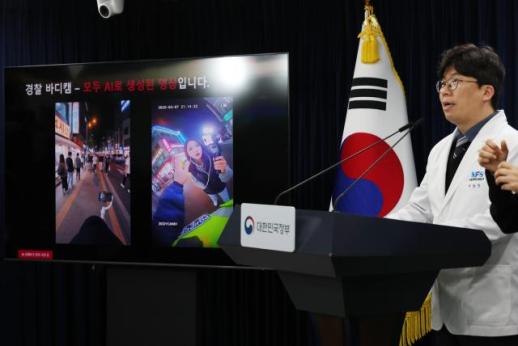 Tools to detect deepfakes and voting fraud showcased ahead of local elections SEOUL, March 10 (AJP) - A demonstration to detect artificial intelligence (AI)-generated deepfakes and prevent other election-related fraud was held at the government complex in central Seoul on Tuesday. It was part of efforts by the Ministry of the Interior and Safety to prevent any illegal activities in voting and other violations ahead of local elections slated for early June. The ministry said it has worked with the National Forensic Service since 2024 and can now detect deepfakes with 92 percent of accuracy, a significant improvement from the previous 76 percent. The ministry pledged to work closely with relevant agencies to protect citizens and crack down on false information and deepfakes. 2026-03-10 17:58:23
 -
 No booze, just brews: Morning rave in Seoul SEOUL, March 10 (AJP) -Music filled a beauty brand store in Bukchon, central Seoul, early in the morning as people gathered with coffee cups in hand, swaying to a DJ set to begin the day. The gathering followed the format of a “morning rave,” a lifestyle event gaining popularity overseas. Instead of alcohol and late-night partying, participants came for music, coffee and conversation. Around 200 people attended, moving between dance space, makeup experiences and personal color consultations. Inside the venue, the mood was relaxed and curious. Some danced freely near the DJ booth while others chatted, took photos or watched the scene unfold. Despite the early hour, the room stayed lively as the music continued through the morning. Despite the early hour, the room stayed lively as the music continued through the morning. The event reflects a growing “sober curious” trend among younger generations, particularly millennials and Gen Z. Coffee, music and community are beginning to replace the traditional nightlife centered on drinking, offering a different rhythm to start the day. 2026-03-10 17:57:00
 -
 Inbee Park Tells Korea’s National Team Golfers: Confidence Is Good, Arrogance Isn’t Korean golf star Inbee Park met with younger players on the national team and national reserve squad and offered practical advice, urging them not to become complacent. The Korea Golf Association said it held a call-up training program for the 2026 national team and reserve squad from March 7-8 at the Berlin Hall on the fourth floor of Seoul Olympic Parktel. Park, who serves as an International Golf Federation board member and executive committee member, attended. Park, a seven-time major champion with 21 LPGA Tour victories, also won the gold medal at the 2016 Rio de Janeiro Olympics. Reflecting on her career, Park told the players they should keep confidence in check. He said, “You can’t be arrogant. Up until I turned pro, I felt like I wouldn’t lose to anyone. But when I got to the pro stage, all the best players from around the world were there.” She added, “Confidence is good, but I thought, ‘I shouldn’t be arrogant.’ You may be the best here, but you may not be outside.” Park also stressed the importance of embracing setbacks. “You shouldn’t be afraid of failure. I hope you pour everything you can into it,” she said. “Challenge yourself until there’s nothing left you want to try, and learn through failure.” The KGA said the first day of training covered mindset and mental preparation, operating rules and the KGA ranking system, media training, sports human rights education, anti-doping education, golf rules and a session titled “Players who keep shining because they are happy.” On the second day, the program included golf training, a biomechanics approach to the golf swing, drug misuse and intake, self-directed injury care, and guidance on putter fitting and selection. The 2026 national team and reserve squad were selected through the KGA ranking system. The national team includes six men and six women, and the reserve squad includes 10 men and 10 women. The men’s national team is Kang Seung-gu (Namseong High School, 2nd year), Kim Min-su (Howon High School Affiliated Broadcast and Correspondence High School, 3rd year), Park Geon-ung (Korea National Sport University, 1st year), Son Jae-i (Dongnae High School Affiliated Broadcast and Correspondence High School, 1st year), Ahn Hae-cheon (Korea National Sport University, 2nd year) and Yoo Min-hyeok (Seogang High School, 3rd year). The women’s national team is Koo Min-ji (Korea National Sport University, 1st year), Kim Gyu-bin (Haksan Girls’ High School, 2nd year), Park Seo-jin (Seomun Girls’ High School, 3rd year), Yang Yun-seo (Incheon Girls’ High School Affiliated Broadcast and Correspondence High School, 3rd year), Oh Su-min (Shinseong High School, 3rd year) and Yoon Gyu-ri (Haksan Girls’ High School, 1st year). The season begins with the 4th Imsil Cheese Cup Amateur Golf Championship, to be held for four days from April 7-10 at Jeonju Shangri-La Country Club in Imsil County, North Jeolla Province.* This article has been translated by AI. 2026-03-10 17:52:41
 -
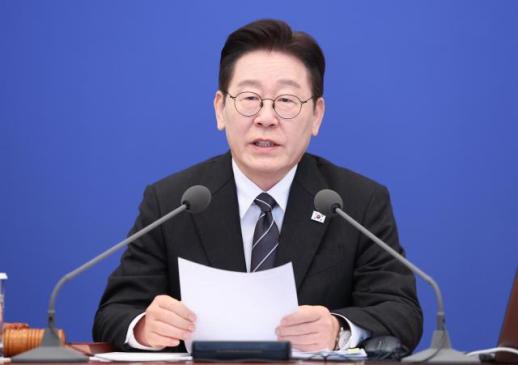 Seoul may revive decades-old fuel price cap, but experts urge caution SEOUL, March 10 (AJP) - South Korea is considering reviving a rarely used cap on retail gasoline prices as policymakers brace for a potential third wave of global oil shocks if the Middle East conflict drags on, though economists warn the government should move cautiously given the risks of distorting market prices. President Lee Jae Myung on Tuesday instructed his cabinet to explore emergency measures to curb surging fuel costs, urging officials to move beyond “normal procedures and manuals” during crisis conditions and quickly prepare a workable price ceiling system. Finance Minister Koo Yun-cheol said the government aims to introduce a framework for a cap within the week. The authority for such a measure comes from the Petroleum and Petroleum Substitute Fuel Business Act, introduced during the oil shocks of the 1970s. The law allows the finance minister to impose price ceilings or floors on petroleum products if prices fluctuate severely and threaten economic stability or daily life. The provision, however, has not been used for nearly three decades since South Korea liberalized its fuel pricing system to enable market forces to determine retail prices. The debate over reviving the mechanism comes as oil prices swing sharply amid the Middle East conflict. Domestic gasoline prices briefly rose above 2,000 won per liter over the weekend, reflecting the volatility in global crude markets. Economists warn against rushing intervention Some economists say introducing a price cap too early could create unintended consequences. Kim Jin-young, a professor of economics at Korea University, argued it is premature to adopt strong interventionist policies while the trajectory of the conflict remains uncertain. “I believe there is a fairly high possibility that the war in Iran will not end soon,” Kim said. “If the conflict becomes prolonged, oil prices could rise even further. But since the war has only just begun, we should focus on conserving supply and managing demand rather than immediately introducing this system.” Kim warned that price ceilings often impose hidden costs. “A price ceiling introduces a different kind of price — not a monetary one,” he said. “During the oil crisis in the United States, government price controls led to long lines at gas stations. In effect, the system imposes a higher cost on those who value their time.” Others say a cap for temporary purpose could help prevent excessive price spikes and protect consumers during periods of extreme volatility. Im Tobin, a professor at Seoul National University’s Graduate School of Public Administration, said the policy could serve as a corrective tool if market prices overshoot. “When crude oil has already been imported and stored, raising retail prices immediately simply because war breaks out allows oil companies to earn excessive profits,” Im said. “In that sense, the policy can help correct market distortions.” He stressed that any price cap should be strictly temporary. “The key is to shorten the duration of this system,” he said. Chang Yenjae, an economics professor at Soongsil University, also said the measure could help cushion the impact of surging energy costs. “During periods of rapidly rising energy prices, a price ceiling can help protect the real purchasing power of low- and middle-income households and stabilize transportation costs,” Chang said. However, Chang emphasized that price regulation alone cannot address structural energy challenges. “It is essential to clearly define the temporary and conditional nature of the price ceiling,” he said. “Relying solely on price controls is not a fundamental solution to energy problems.” Instead, he suggested improving fuel distribution systems and expanding fiscal support for vulnerable households as potentially more effective tools to manage the inflationary ripple effects of higher energy prices. 2026-03-10 17:50:44
 -
 Korea spearheads Asia rebound as crude falls below $90 SEOUL, March 10 (AJP) -South Korean stocks posted the strongest advance in Asia on Tuesday, reversing course after leading the region’s losses a day earlier as oil prices retreated sharply from above $100 a barrel and eased fears of a prolonged energy shock from the Middle East conflict. Korea’s benchmark KOSPI closed up 5.35 percent at 5,532.6, recouping much of Monday’s nearly 6 percent drop triggered by the surge in crude prices. The rally gathered momentum after oil prices slid overnight to below $90 per barrel, reviving investor sentiment and triggering a buy-side sidecar shortly after the opening bell as the main index jumped more than 6 percent. Foreign and institutional investors drove the rebound in Seoul. Foreigners bought a net 1.1 trillion won ($749 million) worth of shares on the KOSPI, while institutions added 847 billion won. Individual investors locked in profits, selling a net 1.8 trillion won. Technology shares led the advance. Samsung Electronics surged 8.3 percent to 187,900 won, while SK hynix jumped 12.2 percent to 938,000 won. Automakers also gained, with Hyundai Motor rising 3.6 percent. The smaller KOSDAQ also climbed 3.21 percent to finish at 1,137.7. Foreign investors purchased 128 billion won worth of shares on the KOSDAQ, while institutions added 72 billion won. Retail investors were heavy sellers, offloading about 200 billion won. Japan’s Nikkei 225 rose 2.9 percent to close at 54,248.39, while the broader TOPIX gained 2.2 percent. Semiconductor equipment makers supported the rally, with Tokyo Electron advancing 2.9 percent and Advantest climbing 5.3 percent. Taiwan’s TAIEX added 2.1 percent to close at 32,771.9, tracking gains in global semiconductor stocks. Hong Kong’s Hang Seng Index climbed 1.9 percent to 25,888, while mainland China’s Shanghai Composite rose 0.6 percent. The rebound in regional markets came after U.S. President Donald Trump suggested the conflict with Iran could end soon, easing concerns over prolonged disruption to global energy supplies. “We are going to have a much safer world as soon as it ends, and it's going to finish pretty quickly,” Trump said during a speech at the Republican Members’ Issues Conference in Florida. Brent crude dropped about 8 percent to $90.25 per barrel, while U.S. benchmark West Texas Intermediate fell nearly 8 percent to $87.24. The Korean won also strengthened as easing oil prices improved investor sentiment, closing at 1,469.3 per dollar compared with 1,467.5 won the previous session. 2026-03-10 17:47:22
 -
 Weak won, Middle East risks weigh on Korean economy as Taiwan pulls ahead SEOUL, Mar 10 (AJP) — South Korea’s economy is increasingly lagging behind technology-driven regional peers such as Japan and Taiwan, weighed down by a structurally weak currency and fading industrial competitiveness — pressures that could deepen if the Middle East conflict drags on. According to the Bank of Korea (BOK) on Tuesday, South Korea’s GDP per capita stood at about $35,800 in 2025, largely unchanged from recent years. Per capita gross national income (GNI) reached 52.46 million won ($36,855), rising 4.6 percent in won terms but only 0.3 percent in U.S. dollar terms, reflecting the drag from currency depreciation. By contrast, Taiwan and Japan posted stronger gains. Both countries — which had trailed South Korea in per capita income over the past three years — reported higher provisional figures for 2025, with Taiwan at $40,585 and Japan around $38,000, surpassing South Korea’s GNI range of $36,000 to $37,000. For Seoul, the reversal against Taiwan is particularly symbolic. South Korea first overtook Taiwan in 2003, when its per capita GNI reached $12,000 compared with Taiwan’s $11,000, and maintained the lead for more than two decades. That advantage has now effectively disappeared. Weak won erodes income gains The South Korean won entered 2026 on fragile footing after ending 2025 at 1,421.9 per dollar, a 2.1 percent depreciation from the previous year’s close of 1,392.5. At its weakest intraday level last year, the currency touched 1,487.6 won per dollar, surrendering nearly 6.8 percent of its value compared with the previous year. The slide has been notable because it occurred even while the U.S. Dollar Index remained below the 100 level for extended periods, suggesting the won weakened despite a relatively soft global dollar. In contrast, the New Taiwan dollar strengthened by about 2 to 3 percent against the greenback during the same period. “Assuming no exchange-rate impact, South Korea’s GDP per capita could exceed $40,000 as early as 2027,” said Kim Hwa-yong, head of the BOK’s National Income Department, underscoring how strongly currency movements influence real income levels. The downward pressure intensified earlier this year as geopolitical tensions triggered capital outflows. The won briefly touched the 1,500 level in overnight trading on March 4, following the escalation of the U.S.-Iran conflict. The currency later rebounded to below 1,470 per dollar on Tuesday as oil prices stabilized after U.S. President Donald Trump signaled that the conflict could end soon. Taiwan’s chip boom leaves Korea trailing The BOK on Tuesday confirmed that South Korea’s GDP growth slowed to 1 percent in 2025, matching the central bank’s earlier projection but falling short of 1.5–1.6 percent estimates from institutions such as the International Monetary Fund (IMF) and the Korea Development Institute (KDI). Taiwan, by contrast, posted a striking 8.63 percent growth rate, far above the roughly 7 percent consensus, while Japan recorded 1.1 percent growth, surpassing South Korea for the first time in 27 years. Taiwan’s surge reflects its dominant position in the global semiconductor supply chain. With TSMC controlling much of the world’s advanced chip manufacturing, the island has captured a disproportionate share of growth generated by the artificial intelligence boom. South Korea also benefited from strong demand for AI-related chips through Samsung Electronics and SK hynix, but the broader economy struggled to keep pace. According to BOK data, the semiconductor sector contributed 0.9 percentage points of the economy’s 1 percent growth in the fourth quarter, effectively accounting for nearly all of the expansion. Outside semiconductors, export momentum weakened. Industries that traditionally anchored Korean manufacturing — automobiles, shipbuilding and defense — lost steam in the second half of the year. Sectors facing intense competition from China, including secondary batteries, steel and petrochemicals, also recorded declining exports. Japan, meanwhile, saw improvements in both capital investment and exports. Facility investment rose 4 percent in 2025, while exports — historically a weaker pillar of the Japanese economy — also grew 4 percent. South Korea’s investment cycle told a different story. Facility investment stagnated in the second half, resulting in zero growth for the year. Automobile exports also showed no annual growth, while steel and petrochemical shipments declined, contributing to an overall 2 percent drop in exports. Hormuz disruption adds new risks The Middle East conflict is now adding a fresh layer of uncertainty to the outlook. Following the Feb. 28 strikes, Iran’s Islamic Revolutionary Guard Corps (IRGC) effectively imposed a blockade on the Strait of Hormuz, according to South Korea’s Defense Intelligence Agency (DIA). Maritime traffic through the strait — which averaged about 98 vessels per day in late February — has reportedly plunged to as few as one ship daily. South Korea is among the economies most exposed to such disruption. Data from the Korea National Oil Corporation (KNOC) show that about 70 percent of South Korea’s crude oil imports come from five Middle Eastern countries — Saudi Arabia, the UAE, Kuwait, Qatar and Iraq — all of which rely on the Hormuz passage. “Major Asian economies such as China, India, Japan and South Korea could be particularly affected, as over 80 percent of oil and LNG shipments through the strait are destined for Asia,” the Center for Strategic and International Studies (CSIS) said in a recent analysis. Oil markets have already reacted sharply. WTI crude, which closed at $67 on Feb. 27, surged to $108.5 by March 8 before retreating below $90 on Tuesday after Trump suggested the conflict could end soon and G7 nations signaled possible strategic reserve releases. Even after the pullback, prices remain roughly 30 percent above recent lows. The BOK, which had recently raised its 2026 growth forecast from 1.8 percent to 2 percent, may now face pressure to revise that outlook. A Citigroup report on March 3 estimated that if international oil prices average $82 or higher this year, South Korea’s GDP growth could fall by 0.45 percentage points to around 1.5 percent. At the same time, consumer inflation could rise by about 1.1 percentage points to 3.2 percent, raising the risk of stagflation, according to the Hyundai Research Institute (HRI). “We expect domestic growth and inflation to be negatively affected,” Kim of the BOK said during a press briefing Tuesday. “The ultimate economic impact will largely depend on whether the conflict becomes prolonged.” 2026-03-10 17:37:05
 -
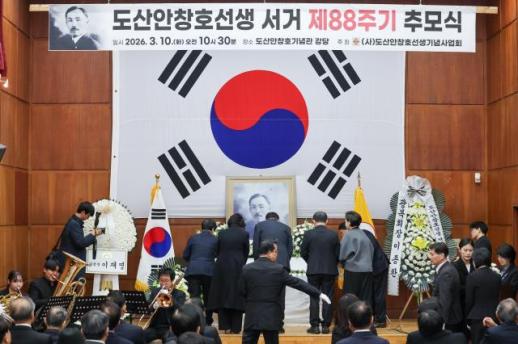 Independence fighter's lifelong dedication remembered SEOUL, March 10 (AJP) - People gathered at a memorial hall in southern Seoul on Tuesday to mark the 88th anniversary of the death of independence fighter Ahn Chang-ho. They laid flowers and bowed their heads in remembrance of his enduring devotion and sacrifice for the country. It was the Sino-Japanese War that changed everything for him. At the age of just sixteen, watching foreign powers clash on Korean soil in 1894, he realized that it was because the country had no strength to defend itself. From that moment, he resolved to dedicate his life to his country, not merely in words but in action. In 1905, he founded the Gongnip Association, the first Korean political organization established in the U.S., drawing 600 members within just two years. He then returned home in 1907 and formed the Sinminhoe, a secret patriotic organization dedicated to restoring Korean sovereignty from Japanese colonial rule. He also established a school in Pyongyang, spearheading educational movements to enlighten people. After the March 1st Independence Movement in 1919, Ahn became Minister of Interior for the Provisional Government in exile in Shanghai. Through both political action and a lifelong commitment to education, Ahn, also known by his pen name Dosan, dedicated himself entirely to the independence of his country. He died in March 1938 at the age of 59, yet his spirit and legacy continue to inspire to this day. 2026-03-10 17:35:53
 -
 Dong-A Pharma launches oral spray for infants; Centellian24 debuts Japan limited set; HK inno.N deal; Severance study Dong-A Pharmaceutical launches ‘Champu Oral Spray’ for infants and young children Dong-A Pharmaceutical said March 10 it has launched “Champu Oral Spray,” which can be used starting in infancy. The main ingredient is benzydamine hydrochloride, which the company said may help ease inflammation of the throat, mouth and gums and help relieve pain before and after tooth extraction. It can be used by infants and young children under age 6. The spray is used 2 to 6 times a day, with the recommended number of sprays varying by age. To improve adherence among young children, the product has a strawberry flavor, and the packaging uses a panda character to create a familiar look. Dongkook Pharmaceutical’s Centellian24 to debut limited ‘Madeca PDRN Sakura Package’ on Japan’s Qoo10 Dongkook Pharmaceutical’s dermacosmetic brand Centellian24 said March 10 it will introduce a limited-edition “Madeca PDRN Sakura Package.” The set includes four products: Madeca Cream Active Renew PDRN, 360-degree PDRN serum, 360-degree PDRN eye cream, and 360-degree PDRN eye patch. The limited edition centers on popular items from Centellian24’s PDRN line. It will be unveiled during Qoo10’s “Mega Wari” discount event in Japan, which runs through March 11, and will also be available for purchase through Qoo10’s live broadcast starting at 8 p.m. HK inno.N, Tanabe Pharma Korea sign co-promotion deal for anemia drug Badanem HK inno.N said March 10 it held a signing ceremony with Tanabe Pharma Korea for a domestic co-promotion agreement for Badanem tablets (vadadustat), a new drug for renal anemia. Under the agreement, the two companies will jointly handle sales and marketing in South Korea. They will share responsibility for medical institutions with more than 100 beds, while HK inno.N will manage those with 100 beds or fewer. HK inno.N will also exclusively distribute the product domestically, citing its experience selling kidney-disease products and its nationwide sales network. Badanem is an oral treatment used to treat anemia in adult patients with chronic kidney disease who are receiving dialysis. It is a hypoxia-inducible factor prolyl hydroxylase (HIF-PH) inhibitor. It comes in 150 mg and 300 mg doses and is taken once daily. Higher continuity of care tied to lower deaths and cardio-cerebrovascular disease, Severance team says A research team led by Kang Hee-taek, a professor of family medicine at Severance Hospital, and Shim Jae-yong, a professor of family medicine at Gangnam Severance Hospital, said March 10 that greater continuity of care in patients with hypertension or diabetes can reduce medical spending, cardiovascular disease incidence and the risk of death. The findings suggest that, in managing chronic disease, maintaining an ongoing treatment relationship with a specific medical institution matters more for health outcomes and cost savings than the number of medical visits. The results were published in the latest issue of the international journal Nutrition, Metabolism and Cardiovascular Diseases. The team treated “continuity of care” — the extent to which a patient consistently receives care from the same institution or clinician — as a key indicator in chronic-disease management and examined how it relates to real-world outcomes. In patients with hypertension, those with higher continuity of care had fewer hospitalizations among both men and women, and women also had fewer emergency room visits. Total hypertension-related medical costs, costs per visit and annual medical costs all tended to be lower in the high-continuity group. Differences were especially clear in the risk of cardiovascular disease, and similar results were found among patients with diabetes.* This article has been translated by AI. 2026-03-10 17:30:00
 -
 SK Inc. to Cancel All Treasury Shares Worth 4.8 Trillion Won SK Inc. said it will cancel treasury shares worth 4.8 trillion won, the largest such move ever by a holding company and equal to about 20% of its shares outstanding. The company said the decision is part of an aggressive effort to boost corporate value and maximize shareholder value in line with the intent of revisions to the Commercial Act. SK Inc. said it decided at a board meeting on Monday to cancel all treasury shares it holds except those reserved for employee compensation. The cancellation covers about 14.69 million shares out of roughly 17.98 million treasury shares, the company said in a regulatory filing. Based on the previous day’s closing prices — 329,000 won for common shares and 237,500 won for preferred shares — the canceled shares are valued at 4.8343 trillion won, it said. The shares to be canceled include not only treasury shares bought to enhance shareholder value but also shares acquired for a “specific purpose” during past efforts to improve the holding company’s governance structure. SK Inc. merged with SK C&C (now SK AX) in 2015 to simplify its structure and increase transparency. “After several rounds of in-depth discussion, the board concluded that canceling all treasury shares is the best option to serve the maximum interests of all shareholders and raise corporate value,” an SK Inc. official said. The official said the company “actively reflected” the intent of the Commercial Act revision, which allows the board to cancel treasury shares acquired for a specific purpose. SK Inc. said the decision also reflects improved financial strength after two years of portfolio rebalancing. On a separate financial statement basis, net borrowings fell to 8.4 trillion won as of the third quarter of 2025 from 10.5 trillion won at the end of 2024, it said. Over the same period, the debt ratio improved to 77.4% from 86.3%. Canceling nearly 5 trillion won worth of treasury shares shows the board’s firm commitment to continue transparent, shareholder-friendly management and set a model precedent for South Korea’s capital markets, the official said. The company will keep strengthening shareholder trust and maintain a management approach that puts shareholders first, the official added. * This article has been translated by AI. 2026-03-10 17:09:19