

Journalist

Jack L. Rozdilsky
-
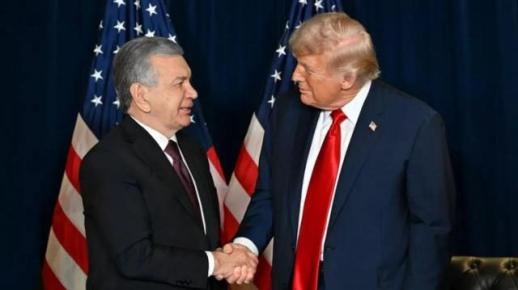 Uzbekistan joins international peace council for Gaza during Washington visit SEOUL, March 03 (AJP) - President Shavkat Mirziyoyev visited Washington from February 17 to February 19 at the invitation of United States President Donald Trump to participate in the inaugural meeting of the Peace Council. The working visit combined high-level political discussions with an extensive economic program, resulting in several agreements designed to strengthen the strategic partnership between Uzbekistan and the United States. The Peace Council is an intergovernmental initiative introduced by President Trump following a Gaza peace plan endorsed by the United Nations Security Council in November 2025. This platform serves as a mechanism to coordinate humanitarian assistance and establish institutional frameworks for the long-term reconstruction and socio-economic recovery of the Gaza Strip. The founding charter was signed in Davos on January 22, 2026, by a group of nations including Jordan, Türkiye, Saudi Arabia, and the United Arab Emirates. Uzbekistan joined the founding members to reaffirm its commitment to peaceful diplomacy and international law. The country has recognized Palestine since 1994 and has provided practical humanitarian support, including 1.5 million dollars through UNRWA in 2023 and the evacuation of 100 wounded Palestinian women and children for medical rehabilitation in late 2023. In 2025, Uzbekistan established a dedicated state fund to provide asylum, healthcare, and education for Palestinian citizens received in the country. At the February 19 meeting in Washington, which included representatives from more than 40 countries, President Trump announced that nine nations—Uzbekistan, Kazakhstan, Azerbaijan, the United Arab Emirates, Morocco, Bahrain, Qatar, Saudi Arabia, and Kuwait—had jointly pledged 7 billion dollars in assistance to Gaza. The United States committed an additional 10 billion dollars to support the council’s operations. During the session, President Mirziyoyev emphasized that any external governance framework for Gaza must rely on internal public support to ensure legitimacy and stability. He confirmed that Uzbekistan is ready to contribute to the construction of residential housing, schools, and healthcare facilities in Gaza to support both humanitarian and development goals. The economic dimension of the visit focused on a portfolio of contracts and projects exceeding 100 billion dollars, originally discussed during the 80th United Nations General Assembly in September 2025. These agreements cover aviation, mining, chemicals, energy, and innovation. Specific projects include cooperation with Denali Exploration Group and Re Element Technologies on rare earth elements, as well as partnerships with Palo Alto Networks regarding artificial intelligence. President Mirziyoyev held meetings with U.S. Secretary of Commerce Howard Lutnick, Eximbank President John Jovanovic, and U.S. Trade Representative Jamieson Greer. A formal agreement establishing a bilateral Investment Platform was signed to facilitate financing for industrial and infrastructure projects. Discussions also addressed Uzbekistan's accession to the World Trade Organization and the development of poultry clusters and agro-industrial cooperation. Trade turnover between the two countries increased 4.7-fold between 2017 and 2025, reaching 1 billion dollars. Exports from Uzbekistan are currently dominated by services, which account for 81 percent of the total, including programming and financial services. Imports from the United States primarily consist of machinery and equipment, representing 59 percent of the trade volume. As of February 2026, 346 enterprises with American capital operate in Uzbekistan. The current economic strategy aims to move beyond trade toward long-term technological partnerships in sectors such as electronics, microelectronics, and pharmaceuticals. This includes potential joint production with companies such as NVIDIA, Intel, and Qualcomm. The visit concluded with the signing of bilateral documents regarding the extraction of critical minerals, financial market reforms, and investment climate improvements. This information was released by the Embassy of Uzbekistan in South Korea on March 3. 2026-03-03 14:56:47
 -
 Middle East Crisis: Korean industries grapple with renewed oil shock SEOUL, March 03 (AJP) - The widening Middle East crisis, triggered by U.S.-Israeli attacks on Iran and Tehran's closure of the Strait of Hormuz, is poised to ripple across South Korea's industrial landscape — compounding pressure on the struggling petrochemical sector while opening fresh prospects for defense exporters. The joint U.S.-Israeli airstrikes on Iran, launched on Feb. 28, killed Supreme Leader Ayatollah Ali Khamenei and triggered retaliatory Iranian missile and drone strikes against U.S. military assets across the Gulf and multiple Arab states. As of Tuesday, fighting had entered a third day with no ceasefire in sight, and U.S. President Donald Trump outlined a four- to five-week timetable for the campaign. Brent crude surged more than 6 percent in Monday trading, briefly approaching $80 a barrel, while European gas prices spiked nearly 40 percent after Qatar halted LNG output at a major facility following intercepted drone threats. Analysts warn that a sustained disruption to Hormuz traffic could push oil above $100 a barrel. The strait carries about 20 percent of the world's crude oil and one-fifth of global LNG. South Korea's exposure is acute as the country imports 70.7 percent of its crude oil and 20.4 percent of its LNG from the Middle East, according to the Korea International Trade Association. Should detour routes become necessary, maritime freight rates could climb 50 to 80 percent, with insurance premiums surging as much as sevenfold akin to the levels of past Gulf crises. The Organization of the Petroleum Exporting Countries said Sunday it would raise output by 206,000 barrels per day in April, but that increase amounts to only a fraction of the roughly 15 million to 20 million barrels per day that normally transit the strait. For now, experts say the risk of a drawn-out conflict remains limited. "Predictions of a prolonged war are not widespread, given Iran's missile-launch capacity and other constraints," said Yoon Jae-sung, an analyst at Hana Securities. "The possibility of a short-term disruption to South Korea's crude oil procurement is limited." Yoon cautioned, however, that a full Hormuz blockade would have far more severe consequences than the energy shock triggered by the Russia-Ukraine war. "Massive supply disruptions would be inevitable not only for crude oil, petroleum products, gas and fertilizer, but also for petrochemicals, and short-term price spikes would follow," Yoon said, pointing to S-Oil, SK Innovation, Unid and Lotte Fine Chemical as companies relatively better positioned to weather volatility. Petrochemicals hit at worst possible timing The conflict arrives at one of the worst possible moments for South Korea's petrochemical industry, the world's fourth-largest producer of ethylene and propylene. The sector has been mired in losses since 2021, battered by Chinese overcapacity and chronically weak margins. Spot cash margins for naphtha-fed steam crackers in Northeast Asia stood at minus $293 per metric ton as of mid-February, according to Chemical Market Analytics by OPIS. South Korea is one of the world's largest importers of naphtha, the crude oil derivative that serves as the primary feedstock for its petrochemical complexes. About 80 percent of ethylene's selling price is tied to naphtha procurement costs. When oil rises, naphtha follows — but producers cannot pass on higher costs in a global market flooded with Chinese supply. The government approved its first major restructuring project just last week. On Feb. 25, the Ministry of Trade, Industry and Energy signed off on the "Daesan No. 1" plan, merging Lotte Chemical and HD Hyundai Chemical operations with a 2.1 trillion won ($1.43 billion) support package. Lotte Chemical's 1.1-million-metric-ton-per-year ethylene cracker will be shut over three years. The deal marks the first consolidation under a broader roadmap targeting a national reduction of up to 3.7 million metric tons of cracking capacity across the Daesan, Yeosu and Ulsan complexes. The restructuring was designed for a low-price, oversupply environment — a sudden crude spike upends those calculations entirely. Freight shock amplifies cost pressure Fuel volatility has already triggered sharp spikes in charter rates for very large crude carriers (VLCCs). Following the U.S.-Israeli strikes, VLCC charter costs surpassed $400,000 per day. Rates that had hovered in the low $200,000 range nearly doubled within days as Iran escalated threats to Hormuz. Projections suggest that if a blockade materializes, charter fees could climb as high as $800,000 per day. According to freight indices for the Middle East–to–East Asia route, the Worldscale index reached 410.44 on Monday, translating into a Time Charter Equivalent of $423,736 per day. That represents more than a twofold increase from Feb. 27 — just before the conflict erupted — when the index stood at 224.72 and TCE at $218,154. Compared with January levels, when TCE averaged $78,793, tanker freight costs have surged more than fivefold in roughly a month. Defense emerges as the clear industrial upside The sole industrial upside from widening armed conflict lies in defense. Korea's defense exports to the Middle East tripled from $241 million in 2019 to $747.5 million in 2024, according to the Export-Import Bank of Korea. The broader Middle East and North Africa region accounted for 27 percent of global arms imports between 2020 and 2024, with regional defense spending projected to reach $255.8 billion by 2029. "Even if the war ends early, weapons imports in the Middle East could increase over the mid- to long term as countries hedge against follow-up Iranian attacks and lingering uncertainty," said Chae Woon-sam, an analyst at Hana Securities. "Not only U.S. defense firms, but Korean defense companies are also expected to benefit from rising regional demand." The conflict has exposed Gulf states' vulnerability to missile and drone strikes, with attacks hitting airports, military bases and residential areas across Qatar, Jordan, Kuwait and Bahrain. That exposure is likely to accelerate demand for the air defense and missile interception systems South Korean firms have been actively marketing. Hanwha Aerospace signed a $3.2 billion Cheongung-II air defense contract with Saudi Arabia in November 2023 and a $3.5 billion missile system deal with the UAE in January 2022. On Feb. 8, Defense Minister Ahn Gyu-back traveled to Riyadh for talks during the World Defense Show 2026, where 40 Korean firms showcased hardware and the two countries signed a new memorandum of understanding on joint defense research and development. Hana Securities said the recent wave of missile strikes has heightened the urgency of regional air defense stockpile replenishment, placing LIG Nex1 in a strong position. The Cheongung-II, often referred to as "Korea's Patriot," could emerge as a competitive mid-tier alternative to the U.S.-made Patriot system, which faces supply constraints and carries a higher price tag. "The Cheongung-II's cost-effectiveness and delivery timelines position it as a viable complement to the Patriot for mid-tier air defense," Chae said. "The unit cost of its interceptor missiles is less than half that of the Patriot's." Experts at the Washington Institute have noted that South Korean defense systems appeal to Middle Eastern buyers seeking to counter Iran's expanding drone and missile capabilities while diversifying beyond sole dependence on U.S. suppliers. Korean systems are designed to integrate with U.S.-supplied command-and-control networks, offering Gulf states redundancy without undermining existing alliance structures. The near-term outlook remains complicated. Iranian strikes on Gulf infrastructure have forced Korean firms to scale back on-the-ground operations. Hanwha, which employs about 123 workers at its Bismayah New City construction project in Iraq, activated emergency safety protocols. Korean Air suspended its Incheon–Dubai route, while shipping companies HMM and Pan Ocean prepared contingency detour plans. Any prolonged closure of Gulf airspace and sea lanes would delay deliveries, joint ventures and research cooperation — even as strategic demand for Korean defense systems grows. 2026-03-03 14:55:09
 -
 HMM Union Threatens April General Strike Over Proposed Move of Headquarters to Busan HMM’s labor dispute over a proposed relocation of its headquarters to Busan is escalating toward a general strike. HMM’s onshore union said Tuesday it will take legal action and launch a general strike in April if the government and major shareholders push ahead with the move without an agreement with labor. In a statement, the union said it believes the government and major shareholders could move to finalize the relocation through a sequence of steps: a March shareholders meeting, an April board meeting and a May extraordinary shareholders meeting to confirm amendments to the company’s articles of incorporation. HMM’s largest shareholders are the Korea Development Bank and the Korea Ocean Business Corp., which hold 35.42% and 35.08%, respectively. To relocate the headquarters to Busan, HMM would need to amend its articles, which currently state the headquarters is in Seoul. The union said major shareholders may appoint three outside directors seen as friendly at the March regular shareholders meeting, then pass a proposal at the April board meeting to amend the articles to change the headquarters location, and finalize it at the May extraordinary shareholders meeting. “If the articles are changed while negotiations are under way, we will pursue legal action against the directors and seek an injunction to suspend the effect of the special resolution at the shareholders meeting or to block the relocation,” the union said. The union also argued the relocation push is politically driven. It said the stated goal of strengthening shipping competitiveness has been sidelined and that the move is being rushed in connection with a political timetable in a specific region. It said shipping companies base headquarters in the Seoul metropolitan area for management efficiency, citing access to information, talent recruitment and global networks, and warned a forced move that ignores industry realities would weaken competitiveness. The union raised job-security concerns, saying the relocation would disrupt the lives of hundreds of employees and their families and, without sufficient consultation and measures, could lead to staff departures and organizational instability. The union said it will begin phased actions. Starting March 11, it plans weekly rallies during commuting hours, followed by a March 26 news conference in front of the headquarters. On April 2, it plans a rally and union assembly to approve a general strike in front of Cheong Wa Dae Sarangchae. It said it is also considering increasing rallies to twice a week or daily depending on developments. “If the government ultimately ignores workers’ right to make a living and the company’s autonomy, we will move into full-scale action including a general strike,” the union said, adding that responsibility for any management disruption and industrial losses would lie with the government. The headquarters issue is being pursued in connection with the government’s plan to develop Busan as a “maritime capital.” With labor-management tensions rising, debate over whether, when and how the relocation would proceed is expected to continue.* This article has been translated by AI. 2026-03-03 14:54:21
 -
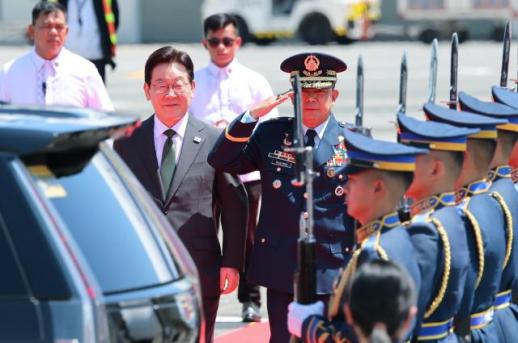 South Korean President Lee arrives in Manila for summit with President Marcos SEOUL, March 03 (AJP) - South Korean President Lee Jae Myung arrived in Manila on Tuesday afternoon for a state visit to the Philippines. The trip coincides with the 77th anniversary of the establishment of diplomatic relations between the two countries. President Lee is scheduled to hold a summit with President Ferdinand Romualdez Marcos Jr., followed by a joint press announcement and a state dinner. This is the second meeting between the two leaders since they met approximately four months ago during the Asia-Pacific Economic Cooperation (APEC) summit in Gyeongju last October. The two presidents are expected to discuss ways to expand future-oriented economic cooperation. Presidential officials said they anticipate new partnerships in sectors such as nuclear power, shipbuilding, and critical minerals. The visit also includes events focused on the shared history of the two nations. The Philippines deployed more troops to the Korean War than any other Asian country, and several stops on the itinerary are dedicated to honoring that service. Before the summit, President Lee visited the monument of Jose Rizal, the Filipino independence activist, to lay a wreath. On March 4, the second day of the visit, he will visit the Libingan ng mga Bayani, or the Cemetery of Heroes, to lay a wreath at the Korean War Memorial and meet with surviving veterans and their families. President Lee will end his visit by attending a business forum with South Korean and Filipino executives. He is also scheduled to hold a luncheon with members of the South Korean community before concluding his four-day Southeast Asian tour. 2026-03-03 14:37:05
 -
 Singer Yoon Jong-shin Says Red Sox Outfielder Masataka Yoshida Resembles Him Singer Yoon Jong-shin has pointed to a baseball player he says looks like him. On Monday, Yoon posted photos and video on social media, writing, “Every time I see him, I feel like he looks like me when I was young.” The player was Masataka Yoshida, a Japan national team member and an outfielder for the Boston Red Sox in Major League Baseball, known for his hitting. Yoshida batted .266 last season, but hit .289 in 2023, his first year in MLB, and .280 in 2024. His career MLB batting average is .282. Yoon and Yoshida also share a similar height: Yoon is 168 centimeters (5 feet, 6 inches) and Yoshida is 172 centimeters (5 feet, 8 inches). 2026-03-03 14:27:18
 -
 NCT DREAM to host live viewing events in 86 cities worldwide SEOUL, March 03 (AJP) - NCT DREAM will broadcast the finale concerts of its fourth world tour in cinemas across 86 cities worldwide, its agency SM Entertainment said Tuesday. NCT DREAM is a seven-member Korean boy group that debuted in 2016 as a unit of the broader NCT brand, known for hit tracks such as “Hot Sauce,” “Candy” and “ISTJ.” The “2026 NCT DREAM TOUR FINALE” will be held over six days, March 20–22 and March 27–29, at KSPO DOME in Seoul’s Olympic Park. All seats for the encore concerts have sold out. Two of the concerts, March 21 and 28, will be screened live in theaters in nine cities across Korea and 43 cities in Japan, as well as in Jakarta, Macau, Singapore, Taipei, Kaohsiung, Kuala Lumpur, Hong Kong, Bangkok and Chiang Mai, bringing the total to 86 cities worldwide. In addition, concerts on March 21, 22, 28 and 29 will be streamed globally through Beyond LIVE and Weverse. Throughout its fourth tour, the group set a record for the most concerts held at Seoul’s Gocheok Sky Dome and became the first K-pop act to perform at Hong Kong’s Kai Tak Stadium. It also staged shows at Thailand’s Rajamangala National Stadium, Jakarta International Stadium and Taipei Dome. The Seoul encore concerts will mark the conclusion of the group’s fourth tour. 2026-03-03 14:23:16
 -
 BoA Launches New Agency, Baypal Entertainment, After Leaving SM Singer BoA, who recently ended her long relationship with SM Entertainment, has announced the launch of a new entertainment company. BoA posted photos on social media on March 3 showing herself and acquaintances with bags pulled over their heads. She tagged both her own account and the Baypal Entertainment account. Baypal Entertainment also posted photos with BoA, adding the caption “???” and hashtags. Baypal Entertainment said BoA “chose a new structure to more clearly realize her musical direction.” The company said Baypal Entertainment is an agency BoA founded herself. The name combines “BoA” and “pal,” meaning friend, and it aims to be a company built together by BoA and her fans. BoA’s side said, “The precious memories and valuable experiences built over a long time are the most important assets that made BoA the strong artist she is today,” adding, “Based on what we have learned, we will further strengthen the substance of her music.” BoA ended her 25-year partnership with SM Entertainment in January.* This article has been translated by AI. 2026-03-03 13:48:17
 -
 Hyundai Motor Group unveils autonomous robot for high-risk firefighting SEOUL, March 03 (AJP) - Hyundai Motor Group released a video showcasing a new autonomous firefighting robot designed to penetrate high-risk disaster zones where human entry is restricted. The "physical AI" solution revealed Tuesday targets environments with collapsing structures, toxic gas, or extreme heat to secure the "golden time" for fire suppression. Developed with the National Fire Agency, the robot features an advanced 6X6 in-wheel motor system that allows for 360-degree rotation on the spot. It moves at about 50 km/h—roughly twice as fast as a running human—and can scale 300mm vertical obstacles or steep warehouse ramps. To overcome blinding smoke, the unit utilizes AI-enhanced thermal imaging and infrared cameras to transmit high-definition data to operators in real-time. It also deploys a high-pressure photoluminescent hose that glows in the dark, serving as a literal lifeline for firefighters to find their way out. "The true value of this robot is not merely its heat resistance or fire suppression power, but its role as a ‘Physical AI’ that operates in actual disaster sites," said Kim Seung-ryong, acting commissioner of the National Fire Agency. He added that the technology marks a "great transition" toward a hybrid era where humans and robots overcome their respective limits. The robot saw its first combat deployment during a factory fire in Eumseong, North Chungcheong Province, on Jan. 30. Beyond active suppression, the platform functions as a mobile data hub, capturing smoke density and temperature levels to refine its machine-learning algorithms. Hyundai Motor Group plans to evolve the system into a fully autonomous "firefighting response platform" capable of analyzing fire origins and calculating the most efficient suppression methods independently. The group said it remains committed to developing technologies that support "uniformed heroes" and ensure public safety. 2026-03-03 13:31:30
 -
 LIG Nex1 Opens Large-Scale Hiring for First Half of 2026 LIG Nex1 said Tuesday it will conduct a large-scale open recruitment drive for the first half of 2026. Applications opened Tuesday and will be accepted through March 18 via the company’s recruitment website. Openings include missile systems, electronic warfare, radar, maritime, unmanned and robotics, electro-optical and information convergence, satellites and AI, the company said. The hiring will cover a range of roles, including R&D positions in hardware, software and mechanical engineering, as well as domestic and overseas business management, quality management and corporate support. The company expects to hire at least a three-digit number of employees. Detailed job descriptions by field are available in the “Recruiting Book” on the recruitment website. Candidates who pass an online AI competency assessment and document screening will move to a software coding test (for software roles), followed by job-specific interviews and then a leadership interview before final selection. With public interest rising in South Korea’s defense industry, LIG Nex1 said it will also hold campus recruiting at 31 universities nationwide. The company said about 60% of its workforce is engaged in R&D. As of February, it had 5,748 employees, up 1,204 over two years, a 26% increase, and was named a “Top Job-Creating Company” by the Labor Ministry for a third consecutive year. A company official said the large-scale hiring is aimed at strengthening competitiveness across the rapidly advancing defense industry and encouraged interest from talent expected to lead future growth businesses. * This article has been translated by AI. 2026-03-03 13:27:16
 -
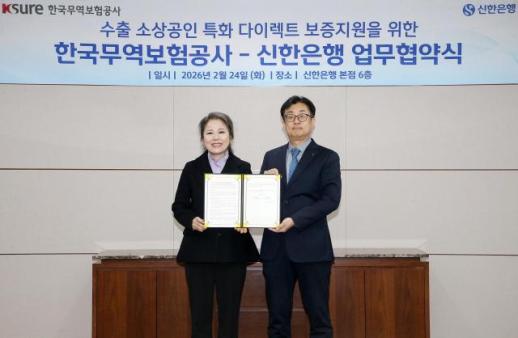 Shinhan Bank, K-Sure Expand Support for Small Exporters Up to 120 Million Won Shinhan Bank said Monday it will strengthen direct guarantee support tailored to small exporters in partnership with the Korea Trade Insurance Corp. The agreement targets small exporters that have struggled to obtain financing because of low credit ratings or limited export track records. The partners said they will expand small-amount guarantees and help promote overseas market entry. Under the deal, Shinhan Bank and the trade insurer will expand the lineup of non-face-to-face guaranteed loan products for low-credit small exporters, fully cover guarantee fees for companies using the “Light” guarantee, and raise guarantee limits for firms that repay direct guarantees on time. With the expanded program, companies rated B- or higher by Korea Evaluation Data can apply for export promotion funds backed by a Korea Trade Insurance Corp. guarantee certificate, from a minimum of 10 million won to a maximum of 120 million won, depending on their rating. “We improved the product structure to support small business owners with export capacity who faced limits on financing due to credit ratings or performance requirements,” a Shinhan Bank official said. The official added the bank will continue to expand practical funding support for small businesses in financial blind spots as part of its inclusive finance efforts. * This article has been translated by AI. 2026-03-03 13:24:00