
Journalist

Joonha Yoo
-
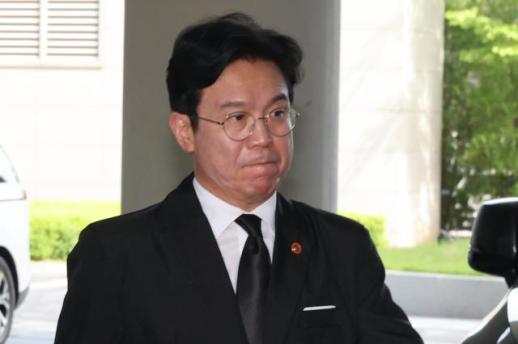 Samsung Live: Labor minister steps onto the mound to save talks and stop strike SEOUL, May 20 (AJP) -With a nationwide strike at Samsung Electronics just hours away, South Korean Labor Minister Kim Young-hoon on Wednesday personally stepped into wage negotiations after government-mediated arbitration collapsed, underscoring mounting fears in Seoul that a prolonged walkout could destabilize the semiconductor industry at the center of the global AI boom. The Ministry of Employment and Labor said Kim would directly oversee renewed talks between Samsung management and the union beginning at 4 p.m. at the Gyeonggi Regional Labor Office, in what officials described as an extraordinary attempt to keep dialogue alive after the National Labor Relations Commission failed to broker a compromise. The minister-led negotiations differ from the commission’s formal post-mediation process and are not intended to produce a legally binding settlement. Instead, the government is seeking to pressure both sides back into voluntary negotiations as concerns grow that the planned 18-day strike could disrupt chip production, exports and investor confidence by flagging an extraordinary authority to disallow a strike in an industrial site should it cause serious damage to national economy. Samsung and the union participated in a second round of post-mediation talks from May 18 but failed to narrow differences over key issues including the distribution formula for performance-based bonuses across business divisions. The labor commission proposed a compromise package balancing both sides’ positions. While the union accepted the proposal, Samsung management withheld a final decision, prompting the commission to declare the mediation unsuccessful. The collapse of negotiations intensified speculation that the government could invoke emergency arbitration powers, a rarely used authority allowing Seoul to suspend strikes and force compulsory mediation in industries deemed critical to the national economy. Labor Ministry spokesperson Hong Kyung-eui said the government would continue supporting labor-management talks “without being bound by formalities” but cautioned that it was “premature” to comment specifically on the possible invocation of emergency arbitration powers. 2026-05-20 16:22:11
 -
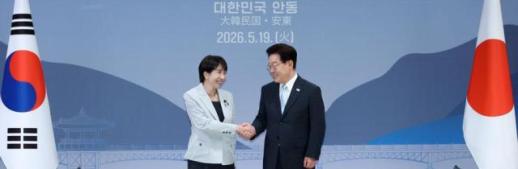 ASIA INSIGHT: Can South Korea and Japan turn shuttle diplomacy into substantive cooperation? SEOUL, May 20 (AJP) - South Korea and Japan have long had a relationship that goes back and forth, sometimes improving, sometimes worsening, and then improving again. This cycle has been driven not only by practical interests, but also by historical issues between the two neighboring countries. But a quieter shift now seems to be taking place. It is not marked by dramatic breakthroughs or major progress on long-standing historical disputes. Instead, it is more gradual, built on the steady rebuilding of trust through frequent exchanges including an unusual new practice in which leaders meet not only in their capitals, but also in each other's hometowns. At a summit between President Lee Jae Myung and Japanese Prime Minister Sanae Takaichi held in Andong, a historic city in southern South Korea on Tuesday, the leaders reflected on a pattern that would have been hard to imagine just a few years ago. Just four months earlier, they had met in Nara, Takaichi's hometown. Now the visit was reciprocated in Lee's hometown. The symbolism was deliberate. By stepping outside the formal setting of traditional diplomacy and into places tied to personal memory, both sides are signaling a desire to humanize a relationship that has long been shaped by historical resentment and mutual misunderstanding. Yet symbolism alone does not define this moment. What gives this phase of bilateral relations its potential significance is the steady accumulation of practical agreements beneath the formal, ceremonial meetings. Among them is a long-delayed effort to address remains recovered from Japan's Chosei coal mine, where DNA identification procedures are finally set to begin. The issue, long marked by emotional and historical weight, is being approached through humanitarian cooperation rather than political contestation. It is a small but telling example, showing that even the most painful historical issues can sometimes be worked through when both sides are willing to cooperate and share responsibility. Police agencies from both countries also signed an agreement to jointly tackle transnational crime and scam networks, which have become increasingly sophisticated and borderless. In an era when fraud is often run across multiple countries and digital platforms, and both sides seem to recognize that older ways of cooperating simply are not enough anymore. Economic cooperation is now driven by practical needs. Both South Korea and Japan rely heavily on imported energy, and with global markets becoming increasingly unstable, neither country can afford to go it alone. The two countries are now exploring ways to coordinate, including sharing crude oil and petroleum reserves and jointly purchasing liquefied natural gas. These are not symbolic gestures, but practical arrangements that could help shield both economies when the next external shock would come. At the same time, the two leaders recognized that regional stability cannot be separated from their bilateral relationship. The prolonged conflict in the Middle East, which began with joint U.S. and Israeli airstrikes against Iran in late February, has showed how distant conflicts can quickly translate into domestic economic vulnerability, including disruptions to global supply chains and risks to key shipping routes such as the Strait of Hormuz. There is also continued emphasis on coordination through broader regional frameworks, including trilateral cooperation with Washington, while keeping channels of dialogue open with North Korea as well as its traditional ally China. Still, the central question remains whether "shuttle diplomacy," a practice of frequent reciprocal visits, can evolve into something more durable than diplomatic routine. There is always a risk that repetition creates comfort without depth, ritual without results. Leaders may visit each other's hometowns, attend cultural events, and issue joint statements, while some key issues remain unresolved. Their next meeting, in this iterative format, is expected to take place at a hot spring resort in Japan, further extending this increasingly personal style of diplomacy and reflecting an effort to turn abstract commitments into more practical mechanisms. Even historical issues, often the most intractable, are being approached through narrower, more manageable paths. Whether this evolving model can endure will depend on how it holds up when political climates change. Shuttle diplomacy can open doors, but it does not guarantee that domestic politics in either country will remain aligned. Security crises, contentious historical issues and other disputes could still persist. For now, at least, a quieter shift is taking shape. 2026-05-20 15:53:23
 -
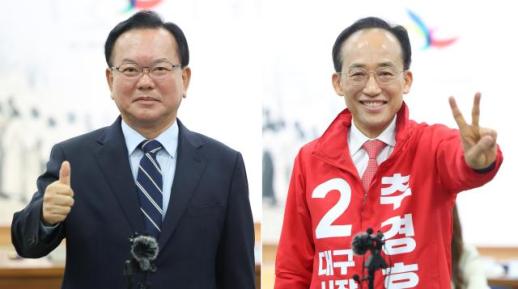 AJP Election Watch: Heavyweight match in Daegu, Kim Boo-kyum vs Choo Kyung-ho SEOUL, May 20 (AJP) -Daegu, a traditional conservative stronghold, remains one of the rare constituencies on South Korea’s electoral map still firmly painted red — the color of the main opposition People Power Party (PPP). In the 2022 presidential election, former President Yoon Suk Yeol captured 75.14 percent of the vote in the southeastern city. A decade earlier, former conservative President Park Geun-hye had also dominated the region. The city did not abandon conservatives even after Yoon’s impeachment following his December 2024 martial law debacle. In last year’s snap presidential election, PPP candidate Kim Moon-soo defeated President Lee Jae Myung by 67.6 percent to 23.2 percent in Daegu. Whether Lee’s approval rating hovering around 60 percent, combined with a divided conservative front, can crack that decades-old political tradition in the June 3 local elections is now one of the country’s most closely watched political questions. The matchup itself is heavyweight politics. Representing the ruling Democratic Party (DP) is former Prime Minister Kim Boo-kyum, a four-term lawmaker under the administration of former liberal President Moon Jae-in. Facing him is PPP Rep. Choo Kyung-ho, a three-term lawmaker who last served as deputy prime minister for economy and finance minister under Yoon. Daegu has never elected a liberal mayor since local elections were institutionalized in 1995. Kim nevertheless has entered the race emboldened by his breakthrough victory in Daegu’s Suseong A district in 2016, when he became the only Democratic Party lawmaker elected from the city. This time, his chances may not be as slim. A Metavoice-Research Lab survey commissioned by JTBC and conducted May 5–6 showed Choo at 41 percent and Kim at 40 percent — a one-point gap within the margin of error. Daegu has effectively become a political testbed for both parties. For the DP, a victory would mark a historic breach into the conservatives’ last fortress. For conservatives, holding the city would reinforce a regional base crucial for any future political revival. At the center of the race is the economy. According to latest government data on Korea’s regional GDP, Daegu posted a 3.9 percent contraction — the steepest decline among all metropolitan cities and provinces nationwide in the first quarter of 2025. Both candidates are framing themselves as crisis managers with the bureaucratic credentials to revive the city’s stagnant economy. Kim is pitching a vision to transform Daegu into “the Pangyo of the South,” referencing the technology hub often dubbed Korea’s Silicon Valley. “To revive Daegu’s economy, we have to change the industrial structure itself,” Kim told AJP in written interview. He argued that Daegu should combine its traditional industrial base — machinery, metals, auto parts and textiles — with artificial intelligence technologies to modernize “design, manufacturing processes, quality control and logistics.” Kim’s blueprint centers on linking Suseong Alpha City, Technopolis, DGIST, local universities, research institutes and private companies into a unified regional innovation ecosystem. “We will create a structure in which young people can learn, find jobs and grow in Daegu,” Kim said. He also pledged to establish an “Asian global youth startup and culture convergence special zone” along with a 100 billion won ($66.3 million) youth startup fund aimed at helping young entrepreneurs commercialize ideas and expand globally. Choo is also pitching economic restructuring — but from the perspective of a veteran economic technocrat. “The biggest reason Daegu’s economy is struggling is that it has not sufficiently responded to changes in the industrial structure,” Choo told AJP separately in his election office in Daegu. “Daegu once led Korea’s industrialization with textiles and manufacturing, but it failed to secure enough growth engines as the industrial paradigm shifted toward AI, semiconductors and digital industries.” Choo proposes fostering five future industries — AI, robotics, future mobility, bio and semiconductors — while simultaneously upgrading traditional sectors such as machinery and textiles. He is also emphasizing service industries favored by younger workers, including medical services, culture, tourism, gaming and digital content. A defining feature of Choo’s campaign is his focus on execution. Rather than offering “mere slogans,” he says he is proposing “actual implementation structures,” including emergency economic task force meetings, a supplementary livelihood budget, a foreign investment attraction team, an AI transformation committee, a startup growth fund and “Daegu-style” university-industry contract departments. The political logic behind Kim’s campaign is straightforward: leverage the power of the ruling party. The next four-year mayoral term will overlap almost entirely with the remaining four years of Lee’s presidency and the DP-controlled National Assembly. “At this time, the success or failure of key issues such as the TK new airport depends on who can better draw support and cooperation from the central government and the ruling party, which holds a majority in the National Assembly,” Kim said. “My strength is the political power and execution ability to turn Daegu’s demands into reality.” Kim also directly challenged Choo’s claim to economic expertise. He pointed out that Daegu’s national budget allocations increased by 10.94 percent in 2021 and 15.47 percent in 2022 during his premiership, while increases slowed sharply to just 0.59 percent in 2023 and 0.94 percent in 2024 when Choo served as finance minister. “‘Finance minister’ is a title, not performance itself,” Kim said. “What Daegu needs now is not a mayor who talks, but a mayor who produces results.” Choo rejects the notion that a PPP mayor would be disadvantaged under a Democratic administration. “The Daegu mayor is an administrator responsible for citizens’ lives,” Choo said. “I have no intention of becoming a mayor who clashes with the central government just because our parties are different.” He argued that his 35 years as an economic bureaucrat, along with his experience as deputy prime minister and finance minister, provide practical leverage. “I know very well how budgets are made,” Choo said. “I have networks across all areas of government ministries. I can communicate directly with working-level officials who design policies and managers who make decisions.” On youth policy, both candidates agree the city’s core problem is not simply population decline, but the lack of quality jobs and competitive wages. Kim said many young residents have told him: “Starting salaries in Daegu’s IT industry are about 70 percent of those in Pangyo,” and “I don’t want to leave my family, but I have no choice.” “This problem cannot be solved with short-term support alone,” Kim said. “Through industrial transformation, major company attraction and future industry development, we will create a structure in which good jobs and better wages are possible within the region.” He is also proposing a “Youth Dandi Chaeum” savings program that would help young workers accumulate up to 30 million won in assets over five years. Choo’s youth strategy focuses on attracting young people back through industrial growth, startup support and stronger university-industry ties. He has proposed “youth reshoring,” Daegu-style contract departments and a 1 trillion won startup fund to cultivate unicorn companies. “We will make Daegu a city where young people return,” Choo said, arguing that future industries and high-value service sectors can reverse the city’s demographic decline. The next mayor will also inherit several major regional development projects, most notably the relocation of Daegu’s military airport and construction of the new TK airport. The project is viewed not merely as an aviation issue, but as a broader test of Daegu’s ability to integrate economically with North Gyeongsang Province, expand logistics networks and attract new industries. Kim frames the airport initiative as an issue requiring political leverage at the national level. Choo frames it as an administrative and fiscal challenge demanding deep experience within the central government bureaucracy. “Cooperation is not achieved through vague requests or begging,” Choo said. “I have learned over decades how work actually gets done.” He added that projects such as the TK new airport and Daegu–North Gyeongsang administrative integration “must be pursued beyond party lines.” Kim, meanwhile, insists Daegu needs a mayor capable of extracting concrete support from the current national power structure. “The new mayor will work on the same timetable as the remaining four years of the president’s term,” Kim said. “Who can better bring in support from the central government and the ruling party will decide the fate of key pending issues.” For decades, Daegu mayoral elections were viewed as predictable contests in conservative territory. This year, however, the race has evolved into a direct showdown between two nationally recognized political heavyweights who agree Daegu must reinvent itself, but disagree sharply on who is best equipped to deliver that transformation. Kim is asking voters to break with Daegu’s political history and use the ruling party’s national power to bring investment, budgets and jobs into the city. Choo is asking voters to trust a veteran conservative economic bureaucrat who says he can rebuild Daegu’s economy “from day one.” “This election is ultimately about who can revive Daegu’s economy,” Choo said. “Choo Kyung-ho will become a professional economic mayor who works skillfully from the first day.” Kim’s closing message is equally blunt. “Daegu now needs a mayor who can produce results, not just words,” he said. 2026-05-20 15:52:57
 -
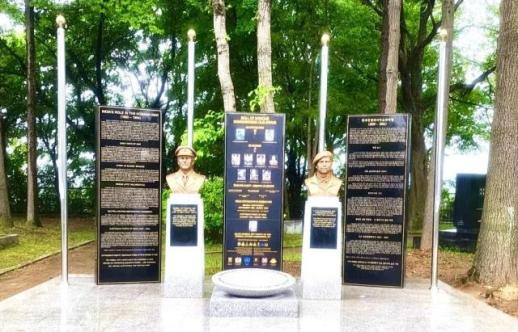 Korea, India to sign MOU on honoring Korean War veterans SEOUL, May 20 (AJP) - South Korea and India will work together on international veterans affairs projects to honor Indian veterans who served in the 1950-53 Korean War as part of a medical support unit, Seoul’s Veterans Affairs Ministry said Wednesday. Minister of Patriots and Veterans Affairs Kwon Oh-eul and visiting Indian Defense Minister Rajnath Singh will sign a memorandum of understanding on bilateral cooperation in international veterans affairs at the Indian Korean War Memorial in Imjingak, Paju, Gyeonggi Province, on Thursday. Under the MOU, the two countries will cooperate in collecting historical records related to India’s participation in the war, honoring veterans, promoting exchanges for veterans’ descendants and future generations, and carrying out academic, educational and cultural projects to shed light on the significance of India’s contribution. After signing the agreement, the two ministers will also attend an unveiling ceremony for the first memorial in South Korea dedicated to Indian Korean War veterans, built by India’s Defense Ministry. The memorial includes busts of Lt. Col. A.G. Rangaraj, who commanded a field hospital during the Korean War, and Gen. K.S. Thimayya, who served as chairman of the Neutral Nations Repatriation Commission after the armistice agreement. Rangaraj was selected by Seoul’s Veterans Affairs Ministry as the Korean War Hero of the Month in March. During the unveiling ceremony, Kwon will present a plaque recognizing the honor to Rangaraj’s descendant, Kalpana Prasad. When the Korean War broke out, India, then a neutral country, dispatched the largest medical contingent among countries that sent medical support, in line with a U.N. resolution on civilian relief. India’s 60th Parachute Field Ambulance arrived in Busan in 1950 and treated many soldiers and patients near the front lines while moving alongside combat units. 2026-05-20 15:45:58
 -
 JYP Entertainment donates 100 mln won for children's rehabilitation treatment SEOUL, May 20 (AJP) - JYP Entertainment has signed a social contribution agreement with Seoul Rehabilitation Hospital and donated 100 million won to support rehabilitation treatment for children and young people with disabilities, the company said Monday. JYP Entertainment and Seoul Rehabilitation Hospital signed the agreement Monday at JYP Center in Seongnae-dong, Gangdong District, Seoul. Seoul Rehabilitation Hospital is a public children's rehabilitation hospital in the Seoul metropolitan area. The donation will be used to help patients aged 24 or younger cover rehabilitation treatment costs and purchase assistive devices. Byun Sang-bong, chief financial officer (CFO) and vice president of JYP Entertainment, said the company decided to partner with the hospital to extend its support beyond surgeries and medical treatment to rehabilitation care. "We hope this will help further develop the pediatric and adolescent rehabilitation system that Seoul Rehabilitation Hospital has built and allow its impact to reach broader communities," Byun said. Lee Ji-sun, director of Seoul Rehabilitation Hospital, said the funds will be used to provide practical support for patients and families in need of rehabilitation treatment and assistive devices. The donation is part of JYP's corporate social responsibility program EDM, short for "Every Dream Matters." Launched in 2020, the EDM medical expense support project has helped children in need of surgery and treatment. From 2020 to 2025, JYP donated a total of 7.92 billion won ($5.25 million) through the program, supporting medical expenses for 4,101 children across 10 countries, including South Korea. JYP Entertainment said it will continue EDM-related social contribution projects in 2026, including medical expense support, volunteer programs and its Love Earth environmental initiative. 2026-05-20 15:31:42
 -
 Stray Kids notch 20th music video with 100 million YouTube views SEOUL, May 20 (AJP) - K-pop boy group Stray Kids’ music video for “Walkin On Water” has surpassed 100 million views on YouTube, becoming the group’s 20th music video to reach the milestone, JYP Entertainment said Wednesday. The music video crossed the 100 million mark Tuesday afternoon. “Walkin On Water” is the title track of “合 (HOP),” a SKZHOP HIPTAPE project released by Stray Kids on Dec. 13, 2024. The video features large-scale choreography and visuals set against traditional and modern backdrops. Stray Kids now has 20 music videos with more than 100 million views on YouTube, the most among fourth-generation K-pop boy groups, according to JYP Entertainment. Previous titles to reach the mark include “God’s Menu,” “Back Door,” “MIROH,” “Hellevator,” “MANIAC,” “S-Class,” “LALALALA,” “Chk Chk Boom” and “MEGAVERSE,” among others. “合 (HOP)” became Stray Kids’ sixth consecutive album to top the Billboard 200, the main U.S. albums chart. “Walkin On Water” uses the image of walking on water and navigating rough waves as a metaphor for the group’s confidence on stage. Stray Kids is set to headline The Governors Ball Music Festival in New York on June 6 and Rock in Rio in Brazil on Sept. 11. 2026-05-20 15:31:26
 -
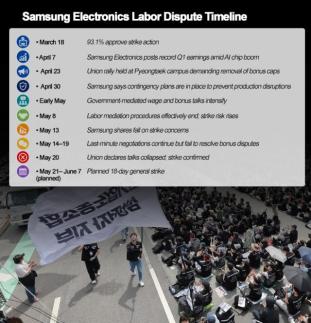 Timeline: Samsung Electronics labor dispute SEOUL, May 20 (AJP) - Samsung Electronics and its labor union failed to reach an agreement in government-mediated wage talks on Wednesday, one day before a planned strike, as disputes over bonus caps and compensation structures remained unresolved. The union said it would proceed with its planned general strike starting Thursday following the collapse of negotiations. Above is the timeline leading to the general strike, beginning with the March 18 vote in which 93.1 percent of participating union members approved strike action. At the heart of the dispute is the cap on bonus payouts, an issue that intensified after rival chipmaker SK hynix removed its bonus ceiling and distributed up to U.S. $477,000 per employee following its record 2025 performance — equivalent to 10 percent of the company’s annual operating profit. Samsung’s main labor union, which is largely led by semiconductor workers, is demanding that the company allocate 15 percent of annual operating profit to employee bonuses and remove the current payout cap altogether. 2026-05-20 15:31:06
 -
 ASIA DEEP INSIGHT: The center of global power is moving eastward SEOUL, May 20 (AJP) - The world is passing through one of the great transitional eras of modern history. The global contest over artificial intelligence between the United States and China, the prolonged devastation of the war in Ukraine, and the widening instability caused by the conflict involving Iran and the Strait of Hormuz have together accelerated the restructuring of the international order. Political uncertainty, energy insecurity, technological rivalry, and financial fragmentation are no longer isolated phenomena. They are converging into a single historical transformation. The world emerging before us is neither the unipolar order that followed the Cold War nor a fully stabilized multipolar system. The United States remains the dominant military and financial power, sustained by the dollar-centered global system and unmatched strategic reach. China, however, is rapidly advancing through manufacturing capacity, demographic scale, digital infrastructure, and artificial intelligence. Meanwhile, Europe, which once stood at the center of global civilization, is increasingly burdened by aging populations, energy vulnerability, industrial fatigue, and strategic hesitation. Russia, weakened by the enormous costs of war and isolation, is gradually losing both economic momentum and geopolitical flexibility. And amid this shifting landscape, a new historical center of gravity is emerging: Northeast Asia. For more than two centuries, the axis of global power moved from the western edge of Eurasia — Britain, France, and Germany — across the Atlantic to the United States. The Industrial Revolution, maritime supremacy, financial capitalism, and military innovation established Western civilization as the dominant force of the modern era. But the geography of power is changing once again. Manufacturing, semiconductors, batteries, artificial intelligence, shipbuilding, digital infrastructure, and advanced supply chains are increasingly concentrated in East Asia. Capital, technology, and industrial energy are flowing toward the Pacific basin. The twenty-first century may ultimately be remembered as the era in which the center of world civilization shifted from the Atlantic to the Indo-Pacific. Within that transformation, few developments are more strategically significant than the gradual reconciliation and convergence of South Korea and Japan. The summit held in Andong between South Korean President Lee Jae Myung and Japanese Prime Minister Sanae Takaichi was not merely another diplomatic meeting. It reflected something larger and more consequential: the recognition that the future security and prosperity of Northeast Asia may depend increasingly on the ability of Seoul and Tokyo to move beyond the paralysis of history and toward strategic cooperation. The two leaders discussed joint responses to energy insecurity, expanded LNG and oil cooperation, supply-chain resilience, and the possibility of oil and petroleum product swap arrangements. These are not symbolic gestures. They are the building blocks of an emerging economic and strategic framework. More importantly, shuttle diplomacy between the two nations has entered a new phase of normalization and emotional trust. Diplomatic engagement is no longer confined to Seoul and Tokyo. It now extends to regional cities such as Busan, Nara, Gyeongju, and Andong — places rich with historical memory and cultural identity. That evolution matters. Genuine diplomacy does not endure through official communiqués alone. It survives through human familiarity, regional exchange, shared experience, and mutual recognition. Only a few years ago, relations between South Korea and Japan were dominated by bitter disputes over wartime history, forced labor, export restrictions, and unresolved emotional wounds. Yet geopolitical reality has slowly pushed both countries toward a more sober understanding of their shared circumstances. China's rise, North Korea's nuclear ambitions, instability in global energy markets, and shifts in American strategic priorities have all forced Seoul and Tokyo to confront a difficult truth: neither country can fully secure its future alone. Economically, the logic of cooperation is becoming increasingly compelling. Japan possesses extraordinary strengths in precision manufacturing, industrial materials, and foundational technologies. South Korea has emerged as a global leader in semiconductors, batteries, shipbuilding, digital infrastructure, and applied industrial innovation. Japanese industrial depth combined with Korean speed and adaptability could create one of the most formidable technological ecosystems in the world. The age of artificial intelligence makes such collaboration even more essential. Modern supply chains are no longer linear or national. Semiconductor production alone requires integrated systems involving design, materials, equipment, manufacturing, packaging, energy, cooling technologies, and massive data infrastructure. No single nation can dominate such systems entirely by itself. In that sense, South Korea and Japan are gradually becoming not merely neighbors, but strategic partners bound by technological interdependence. This is why the concept of a Korea–Japan economic community, previously discussed by SK Group Chairman Chey Tae-won, deserves far greater international attention than it has received. Such a community would not mean economic integration alone. It could evolve into a broader framework encompassing finance, tourism, sports, youth exchanges, cultural industries, energy security, AI cooperation, advanced manufacturing, and maritime logistics. Economics creates systems. Culture creates emotional trust. Tourism and sports create familiarity between peoples. A genuine regional community requires all three. The international community naturally views this emerging Korea–Japan alignment with a mixture of hope, caution, and strategic anxiety. The United States strongly supports closer cooperation between Seoul and Tokyo because such cooperation strengthens the broader democratic alliance structure in Asia. Yet Washington may also quietly recognize that a deeply integrated South Korea–Japan technological bloc could eventually operate with greater strategic autonomy. China, meanwhile, supports regional economic integration in principle but remains wary of a closer alignment between two liberal democracies closely tied to the American alliance system. Russia, increasingly constrained by war and economic exhaustion, finds itself less capable than ever of shaping developments in Northeast Asia. Europe, too, watches carefully. For decades, Europe represented the intellectual and industrial center of modern civilization. Today, however, East Asia increasingly defines the pace of manufacturing innovation, digital commerce, consumer technology, and cultural influence. South Korean popular culture and Japanese creative industries together already possess immense global reach. Korean film, music, television, and digital culture, combined with Japanese animation, literature, gaming, and design, could form one of the most influential cultural spheres of the century. And culture matters. In the modern world, cultural influence is no longer secondary to economic power. It shapes tourism, consumer behavior, national identity, and geopolitical soft power itself. Sports may prove equally important. Youth football exchanges, baseball cooperation, e-sports leagues, academic partnerships, and regional tourism networks can often accomplish what formal diplomacy cannot. Political treaties may open doors, but human relationships sustain civilizations. None of this erases history. The wounds between Korea and Japan remain real. Forced labor, wartime memory, territorial disputes, and unresolved historical grievances continue to carry emotional and political weight in both societies. Those wounds should neither be denied nor trivialized. But there is a profound difference between remembering history and becoming imprisoned by it. The challenge for both nations is not to forget the past, but to prevent the past from destroying the future. That requires strategic maturity, historical empathy, and what classical East Asian philosophy once described as seeking common ground while respecting differences. The future of South Korea–Japan relations cannot remain limited to summit meetings alone. Businesses must connect supply chains and innovation networks. Universities must connect young people and knowledge systems. Local governments must expand tourism and cultural cooperation. Media institutions must move beyond perpetual conflict narratives and help societies imagine the possibilities of coexistence. Ultimately, governments may open the door, but ordinary citizens must walk through it. Politics can create frameworks. Economics can build roads. Culture can connect hearts. Younger generations can transform historical rivalry into shared destiny. The center of global power is slowly moving eastward. The Atlantic age that dominated the world since the eighteenth century is gradually giving way to a Pacific and Indo-Pacific era. Within that transition, the partnership between South Korea and Japan may become one of the defining forces shaping the future of East Asia. The summit in Andong was not simply a diplomatic event. It may one day be remembered as a quiet but decisive signal of historical realignment. History is not shaped only by wars and empires. Sometimes it is reshaped by nations choosing cooperation over resentment, strategy over emotion, and the future over the burdens of the past. And if South Korea and Japan can truly move forward together, they may yet become standard-bearers for global peace and prosperity in the twenty-first century. 2026-05-20 15:22:46
 -
 Homeplus stores fade as Korea's offline retail hunts for a lifeline SEOUL, May 20 (AJP) - Finding a grocery item for an impromptu home dinner has become something of a luxury, said Michelle, an expatriate homemaker in her 40s living in Seorae Village, a quiet enclave in southern Seoul that is home to much of Korea’s French community due to its proximity to the country’s only French international school. Apart from a handful of convenience stores, butcher shops and fruit vendors, the neighborhood’s only meaningful grocery option is a Homeplus supermarket whose shelves are increasingly dominated by tissues, detergents and whatever inventory remains. "I walked around the neighborhood for more than half an hour to buy a carton of eggs," she said. "I gave up on finding spaghetti sauce." The affluent Seocho district neighborhood has seen more than three grocery stores shut down in recent years, leaving Homeplus as the area’s last sizable brick-and-mortar supermarket. Weekend checkout lines regularly stretch across the store, while delivery orders can take hours. But even there, signs of retreat are becoming difficult to ignore. Cashiers have been reduced to a single counter, and delivery staff have all but disappeared. At the retailer's branch in Hwaseong, Gyeonggi Province, the basement floor once occupied by cosmetics chains Olive Young and Nature Republic now sits vacant after both tenants pulled out. The pork counter labeled "Handon" — domestic pork — displays wooden cutting boards instead of meat. Ceramic bowls sweat with condensation beside packs of marinated bulgogi, while kitchen scissors rest awkwardly among refrigerated chicken trays. Frying pans are stacked in the eggs-and-tofu aisle. In the liquor section, beer has vanished entirely. Only zero-alcohol versions of Hite and Terra beer remain alongside slow-moving whisky and traditional liquors. Soju is nowhere to be found. The scene tells a sharper story than any balance sheet. Homeplus, South Korea's second-largest hypermarket operator, is bleeding cash under court-led rehabilitation proceedings even after agreeing to sell its supermarket arm, Homeplus Express, to NS Shopping, an affiliate of Harim Group, for around 120 billion won ($79 million). The proceeds from the sale are not expected to arrive until late June, and the company said earlier this week that 37 of its 104 hypermarkets have suspended operations since May 10. Only 67 stores remain open. Local reports say April salaries went unpaid, while payroll due Thursday for May is also unlikely to be met. Homeplus has requested a short-term bridge loan from its largest creditor, Meritz Financial Group, using the proceeds from the Express sale as collateral. But negotiations have reportedly stalled as Meritz demands joint guarantees from owner MBK Partners and company management, citing potential breach-of-trust risks should the rehabilitation collapse. "Without resolving wage arrears and unpaid supplier bills, it is extremely difficult to sustain the rehabilitation process," Homeplus said in a statement. "If the remaining 67 stores are also forced to close, continuing rehabilitation proceedings will no longer be feasible." The picture beyond Homeplus is hardly any brighter. Data from South Korea's Ministry of Trade, Industry and Energy show sales at large discount chains plunged 15.2 percent in March from a year earlier, marking the sector’s eighth consecutive quarter of decline since the second quarter of 2024. Smaller-format supermarket chains, known locally as SSMs, saw sales fall 8.6 percent. Online retail, by contrast, expanded 8.1 percent and now accounts for 60.6 percent of all major retail sales. The hypermarket sector's share has shrunk to just 8.1 percent, down sharply from 15.1 percent in 2021. The collapse in consumer trust toward Coupang following last year's data breach briefly dented e-commerce momentum, but analysts say the damage inflicted on offline retail after years of online migration has become structural rather than cyclical. Single- and two-person households — once the core customer base for chains like Homeplus — increasingly prefer smaller, faster and app-based purchases over large weekly shopping trips. Rivals that recognized the shift early are beginning to pull away. Emart, South Korea's largest discount chain, posted a first-quarter operating profit of 178.3 billion won, its strongest first-quarter performance in 14 years after converting major stores into experience-focused "Starfield Market" complexes. Lotte Mart, benefiting in part from Homeplus’ troubles, lifted domestic operating profit by 30.9 percent through tighter promotions and a heavier grocery focus. Convenience-store chains are pushing in the opposite direction — outward. GS25 and CU launched 24-hour delivery services through Coupang Eats this week, filling the final overnight gap in their nationwide quick-commerce networks. Meanwhile, Daiso expanded same-day delivery coverage to all 25 districts of Seoul on May 14, effectively transforming its 1,600 stores into urban micro-fulfillment hubs. Even Lotte Mart is accelerating investment in logistics infrastructure through its Zetta grocery app and an automated fulfillment center in Busan developed with Britain's Ocado, scheduled to begin operations later this year. The common thread is increasingly clear: offline space alone no longer pays the rent. The survivors are reinventing stores as experience venues, logistics hubs or rapid-delivery nodes — anything that offers a function a smartphone screen cannot. Homeplus, by contrast, is running out of time to decide what it wants to become. Supplier arrears alone are estimated at around 200 billion won, exceeding the cash expected from the sale of Homeplus Express. Even if Meritz ultimately agrees to extend emergency funding, industry observers say the money would buy only weeks, not a turnaround. For now, the empty shelves in Hwaseong stand as a reminder of what happens when a retail giant stops being a destination and becomes, briefly, a showroom for whatever stock remains. 2026-05-20 15:11:06
 -
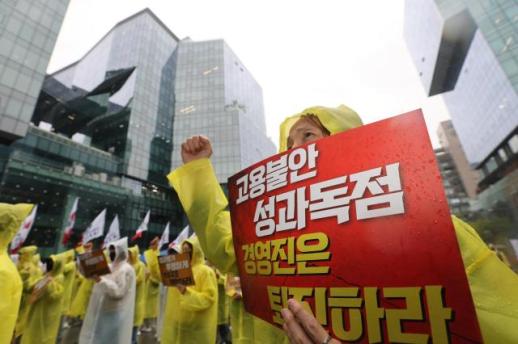 Kakao union wins strike mandate as Korean tech labor unrest spreads SEOUL, May 20 (AJP) - Unionized workers at Kakao and four of its affiliates voted overwhelmingly in favor of industrial action, clearing the way for what would be the first joint strike in the South Korean tech giant's history and adding to a swelling wave of labor unrest sweeping the country's chip and platform industries. The Kakao branch of the Koren Federation of Chemical and Textile, and Food Workers Unions announced Wednesday all five affiliates — Kakao, Kakao Pay, Kakao Enterprise, DKTechin and XLGames — backed the strike in ballots that closed by 11 a.m. The announcement came at a rally in front of Pangyo Station, just south of Seoul, where the company is headquartered. "All five entities passed the vote in favor, and now that we have secured the legal right to industrial action, we will share our plans for the fight ahead," a union spokesperson announced. The dispute reached the strike stage after mediation talks at the Gyeonggi Regional Labor Relations Commission collapsed last week for four affiliates, while a separate session for the headquarters was postponed. At the heart of the standoff is Kakao's performance bonus framework. The company paid out bonuses ranging from 3 to 9 percent of annual salary in February after posting record earnings last year, but the union is pushing for a structured payout tied to a fixed share of operating profit, alongside stock options for long-tenured staff. The union's grievances have been compounded by Kakao's sale of AXZ, the operator of legacy portal Daum, to AI startup Upstage — a deal the union has condemned as a reversal of earlier promises on employment security. The Kakao vote lands amid a broader reckoning over pay across South Korea's technology backbone. A strike involving some 50,000 Samsung Electronics workers is set to begin Thursday after wage talks broke down, with the union demanding performance bonuses equivalent to 15 percent of operating profit and the removal of payout caps. The pressure traces back to SK Hynix, which scrapped its bonus ceiling in September 2025 and tied payouts to 10 percent of operating profit — a benchmark that has since triggered escalating demands from Samsung Biologics, Hyundai Motor and LG Uplus unions, some seeking as much as 30 percent. Industry watchers warn that if such fixed bonus practices spread from semiconductors into the wider IT sector, companies may lose the flexibility to weather shifting business cycles — a prospect that puts Kakao's coming days at the center of a far larger debate. 2026-05-20 14:46:48