


Latest by
-
 Accidents in Seoraksan National Park: One Dead, Two Rescued Accidents involving hikers have occurred in Seoraksan National Park in Gangwon Province, resulting in one death and two rescues. According to Yonhap News and local fire authorities, a 43-year-old Australian hiker, identified as A, was reported lost while hiking in Seoraksan at 8:12 p.m. on June 11. Rescue teams located A near Geumganggul after conducting a nighttime search. They assisted him in descending the mountain, and he was safely transported to his accommodation about three hours after the initial report. A displayed temporary symptoms of dehydration but has since recovered, according to reports. Earlier that day, at 6:54 p.m., a 66-year-old hiker, identified as B, collapsed while hiking near Bongjeongam in Yongdae-ri, Inje County. Rescue personnel performed CPR on B for over two hours after receiving the emergency call, but he ultimately did not survive. The police are investigating the circumstances surrounding the incident, including interviewing the person who made the report. Additionally, at 5:07 p.m. the same day, a 37-year-old hiker, identified as C, became lost while descending near Madeungnyeong in Yongdae-ri, Inje County. C's health was reported to be relatively stable. Rescue teams brought him down from the mountain approximately nine and a half hours after the report was made, and he was also taken to his accommodation.* This article has been translated by AI. 2026-06-12 09:18:00
 -
 KOSPI Surges Over 6% Amid U.S. Semiconductor Rally and Easing Middle East Tensions The KOSPI opened with a surge of over 6%, driven by a rally in U.S. semiconductor stocks and expectations of reduced geopolitical risks in the Middle East. Following a strong performance in the New York stock market, buying activity has concentrated on major semiconductor firms such as Samsung Electronics and SK Hynix. As of 9:07 a.m. KST, the KOSPI was up 518.36 points (6.68%) at 8,282.31. The index started at 8,263.85, an increase of 499.90 points (6.44%) from the previous session, and continued to climb. On June 11, the Dow Jones Industrial Average closed up 929.97 points (1.86%) at 50,848.75. The S&P 500 rose by 127.31 points (1.75%) to finish at 7,394.30, while the tech-heavy Nasdaq gained 640.16 points (2.54%) to close at 25,809.66. U.S. markets were buoyed by a May Producer Price Index (PPI) that eased market concerns, along with President Donald Trump’s announcement of a withdrawal from plans to strike Iran and the potential for progress in negotiations. This optimism was further fueled by strong performances from semiconductor stocks, including Micron (up 11.7%), Intel (up 9.3%), and Nvidia (up 2.2%). At this time, institutional investors are net buyers in the securities market, purchasing 318.3 billion won. In contrast, foreign and individual investors are net sellers, offloading 263.9 billion won and 10.01 billion won, respectively. Among the top market capitalization stocks, Samsung Electronics (up 9.53%), SK Hynix (up 9.09%), SK Square (up 10.18%), Samsung Electro-Mechanics (up 9.75%), Hyundai Motor (up 5.53%), LG Energy Solution (up 3.77%), Samsung Life Insurance (up 8.63%), and Samsung C&T (up 10.73%) are all showing strong gains. Meanwhile, the KOSDAQ index has risen by 31.85 points (3.19%) to 1,028.78. It started at 1,027.05, up 30.12 points (3.02%), and has maintained its upward trend. In the KOSDAQ market, individual investors are net buyers, acquiring 265 billion won, while foreign and institutional investors are net sellers, selling 244.2 billion won and 26.6 billion won, respectively. Most of the top KOSDAQ stocks, including Alteogen (up 0.43%), EcoPro BM (up 4.08%), EcoPro (up 4.96%), JUSUNG Engineering (up 9.78%), Rainbow Robotics (up 3.14%), Kolon TissueGene (up 1.84%), Wonik IPS (up 12.48%), and Rino Technology (up 0.80%), are also experiencing increases. Han Ji-young, a researcher at Kiwoom Securities, stated, "Expectations are rising for a memorandum of understanding between the U.S. and Iran, along with easing inflation concerns in the U.S. and strong semiconductor stocks, which are improving investor sentiment. The KOSPI 200 futures surge is likely to lead to a strong domestic market opening, followed by a rotation among sectors." He added, "Recent adjustments have alleviated excessive concentration burdens, and the environment for sector rotation is improving. While strategies focusing on expanding the share of leading stocks in semiconductors and the AI value chain remain valid, it is also important to pay attention to sectors like securities, banking, and shipbuilding that have been relatively overlooked."* This article has been translated by AI. 2026-06-12 09:15:00
 -
 Ridi Launches Sports Manga Exhibition for World Cup Season Featuring 'Blue Lock' and 'Ao Ashi' As the 2026 FIFA North America World Cup kicks off, excitement for soccer is on the rise, prompting the content platform Ridi to launch a sports manga exhibition. Starting June 12 and running for a month, Ridi's exhibition titled "Sports Manga is Essential in Life" will showcase various sports-themed works, including soccer. The initiative aims to bring the joy and emotion of sports to fans even outside the stadium. Among the featured works is "Blue Lock," a manga that follows 300 high school students competing for the coveted striker position. With its intense competition and unique characters, it offers a distinct appeal compared to traditional sports manga and has garnered a global fanbase through its anime adaptation, film, and spin-offs. "Ao Ashi" focuses on youth soccer, realistically portraying team tactics and game management. The story enhances readers' understanding of soccer while depicting players' growth, earning positive reviews. "DAYS" tells the story of an ordinary high school student, Tsukushi, who grows through soccer, emphasizing hard work and passion over innate talent. During the exhibition, customers who purchase the featured works will receive Ridi points based on their spending, along with various other benefits. More details about the exhibition can be found on the Ridi website and mobile app.* This article has been translated by AI. 2026-06-12 09:06:00
 -
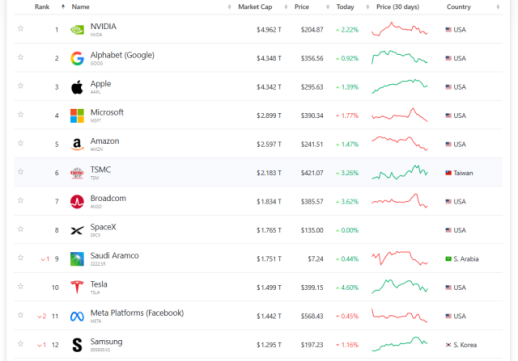 SpaceX Achieves Record IPO, Becomes Eighth Largest Company SpaceX, the aerospace company led by Tesla CEO Elon Musk, has completed the largest initial public offering (IPO) in history, quickly rising to become the eighth largest company in the world by market capitalization. According to global market capitalization tracking site Company Market Cap, SpaceX's market cap reached $1.765 trillion (approximately 2,680 trillion won) based on an IPO price of $135 per share, surpassing Saudi state oil company Aramco, which has a market cap of $1.751 trillion. This valuation also exceeds that of Tesla, which is ranked tenth with a market cap of $1.499 trillion. Last week, Samsung Electronics briefly reached ninth place in market cap but fell to twelfth as of the close on June 11, Korean time. SpaceX confirmed the IPO price at $135 per share and will begin trading on Nasdaq under the ticker symbol 'SPCX' starting June 12. The company raised approximately $75 billion (about 113 trillion won) by selling around 555.6 million shares, with an estimated enterprise value of about $1.77 trillion (approximately 2,668.8 trillion won). Despite the IPO, Musk's control over SpaceX remains intact. According to the Associated Press, Musk will retain 82.4% of the voting rights through dual-class shares after the IPO. 2026-06-12 09:06:00
 -
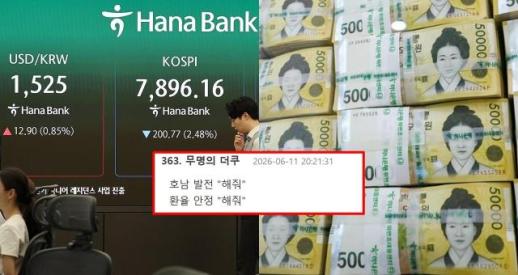 Government Seeks Cooperation from Major Exporters Amid Currency Stability Concerns The South Korean government has requested cooperation from major exporters, including Samsung Electronics and SK Hynix, to stabilize the foreign exchange market as the won-dollar exchange rate has remained above 1,500 won for 17 consecutive trading days. This news has drawn criticism online, with many users arguing that the government is overly reliant on corporations. On June 11, Heo Chang, the Second Vice Minister of the Ministry of Economy and Finance, and Moon Shin-hak, the Vice Minister of Trade, Industry and Energy, held a meeting at the Government Seoul Complex with representatives from key exporting companies such as Samsung Electronics, SK Hynix, Hyundai Motor, Kia, HD Korea Shipbuilding & Offshore Engineering, Samsung Heavy Industries, and Hanwha Ocean to assess the current foreign exchange market situation. During the meeting, the government discussed measures to stabilize the foreign exchange market, including early currency exchange for export proceeds and increasing the inflow of overseas retained earnings into the domestic market. Heo emphasized the importance of exporters' roles in improving supply and demand in the foreign exchange market and reducing volatility. Moon also highlighted the need for active corporate involvement to minimize the negative impacts of high exchange rates. The government has identified foreign capital outflows, certain speculative trades, and market disruptions as factors contributing to the recent depreciation of the won. Additionally, it noted that exporters holding onto dollars for extended periods has reduced the supply of dollars in the foreign exchange market, further weakening the won. However, the news has sparked backlash online, with critics accusing the government of shifting the burden of currency defense onto large corporations. Particularly in conservative circles, comments included, "They asked for profit sharing, and now they want us to handle currency exchange too," and, "After demonizing large corporations, they turn to Samsung and Hynix when times get tough. Is it the responsibility of companies to solve the exchange rate issue? This is sheer incompetence. What kind of country is this?" One user pointed out, "When the semiconductor market was struggling, the government criticized companies, but now they are trying to take credit for the recovery while pressuring them to sell dollars. I don't understand this double standard." Another user remarked, "Asking companies to convert dollars to won in a high exchange rate situation essentially means asking them to incur losses. It seems like the government is offloading its responsibilities onto businesses." Unusually, similar sentiments emerged from progressive communities as well. Users expressed, "It seems like they expect companies to solve all problems," and, "Is it appropriate for the government to keep asking private companies for help? Shouldn't these issues be addressed through monetary policy? They keep demanding companies sell dollars, buy bonds, and invest." Some users criticized the contradiction of increasing regulations on businesses while simultaneously seeking their cooperation when needed, questioning whether the government is overly dependent on Samsung and Hynix for economic management. 2026-06-12 09:03:00
 -
 Jeonbuk Aims to Become South Korea's AI and Robotics Hub "(In response to a question from ABC Broadcasting) Governor, Hyundai Motor has chosen Saemangeum as a base for AI and robotics rather than an automobile factory. Are you confident in making Jeonbuk South Korea's first physical AI special zone?"South Korea's industrialization began in Ulsan, with the automotive, shipbuilding, and steel industries driving the national economy. In the information age, Pangyo became a symbol of growth. However, the AI era poses a new question: Will artificial intelligence remain confined to algorithms in computers, or will it become a technology that drives factories, cities, logistics, and agriculture in the real world? The world is now entering a competition for physical AI. The United States is focusing on humanoid robots, while China is promoting an AI manufacturing revolution as a national strategy.Amid this backdrop, Jeonbuk has unexpectedly seized an opportunity. Hyundai Motor Group plans to invest 9 trillion won in Saemangeum to establish an AI data center, a robotics manufacturing cluster, and a hydrogen energy hub, positioning Jeonbuk at the forefront of South Korea's future industries. Governor Lee Won-taek has also proposed the Saemangeum AI semiconductor mega-cluster, declaring his intention to make Jeonbuk a center for AI, semiconductors, robotics, and drones.The question remains.Can Jeonbuk transform from a land of agriculture into a testing ground for South Korea's future industries? Why is Saemangeum becoming the forefront of South Korea's physical AI?In the industrial revolution era, ports were crucial. In the information age, data became essential. In the AI era, data, power, and physical spaces that drive the real world are becoming increasingly important.Saemangeum possesses these essential conditions.It has vast land, renewable energy, and integrated port and logistics infrastructure. In the past, having a large area was not seen as an advantage; it was often criticized for slow development. However, the narrative has changed in the AI era. Data centers, robotics factories, semiconductor plants, and hydrogen facilities all require large spaces.Hyundai Motor Group's choice of Saemangeum reflects this need.Hyundai is not merely establishing an automobile factory but is building a future industrial hub that includes an AI data center, a robotics manufacturing cluster, hydrogen energy facilities, and solar power plants. The investment amounts to 9 trillion won. The government and industry expect this initiative to create over 70,000 jobs and generate more than 16 trillion won in economic impact.The key point is not the investment amount.It is significant that Hyundai has chosen Jeonbuk as a production base for AI and robotics rather than just automobiles.This signifies a historic opportunity for Jeonbuk to shift from being on the periphery of manufacturing to becoming a center for future industries.A New Industrial Map Created by Drones and RobotsJeonbuk is already a key hub for South Korea's drone industry.The areas around Gunsan, Gimje, and Gochang boast the largest airspace in the country for drone test flights and demonstration projects. Active experiments are being conducted with agricultural drones, logistics drones, and defense drones.However, drones alone are not enough.AI must be integrated.The future of drones will not involve human-operated machines. Instead, they will be autonomous systems that make decisions and fly on their own. The future of logistics and defense will also be managed and commanded by AI.Robots will follow a similar trajectory.The robotics cluster that Hyundai is establishing in Saemangeum is not just a production facility. It aims to create a platform for a cyclical structure where AI trains robots, robots generate data, and data further develops AI.If Seoul creates AI services and Pangyo develops platforms, Jeonbuk can become a space that demonstrates how AI operates in reality.Saemangeum could be the first place to experiment with AI driving factories, flying drones, and training robots.Thus, Jeonbuk has the potential to become not just an industrial complex but South Korea's first physical AI testbed.Lee Won-taek's Bold Move: AI SemiconductorsThe core of the AI industry is ultimately semiconductors.AI data centers require semiconductors, and robots also depend on them. Autonomous vehicles, drones, and smart factories cannot exist without semiconductors.This is why Lee Won-taek's most prominent campaign promise was the Saemangeum AI semiconductor mega-cluster.He announced plans to develop a 3 million pyeong semiconductor industrial complex in Saemangeum and attract global companies, including Samsung Electronics and SK Hynix, to secure an investment of 200 trillion won. His vision is to create an all-in-one ecosystem capable of everything from semiconductor packaging to AI computation.Of course, the reality is not easy.Attracting Samsung and SK Hynix cannot be resolved solely by the will of local government.However, what matters is the direction.Jeonbuk must transform from a region that waits for central government support to one that proactively proposes future industries and attracts businesses.If Saemangeum can connect AI data centers, robotics factories, semiconductor clusters, and renewable energy industries, Jeonbuk could become the region that completes future industrialization first, rather than the last to start.Jeonbuk's Future Lies in Industrial ConvergenceMany still remember Jeonbuk as an agricultural region.This is not incorrect.However, that alone cannot explain Jeonbuk's future.Agriculture is also evolving with AI.Drones are spraying pesticides, AI is predicting crop yields, and robots are assisting with harvesting.Agriculture is becoming interconnected with AI, drones, robotics, and data industries.Jeonbuk's future competitiveness lies in this connectivity.Only when the AI data center in Saemangeum, Hyundai's robotics factory, the drone industry, agricultural biotechnology, renewable energy, and semiconductor industries are interconnected will a new industrial ecosystem emerge.The success of Lee Won-taek's administration over the next four years hinges on this.Can Saemangeum be transformed from a mere industrial complex into a testing ground for South Korea's future industries?Can Jeonbuk shift from being known for agriculture to becoming the center of the AI and robotics revolution?The answers to these questions will determine Jeonbuk's future over the next four years.:Who is Lee Won-taek:Lee Won-taek is a politician from Gimje with extensive experience in civic activities and agricultural and regional policy. He has been deeply involved in Saemangeum development, the promotion of Jeonbuk as a special self-governing province, and regional balanced development issues since his time as a member of the National Assembly. He has consistently argued that agriculture should be connected not just as a primary industry but with advanced industries.In this election, he did not limit himself to the existing agriculture-centered strategy. He presented a vision to develop Saemangeum into an AI semiconductor mega-cluster and to connect the drone, robotics, data center, and renewable energy industries to make Jeonbuk a hub for future industries. Notably, he has outlined a strategy to cultivate Jeonbuk as a center for AI, robotics, and hydrogen industries in conjunction with Hyundai Motor Group's 9 trillion won investment in Saemangeum.For him, this term is not just about managing the provincial government. It is a historical test of whether Jeonbuk can leap forward as South Korea's first special zone for future industries and whether Saemangeum can grow into a core hub for AI, robotics, and semiconductor industries.* This article has been translated by AI. 2026-06-12 09:03:00
 -
 NS Home Shopping Sponsors Environmental Day Event in Seongnam NS Home Shopping is accelerating its environmental, social, and governance (ESG) initiatives by supporting an eco-friendly experiential festival in Seongnam. On June 13, NS Home Shopping will participate in the 31st Seongnam Environmental Day event at the Seongnam City Hall's Neunam Lake Square, sponsoring its signature experiential program, "Palm Farm." Palm Farm is designed to teach children and families about environmental issues such as biodiversity, climate change, resource recycling, and eco-friendly agriculture through engaging activities. The event will feature various hands-on programs, including "Mosquito OUT! Cinnamon Stick Garland Making," which teaches about food chains and biodiversity, and an escape room challenge called "Seed Code: The Last Code to Save the Earth," focused on zero waste missions. Notably, the "Palm Farm Native Lettuce Seedling Planting" program allows participants to observe seeds harvested from the Pangyo Environmental Ecology Learning Center and plant native lettuce seedlings in paper pots, learning about the relationship between nature and food. This sponsorship reflects NS Home Shopping's commitment to its slogan, "YES, NS! (Your every step, with NS!)," which emphasizes growth alongside partners, local communities, and consumers for a better future. Additionally, NS Home Shopping will host the "Healthy Food Photo Event with NS Home Shopping" at the venue, where participants can take family photos with healthy food campaign signs, reinforcing the importance of healthy eating and environmental awareness. Since 2016, NS Home Shopping has collaborated with the Gyeonggi Love Fruit Foundation on various projects, including environmental improvements for small welfare facilities and support for low-income families in Seongnam, accumulating donations totaling 1.25 billion won as of 2025. In recognition of these efforts, the company received the "Gyeonggi Love Fruit ESG Sharing Company" certification from Seongnam City and the Gyeonggi Community Chest of Korea last year. Lee Sang-geun, chair of NS Home Shopping's social contribution committee, stated, "We will continue to engage in various ESG activities to enhance environmental awareness among future generations and expand community exchanges involving citizens, institutions, and businesses."* This article has been translated by AI. 2026-06-12 09:03:00
 -
 Jensen Huang Discovers 'AI Cake' in South Korea, A Nation with All Five Layers Artificial intelligence (AI) is likened to a five-layer cake, a metaphor frequently emphasized by Jensen Huang, CEO of NVIDIA. During his four-day visit to South Korea, he appeared to discover this 'completed cake' in the country. NVIDIA views AI not as a single product but as a complex structure. The foundation consists of energy, followed by semiconductors, infrastructure that supports and drives the AI models, and finally, the application stage where economic value is generated. Huang believes that the demand across all application stages ultimately reaches the power plants. He asserts that the competition for supremacy in the AI era will hinge on the competitiveness of all five layers. Countries that possess all these layers are rare. China has vertically integrated energy, infrastructure, and applications, while the United States leads in advanced semiconductors and models. In contrast, Huang assesses that South Korea has the potential to fill all five layers. His enthusiasm throughout the tightly packed schedule supports this view. As he concluded his visit on June 10, Huang stated, "Now is your time. You must seize this opportunity." He added, "South Korea is in a very special moment, in a unique position." Building the Foundation with Energy and Infrastructure for AI Huang's agenda began at the bottom layer, focusing on energy and the physical infrastructure above it. However, the core emphasis was on 'cloud' services that provide computational power. SK Telecom plans to build a gigawatt-level AI cloud based on NVIDIA's DSX platform. The first AI factory is set to launch in 2027, providing sovereign and physical AI services domestically. Naver is also embarking on a similar phased expansion, starting with 55 megawatts in the first half of 2027, scaling to 100 megawatts that same year, and reaching 200 megawatts by 2028, ultimately aiming for gigawatt capacity. LG has joined the competition through LG Uplus, which will establish a large-scale AI data center based on NVIDIA DSX to accommodate the latest GPUs and support future AI cloud and GPU services. Its affiliate, LG Energy Solution, is developing an 800V direct current power system to power this initiative. These facilities are not traditional data centers but are referred to by NVIDIA as 'AI factories,' transforming power and data into tokens, the fundamental outputs of modern intelligence. This construction trend extends to the west coast. Huang expressed NVIDIA's willingness to participate in the AI data center project that Hyundai Motor Group is pursuing in Saemangeum. This marks a concrete manifestation of the infrastructure layer, with land, power, and cooling being realized in concrete, forming the physical foundation for the cloud services that SK Telecom, Naver, and LG will sell. Semiconductors: South Korea's Strongest Asset South Korea's position in semiconductors, one layer above, is the most solid. NVIDIA and SK Hynix have established a long-term technological partnership to jointly develop memory across four NVIDIA platforms encompassing AI infrastructure, personal AI, and physical AI. This memory is designed to align with NVIDIA's computational roadmap rather than simply purchasing off-the-shelf products. After meeting with SK Group executives, Huang told reporters, "SK is our largest memory partner," and added, "We are expanding this collaboration into several new markets." Samsung Electronics marked the other end of his schedule. On the evening of June 9, Huang concluded his visit with a private meeting with Jeon Young-hyun, Vice Chairman of Samsung Electronics' Device Solutions Division. The two sides reportedly discussed broad cooperation encompassing next-generation high-bandwidth memory (HBM), advanced packaging, and foundry manufacturing. After the meeting, Huang returned to a recurring theme throughout his visit. He stated, "The next wave of AI is physical AI, where AI interacts with the physical world." He praised South Korea as a very unique country due to its social and cultural cohesion, noting, "Today, South Korea is a global leader in heavy industry and manufacturing." He added, "South Korea is also world-class in electronics, and interestingly, it ranks among the top in software and AI as well." He emphasized, "Countries excelling in manufacturing and heavy industry tend to be weak in software, and those strong in software often lag in heavy industry, but South Korea excels in all areas. It is a unique situation." AI Models: Homegrown Innovations The next layer, AI models, is often perceived as an area where South Korea relies on imports. However, this visit painted a different picture. NVIDIA and LG AI Research are collaborating to enhance EXAONE, one of South Korea's representative sovereign AI models. LG is training this model using NVIDIA's Blackwell GPU and NeMo framework, showcasing a homegrown model refined on Korean infrastructure. EXAONE is not alone. Naver possesses HyperCLOVA X, deeply rooted in the Korean language, while NC, highlighted by Huang for its technological prowess in gaming, has developed its own VARCO model series. Although many of the accelerators powering these major Korean AI models are foreign, there is a gradual shift toward domestic solutions. Applications: A Passion for Physical AI Above all these layers lies the application stage, which Huang sees as the realm where true economic value is generated and where his enthusiasm was most palpable. Huang stated, "South Korea excels in manufacturing, mechatronics, and AI, and the fusion of these strengths will make robotics and physical AI a major growth driver for the country." NVIDIA's concept of physical AI, particularly in robotics, led to the broadest collaborations during this visit. LG Electronics is considering applying NVIDIA's Isaac GR00T inference model to future home robots, while LG CNS is integrating NVIDIA technology into industrial automation and logistics systems. Doosan emerged as an unexpected beneficiary of this visit. The industrial group supplies advanced electronic materials used in AI accelerators and has established a reciprocal relationship by adopting NVIDIA's platform to develop and train its own robotic systems. Huang highlighted this relationship by throwing the first pitch for the Doosan Bears at Jamsil Baseball Stadium. From Samgyeopsal to Shilla Hotel: A Journey Through the Ecosystem This tour itself reflected the breadth of the ecosystem NVIDIA perceives in South Korea. The itinerary began with a gathering over samgyeopsal and soju in Hongdae, attended by Chey Tae-won, Chairman of SK Group, Koo Kwang-mo, Chairman of LG Group, and Lee Hae-jin, founder of Naver. It continued with discussions on autonomous driving with Chung Eui-sun, Chairman of Hyundai Motor Group, memory negotiations at SK Hynix, and concluded with a meeting with Samsung Electronics' semiconductor division at the Shilla Hotel. As Huang prepared to leave Seoul, the 'five-layer cake' had evolved beyond a mere presentation slide. Energy was represented by South Korea's nuclear capabilities and the construction of AI factories, while semiconductors were embodied by SK Hynix and Samsung Electronics. Infrastructure was provided by SK Telecom, Naver, and LG, while models were represented by sovereign AIs like EXAONE and HyperCLOVA X. Applications were evident in various sectors, from autonomous vehicles to factory robots. Huang remarked, "South Korea is collaborating with NVIDIA across all layers of the AI ecosystem, from energy to semiconductors, infrastructure, robotics, and applications." His message to a country long identified solely as a semiconductor powerhouse was broader. South Korea's strength lies not in any single layer of the AI stack but in its rare ability to build nearly every layer independently.* This article has been translated by AI. 2026-06-12 09:03:00
 -
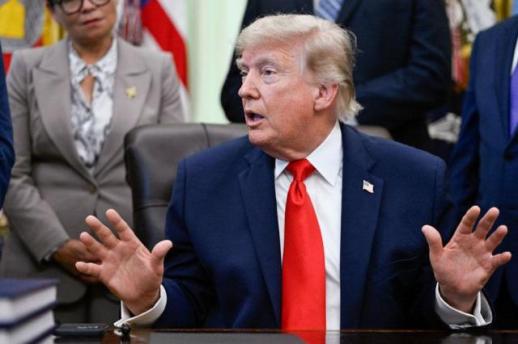 Trump says Iran deal in 'pretty final shape' as Tehran says no final decision yet SEOUL, June 12 (AJP) - A peace deal between Washington and Tehran is in its final stages and could be signed in Europe as soon as this weekend, U.S. President Donald Trump said on Thursday. Speaking to reporters at the White House, Trump said the U.S. had "just made a great settlement of the war with Iran," announcing that he had canceled planned strikes against Tehran. "We have a signing soon and the documents are in pretty final shape, so we'll see," he added. Trump also said that Vice President JD Vance would travel to Europe for the signing, while the president remains at the White House, where he is scheduled to host UFC Freedom 250 on the South Lawn on Sunday to celebrate his 80th birthday. Describing the agreement as a major step toward ending months of conflict in the Middle East, Trump said the most important part of the deal is a commitment that Iran would neither develop nor acquire nuclear weapons. "We have a deal that Iran will never have a nuclear weapon, which was the whole purpose of what we had to go through to get this. So, it's a very big thing," he said, adding that the agreement would also include the reopening of the Strait of Hormuz, a critical chokepoint for roughly one-fifth of the world's oil supply. Contrary to Trump's claims, Foreign Ministry spokesperson Esmaeil Baghaei said that while both sides have made some progress in negotiations, no final decision has been reached. He said several key issues remain unresolved including sanctions relief and access to frozen Iranian assets, vowing that Tehran will not compromise on its core demands. Countries that rely on the strait for energy shipments including South Korea, are closely watching developments, hoping that a possible final deal after months of conflict and repeated fragile ceasefires will help stabilize global energy supply chains. 2026-06-12 09:01:34
 -
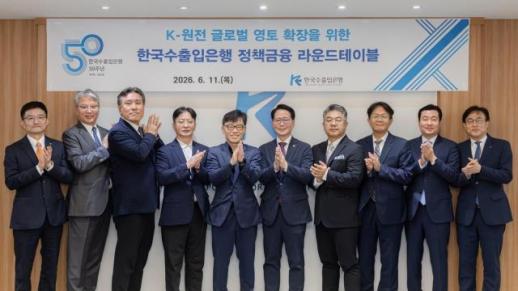 Korea Eximbank Launches K-Finance Package to Support Nuclear Power Exports Korea Eximbank is strengthening its policy finance support system to expand overseas nuclear power orders. The bank aims to enhance the export competitiveness of 'K-nuclear' by preparing tailored financial packages for large-scale nuclear projects in countries like the Czech Republic and Vietnam. On June 12, Korea Eximbank held a 'K-Nuclear Global Expansion Policy Finance Roundtable' at its headquarters in Yeouido, Seoul. The event was attended by representatives from state-owned nuclear power companies such as Korea Electric Power Corporation and Korea Hydro & Nuclear Power, as well as engineering, procurement, and construction (EPC) firms like Doosan Enerbility, Hyundai Engineering & Construction, Samsung C&T, and Daewoo Engineering & Construction, along with the Korea Nuclear Export Industry Association. This roundtable was organized in response to the increasing electricity demand driven by the growth of the artificial intelligence (AI) industry, the rising importance of energy security, and the need to achieve carbon neutrality, which has brought renewed attention to the role of nuclear power. Discussions also focused on Korea Eximbank's role as a policy finance institution in line with the government's recently announced 'K-Nuclear One Team Export System Efficiency Improvement Plan.' Participating companies shared challenges they face in pursuing overseas nuclear projects, including geopolitical risks and the burdens of securing large-scale, long-term financing. In response, Korea Eximbank pledged to provide customized financial solutions based on its past experience in financing the Barakah nuclear power plant in the United Arab Emirates, helping domestic companies secure competitive advantages in bidding. Korea Eximbank plans to quickly establish a 'K-Finance Package' targeting large nuclear projects in Vietnam, the Czech Republic, Bulgaria, and Poland. The bank will proactively prepare financing solutions tailored to the needs of project owners and will also support exports in next-generation nuclear fields, such as small modular reactors (SMRs) and key equipment. Additionally, it will promote cooperative financing for small and medium-sized partner companies that form the backbone of the industrial ecosystem.* This article has been translated by AI. 2026-06-12 09:00:00