
Journalist

Jun sungmin
-
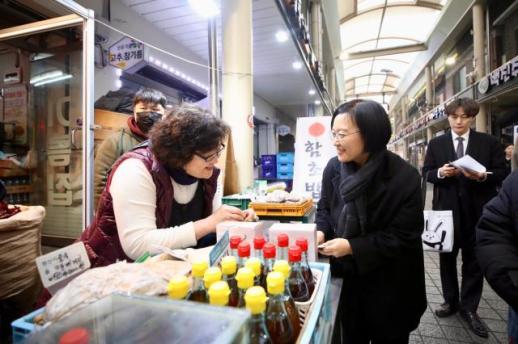 Minister Han Seung-sook Visits Gongju's Saseong Market to Discuss Local Bookstore Development Minister Han Seung-sook of the Ministry of SMEs and Startups visited Gongju's Saseong Market and the surrounding Jeamincheon commercial area to gather feedback and discuss the future of local bookstores. On May 18, the ministry reported that Minister Han visited Saseong Market, where she purchased rice cakes and side dishes, encouraging merchants who are struggling due to rising prices and decreased consumer spending while listening to their concerns. She then toured the Jeamincheon area, visiting the 'Gongju Youth Shared Housing,' which has transformed an old inn into shared housing for young entrepreneurs, as well as the independent bookstore 'Bookstore, Itta' and the Hanok cafe 'Lucia's Garden,' where she heard from small business owners. A 'Local Bookstore Meeting' was held at the independent bookstore 'Old Questions' near Jeamincheon. Attendees included Ji Myung-hoon, the representative of 'Old Questions,' Yeon Young-sook, who operates 'Danbi Bookstore' in Sejong, and Kim Jun-tae, who runs 'Dadada' in Daejeon, among other representatives from regional bookstores in the Chungcheong area. Also present were Lee Dae-geon, president of the National Local Bookstore Network, along with commercial district planners and experts who shared their insights. The meeting began with a presentation by Lee on the 'Current Status of Local Bookstores, Best Practices, and Future Development Directions,' followed by a free discussion format. Participants shared the role and importance of local bookstores as key hubs that connect people within local commercial districts and traditional markets, discussing future development directions. According to a 2024 survey on local bookstores conducted by the Korea Publishing Culture Industry Promotion Agency, there are approximately 3,295 local bookstores nationwide, with 21 areas identified as at risk of extinction. Minister Han stated, "Local bookstores are not just spaces for selling books; they are cultural hubs where community stories come to life. We will continue to support the development of local bookstores as cultural anchors in commercial districts, from startup assistance to collaboration and revitalization efforts."* This article has been translated by AI. 2026-05-18 19:05:16
 -
 Controversy Surrounds Historical Accuracy in '21st Century Great Lady' Choi Tae-sung, a Korean history instructor, has sparked attention by proposing the establishment of a "Historical Verification Research Institute" in response to the controversy surrounding the MBC drama '21st Century Great Lady.' Despite achieving over 13% viewership ratings, '21st Century Great Lady' has faced criticism for historical inaccuracies. Scenes such as the character Lee An-dae-gun (played by Byun Woo-seok) shouting "cheonsae" instead of "manse" during a royal coronation, and the use of a Chinese-style crown instead of the appropriate Korean imperial crown, have drawn scrutiny. After the show's conclusion, debates arose regarding whether the portrayal of South Korea as a constitutional monarchy implied it was a vassal state of China rather than a sovereign nation. Viewers have called for apologies from the production team and cast, prompting Choi Tae-sung to express his views on social media. On May 18, Choi stated, "Korean dramas and films have become content consumed by audiences worldwide. A production system that matches this status is necessary." He criticized the frequent historical inaccuracies, questioning why millions are spent on actor salaries while historical verification costs are often minimal. He added, "Actors should be able to focus solely on their performances. It’s disheartening to receive criticism after working hard to create a good historical drama. I hope a Historical Verification Research Institute can be established." As the controversy intensified, the production team issued an apology on May 16, stating, "We apologize for causing concern regarding the world-building and historical verification issues. We will correct the audio and subtitles for the relevant scenes in replays, VOD, and OTT services." On May 18, lead actors IU and Byun Woo-seok also posted apologies on their social media accounts. IU expressed her regret, saying, "As the lead actress, I feel heavy-hearted for not demonstrating a responsible attitude and for disappointing viewers. I sincerely reflect on and apologize for not considering the various verification issues in the drama more deeply." Byun Woo-seok, in a handwritten apology, acknowledged, "I lacked sufficient consideration of the historical context and significance embedded in the work and how it would be perceived by viewers. I will strive to approach my roles with greater caution and depth in the future." Once anticipated as a major success due to the pairing of two highly popular actors, '21st Century Great Lady' has seen its success overshadowed by the ongoing historical distortion controversy. Attention now turns to how related content, including the web novel by writer Yoo Ji-won and the OTT video released on Disney+, will address these historical issues.* This article has been translated by AI. 2026-05-18 19:02:06
 -
 South Korea Hosts Workshop with OpenAI on Cybersecurity Collaboration The South Korean government held a practical workshop with global artificial intelligence (AI) company OpenAI to discuss cybersecurity collaboration and the Trusted AI Cybersecurity Program (TAC). On May 18, the Ministry of Science and ICT (MSIT) announced that it explored AI-based cybersecurity cooperation with various agencies, including the Ministry of Foreign Affairs, the National Intelligence Service, the Financial Services Commission, the National AI Strategy Committee, the AI Safety Research Institute (AISI), the Korea Internet & Security Agency (KISA), and the Financial Security Institute. The workshop was organized for Shasha Baker, OpenAI's Head of National Security Policy, to explain the TAC program to South Korean government officials. MSIT requested OpenAI to share information and collaborate on addressing AI security threats. Both parties agreed to continue active discussions on the application of AI models in the cybersecurity field following this meeting. Baker stated, "To effectively respond to cyber threats in the AI era, close public-private cooperation is essential. When the government, businesses, infrastructure operators, research institutions, and AI companies collaborate based on a shared sense of responsibility, we can safely utilize AI and enhance cyber resilience." Choi Woo-hyuk, Director of the Information Security Network Policy Office at MSIT, noted, "Through this workshop and meeting, there was a consensus that AI should be a weapon for defense rather than an attacker, and that close cooperation between the public and private sectors is necessary to address AI security threats. We will continue to enhance domestic AI security capabilities through active collaboration and practical discussions with global AI companies." Meanwhile, MSIT held a meeting with Anthropic on May 11 to discuss Anthropic's 'Mythos' access rights, AI stability policies, and the AI Basic Act.* This article has been translated by AI. 2026-05-18 19:00:00
 -
 Government Launches Major Spending Restructuring to Enhance Budget Efficiency The South Korean government has initiated its largest-ever spending restructuring effort to reduce unnecessary financial expenditures. This move includes mandates for each ministry to implement spending restructuring at the project level, reinforcing the commitment to enhance fiscal efficiency. On May 18, the Ministry of Strategy and Finance notified various ministries of the results from the "Integrated Financial Project Evaluation" conducted over the past four months since January. As a result of this restructuring, 901 project budgets are set to be reduced or consolidated. This evaluation differs from previous self-assessments conducted by individual ministries. To enhance objectivity and reliability while alleviating the evaluation burden on ministries, 153 external experts were engaged to form a "Private Expert Evaluation Group." Out of 2,487 projects evaluated, 901 (36.2%) were identified for budget reductions or consolidations. Only 89 projects (3.6%) were deemed to be proceeding normally, while 1,497 projects (60.2%) were classified as needing improvement. The sector with the largest budget reductions is transportation and land, with 54 projects (17.3262 trillion won) facing cuts or consolidation. This is followed by disaster safety with 84 projects (8.6024 trillion won) and defense, diplomacy, and unification with 46 projects (3.7149 trillion won). Unlike previous self-assessments, ministries are now required to implement spending restructuring at the project level. If they fail to meet the restructuring targets by September, they must submit a justification for the unimplemented changes to the Open Budget portal for public disclosure. The Ministry anticipates that these restructuring efforts could lead to a total of 77 trillion won in budget adjustments. The Ministry plans to link the results of this integrated evaluation to the formulation of next year's government budget. Projects that receive poor performance ratings will see budget requests from ministries reduced accordingly. Projects identified for improvement must have their necessary adjustments reflected in a performance management improvement plan, which is to be submitted next month. Projects that demonstrate excellent performance will be rewarded. The evaluation group will select up to 50 outstanding projects, which will be exempt from evaluation in the following year. In July, a public vote will determine which projects are perceived to have high satisfaction and impact, with rewards for the project managers. By the end of this month, ministries must submit their budget requests for 2027, reflecting the evaluation results to the Ministry of Strategy and Finance. The report on the integrated evaluation results will be made public on the Open Budget portal next month. A Ministry official stated, "To strengthen the integrity of the integrated evaluation system, we will comprehensively address the improvement tasks raised during the evaluation process and the challenges faced by ministries, aiming to implement system improvements in the second half of the year." Woosuk Jin, head of the evaluation group and a professor at Myongji University, noted, "Compared to previous self-assessments, only 3.6% of projects were rated as normal, indicating a stricter evaluation. The differences in spending restructuring rankings among ministries suggest that further management will be necessary going forward."* This article has been translated by AI. 2026-05-18 18:57:32
 -
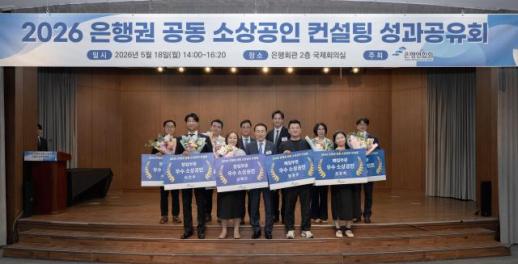 Annual Business Closures Exceed 1 Million as Banks Increase Support for Small Enterprises As annual business closures surpass 1 million, the banking sector is stepping up to provide consulting and financial support for struggling small enterprises.Cho Yong-byeong, chairman of the Korea Federation of Banks, stated at the 'Joint Small Business Consulting Results Sharing Event' held on May 18 in Seoul, "Small business owners, our valued customers, are directly facing economic changes and cost burdens in the most immediate sectors of the economy." He emphasized the commitment to actively support the processes of business closure and recovery.Since 2025, 20 domestic banks have collaborated on consulting for startups and businesses facing closure. Due to recent economic downturns, the number of consulting applicants has reached 646, exceeding the initial target by more than double. In total, 2,100 consulting sessions have been provided to 800 small business owners. The consulting results indicate a concerning trend, with 50% of requests focusing on closure strategies rather than management improvement or tax inquiries, highlighting the deepening financial struggles of small businesses. The service industry accounted for the largest share of requests at 27.1%, followed by retail and food services at 26.3%.The prolonged domestic economic slump has led to a wave of closures among self-employed individuals, who are crucial to local economies. The annual business closure rate has reached over 1 million, with a closure rate of approximately 9%. Increasing numbers of self-employed individuals are unable to meet their loan obligations, contributing to a rise in delinquency rates. The delinquency rate for loans to individual business owners at the five major banks—KB Kookmin, Shinhan, Hana, Woori, and NH Nonghyup—was 0.78% in the first quarter of this year, up 0.07 percentage points from late January. Meanwhile, Kakao Bank, which has been increasing its loans to individual business owners, reported a delinquency rate of 1.40%.In response, the Korea Federation of Banks has implemented tailored consulting services based on data and artificial intelligence (AI) from professional consultants. Additionally, they are linking consulting services for small business owners to various financial support programs, such as Personal Business Loan 119, to alleviate interest burdens. It is estimated that 99.3% of borrowers have total loans of less than 1 billion won. If 30% of those who close their businesses apply for financial support, the reduction in interest burdens could amount to 315 billion won annually. A consultant noted, "27% of applicants have completed their business closure process, and we will continue to support the remaining applicants."However, the burden on the banking sector is significant. The annual financial support burden for small businesses is estimated to be between 600 billion and 700 billion won. Nevertheless, as support for startups and businesses in distress aligns with productive finance strategies, the banking sector plans to expand the scope of Personal Business Loan 119 and long-term installment repayment options.Chairman Cho stated, "We will continue to disseminate the experiences and best practices from this joint initiative across the banking sector to enhance the self-sustainability of small businesses and support the recovery of the economy and inclusive finance."* This article has been translated by AI. 2026-05-18 18:52:33
 -
 Samsung Life Insurance Eyes Overseas M&A as Thai Profits Surge 63% As the domestic insurance market faces growth limitations due to low birthrates and an aging population, the life insurance industry is increasingly focusing on expanding into overseas markets. Samsung Life Insurance is bolstering its international strategy based on strong performance from its Thai subsidiary. According to data from the Financial Supervisory Service on May 18, Samsung Life's Thai subsidiary reported a net profit of 10.4 billion won in the first quarter of this year, a 63% increase from 6.4 billion won in the same period last year. During this time, assets grew by 11.7% to reach 1.34 trillion won. The K-ICS (Korea Insurance Capital Standard) ratio stood at 323% at the end of the first quarter, significantly exceeding the Thai insurance authority's minimum requirement of 140%. Established in 1997, Samsung Life's Thai subsidiary was the first overseas venture by a domestic life insurer. The company is positioning Thailand as a key hub in Southeast Asia, expanding its business through bancassurance partnerships and local investments. Currently, it operates four branches and 133 sales offices in major regions of Thailand, primarily focusing on a consultant-based sales organization. The Thai insurance market is witnessing a growing demand for health and protection products, driven by an expanding middle class and rising incomes. According to the Organization for Economic Cooperation and Development (OECD), the size of life insurance premiums in Thailand has increased from $3.2 billion in 2000 to an estimated $19 billion by 2024. Buoyed by local business growth, Samsung Life has also indicated the possibility of further overseas investments. During a conference call on May 14 regarding its first-quarter results for 2026, the company stated, "Our businesses in Thailand and China are growing rapidly, and profitability is improving. Based on this experience, we are exploring new merger and acquisition opportunities." Industry experts believe that the structural slowdown in the domestic market, exacerbated by low birthrates and an aging population, is driving the push for overseas expansion. The popularity of whole life insurance, a core product in the life insurance sector, is also waning. Hanwha Life is noted as one of the most aggressive domestic life insurers in expanding its overseas operations. The company is strengthening its local sales in Vietnam and Indonesia and has recently acquired a bank in Indonesia, pursuing a strategy that integrates insurance and finance. An industry insider remarked, "As it becomes increasingly difficult to generate stable profits in the domestic insurance market due to demographic changes, the need for overseas market expansion is growing. However, international operations require a long-term approach due to differences in language, culture, and regulatory environments, which is why this trend is predominantly led by larger firms."* This article has been translated by AI. 2026-05-18 18:49:28
 -
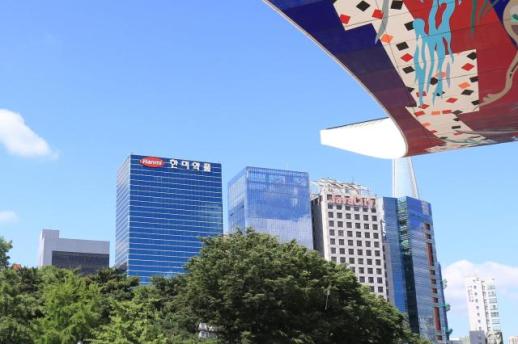 Hanmi Pharmaceutical Expands Obesity Drug to Diabetes Treatment Hanmi Pharmaceutical is expanding the indications for its GLP-1 drug, epeglanatide, to include diabetes treatment. The company views obesity not as a standalone disease but as part of a complex metabolic disorder that includes type 2 diabetes and cardiovascular diseases. To this end, Hanmi is implementing a Life Cycle Management (LCM) strategy to broaden the use of epeglanatide, aiming to develop a 'metabolic disease integrated platform' that connects obesity, diabetes, and cardiovascular conditions.On May 18, Hanmi announced that it has begun dosing participants in a Phase 3 clinical trial in South Korea to expand the drug's indications for diabetes treatment. The trial evaluates the blood sugar control effects of a combination therapy involving epeglanatide, metformin, and SGLT2 inhibitor dapagliflozin in patients with type 2 diabetes, with the first doses administered last month.The Phase 3 trial is being conducted as a multicenter, randomized, double-blind, placebo-controlled study involving domestic patients. The trial is expected to conclude in 2028.Hanmi plans to secure diabetes indications based on its global development experience involving 6,000 type 2 diabetes patients in collaboration with its partners.According to the company, epeglanatide not only shows weight loss and blood sugar control effects but also has potential cardiovascular and kidney protective benefits.Kim Na-young, head of Hanmi's Innovation Growth Division, stated, "Epeglanatide has the potential to expand its treatment area beyond obesity to various metabolic diseases, including diabetes and cardiovascular and kidney diseases."Meanwhile, Hanmi submitted a product approval application for its obesity drug epeglanatide to the Ministry of Food and Drug Safety in December last year. It has been designated for the Global Innovative Fast Track (GIFT) program, which is expected to shorten the review period compared to standard approval processes.The company emphasizes that epeglanatide has been directly tested for efficacy and safety in Koreans, unlike major global products such as 'Wegovy,' and aims to enter not only the domestic market but also the global market, including Asia.The global obesity treatment market is experiencing rapid growth. 'Mounjaro' generated $8.7 billion in sales in the first quarter of this year, surpassing cancer drug 'Keytruda' to become the world's best-selling drug. During the same period, 'Wegovy' recorded sales of 18.235 billion kroner (approximately $4 billion), solidifying the position of obesity and diabetes new drugs as key growth drivers in the global pharmaceutical market.* This article has been translated by AI. 2026-05-18 18:46:14
 -
 Shinhan Bank Provides 7.5 Billion Won in Guaranteed Loans to Incheon SMEs Shinhan Bank announced on May 18 that it will provide a total of 7.5 billion won in guaranteed loans to small and medium-sized enterprises (SMEs) and small businesses in the Incheon area.To support mid- to low-credit companies and e-commerce businesses, Shinhan Bank has signed a 'Specialized Inclusive Finance Guarantee Agreement' with the Incheon Credit Guarantee Foundation.The initiative aims to reduce the financial burdens faced by small businesses with mid- to low-credit ratings and to provide stable operating funds for online sellers experiencing cash flow issues due to delayed settlements.The loan limit for each business is set at a maximum of 50 million won, targeting new operating fund loans offered by Shinhan Bank. The guarantee will cover 100% of the loan amount, with a guarantee fee rate of 0.8% per year. The loans will be structured with a one-year grace period followed by four years of installment repayment or a lump-sum repayment at maturity.Currently, Shinhan Bank serves as the primary bank for Incheon City, with a new primary bank to be designated in August. This financial support for SMEs in Incheon is expected to have a positive impact on the upcoming selection of the primary bank.A Shinhan Bank official stated, "We will continue to collaborate with local credit guarantee institutions to provide financial support that small businesses and SMEs can truly feel in their operations."* This article has been translated by AI. 2026-05-18 18:41:48
 -
 Doosan Construction Secures $733 Million Busan Mangmi 5 Redevelopment Project Doosan Construction has secured the construction rights for the Mangmi 5 District redevelopment project, a major urban renewal initiative in Busan's Suyeong-gu. With this contract, Doosan has surpassed 2 trillion won in new orders for the year. The company announced on May 18 that it was selected as the final contractor after receiving overwhelming support from members at the general assembly of the Mangmi 5 District redevelopment association held on May 16. Doosan had set a record-high order target of 6 trillion won for this year, and this significant project in Busan is expected to accelerate its progress toward that goal. The redevelopment project involves the construction of 13 residential buildings, ranging from five underground floors to 32 above-ground floors, totaling 1,800 housing units and commercial facilities. The total construction cost is approximately 733.4 billion won. Mangmi-dong, where the project will be located, is recognized as a prime residential area in Busan, boasting excellent living infrastructure. It is conveniently situated near Mangmi Station on Busan Subway Line 3 and has strong connectivity to major transportation networks, including the Gwangandaegyo Bridge and the Wondong Interchange, facilitating easy access to nearby districts such as Yeonje-gu and Haeundae-gu. A Doosan Construction representative stated, "We will complete the Mangmi 5 District as a landmark project that reflects the high residential preference in Suyeong-gu, and we will repay the support of our members. In the future, we will maintain a rigorous selection process for new orders while focusing on high-quality projects with proven business viability to sustain our solid growth." Meanwhile, Doosan Construction's quarterly report released on May 14 indicated that the company recorded a consolidated revenue of 359.4 billion won in the first quarter of this year, a 15.3% decrease compared to the same period last year. However, operating profit surged by 263.0% to 29.9 billion won, and net profit increased by 430.7% to 22 billion won. Notably, the operating profit margin improved significantly from 1.9% in the first quarter of last year to 8.3% this year, reflecting a substantial enhancement in profitability.* This article has been translated by AI. 2026-05-18 18:36:25
 -
 AJP Eye: Samsung strike crisis lays bare Korea's dependence on one company SEOUL, May 18 (AJP) -A rare coalition of voices — the government, opposition politicians and even the central bank — has united this week to try to head off a walkout at the world's largest memory chipmaker, underscoring the outsized weight of Samsung Electronics - responsible for roughly one-fifth of South Korea's exports and the benchmark KOSPI index. What began as a labor dispute over bonuses has rapidly become a national economic and political flashpoint, exposing how deeply the country's economy, financial markets and policy stability remain tied to the fortunes of a single corporate giant. Samsung Electronics labor and management resumed talks Monday — a second round of post-mediation negotiations at the Central Labor Relations Commission in Sejong — with three days left before the union's planned 18-day general strike, set to begin May 21. Negotiators remained deadlocked in the backdrop of heavy pressure. "It's a parallel line," commission chairman Park Soo-geun told reporters repeatedly outside the mediation room when asked whether any progress had been made. No compromise proposal had been drafted as of late afternoon. The marathon negotiations, which began at 10 a.m. Monday and were scheduled to continue Tuesday, are widely viewed as the final realistic opportunity to avert the first prolonged large-scale strike in Samsung's semiconductor division. At the heart of the standoff is the union's demand to abolish the existing 50 percent cap on performance bonuses and lock in a formula allocating 15 percent of operating profit to bonus pools. Management has countered with a three-year proposal that would preserve the current Overall Performance Incentive framework while setting aside additional profit-sharing funds only if the Device Solutions division's operating profit surpasses 200 trillion won ($145 billion). An emergency report recently submitted by the Bank of Korea to the presidential office warned that an 18-day strike followed by a prolonged production recovery could shave as much as 0.5 percentage point off South Korea's economic growth this year. The central bank estimated semiconductor production losses at around 30 trillion won if memory chip lines suffer a full shutdown and require three additional weeks to normalize — effectively erasing roughly 15 trillion won in GDP value-added from an economy forecast to grow about 2.5 percent this year. The central bank reportedly modeled multiple scenarios based on shutdown rates, supply chain disruptions and global chip pricing. The concern reflects the uniquely fragile structure of chip fabrication. Unlike conventional manufacturing, semiconductor production flows continuously around the clock, with wafers moving through tightly synchronized processes measured in seconds. Even small delays can ripple across entire facilities. Industry watchers estimate Samsung's memory operations alone could lose nearly 900 billion won per day if wafers miss designated processing windows and must be discarded. Samsung controls more than 40 percent of the global DRAM market, meaning any disruption would reverberate across global electronics supply chains and could trigger sharp price increases in memory chips used in smartphones, AI servers and personal computers. The government's increasingly direct intervention illustrates the scale of concern. Prime Minister Kim Min-seok warned over the weekend that the upcoming talks represented "effectively the last chance" to prevent a strike, while officials openly raised the possibility of invoking emergency arbitration powers — a rarely used measure that can suspend strikes deemed harmful to the national economy. President Lee Jae Myung added further pressure Monday in a lengthy social media post, acknowledging that labor rights are constitutionally protected but arguing they may be limited "for public welfare" so long as their essential substance is not violated. "In a free democratic and capitalist market economy like South Korea, labor must be respected as much as business, and management rights must be respected as much as labor rights," Lee wrote. His remarks were widely interpreted as a warning that the administration remains prepared to escalate intervention if negotiations collapse. The political establishment, business groups and shareholder activists have since joined the pressure campaign. Six major business lobbies — including the Korea Enterprises Federation and the Korea Chamber of Commerce and Industry — issued a joint statement urging the union to stand down and calling on the government to invoke emergency arbitration immediately if a walkout proceeds. A retail shareholder advocacy group warned separately that institutionalizing fixed profit-sharing formulas could infringe on shareholder property rights and conflict with corporate capital principles. The union fired back, accusing the government of acting as Samsung's spokesperson rather than an impartial mediator. The National Samsung Electronics Union argued that official warnings about "months-long paralysis" overstated operational realities, noting that semiconductor facilities routinely undergo temporary shutdowns and maintenance without catastrophic consequences. Adding another dimension to the confrontation, a Suwon court on Monday partially granted Samsung's injunction request to prohibit illegal strike actions. The court barred the union from occupying production and research facilities and ordered workers responsible for critical safety, drainage, ventilation and wafer protection to maintain normal staffing throughout any strike — effectively ensuring roughly 7,000 essential employees remain on site and reducing the likelihood of a complete plant shutdown. Still, industry experts warned that even without a full shutdown, prolonged labor disruption could severely damage productivity, delay equipment maintenance and disrupt high-value process calibration. "Even slight imbalances in one section of the semiconductor flow can trigger a domino effect across upstream and downstream processes," one industry executive said. The confrontation has also become a broader symbol of South Korea's economic concentration risk. For decades, Samsung Electronics has functioned not merely as a corporation but as a pillar of national growth — driving exports, tax revenue, pension returns and market sentiment. That central role has grown more pronounced during the global AI boom, with Samsung and rival SK hynix powering much of Korea's recent stock market rally. A prolonged disruption now threatens not only chip exports but also currency stability, investor confidence and broader perceptions of Korea's economic resilience. As the clock ticks toward a potential disruption in global chip supplies, South Korea this week finds itself confronting an uncomfortable reality: a labor dispute inside Samsung Electronics has become a stress test for the limits of the country’s entire economic model. 2026-05-18 18:35:07