

Journalist

Jung Sung-chun
-
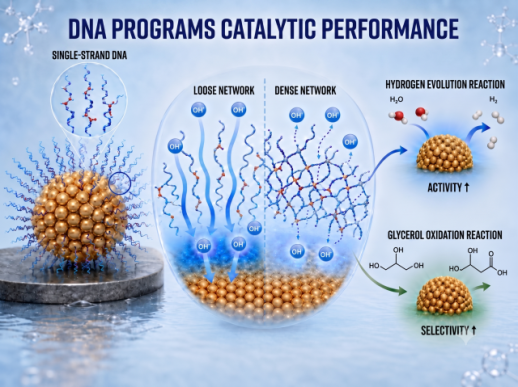 Researchers design DNA coatings to control catalyst environments for chemical production SEOUL, June 08 (AJP) - Researchers in South Korea have developed a method to coat chemical catalysts with single-stranded DNA, enabling precise control over the surrounding chemical environment to improve hydrogen and chemical production, the Korea Advanced Institute of Science and Technology said Sunday. The research team, led by Professor Park Ji-min from the Korea Advanced Institute of Science and Technology (KAIST)'s department of chemical and biomolecular engineering, applied single-stranded DNA to the surface of gold nanoparticle catalysts. By altering the sequence of the DNA, the researchers could control the local acidity and ion distribution at a nanometer scale without changing the structure of the catalyst itself. In chemical reactions driven by electricity, the immediate environment surrounding a catalyst determines how efficiently it operates. Traditionally, scientists used polymer coatings to manage this space, but these materials lacked the precision needed to design internal structures at a microscopic level. Because DNA naturally carries a negative charge and its structure can be altered by changing its sequence, it serves as an effective tool for guiding the movement of ions. Using real-time analysis techniques, the team observed that the DNA layer functions as a customized interface that manages the flow of hydroxide ions. When applied to hydrogen generation and the conversion of glycerol, the specific DNA sequences directly impacted the efficiency of the reactions. Adjusting the sequence increased the production rate of glycerate, a material used in cosmetics and pharmaceuticals, demonstrating that reaction outcomes can be controlled solely through DNA modification. The study, co-authored by doctoral students Oh Sang-yeon and Lee Tae-kyung, was published in the Journal of the American Chemical Society on May 5, 2026. "This research is an example showing that DNA can be utilized not just as a genetic information storage medium, but as a precision nanomaterial to control electrochemical reactions," Professor Park said. "By adjusting the acidity and ion movement on the catalyst surface through DNA sequence design, we expect it to be widely utilized in overall carbon neutrality technologies, including hydrogen production and biomass conversion in the future." (Reference Information) Journal/Source: Journal of the American Chemical Society Title: Programmable Single-Stranded DNA Layers as Modulators of Nanoscale pH at Electrocatalytic Interfaces Link/DOI: 10.1021/jacs.6c02995 2026-06-08 16:21:17
 -
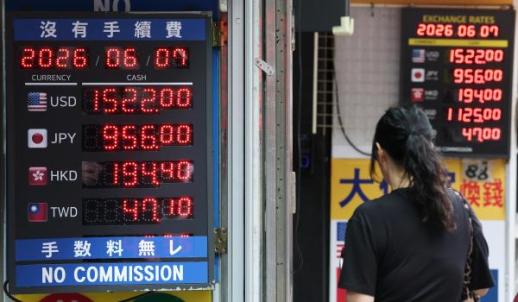 Financial Authorities Urge Banks to Address Soaring Exchange Rates As the won-dollar exchange rate reaches its highest level since the global financial crisis, financial authorities have convened an emergency meeting with banks to assess the situation.The Financial Services Commission announced that it held a meeting on the foreign exchange market on June 8 at the Government Seoul Building, chaired by Shin Jin-chang, the head of the commission's secretariat. Attendees included representatives from the Financial Services Commission, the Ministry of Economy and Finance, the Financial Supervisory Service, the Bank of Korea, as well as major banks such as KB Kookmin, Shinhan, Hana, Woori, NH Nonghyup, State Street Bank, HSBC, and SC Bank.This meeting followed an emergency market situation assessment meeting held the previous day, chaired by the Deputy Prime Minister for Economic Affairs.Participants noted that recent fluctuations in the foreign exchange market are influenced by adjustments in foreign investor proportions in the domestic stock market and profit-taking, alongside global uncertainties such as rising tensions in the Middle East and expectations of U.S. interest rate hikes.However, they assessed that the fundamentals of the South Korean economy remain strong, with continued upward revisions in profit forecasts for domestic companies, particularly in the semiconductor sector, and an expanding current account surplus due to robust exports. They agreed that excessive volatility and one-sided trends in the foreign exchange market are undesirable.Additionally, authorities and related institutions will closely monitor derivative transactions in the offshore non-deliverable forward (NDF) market, which could impact the domestic foreign exchange market. They also plan to explore institutional improvements to absorb future offshore NDF transactions into the domestic market.Furthermore, they will investigate any speculative trading or market disruption linked to the weakening won through the Bank of Korea and the Financial Supervisory Service, and will take strict action if any illegal activities are confirmed.Shin Jin-chang stated, "We will maintain a 24-hour alert status, closely monitor market conditions, and respond promptly when necessary."Major financial groups have also initiated emergency responses. KB Financial held an urgent executive meeting on the same day to review foreign exchange market trends and the group's overall response status. The meeting focused on assessing the response measures of its affiliates to address market, capital, and liquidity risks arising from the surge in exchange rates, and they agreed to continuously review their emergency response systems and management plans.Hana Financial convened a crisis management council on June 4 to discuss the capital adequacy and liquidity status of the group and its affiliates, as well as future response strategies.Shinhan Financial is also analyzing factors affecting foreign exchange market volatility and reviewing major currency hedging positions through its crisis management council. Woori Financial is activating its emergency response system, focusing on assessing the impacts on liquidity and capital adequacy.* This article has been translated by AI. 2026-06-08 16:18:00
 -
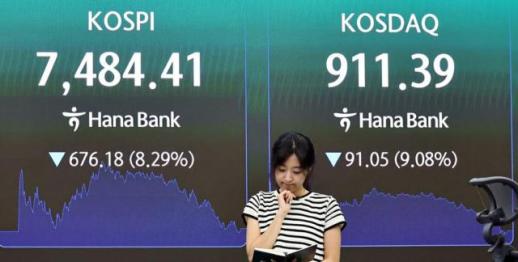 KOSPI plunges over 8% as chip stocks slide SEOUL, June 8 (AJP) - South Korea's benchmark KOSPI closed down 8.3 percent on Monday, shedding 676.18 points to 7,484.41 in one of its steepest single-day falls on record, after a U.S. semiconductor rout tripped circuit breakers on both of Seoul's main markets and gutted the chip giants that anchor the index. Samsung Electronics collapsed 10.2 percent to 295,500 won (US$192.4) and SK Hynix fell 7.7 percent to 1,911,000 won, the two memory-chip makers alone accounting for most of the decline. Yet the session was not a uniform liquidation. Naver, the country's largest internet platform, surged 9.2 percent to 279,000 won, a near-mirror image of the chip names as investors fled hardware and piled into the businesses the artificial intelligence build-out had left behind. That split was the story. Trading halted on both the KOSPI and the junior KOSDAQ as each tripped a circuit breaker, a mechanism that suspends all trade for a set period once an index falls past a preset threshold, the breakers and a sidecar firing together for only a handful of times this year. The KOSPI plunged as much as 8.8 percent to an intraday low of 7,442.7 before clawing back a sliver of the loss, while the KOSDAQ, home to smaller technology and biotechnology names, fared worse still, closing down 9.1 percent at 911.4. Beneath the headline crash, money tore along a single fault line, punishing the AI hardware trade that has led Korean equities for months while rewarding the platform and internet names that rally had crowded out. Foreign investors, the source of weeks of net selling, turned buyers into the close. Overseas funds bought a net 297.6 billion won of stock by the bell, while domestic individuals sold 124.4 billion won and institutions sold 146.7 billion won, a reversal from earlier in the session when foreigners had been heavy sellers. The late turn suggested some overseas money treated the crash as an entry point rather than an exit, even as the breadth of the decline stayed overwhelming, with 1,634 stocks falling against just 75 gainers. The trigger was external. A Friday rout in US chip shares carried across Asia, and the damage tracked semiconductor exposure market by market. In Tokyo, the Nikkei 225 fell 3.9 percent to 64,024.6, dragged down by chip-equipment makers Tokyo Electron, off 7.8 percent, and Advantest, down 6.3 percent, with SoftBank Group falling 7.8 percent. The Shanghai Composite proved far more resilient, easing 1.5 percent to 3,968.8 as Chinese chip names including Cambricon Technologies and NAURA Technology fell only modestly, a sign the selling concentrated where exposure to the global AI hardware cycle ran deepest. South Korea sat at the center of that exposure. The KOSPI leans more heavily on its two memory-chip makers than any major regional index leans on its semiconductor names, which is why Seoul fell hardest even though the shock originated on Wall Street. The depth of the drop reflected the index's construction as much as the day's sentiment, a structural vulnerability that turns a global chip selloff into a domestic rout. Currency markets did not amplify the stress. The won firmed sharply, with the dollar buying 1,535.9 won, down 23.6 from the prior reference. A stronger won removes one channel through which a selloff can feed on itself, and the foreign buying into the close pointed the same way, suggesting overseas investors were not fleeing Korean assets wholesale so much as repricing a single trade. Naver's surge offered the clearest read on where the money went. As investors dumped the memory makers, they rotated into a platform business whose valuation does not hinge on the price of high-bandwidth memory, the specialized chips that stack DRAM for AI servers and that have driven the Samsung and SK hynix rally. For one session at least, the trade that had powered the KOSPI to its highs ran violently in reverse. For all the severity of the headline number, Monday was less a verdict on Korean equities than on a single crowded trade. The market did not sell everything. It sold chips, and it bought what chips had displaced. Whether Naver's jump marks the start of a durable rotation or a one-day scramble for cover will turn on whether the AI hardware selloff that began on Wall Street has found a floor, or merely a pause. 2026-06-08 16:16:59
 -
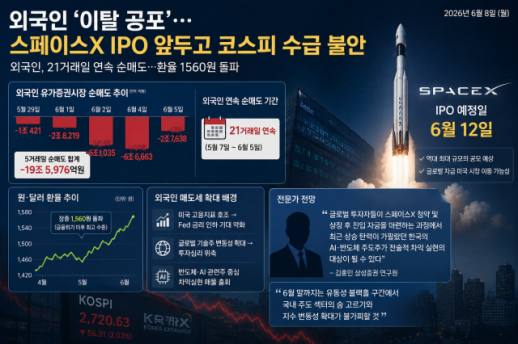 Foreign Investors Spark Fear in KOSPI Market On June 8, the Korean stock market experienced a sharp decline, driven by foreign investors who have been selling off their holdings. This month alone, foreign investors have sold approximately 20 trillion won. While analysts suggest this is not a case of a "sell Korea" trend but rather a necessary adjustment following a rapid rise in the market, it has nonetheless heightened fears among investors. Concerns are growing that supply and demand instability surrounding the KOSPI will increase as the SpaceX initial public offering (IPO) approaches on June 12. According to the Korea Exchange, foreign investors recorded net selling for five consecutive trading days from May 29 to June 5, amounting to a total of 19.6 trillion won. On June 8, they sold an additional 3.748 trillion won worth of stocks. This foreign selling trend is not seen as a short-term phenomenon. Since the KOSPI stabilized around the 7,000 mark on May 7, foreign investors have been net sellers for 21 consecutive trading days. The recent rise in the won-dollar exchange rate, which surpassed 1,560 won during trading, has reached its highest level since the financial crisis, leading market observers to view the increased foreign selling as a contributing factor to the won's depreciation. The decline in foreign investor sentiment is attributed to the strong U.S. employment data, which has diminished expectations for interest rate cuts by the Federal Reserve, alongside increased volatility in global tech stocks. Analysts note that profit-taking activities, particularly in semiconductor and AI-related stocks that had driven the recent KOSPI gains, have contributed to the heightened foreign selling. The upcoming SpaceX IPO on June 12 is considered a major variable for short-term supply and demand. With the largest-ever public offering on the horizon, there are concerns about potential capital reallocations by global investors, which could further impact foreign demand in the domestic market. Kim Jong-min, a researcher at Samsung Securities, stated, "Given that this is the largest mega IPO in history, it could act as a disruptive factor for supply and demand in the domestic market in the short term. Global investors may target Korean AI and semiconductor stocks for tactical profit-taking as they prepare funds for the SpaceX subscription and post-listing investments." He added, "Until the end of June, we can expect a liquidity black hole period, leading to a necessary pause for the leading sectors in Korea and increased volatility in the index."* This article has been translated by AI. 2026-06-08 16:15:00
 -
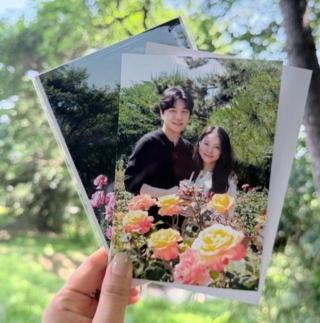 Sooja from 'I Am Solo' Surpasses 160,000 Followers on Social Media Sooja, a participant in the 31st season of 'I Am Solo,' has seen her social media follower count exceed 160,000 as of June 8. This achievement appears to make her the most followed participant from the SBS Plus and ENA reality show. In comparison, Ok-soon, known for her resemblance to BLACKPINK's Jisoo from season 22, has 131,000 followers. Currently, Kyungsoo, who is married to Sooja, supports her influencer activities. On June 6, Sooja posted several photos on her social media account, sharing a quote from poet Jin Eun-young: "Days that remind me of a lover as lovely as green." In the photos, Sooja is seen wearing a white blouse paired with a skirt, while Kyungsoo is dressed in all black, both surrounded by flowers and looking happy, evoking envy among viewers. The couple met while filming 'I Am Solo' season 31. During the show, Sooja faced bullying allegations from fellow female contestants, including Ok-soon, Young-sook, and Jung-hee, which sparked public outrage. Young-sook competed with Sooja for Kyungsoo's affection, but ultimately, Sooja and Kyungsoo chose each other, forming a couple. Netizens have expressed their support for the couple, especially considering the emotional distress Sooja experienced, including a hospital visit during filming. Kyungsoo drew attention by posting supportive messages for Sooja following the controversy. On June 3, he shared on his social media, "From the moment I received the call to join 'Solo Country' until the moment I left, I spent five days and six nights immersed in the experience. I realized many shortcomings about myself while reflecting on my appearance through the broadcast and thought I needed to become a better person. "Of course, there were edited scenes for entertainment and many moments I wanted to clarify, but I believe that every moment, whether disappointing or joyful, ultimately represented who I am. I sincerely thank the viewers who believed in me and watched over me with warm eyes despite the numerous misunderstandings surrounding season 31. "Sooja, I’m embarrassed, but thank you for believing in me from start to finish, and I’m sorry. You worked hard during the show. Let’s meet more beautifully in the future."* This article has been translated by AI. 2026-06-08 16:15:00
 -
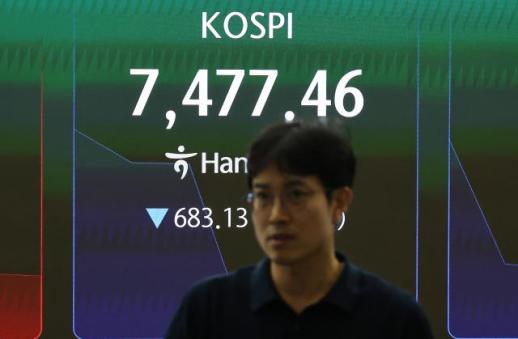 Have Semiconductor Stocks Peaked? Is This a Buying Opportunity? The fallout from the 'Broadcom shock' continued on June 8, as major players in the KOSPI, Samsung Electronics and SK Hynix, experienced significant declines for the second consecutive trading day. Investors are increasingly concerned, but analysts suggest that interpreting the recent downturn as a sign of worsening market conditions may be premature, emphasizing that this could be a buying opportunity. According to the Korea Exchange, Samsung Electronics closed at 295,500 won, down 10.18% from the previous trading day, while SK Hynix finished at 1,911,000 won, a decrease of 7.68%. Both stocks have seen declines for three and four consecutive trading days, respectively. Market attention is focused on whether the recent adjustments indicate a peak in the semiconductor sector or if they represent a temporary pause in an upward trend. Experts generally believe that it is too early to worry about a downturn in the industry. Han Ji-young, an analyst at Kiwoom Securities, stated, "The sharp drop in U.S. semiconductor stocks cannot be attributed to a peak-out in memory cycles or a slowdown in AI demand. Instead, it appears to be a correction prompted by accumulated fatigue and supply-demand pressures following the significant price increases in these sectors, combined with rising U.S. market interest rates due to employment surprises." There are also opinions in the securities industry suggesting that this correction should be viewed as a buying opportunity. On the same day, SK Securities assessed the recent stock adjustments as a chance to buy, maintaining target prices for Samsung Electronics and SK Hynix at 610,000 won and 4,000,000 won, respectively. NH Investment & Securities also raised its target price for Samsung Electronics from 490,000 won to 530,000 won and for SK Hynix from 3,100,000 won to 3,200,000 won. Han Dong-hee, an analyst at SK Securities, emphasized, "The structural bottlenecks in memory during the AI era and the strong performance of memory companies are not values that change quickly. This correction is an opportunity." Ryu Young-ho, an analyst at NH Investment & Securities, noted, "As AI spreads, various components are experiencing bottlenecks, particularly in semiconductors, where demand is growing faster than supply." Jensen Huang, CEO of NVIDIA, also commented during a briefing with SK Group, stating, "We are witnessing tremendous demand globally for more AI factories, and our business is thriving. We are just at the beginning stages of building AI infrastructure, and the future looks very bright." However, there are warnings about the potential for increased short-term volatility. Kim Ji-hyun, an analyst at Daol Investment & Securities, cautioned, "Given the high valuation pressures in semiconductors and concerns about rising oil and intermediate goods prices, it is essential to be vigilant about volatility in June and July."* This article has been translated by AI. 2026-06-08 16:15:00
 -
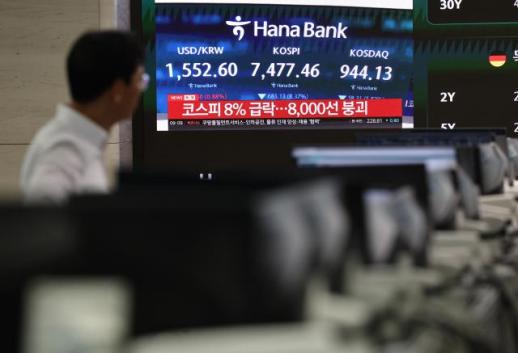 U.S. Semiconductor Stocks Plunge, KOSPI Falls Below 8000 It was a day of fear in the markets. Concerns over U.S. tightening, a sharp drop in semiconductor stocks, and a surge in exchange rates combined to hit the domestic financial market hard, marking a "Black Monday." The KOSPI index fell below 8000 during trading and closed around 7400, while the won-dollar exchange rate reached its highest level in 17 years and three months. According to the Korea Exchange, the KOSPI opened at 8048.09, down 112.50 points (1.38%) from the previous trading day, and fell below 7500 during the session. It closed at 7484.41, down 676.18 points (8.29%). The total market capitalization of the KOSPI dropped by nearly 548 trillion won, from 6136 trillion won to 6686 trillion won in just one day. The KOSDAQ index also saw a significant decline, closing at 911.39, down 91.05 points (9.08%) from the previous day. The sharp drop triggered circuit breakers and temporary halts on sell orders in both the KOSPI and KOSDAQ markets. Samsung Electronics and SK Hynix both lost key price levels, with Samsung closing at 295,500 won, down 10.18%, and SK Hynix at 1,911,000 won, down 7.68%. The domestic stock market was hit hard by dual negative factors: concerns over U.S. tightening and the plunge in semiconductor stocks. U.S. non-farm payrolls for May exceeded market expectations, dampening hopes for a Federal Reserve interest rate cut. Additionally, shares of Nvidia and Micron, along with the Philadelphia Semiconductor Index (SOX), plummeted, quickly eroding investor sentiment. Foreign investors continued to sell off stocks in large volumes, increasing downward pressure on the won. The won-dollar exchange rate surged past 1555 won during trading, reaching its highest level since the global financial crisis. In the Seoul foreign exchange market, the won-dollar rate opened at 1555.2 won, up 16.1 won from the previous trading day's closing rate of 1539.1 won. This marks the highest level based on the opening price since March 6, 2009, during the global financial crisis (1590 won). Although the won-dollar exchange rate closed at 1535.0 won, down 4.1 won from the previous day, it briefly spiked to the highest level since the financial crisis, reflecting the market's anxiety. 2026-06-08 16:15:00
 -
 Samchundang Pharmaceutical Shares Plunge Over 18% Amid Global Market Decline Samchundang Pharmaceutical, which once saw its stock price exceed 1 million won and ranked first in KOSDAQ market capitalization, has experienced a decline of over 18% due to a global market downturn. This drop is attributed to concerns over U.S. monetary tightening and a flight from risk assets, particularly impacting the recently surging pharmaceutical and biotech sectors. On June 8, the Korea Exchange reported that Samchundang's shares closed at 239,000 won, down 18.15% (53,000 won) from the previous trading day. The stock opened at 270,500 won and fell to as low as 238,500 won during the day. The sharp decline in stock price is linked to fears of U.S. monetary tightening and a significant drop in semiconductor stocks, which has triggered a broader aversion to risk assets. The U.S. non-farm payrolls for May exceeded market expectations, dampening hopes for interest rate cuts by the Federal Reserve, while tech stocks like NVIDIA and Micron plummeted, leading to a sell-off in the domestic market. Particularly, the pharmaceutical and biotech sectors, which had seen substantial gains recently, are now facing increased selling pressure as investors seek to realize profits. Samchundang, noted for its rapid rise this year as a prominent growth stock, has been significantly affected by the deteriorating investor sentiment. In March, the company’s stock price surged past 1 million won, driven by expectations surrounding the development of an oral GLP-1 treatment for obesity and diabetes, propelling it to the top of the KOSDAQ market capitalization rankings. However, subsequent management decisions regarding a block deal and the ensuing uncertainty surrounding a licensing agreement with a U.S. partner have shaken market confidence, leading to a reversal in stock performance. Currently, Samchundang's stock price has fallen over 70% from its peak in March. The recent plunge has significantly reduced its market capitalization, impacting its status as a leading growth stock on KOSDAQ. Market analysts suggest that short-term volatility may continue to exert selling pressure on overvalued growth stocks. However, they also note that expectations for improved performance due to the oral GLP-1 business and an increased share of high-margin products remain valid for Samchundang Pharmaceutical.* This article has been translated by AI. 2026-06-08 16:12:00
 -
 Kakao Faces User Concerns Amid Stock Decline Market sentiment toward Kakao has shifted from optimism to concern. On June 8, the KOSPI index, which had been rising, entered a correction phase, while Kakao's stock recently hit a 52-week low. Despite a strong performance in the domestic stock market, particularly for AI beneficiaries, Kakao's shares have struggled to find a rebound, raising concerns about increasing uncertainty surrounding the company. On June 10, Kakao's labor union plans to hold its first-ever strike, a four-hour protest that carries significant symbolic weight. As labor disputes continue, Hong Min-taek, the Chief Product Officer who led the redesign of KakaoTalk last year, has left the company. User dissatisfaction stemming from the controversial changes to KakaoTalk's friend list remains unresolved. CEO Jeong Sin-a recently apologized via the company bulletin board for the failure to reach an agreement in wage negotiations. She also announced the establishment of a 'User First Task Force' within KakaoTalk to prioritize user experience, signaling a commitment to place users at the forefront of the company's values. User-centricity has been a key theme in Kakao's growth history. Launched in 2010, KakaoTalk transformed mobile communication in South Korea by eliminating the cost of text messaging. The platform has since expanded its services to include emoticons, voice calls, video calls, gifting, and shopping, addressing various user inconveniences. Identifying and resolving user issues has been Kakao's competitive edge. The platform continues to receive regular updates every month. Recently, the number of emoticons available for the message reaction feature was expanded from six to 114, reflecting ongoing improvements in functionality. However, some users are questioning whether KakaoTalk is evolving in the right direction. Employees are seeking features that allow them to easily grasp key information in group chats with dozens or hundreds of participants. Open chat users are demanding solutions to issues with advertising accounts and spam. As the AI era progresses, user expectations are rising, but opinions vary on how well Kakao is meeting those expectations. While Kakao was once praised for anticipating and addressing user concerns, there are now criticisms regarding the gap between user-desired changes and the company's initiatives. Jeong Sin-a's leadership is also under scrutiny as she faces the dual challenges of resolving labor disputes and improving profitability while enhancing AI competitiveness and innovating KakaoTalk services. The departure of Hong Min-taek, who led key service reforms, has further highlighted the need for organizational stability as a critical management priority. Some voices suggest that Hong's departure calls for a reevaluation of Kakao's decision-making structure and overall organizational culture, as service reforms should reflect the collective judgment of the entire organization rather than the decision of a single individual. Kakao is one of South Korea's largest mobile platforms and is considered to possess ample resources and technological capabilities in the AI competition. However, the market is not only curious about its technological prowess but also whether Kakao can regain its status as a preferred platform among users and whether its management can provide a clear direction for that goal. The recent 52-week low reflects the market's and users' assessment of Kakao. What Kakao needs now is leadership that reaffirms its commitment to user-centric principles rather than merely introducing new structures or slogans.* This article has been translated by AI. 2026-06-08 16:12:00
 -
 Orion Experiences First Partial Strike Amid Labor Dispute Orion's sales labor union has initiated its first partial strike in the company's history amid ongoing disputes over wage system reforms. The food industry is closely watching the situation as companies face prolonged domestic stagnation and rising labor costs. According to industry sources, the Orion branch of the Korean Confederation of Trade Unions conducted a partial strike from June 4 to June 5. Approximately 70 sales employees responsible for supplying and selling products to domestic supermarkets participated in the strike, which involved refusing to work in the afternoon. The union secured the right to strike with a 94.5% approval rate in a prior vote. Negotiations between Orion and the union began in January, but discussions broke down in April, and mediation attempts by the Central Labor Relations Commission in April and May also failed to reach an agreement. The company proposed a wage increase of 3.5%, up from the previous 2%, but the union rejected this offer, arguing it does not align with the company's growth and is demanding a 7.5% increase. The union is also calling for the implementation of a previously agreed adjustment of the basic salary and allowances ratio (from 60:40 to 70:30) and improvements to the compensation system for on-site duties. This strike is considered unusual given that Orion has historically provided some of the best working conditions in the confectionery industry. According to the company's business report from last year, the average annual salary for employees was 81 million won, significantly higher than that of competitors. However, the conflict has arisen due to a perceived gap in compensation felt by employees. Compared to 2024's average salary of 88 million won, last year's average salary has actually decreased. Additionally, while dividends surged from 49.4 billion won to 138.4 billion won over the past three years, the union claims that employee compensation has not kept pace. The disparity in perceptions between labor and management has also been exacerbated by strong overseas business performance and stagnation in domestic operations. Last year, Orion recorded its highest-ever consolidated revenue of 3.33 trillion won and an operating profit of 558.2 billion won, with 66.7% (2.22 trillion won) coming from overseas subsidiaries in countries like China and Vietnam. In the first quarter of this year, revenue from overseas subsidiaries increased by 24.4% compared to the previous year, while revenue from the Korean subsidiary grew only 0.4%. There remains a significant gap between labor and management regarding how much of the overseas success should be reflected in employee compensation. The industry is concerned that this situation could have broader implications for wage negotiations across the food sector. Major companies like Nongshim are currently engaged in wage negotiations, and the union leading the Orion strike has members in various companies, including Haitai Confectionery, Paris Baguette, Dunkin', Samlip, Pulmuone, Dongseo Foods, and Jeong Sik Food. Orion plans to hold additional negotiations on June 10. An Orion representative stated, "We operate one of the industry's best compensation systems, and the average salary per employee has nearly doubled over the past decade. We provide annual wage increases along with performance bonuses and special bonuses during the Chuseok holiday." The representative added, "We aim to create a better company through amicable negotiations with the union." 2026-06-08 16:12:00