

Journalist

Jung Sung-chun
-
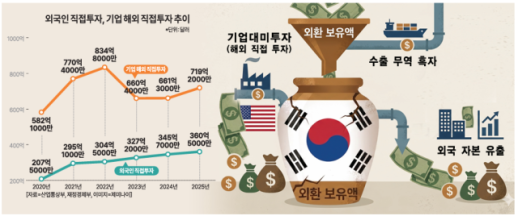 High Exchange Rates Lead to Record Overseas Investment by Korean Firms The won-dollar exchange rate surged past 1,560 won, intensifying tensions in the foreign exchange market. This spike is attributed to escalating geopolitical risks in the Middle East and unprecedented foreign investor sell-offs in the stock market. Analysts suggest that the root cause of the high exchange rate extends beyond short-term supply shocks to a structural "dollar outflow" issue within the South Korean economy. Despite earning dollars through exports, these funds are quickly funneled into overseas assets rather than remaining in the domestic foreign exchange market. According to the Ministry of Trade, Industry and Energy, foreign direct investment (FDI) flowing into South Korea totaled $36.05 billion last year, while South Korean companies' overseas direct investment (ODI) reached $71.9 billion, more than double the FDI figure. FDI refers to investments where foreign entities acquire at least 10% of a domestic company's shares or participate in its management, serving as an indicator of South Korea's long-term investment appeal. High exchange rates could potentially increase FDI inflows. A higher exchange rate allows foreign investors to secure more won-denominated assets and facilities for fewer dollars, lowering initial investment costs. An increase in FDI would lead to more dollars entering the domestic market, strengthening the won and contributing to exchange rate stability. However, FDI in 2025 saw only a slight increase from the previous year ($34.57 billion), suggesting that foreign investors maintain a negative long-term outlook on South Korea's economic fundamentals despite the high exchange rates. Additionally, since the onset of the Trump administration's second term, the trend of reshaping supply chains and increasing investments in the U.S. has accelerated the relocation of domestic companies' production bases overseas. Major South Korean corporations have significantly increased local factory investments in North America to meet U.S. subsidy requirements and avoid high tariffs. The number of overseas direct investments has steadily risen from 10,657 in 2020 to 13,190 in 2024. The outflow of direct investments is compounded by foreign capital withdrawal from the securities market. As of June 5 this year, foreign investors have net sold a total of 119 trillion won in domestic securities. The stock market briefly surpassed 8,000 points, prompting profit-taking actions. Consequently, each time foreign selling increases, the exchange rate has also risen in tandem. Furthermore, even with a slight trade surplus each month, the demand for currency exchange from foreign stock sales (dollar purchases) has far exceeded the trade surplus, negating its benefits. The pace of foreign capital outflow has accelerated since the outbreak of war in the Middle East. Compared to the global financial crisis in 2008 or the COVID-19 pandemic in 2020, the recent foreign stock sell-off has significantly heightened liquidity pressures, making it increasingly difficult to meet dollar exchange demands solely through trade surpluses. Experts point to large-scale investment agreements with the U.S. as a factor pressuring the won's supply. Jeong Yong-taek, a researcher at IBK Investment & Securities, stated, "Given the substantial investments planned in local currency dollars, even if exports increase significantly, there is little incentive to convert funds into won for domestic use. Once these investments are executed, the resulting demand for dollars will exert psychological pressure on market participants."* This article has been translated by AI. 2026-06-08 18:33:00
 -
 Deputy Prime Minister Baek Kyung-hun Meets NVIDIA's Jensen Huang to Discuss AI Collaboration The Ministry of Science and ICT is accelerating efforts to expand domestic AI infrastructure and foster a Physical AI ecosystem in collaboration with NVIDIA. On June 8, Deputy Prime Minister and Minister of Science and ICT Baek Kyung-hun met with NVIDIA CEO Jensen Huang at the Korea AI Ecosystem Reception held at the Shilla Hotel in Seoul. The two sides discussed ways to expedite the establishment of NVIDIA's computing infrastructure in South Korea and enhance cooperation for the growth of the domestic Physical AI ecosystem. Baek and Huang agreed on the need to translate the collaboration established during last year's Asia-Pacific Economic Cooperation (APEC) into tangible results. They also discussed the introduction of NVIDIA's Vera Rubin-based AI factory and ways to activate collaboration between domestic industry, academia, and NVIDIA in the Physical AI sector. Baek urged for the smooth introduction of 260,000 graphics processing units (GPUs) promised during APEC and the establishment of the latest AI computing infrastructure based on NVIDIA's Vera Rubin NVL72 AI factory within the year. He emphasized the importance of exploring government support measures for collaboration between NVIDIA and domestic industry and academia to grow the Physical AI ecosystem. He expressed hope for the swift establishment of NVIDIA's research and development center in South Korea to further enhance collaboration in Physical AI research. "If we strategically cooperate with NVIDIA, we can create successful cases across various industries," Baek said, adding, "I hope today's reception serves as a stepping stone for our country's AI capabilities to take a leap forward." Meanwhile, Huang visited companies such as SK, LG, Seoul National University, and Naver to discuss AI collaboration opportunities. At SK's Serin Building in Jongno, he stated, "The era of Physical AI has arrived, and no country is better prepared than Korea. South Korea is one of the leading AI ecosystems in the world, and AI infrastructure is essential."* This article has been translated by AI. 2026-06-08 18:33:00
 -
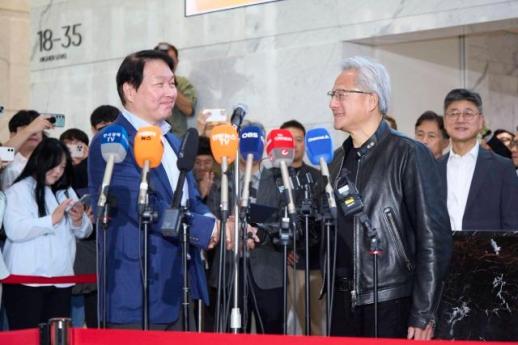 Nvidia's AI Factory Supercycle Boosts South Korean Industry Nvidia CEO Jensen Huang's visit to South Korea signals a potential expansion of the artificial intelligence (AI) supercycle from memory semiconductors to the AI factory sector. Companies are expected to enter a significant phase of benefiting from AI in data centers, robotics, and manufacturing. On June 8, Huang met with leaders from major South Korean corporations, including SK, Hyundai, and LG, to discuss AI collaboration strategies. During his visit, he engaged with the local business community in informal settings, such as enjoying Korean barbecue and chicken, while also outlining specific collaboration plans with each group. Notably, Nvidia does not view South Korea solely as a supplier of high-bandwidth memory (HBM). Analysts suggest that the capabilities of South Korean companies in memory, telecommunications, manufacturing, robotics, and internet platforms align well with Nvidia's next-generation AI strategy. The partnership with SK is evolving beyond traditional HBM supply to include possibilities for AI infrastructure and AI cloud collaboration. LG, with its strong presence in home appliances, automotive components, batteries, displays, and smart factories, is well-positioned for collaboration. Nvidia has identified physical AI, which applies AI to real-world robotics and factories, as a key growth driver, suggesting an increasing intersection with LG's operations. Doosan and Naver are also included in Nvidia's plans to expand the AI ecosystem in South Korea. Doosan is expected to partner in robotics and semiconductor materials, while Naver is set to expand its partnership in building large-scale AI factories and cloud infrastructure. Industry insiders note that Huang's direct joint announcements with South Korean companies are unusual, indicating a reassessment of South Korea as a testing ground for AI factories. An industry source stated, "Huang's visit demonstrates that collaboration with South Korean companies is expanding beyond HBM to include data centers, robotics, and manufacturing AI in the AI factory sector. From Nvidia's perspective, South Korea is a rare partner with both memory and manufacturing capabilities."* This article has been translated by AI. 2026-06-08 18:21:00
 -
 K-Memory Expansion: Demand Surge in Supercomputers, PCs, and Robotics The demand for memory semiconductors is rapidly expanding beyond AI data centers to encompass supercomputers, AI PCs, and robotics, driven by the proliferation of artificial intelligence (AI). The applications for advanced K-memory, which has primarily focused on AI accelerators like graphics processing units (GPUs), are expected to broaden significantly.On June 8, Jensen Huang, CEO of NVIDIA, emphasized the importance of Korean memory semiconductors during his third day in South Korea. All four new products recently unveiled by NVIDIA require substantial memory input. The next-generation AI accelerator, 'Vera Rubin,' will utilize a vast amount of high-bandwidth memory (HBM), while the new central processing unit (CPU) 'Vera' and the AI PC platform 'RTX Spark' will be equipped with a significant amount of low-power, high-performance DRAM (LPDDR5). The robotics platform 'Jetson Thor' is also in the process of developing customized memory.During a dinner meeting on June 5 in Hongdae, Huang stated, "Next year, four new products will be launched simultaneously, and we will need a lot of Korean memory semiconductors," adding, "We will strengthen our partnerships with Korean companies like SK Hynix and Samsung Electronics."A particularly noteworthy area is physical AI. As robots and autonomous manufacturing systems become more widespread, the demand for memory to support real-time data processing and AI inference will inevitably increase. According to a report from the Korea Automotive Technology Institute, the current DRAM capacity used in standard vehicles is around 16GB, but level 4 technology could require up to 300GB, with similar capacities expected for robots.AI factories are also emerging as significant demand sources. As AI systems increasingly control overall factory operations, the demand for memory in data centers, robots, and edge devices is expected to surge. The need for HBM, as well as DRAM for CPUs, LPDDR, and memory for robots, positions these technologies as key infrastructure driving next-generation memory demand.The collaboration between SK Hynix and NVIDIA to co-develop next-generation memory is seen as a proactive strategy to respond to this market expansion. Their partnership, which initially focused on HBM, is now extending into the realm of customized memory semiconductors for physical AI and AI factories. Huang remarked, "SK is our largest memory partner," and noted that they are jointly designing a roadmap to advance NVIDIA's architecture and SK's memory technology.* This article has been translated by AI. 2026-06-08 18:18:00
 -
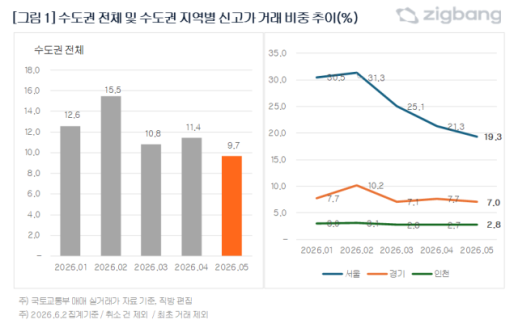 Percentage of Record High Apartment Transactions in Seoul Area Falls Below 10% The proportion of record high apartment transactions in the Seoul metropolitan area has fallen below 10% for the first time this year. The increase in land transaction permit zones and stricter loan regulations have led to a heightened wait-and-see attitude, particularly in high-priced districts of Gangnam. However, record high transactions continue in semi-core areas of Seoul and around the semiconductor industry belt in Gyeonggi Province, highlighting a growing regional polarization. According to an analysis of apartment sales transaction data from the Ministry of Land, Infrastructure and Transport by Zigbang, the proportion of record high transactions in the metropolitan area was recorded at 9.7% in May, the lowest level this year. The decline in the proportion of record high transactions is attributed to the dampened buying sentiment following the expansion of land transaction permit zones and stringent loan regulations implemented after the real estate measures of October 15 last year. Additionally, the upcoming expiration of the tax exemption for multiple homeowners on May 9 led to a release of some urgent sales, further impacting the decrease in record high transactions. By region, Seoul's record high transaction proportion fell to 19.3%, down 2 percentage points from the previous month (21.3%), while Gyeonggi Province decreased from 7.7% to 7.0%. In contrast, Incheon saw a slight increase from 2.7% to 2.8%. The proportion of record high transactions in Seoul has declined for three consecutive months, dropping from 31.3% in February to 25.1% in March, 21.3% in April, and now 19.3% in May. The number of record high transactions has also decreased. In Seoul, the number of record high transactions exceeded 1,000 each month, but fell to 864 in May, with total transactions at 4,467, below the recent three-month average of 6,563 (February to April). Notably, the decline in Gangnam has been pronounced. The proportion of record high transactions in Gangnam District dropped to 19.3%, a decrease of 31.1 percentage points compared to the same period last year. Seocho District recorded 33.8% (-14.3 percentage points), and Yongsan District reported 26.4% (-9.0 percentage points). Conversely, Yeongdeungpo District (41.2%), Dongjak District (35.3%), and Dongdaemun District (31.8%) saw their proportions of record high transactions increase by around 20 percentage points or more compared to the previous year. The average transaction prices in these areas were 1.29 billion won in Yeongdeungpo, 1.5 billion won in Dongjak, and 1.11 billion won in Dongdaemun, indicating active transactions in the 1 billion to 1.5 billion won range. The relatively lower impact of loan regulations and the ongoing transition from jeonse (long-term rental) to purchase contributed to the increase in record high transactions. Additionally, the overall proportion of record high transactions in Gyeonggi Province was 7.0%, down 0.7 percentage points from the previous month, but significant regional differences were evident. Guri City saw a record high transaction proportion of 21.1%, an increase of 18.9 percentage points compared to the previous year, while Suji District in Yongin also rose to 19.4%, up 16.1 percentage points year-on-year. Notably, Dongtan District in Hwaseong recorded a record high transaction proportion of 12.0%, marking six consecutive months of growth. Dongtan is considered a key residential area for the southern Gyeonggi semiconductor industry belt, housing Samsung Electronics' Hwaseong and Giheung campuses, as well as ASML's Hwaseong campus. The real estate market in Icheon is also showing signs of activity. According to the Ministry of Land, Infrastructure and Transport's real transaction disclosure system, the total real estate transaction volume in Icheon (including apartments, multi-family dwellings, and officetels) increased by 17.7%, from an average of 626 transactions per month in the second half of last year to an average of 737 transactions from January to April this year. Additionally, the 'Icheon Lotte Castle Ferraz Sky' recorded a transaction price of 620 million won for a 84 square meter unit last June, setting a local record. Currently, the metropolitan market is experiencing a coexistence of a wait-and-see attitude in high-priced Gangnam complexes and strong performance in areas with good access to the semiconductor industry belt and Seoul, leading to deepening polarization. Industry experts are closely monitoring whether this differentiated trend will continue following the local elections in June, depending on real estate policies, interest rates, and household debt management strategies.* This article has been translated by AI. 2026-06-08 18:18:00
 -
 Data Breaches at Tving and CU Prompt Anticipation of Coupang Penalties Concerns over data breaches have resurfaced following incidents involving the online streaming service Tving and the convenience store CU. According to industry sources, investigations are underway into Tving and BGF Networks, which operates CU, for large-scale personal information leaks. Attention is also focused on proposed amendments to the Personal Information Protection Act being pushed by the Personal Information Protection Commission (PIPC). The PIPC recently received a report of a data breach from Tving and has initiated an investigation. The leaked information is believed to include user IDs, names, birth dates, genders, mobile phone numbers, email addresses, linked information (CI), duplicate membership verification information (DI), refund account numbers, and passwords. BGF Networks has also confirmed signs of customer information being leaked and is currently responding to the situation. The leaked data includes user IDs, passwords, names, birth dates, genders, addresses, emails, and mobile phone numbers. The industry is particularly concerned about the CI leak. CI is a unique identifier generated by identity verification agencies, used to confirm the identity of individuals without directly storing their resident registration numbers. Past data breaches, including those involving Coupang and Lotte Card, have also included CI information. While individual incidents may have limited impact, the combination of multiple breaches can significantly increase risks. Security experts warn that if the leaked information is interconnected, it could reconstruct individuals' consumption patterns, preferences, and personal information. For instance, if previously leaked shopping history data is linked with Tving's content usage information through the same CI, it could largely identify an individual's online activities. If this is combined with address or contact information, the risk of secondary crimes such as voice phishing or smishing could increase. In light of these concerns, the PIPC has proposed amendments to the Personal Information Protection Act that would allow fines of up to 10% of a company's total revenue for repeated and serious data breaches. Previously, the maximum fine was capped at 3% of total revenue. This aims to impose punitive fines on companies that neglect data protection and encourage investment in security measures. The amendments are set to take effect on September 11, and the PIPC is currently in a public consultation period. Some in the industry believe that the proposed amendments could lead to discrimination against domestic companies. Coupang is a prime example. The PIPC plans to determine the final penalty for Coupang's data breach during a plenary meeting on June 10. Under the current law applicable at the time of the breach, the maximum fine could exceed 1 trillion won, capped at 3% of total revenue. However, the U.S. government has expressed concerns that imposing penalties on Coupang could disadvantage American companies, suggesting that the actual penalty may be lower. Legal experts estimate that the fine imposed on Coupang could range from 300 billion to 400 billion won. As a result, there are fears that the proposed amendments to increase fines could lead to discrimination against domestic companies. Enforcement against global platform operators is challenging, while domestic firms may bear a heavier regulatory burden. The outcome of Coupang's penalties is expected to set a precedent for future data breach incidents. Park Chun-sik, a former professor of cybersecurity at Ajou University, stated, "While it is necessary to strengthen responsibilities for data protection, if the perception arises that only domestic companies are bearing excessive burdens, it could lead to allegations of discrimination. A policy that encourages both stricter penalties and increased security investment by companies should be implemented concurrently."* This article has been translated by AI. 2026-06-08 18:18:00
 -
 Jensen Huang: AI Factory Demand Surges as SK, Hyundai, LG, Doosan Form Alliances "We need to build more AI factories," Jensen Huang, CEO of NVIDIA, succinctly summarized his visit to South Korea, which lasted four days. On the final day, June 8, during a visit to SK's headquarters in Seoul, he emphasized, "There is tremendous demand for more AI factories globally, and business is booming." Huang met with major South Korean companies, including SK, LG, Hyundai Motor, and Doosan, to discuss AI collaboration strategies. In the morning, he met with Chey Tae-won, Chairman of SK Group, at SK's headquarters, followed by a meeting with Kwon Bong-seok, Chairman of LG Group, at LG Twin Towers in Yeouido. In the afternoon, he visited Hyundai Motor Group's office in Yangjae to meet with Chairman Chung Eui-sun, and the day before, he expanded discussions with Park Jung-won, Chairman of Doosan Group, at Jamsil Baseball Stadium. SK and NVIDIA agreed to expand their collaboration centered on high-bandwidth memory (HBM) as part of the next-generation AI factory infrastructure. SK Hynix will work with NVIDIA to co-develop next-generation memory for AI factories and collaborate on memory development for the Vera Rubin AI supercomputer, Vera CPU, RTX Spark PC, and Jetson Thor robotic computing platform. Huang stated, "AI factories are the engine of the next industrial revolution, and advanced memory is key to their performance. We will jointly develop next-generation memory for AI factories and support the acceleration of infrastructure expansion from frontier model training to agentic AI and physical AI." NVIDIA and LG will strengthen their collaboration in robotics, AI infrastructure, and autonomous manufacturing. LG Electronics plans to develop humanoid and logistics robots based on NVIDIA's robotics platform, Isaac Groot. LG Innotek will focus on developing sensing modules and optical components for robots, while LG CNS will integrate NVIDIA technology into its industrial robot platform, PhysicalWorks. The two companies will work together to create a physical AI ecosystem, including AI model development, robot training and operation, and digital twin construction. Huang noted, "Through NVIDIA's digital twin supercomputing matrix and physical AI platform, LG will be able to expand beyond homes and vehicles into factories and AI infrastructure." With Hyundai Motor Group, discussions focused on collaboration in autonomous driving and robotics related to physical AI. Chairman Chung reportedly explained the Saemangeum project to Huang and proposed participation in AI and data center initiatives. Hyundai is considering developing the Saemangeum area as a future industrial hub combining AI, data centers, and eco-friendly energy infrastructure. Huang toured Hyundai's Yangjae office, where he viewed the hydrogen fuel cell vehicle Nexo, an automated hydrogen charging robot, purpose-built vehicles (PBV) PV5, and Boston Dynamics' four-legged robot, Spot. With Doosan, the potential for collaboration in enhancing AI factory infrastructure and robotics was highlighted. Huang met with Park Jung-won at Jamsil Baseball Stadium the previous day to discuss linking Doosan's key businesses, such as energy, electronic materials, and collaborative robots, with NVIDIA's AI platform. Industry analysts suggest that Huang's visit signals a shift in collaboration between NVIDIA and South Korean companies from memory supply chains to AI factories, robotics, autonomous driving, and smart manufacturing. This direct engagement by NVIDIA with major South Korean manufacturers indicates a strategic pivot towards data centers and real-world industrial applications following the growth of AI semiconductors. 2026-06-08 18:18:00
 -
 Naver and NVIDIA Formalize Global AI and Robotics Alliance Jensen Huang, CEO of NVIDIA, announced a formal partnership with Naver to establish a global AI factory, focusing on three key areas: building frontier AI models, collaborating on AI cloud infrastructure, and developing a robotics-based future business environment. According to the IT industry on June 8, Huang visited Naver's headquarters in Seongnam at 3:45 PM, where he met with Lee Hae-jin, Chairman of Naver's Board, and CEO Choi Soo-yeon. The lobby of Naver 1784 was filled with employees eager to see Huang. Before his arrival, Lee and Choi waved to the gathered staff. The atmosphere heightened as the announcement of the agreement to jointly build a gigawatt-scale global AI factory was made. Upon Huang's arrival, Lee welcomed him with a hug. Following the greeting, Huang and Lee discussed future collaboration, including the establishment of the global AI factory. Huang stated, "The reason NVIDIA collaborates with many companies in Korea is that there are many excellent firms here. Naver's capabilities in software are remarkable. I believe Naver's software, cloud, and AI technologies are outstanding. In fact, NVIDIA and Naver jointly developed Korea's first AI model, which we are proud to say is world-class technology." In addition to the global AI factory project, NVIDIA and Naver will collaborate on building an open frontier AI model based on the Nemotron framework. They plan to develop robotic systems over the next decade to create a robotics-based future business environment. Huang remarked, "I saw a robot delivering iced coffee upstairs. In the future, a robot will come when called and deliver coffee. This is the vision of future businesses." He emphasized, "Dreams are becoming reality." Lee highlighted Naver's unique position in the AI factory landscape, stating, "We were the first company to introduce NVIDIA's GPUs to build a SuperPOD and have invested early in this area. Naver already operates its own data center. In the current market, Naver is the only company capable of meeting rising demand." He added, "A gigawatt-scale data center is enormous, and this is a significant opportunity for Naver. No other company has the experience and technology to undertake such a project." Huang also discussed the goals of the Nemotron alliance, stating, "The purpose of Nemotron is to expand the reach of AI and support areas that closed models cannot address. NVIDIA will combine its expertise in AI model development and frontier AI advancement with Naver to build top-tier frontier models. Naver will optimize and enhance these models for its cloud, robotics, and services." Recently, Naver became the first domestic company to join the 'NVIDIA Nemotron Alliance,' which includes 12 global AI firms such as MistralAI and Purplecity. Naver is accelerating the enhancement of 'HyperCLOVA X' by combining its own data and accumulated learning data with the joint technological development outcomes of Nemotron. Huang noted, "Korea is world-class in various fields, including manufacturing, heavy industry, electronics, and software. I want to emphasize that such a country is rare in the world. Naver is an excellent partner in AI and robotics. Together with Naver, NVIDIA will lead the world in AI and robotics partnerships." The collaboration with Naver aligns with NVIDIA's goal of expanding its AI infrastructure ecosystem across Asia, the Middle East, and Europe. Emphasizing sovereign AI, NVIDIA's direction aligns with Naver's capabilities in AI infrastructure. This alliance will enable Naver to build an AI data center four times the size of the current largest data center in the country, propelling it to a global scale. Naver will initially use its hyperscale data center in Sejong as a base to implement a phased roadmap for building gigawatt-scale infrastructure. The plan starts with 55 megawatts (MW) in the first half of next year, followed by 100 MW in the same year, and expanding to 200 MW by 2028 to meet global demand. Huang appeared on Naver's streaming platform 'Chijijik,' stating, "NVIDIA and Naver have collaborated based on a long-standing friendship. Naver is Korea's first cloud and AI company, and our partnership has been a treasured asset for me over the years." Meanwhile, Huang mentioned that during his visit to Korea, he was given the name 'K-Jensen' at an event held at Seoul National University.* This article has been translated by AI. 2026-06-08 18:15:00
 -
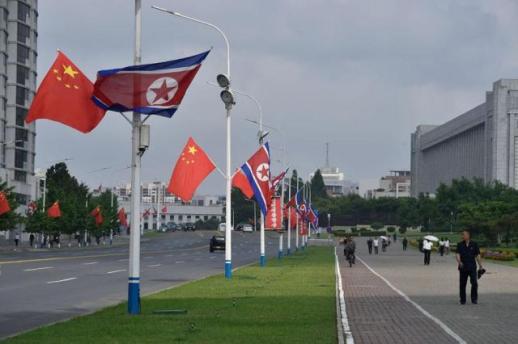 Experts urge 'peaceful coexistence' strategy at timely forum as Xi visits Pyongyang SEOUL, June 8 (AJP) - "South Korea should become a country that designs the agenda and conditions that force North Korea and the United States to meet again, rather than a country waiting for a North Korea-U.S. summit." A forum hosted by a South Korean parliamentary research group, which coincided with Chinese President Xi Jinping's visit to Pyongyang on Monday, called for Seoul to pursue a strategy of "peaceful coexistence" with North Korea amid the shifting dynamics of U.S.-China relations and growing uncertainty surrounding the Korean Peninsula. The forum was held at the National Assembly in Seoul and organized by the Northeast Asia Peaceful Coexistence Forum, a parliamentary study group led by Unification Minister Chung Dong-young. In his opening remarks, Chung said, "The tectonic plates surrounding the Korean Peninsula are shifting violently." He described the event as a gathering where some of South Korea's leading experts would discuss what kind of peaceful coexistence strategy Seoul should pursue toward North Korea amid the changing international situation. Chung added that he viewed the discussion as a "very solemn opportunity to hold an important debate at an important moment." Former Unification Minister Kim Yeon-chul said the forum was "timely." "Only by comprehensively evaluating the U.S.-China summit can we discuss the significance of Xi's visit to North Korea today within the broader context of the U.S.-China summit," Kim added. Choi Jong-kun, a professor of political science and international relations at Yonsei University and one of the presenters at the forum, argued that the recent Beijing summit between U.S. President Donald Trump and Xi represented a framework for "managed stabilization" rather than a comprehensive breakthrough in bilateral relations. According to Choi, the summit followed earlier face-to-face meetings between Trump and Xi in Busan in October 2025 and in Beijing in May 2026, reflecting a mutual recognition that neither side could overwhelm the other and that direct confrontation would impose heavy costs on both countries. "The core phrase of the summit was a 'constructive U.S.-China relationship of strategic stability,'" Choi said. He said Washington emphasized transactions and trade outcomes, while Beijing focused on order and red lines, particularly on Taiwan. Choi said the summit did not restore free trade or produce a "big deal," but instead marked the emergence of “managed trade” involving selective easing and continued tariff pressure. He also argued that the Korean Peninsula had become a secondary issue in U.S.-China relations. "The Korean Peninsula agenda has been structurally pushed down the priority list," Choi said. "This is the most uncomfortable but most important reality for South Korea." Choi said the absence of a new North Korea-U.S. summit was not accidental but reflected structural conditions, including the unresolved clash between denuclearization and regime survival, North Korea's changed negotiating calculus after the collapse of the 2019 Hanoi summit, deepening ties between Pyongyang and Moscow, and Washington's broader strategic distractions. He warned that Taiwan-related tensions could directly affect security conditions on the Korean Peninsula, saying a crisis in the Taiwan Strait could simultaneously involve U.S. forces in South Korea and Japan, Japan's security role and North Korean military opportunism. Choi argued that a strategy of peaceful coexistence with North Korea did not amount to abandoning unification but rather establishing the minimum conditions necessary to make future unification possible. He called for restoring mechanisms to reduce military risks, including communication channels and measures to prevent accidental clashes, and urged broader non-state engagement with North Korea through local governments, civil society, culture and sports exchanges. Min Jeong-hun, a professor at the Korea National Diplomatic Academy's Department of North American and European Studies and another presenter at the forum, said the Trump administration's recent military actions against Iran were difficult to justify as an immediate security necessity because Tehran did not possess deployable nuclear warheads or long-range missiles capable of directly striking the U.S. Min said the Trump administration's China policy in its second term was expected to pursue "competitive coexistence," maintaining pressure on Beijing while managing economic and trade relations to maximize U.S. interests. He said the goal of strategic competition was not to defeat China outright but to preserve U.S. superiority by constraining China's rise. Min described the recent U.S.-China summit as focused primarily on managing bilateral ties and reducing friction in trade and economic areas. He noted that both countries agreed to pursue a "constructive relationship of strategic stability" based on fairness and reciprocity and said planned future meetings between Trump and Xi could help stabilize relations through what he described as "shuttle diplomacy." Min said China's reaffirmation of its hard-line stance on Taiwan was one of Beijing's key achievements at the summit, while Trump maintained strategic ambiguity by avoiding direct public confrontation over the issue. He said the summit underscored the need for South Korea to recalibrate its strategic position between Washington and Beijing based on a "pragmatic diplomacy centered on national interests." Min also called for South Korea to strengthen cooperation with the United States and other advanced economies in strategic industries and technology while simultaneously expanding practical cooperation with China in economic and cultural areas. He said Seoul should continue communication with Beijing on North Korea-related issues and work toward a more reciprocal and future-oriented alliance with the United States. Min added that South Korea should play an active "pace maker" role in helping restart dialogue between Washington and Pyongyang and in facilitating meaningful progress in future negotiations. Asked by AJP about the outcomes of Xi's visit to North Korea, Chung replied, "Let's wait and see." Meanwhile, North Korean leader Kim Jong-un made a rare public appearance at an airport to welcome Xi, who arrived in Pyongyang on early Monday afternoon for a two-day visit, the first in nearly seven years. 2026-06-08 18:12:34
 -
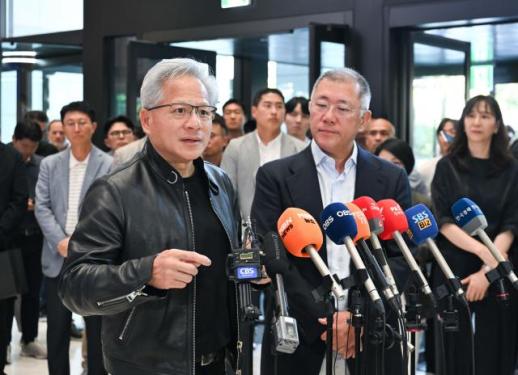 Jensen Huang Highlights South Korea's AI Valley at Saemangeum Project Jensen Huang, CEO of NVIDIA, responded positively to Hyundai Motor Group's proposal for the Saemangeum project. The two companies have agreed to expand their collaboration beyond autonomous driving to include robotics and AI factory development. Huang made these remarks on June 8 after a closed-door meeting with Hyundai Motor Group Chairman Euisun Chung at the company's headquarters in Yangjae, Seoul. "Chairman Chung and I are very good friends," Huang said. "The two companies have collaborated in the autonomous driving sector for several years, and we are now expanding our partnership to include robot taxis, autonomous mobility, robotics, and AI factories." He praised Hyundai's capabilities, stating, "Hyundai has incredible strengths in manufacturing, mobility, and heavy industry. There is no company better positioned than Hyundai in the era of robotics, which is the next evolution of AI." The Saemangeum project was a key topic during their meeting. Hyundai Motor Group plans to invest approximately 9 trillion won (about $7.5 billion) from this year until 2029 to develop Saemangeum into a future energy city. Huang referred to Saemangeum as an "AI Valley," expressing his interest in the initiative. He remarked, "If there is Silicon Valley in the U.S., South Korea is creating an AI Valley. AI will be a very important technology for this region." He added, "Chairman Chung invited NVIDIA to establish a presence in Saemangeum. If there is great barbecue, I would gladly build NVIDIA in Saemangeum." Huang also emphasized the need to expand South Korea's AI infrastructure. He stated, "Currently, the AI infrastructure in Korea is insufficient to meet the demands of researchers, startups, and large corporations. In the future, there will be a significant need for large-scale AI factories."* This article has been translated by AI. 2026-06-08 18:09:00