

Journalist

KI SU JEONG
-
 Elected Officials Begin Transition Preparations Following Local Elections Elected officials from the recent local elections have begun preparations for their terms. On June 4, they received their certificates of election, formalizing their status as elected officials, and some have started forming transition teams. According to the National Election Commission, local election offices began issuing certificates to elected officials on this day. Choo Mi-ae, who made history as the first female governor of Gyeonggi Province, paid her respects at the Hyeonchung Tower in Suwon during her first official schedule in the morning and received her certificate from the Gyeonggi election commission in the afternoon. Incheon Mayor-elect Park Chan-dae also attended the certificate presentation ceremony at the Incheon election commission. Choo Kyung-ho, the newly elected mayor of Daegu, and Kim Sang-wook, the newly elected mayor of Ulsan, both received their certificates from their respective local election offices, officially confirming their election. Min Hyung-bae, the first integrated mayor of Gwangju, paid respects at the May 18th National Cemetery in the morning and received his certificate from the Gwangju election commission in the afternoon. Incumbent leaders who challenged for re-election, including Lee Cheol-woo, the newly elected governor of North Gyeongsang Province, and Park Wan-soo, the newly elected governor of South Gyeongsang Province, also received their certificates and returned to their offices. Some elected officials have begun forming transition teams. Under Article 105 of the current Local Autonomy Act, governors can establish transition teams with up to 20 members. The teams can operate for 20 days after the start of the local government term, allowing them to function until July 20. Woo Sang-ho, the newly elected governor of Gangwon Province, appointed former Gangwon Vice Governor Choi Heung-jip as the head of his transition team, beginning the groundwork for his administration. Daejeon Mayor-elect Heo Tae-jung has designated Park Jeong-hyun, the head of his campaign, as the transition team leader. However, the certification for the Seoul mayoral election has been delayed due to uncounted ballots. Incumbent mayor Oh Se-hoon, the candidate from the People Power Party, staged a dramatic comeback on the morning of June 4, defeating Democratic Party candidate Jeong Won-o. After trailing by more than 10 percentage points early in the counting, Oh overtook Jeong around 7:16 a.m. and maintained his lead to secure victory. Nonetheless, the opening of two ballot boxes at the second polling station in Jamsil 7-dong, Songpa District, has been postponed, preventing the issuance of his certificate. As of 5:15 p.m. on the same day, the vote count for the Seoul mayoral election stood at 99.54%. The Seoul election commission stated, "We cannot confirm the election of the Seoul mayor as the ballots are still being counted." 2026-06-04 17:21:00
 -
 Cannes Highlights Hirokazu Kore-eda's New Film 'The Sheep in the Box' Exploring Family in the AI Era Korean filmmaker Hirokazu Kore-eda, celebrated at Cannes, questions the meaning of family through the coexistence of humans and humanoids in his latest film, 'The Sheep in the Box.' Known for exploring relationships beyond blood ties in works like 'Shoplifters' and 'Monster,' Kore-eda delves into themes of love, loss, and the complexities of living together in this new project.On June 4, a press screening and conference for 'The Sheep in the Box' took place at Megabox COEX in Gangnam, Seoul. Kore-eda and actress Rimu Kuwaki attended the event to discuss the film.'The Sheep in the Box' tells the story of a 7-year-old humanoid that enters a household to replace a deceased child, exploring the joy of becoming a family and the anxiety of potential abandonment. This film marks Kore-eda's tenth entry into the Cannes Film Festival, where it has been invited to compete in the official selection.Kore-eda cited the rise of generative artificial intelligence (AI) as a catalyst for the film's concept. He explained, "The idea for the film came about two years ago. I heard about a business in China that uses generative AI to resurrect deceased individuals. During a work trip to China, I met the founder of this business, who showed me how they create AI representations using photos and videos left on the deceased's phones. This inspired the film's narrative."Kore-eda expressed curiosity about how audiences would receive the film, stating, "This is not a story where everyone lives happily ever after. It shows the remaining children and the departing adults, who do not know how the humanoid children will live. They will have to imagine and feel what is invisible. I wanted to convey that imagination to the audience."He emphasized that the relationship between humans and humanoids should not be viewed merely as a conflict between technology and humanity. Instead, he connected it to the dynamics of marriage, noting, "I thought about how difficult and interesting it is for two different beings to coexist. Just as glass and wood can harmonize, I wanted to express the coexistence of humans, plants, and humanoids in various ways. In the film, the mother who lost her child regrets harsh words spoken to her child, while the father regrets things left unsaid. They start as a couple with different regrets but live together in the same box, imagining their lost child, Kakeru. I wanted to convey something through the relationships of these disparate beings."At the center of the film is Rimu Kuwaki, who was selected from a competitive pool of 200 candidates. Kore-eda shared that he made the casting decision based on his first impression, saying, "I had a gut feeling about this child."He added, "We held multiple auditions, and the final decision was made with the consensus of the entire staff. The pivotal moment was a scene in the bathhouse towards the end of the film, where she acted alongside Daigo, who plays Kensuke. That performance solidified my decision to cast her."Kuwaki recalled the moment she learned she got the role, saying, "My family jumped for joy together. My dad, mom, and sister cried a lot. At first, I thought, 'Why are they crying so much?' But later, after my mom explained, I was so happy that I almost cried too."Kuwaki also praised Kore-eda's directing style, stating, "He told me to act naturally, to be myself. Other directors often give specific instructions, but Kore-eda made it comfortable by saying to just be yourself. He joked that it was okay to do it casually, but I think it was more than that."Kore-eda explained that he aimed to draw out natural performances from the young actors rather than giving detailed directions. He said, "In fact, there was no directing or instruction regarding the actors' performances. We practiced while Daigo and Kuwaki were conversing and waiting. Ayase also joined in, and when the atmosphere was right, we started filming."He praised Kuwaki's quick thinking, noting, "She has a rare quality. After the first take, she had the ability to change the mood or dialogue in the second take, showing a playful sense and adaptability. She acted with great enjoyment, which made me feel she was not just a child actor."Kuwaki's improvisation impressed Kore-eda, who recalled a scene in the bathhouse where she says, 'Please keep it a secret.' He noted, "There’s a line where she asks, 'What should I do?' while teasing her dad, and that was not something I directed. I was surprised she delivered it that way."In closing, Kuwaki expressed her gratitude, saying, "Thank you for watching 'The Sheep in the Box.' I believe this film is about love. It’s a movie that makes you think and reflect multiple times. I hope you watch it thoughtfully."Kore-eda also encouraged viewers to imagine the unseen elements of the film, stating, "Movies are made from what is visible, but the unfilmed parts are also important. Just as architecture suggests that the essence lies in the unseen, I was conscious of that while making this film."He added, "While the film shows various visible elements like forests and instant noodles, I hope you also imagine what is not visible."Meanwhile, 'The Sheep in the Box' is set to be released in South Korea on June 10.* This article has been translated by AI. 2026-06-04 17:18:00
 -
 Hyundai Home Shopping Expands Offline Beauty Store 'Coasis' Hyundai Home Shopping is expanding its offline beauty business by opening new Coasis stores. This move comes as the TV home shopping market faces structural growth challenges, prompting the company to diversify its customer engagement strategies beyond broadcasting.According to industry sources, Hyundai Home Shopping will open its third Coasis location at Hyundai Outlet Garden Five in Songpa-gu, Seoul, on June 5, followed by a store in Dongdaemun on June 12. This expansion adds two new locations just two weeks after the opening of the second store at Hyundai Department Store in Gangdong-gu on May 29.Ahead of the opening of the third store, a white barrier was installed on the first floor of Hyundai Outlet Garden Five, featuring the slogan, "Making Your Beauty Journey Special," as final preparations were underway.Hyundai Home Shopping opened its first Coasis store in December 2025 at Hyundai Premium Outlet Space One in Namyangju, Gyeonggi Province. While Coasis operates similarly to beauty edit shops like CJ Olive Young, its target demographic differs. Olive Young primarily attracts customers in their teens and twenties, whereas Coasis focuses on women aged 30 to 60. As a result, the store prominently features functional skincare products addressing issues like pigmentation, wrinkles, and elasticity, with over 90% of its offerings being skincare items.The store layout is designed with middle-aged customers in mind. For instance, the height of display counters has been lowered to below 90 cm to facilitate easier browsing for customers in their 40s and 50s. Additionally, at the Cheonho store, testing products that were previously scattered throughout the store have been consolidated in one area to minimize customer movement, contrasting with the typical beauty shop layout where testing products are placed in front of each product row.The expansion of Coasis is closely linked to the slowdown in the TV home shopping market. According to the Korea TV Home Shopping Association, the total transaction amount for Hyundai Home Shopping and six other TV home shopping companies was 18.505 trillion won last year, a 5.1% decrease from the previous year. The average annual growth rate over the past five years has also been recorded at -4.2%. Additionally, due to declining TV viewership, broadcast revenue has dropped to 2.618 trillion won.In response, Hyundai Home Shopping is shifting away from a broadcasting-centric business model to diversify its channels both online and offline. Han Kwang-young, CEO of Hyundai Home Shopping, stated at a shareholders' meeting in March 2025, "We will seek to reach customers through various methods, not just broadcasting and online, by expanding our sales channels." He reiterated this commitment in March 2026, emphasizing the need to further expand offline customer engagement.With Han's vision to develop Coasis into a regional beauty landmark, Hyundai Home Shopping is expected to continue its store expansion. A company representative noted, "We will open two additional stores at Hyundai Outlet this month and are continuously reviewing future expansion directions."* This article has been translated by AI. 2026-06-04 17:18:00
 -
 Korea's K-Tech Demo Day Held in New York to Boost U.S. Market Entry for SMEs The Korea SMEs and Startups Agency is enhancing financial support for small and medium-sized enterprises (SMEs) entering the U.S. market. On June 2, the agency held the "K-Tech Demo Day" in Manhattan, New York, showcasing 12 domestic tech service SMEs. The event attracted over 200 attendees, including representatives from global venture capital firms and investment banks such as Third Prime and JPMorgan Chase, as well as officials from the New York City Economic Development Corporation, the New Jersey Economic Development Authority, and the Brooklyn Chamber of Commerce. The morning session featured investment presentations (IR pitching) from the 12 startups, along with one-on-one investment consultations. The afternoon included discussions on local government support policies for businesses, financial support programs from local banks, strategies for attracting U.S. venture capital investment, and a panel discussion featuring Korean entrepreneurs in the K-beauty, food, and tech sectors. Earlier this year, in January, the agency opened the "K-Startup Center Silicon Valley" to assist domestic startups in expanding into the U.S. market and increasing exports. Park Il-cheol, a commercial attaché at the Korean Consulate General in New York, stated in his remarks, "Our overseas missions and local public institutions are working as a united team to actively support the entry of our SMEs into the U.S. market. I will ensure that this event serves as a successful example of our government's support for the global expansion of SMEs through collaborative efforts." Park Jang-hyuk, the agency's global growth director, emphasized, "This event is focused on providing practical assistance for attracting U.S. venture capital investment for promising domestic tech service SMEs. We will continue to strengthen connections with local investors, banks, and government agencies to expand financial support for domestic companies entering the U.S. market."* This article has been translated by AI. 2026-06-04 17:18:00
 -
 Baekdabang Launches Two New Baumkuchen Flavors Filled with Cheese and Custard Cream Daebong Korea's coffee brand Baekdabang has introduced two new dessert items, the 'Cheese Holic Baumkuchen' and 'Custard Holic Baumkuchen,' filled with cheese and custard cream, respectively. On June 4, Baekdabang announced the launch of these new flavors, which follow the previously released 'Choco Holic Baumkuchen.' The 'Cheese Holic Baumkuchen' features a rich cheese cream filling that delivers a savory and sweet flavor, while the 'Custard Holic Baumkuchen' is filled with smooth and sweet custard cream, emphasizing a creamy taste. The new products will be available at Baekdabang locations nationwide, excluding some stores, as well as at Baekdabang's Bakery Research Institute. Baekdabang has been accelerating its dessert menu expansion recently. Following the launch of 'Choco Churros Chewy Balls' and 'Corn Chewy Balls' last month, the introduction of the Baumkuchen products further broadens its dessert offerings. A Baekdabang representative stated, "We introduced these new products to expand our dessert menu that pairs well with coffee. We will continue to enhance customer satisfaction through a diverse dessert lineup."* This article has been translated by AI. 2026-06-04 17:18:00
 -
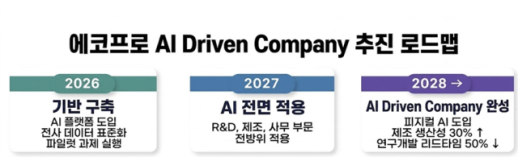 EcoPro Launches Comprehensive AI Initiative Ahead of 30th Anniversary EcoPro has announced its commitment to a company-wide initiative called "AX (AI Transformation)," aiming to integrate artificial intelligence (AI) across all sectors by its 30th anniversary in 2028. On June 4, EcoPro stated that it plans to go beyond using AI as a mere work assistant, applying it comprehensively in manufacturing and research and development (R&D) to drive significant innovation. Notably, the company's Hungarian subsidiary, EcoPro BM, aims to enhance productivity through the introduction of AI-based robotics for operational automation. EcoPro intends to implement a "three-phase roadmap" to become an AI-driven enterprise, leveraging partnerships with leading AI consulting firms. According to the AX three-phase roadmap, EcoPro will establish the foundation for AX this year through company-wide data standardization and pilot projects. Building on this, the company plans to scale up operations next year, with the goal of becoming an AI-driven company by 2028, where AI will facilitate 24/7 operations across all domestic and international subsidiaries. Initially, EcoPro will integrate AI into its R&D sector, aiming to reduce the lead time from R&D to mass production by 50%. Previously, the timeline for product planning to mass production took at least three to five years, but the company plans to cut this duration in half using AI. The introduction of "Physical AI" will also be pursued, with plans to establish autonomous manufacturing plants and laboratories. This implementation is expected to allow robots to take over hazardous tasks, creating a continuous operation and experimentation system that functions 24/7 throughout the year. The production sites will also integrate AI operational systems. The current reliance on workers' experience and intuition will shift to an "AI autonomous control environment" utilizing a manufacturing data platform and machine learning. EcoPro aims to enhance operational efficiency and manufacturing productivity by 30% through the establishment of an "AI autonomous control mother line" in precursor and cathode material calcination lines. AI is expected to analyze and predict defect causes with 95% accuracy and reduce energy consumption by approximately 15-20% through a data-driven predictive maintenance system. Lee Soo-ho, Vice President of EcoPro's AI Innovation Office, stated, "Beyond innovating traditional manufacturing methods, collaboration with AI is now essential. We plan to create an environment where employees can naturally utilize AI as a colleague, thereby improving operational efficiency across the board." Meanwhile, EcoPro BM plans to commence full-scale production at its Debrecen plant in Hungary during the first half of the year. This move aims to directly address the tightening regional regulations, such as the EU Critical Raw Materials Act (CRMA), while strengthening its supply chain and securing new clients among European original equipment manufacturers (OEMs).* This article has been translated by AI. 2026-06-04 17:12:00
 -
 Kyochon F&B Launches Summer Market Popup at Shinsegae Department Store in Daegu Kyochon F&B will host a popup store at the Shinsegae Department Store in Daegu, showcasing its food and beverage brands, including chicken, craft beer, and makgeolli. The popup store, themed 'Summer Market,' will run from June 5 to June 11 on the first basement floor of the Shinsegae Department Store's food hall. This event features a modern reinterpretation of the atmosphere of traditional markets and taverns. Visitors will have the opportunity to sample a variety of Kyochon products, including chicken, makgeolli, craft beer, sauces, and vinegars. Kyochon F&B is expanding its business beyond chicken to include traditional liquors, fermented products, craft beer, and sauces. Participating brands in this event include Kyochon Chicken, craft beer brand Moon Bear, traditional liquor and fermented products brand Fermentation Workshop 1991, sauce specialist BHNBIO, and K&P Food, which produces fermented vinegar and pickled radishes. The event will also feature a set menu that includes Kyochon Chicken's popular side dishes, such as 'Spicy Rice Cake Soup' and 'Wedge Potatoes,' along with boneless chicken. Limited-time menu items like 'Cheongyu Boneless Chicken' and 'Chili and Nacho Boneless Chicken,' which received positive feedback at the popup in April at Hyundai Department Store in Pangyo, will also be available again. Alcoholic beverages will also be offered. Moon Bear will provide craft beer packages and wine beer packages, while Fermentation Workshop 1991 will sell its 'Galaxy' series, 'Galaxy Starry Night,' and APEC set. Additionally, various products showcasing Kyochon’s food culture, including Fermentation Workshop 1991's fermented product sets, BHNBIO's sauce sets, and K&P Food's fermented vinegar, will be available for tasting and purchase at the venue. Following the success of the popup at Hyundai Department Store in Pangyo, which drew long lines, Kyochon F&B plans to further expand customer engagement through this event. The previous popup featured popular pairings like Kyochon boneless chicken with Fermentation Workshop 1991's 'Galaxy Makgeolli,' as well as limited-time menu items that sold out quickly. A Kyochon F&B representative stated, "This popup store is designed to allow customers to experience Kyochon’s diverse flavors in a unique market setting within a department store. We will continue to expand opportunities for customers to engage with various brands and food cultures."* This article has been translated by AI. 2026-06-04 17:09:00
 -
 Choi Seung-ho: Government Would Intervene in Samsung Strike Within 30 Minutes Choi Seung-ho, chairman of the Samsung Electronics Inter-Company Labor Union, is facing criticism for failing to take responsibility following the recent wage negotiation agreement. Concerns have been raised that he is attributing internal dissatisfaction with the agreement to "government pressure" while avoiding resolution of conflicts with the DX division. On June 4, industry sources reported that Choi stated in a recent internal message, "If there is a strike, the government will intervene within 30 minutes, and adjustments reflecting operating profits will be impossible." This suggests that the potential for urgent government intervention influenced the union's decision to accept the provisional wage agreement for 2026. Regarding the postponement of performance bonuses for loss-making divisions, Choi noted, "We provisionally agreed that a one-year delay is the bottom line for the Joint Action Headquarters." He added, "I would like to provide more explanation about the provisional agreement, but I was asked if this could be done within a day." This explanation appears to be a response to internal backlash against the agreement. While a special performance bonus linked to operating profits was established for the DS division, limited compensation was applied to the DX division and some other organizations, leading to increased dissatisfaction within the union. Choi cited potential government intervention and the judgment of the Joint Action Headquarters as reasons for not pushing for stronger demands. However, Choi's use of the term "government intervention" suggests that he was indicating the possibility of the government stopping a strike through urgent mediation, which could lead to arbitration by the Central Labor Relations Commission. Although the mandatory mediation system previously applied uniformly to essential public services has been abolished, the current law still allows for arbitration procedures following urgent mediation. Choi also addressed internal communication, stating, "I will ensure that this does not happen in the future." He mentioned that he would provide additional comments during the staff farewell ceremony, effectively acknowledging that there was insufficient explanation and feedback during the agreement process. The approach to the conflict between the DS and DX divisions has also sparked controversy. After the agreement passed, Choi mentioned the possibility of negotiating separately for DS and DX and proposed a leadership structure of five members from DS and three from DX. While this is framed as a way to reflect the interests of each division, it may be perceived as an attempt to maintain DS-centric outcomes while sidelining DX concerns. Currently, the employee ratio between Samsung Electronics' DS and DX divisions is approximately 60 to 40. However, a five-to-three structure would increase the DS representation to 62.5%. By reducing the overall size of the leadership and limiting DX's representation to three members, the decision-making influence of DX would inevitably diminish. This raises concerns that the proposal may not be a balanced approach but rather a fixed advantage for DS. Choi stated, "We plan to facilitate communication of opinions by organizing staff members by division." However, after drawing lines between DS and DX, the response to DX's backlash appears to be a move towards separation, which has been criticized as lacking integrated leadership. Critics argue that the union chairman, who should mediate conflicts, is instead institutionalizing the conflict structure. The upcoming reappointment general meeting scheduled for June 17 is also a variable. Choi has expressed his intention to seek evaluation from union members, but there are mixed opinions internally about whether the reappointment process is a mechanism for accountability or a political maneuver to maintain his position. Some interpret this as an attempt to reaffirm leadership based on support from the DS division amid the divided interests of DS and DX. Choi's statement that he plans to establish a delegate system starting in 2027 also appears to be a reactive measure. Concerns have been raised through media reports about the lack of internal checks, such as a delegate council, in the operation of the Samsung Electronics union. The decision to introduce a delegate system is seen as a response to these criticisms. However, setting the implementation date for next year suggests an intention to avoid immediate accountability regarding the current agreement and the reappointment process. An industry insider remarked, "Even if there was government pressure, the responsibility for the agreement lies with the union leadership. While separating DS and DX may disperse dissatisfaction in the short term, it could further divide the internal union at Samsung Electronics in the long run."* This article has been translated by AI. 2026-06-04 17:06:00
 -
 Jokuk Resigns as Party Leader After Election Defeat, Takes Responsibility Jokuk, the leader of the Jokuk Innovation Party, announced on June 4 that he would resign from his position following his defeat in the Pyeongtaek by-election. He stated, "I will step down as party leader, taking responsibility for the election results." However, he left open the possibility of re-election, saying he would reflect and prepare for the future. In a Facebook post, Jokuk said, "I will take a moment to pause, but I urge my fellow party members to move forward confidently. I am resigning as party leader today due to the election results." He attributed the election outcome to his shortcomings, stating, "I was unable to open a new path of hope for the dedicated party members who have devoted themselves under the name of the Innovation Party." Jokuk expressed concern about divisions within the broader democratic camp, yet emphasized, "The fact that the Innovation Party remains the third-largest party in the National Assembly has not changed. I urge the new leadership to strengthen the DNA of the Innovation Party even more." He added, "Please ensure a definitive conclusion to the urgent task of prosecutorial reform. Respect each other and unite to walk the path of social reform without wavering. I, too, will reflect on myself and prepare for what comes next." Previously, Jokuk aimed to secure a seat in the National Assembly through the Pyeongtaek by-election. However, he finished third, behind Yoo Yi-dong of the People Power Party and Kim Yong-nam of the Democratic Party, effectively ending his hopes of returning to the legislature. Jokuk was elected as party leader during the second national party convention held on November 23 last year in Cheongju, Chungbuk, marking the beginning of his term.* This article has been translated by AI. 2026-06-04 17:06:00
 -
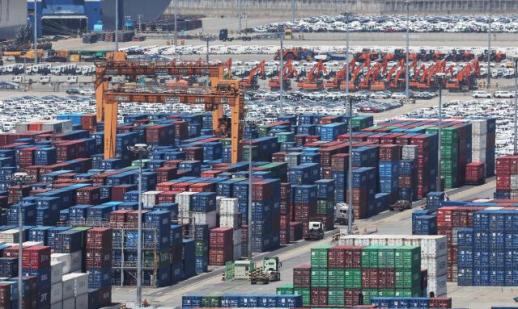 U.S. Tariff Burden on South Korean Companies Drops from 3rd to 6th Place South Korea's ranking in effective tariff rates on exports to the United States has improved since the announcement of the U.S. reciprocal tariff policy in April of last year. In the second quarter of 2025, South Korea ranked third among the top 10 exporting countries to the U.S., but this dropped to sixth place in the first quarter of this year, indicating a reduction in tariff burden. The effective tariff rate is calculated by dividing the tariff amount by the U.S. import value. According to an analysis of customs statistics by the Korea Chamber of Commerce and Industry (KCCI) on June 4, South Korea's exports to the U.S. in the first quarter of this year totaled $36.74 billion, with a tariff amount of $3.2 billion and an effective tariff rate of 8.7%. This rate is significantly lower than China's 26.4%. South Korea ranks sixth among the top 10 exporting countries to the U.S., following India (14.1%), Japan (11.2%), Germany (10.3%), and Vietnam (9.9%). In the first quarter of this year, South Korea's tariff amount on exports to the U.S. was $3.2 billion, placing it seventh among the top 10 exporting countries. The implementation of a 10% general tariff on U.S. imports in April last year and item-specific tariffs on automobiles and parts (25%) and steel and aluminum (50%) peaked in the third quarter. However, following the conclusion of tariff negotiations between South Korea and the U.S. and a reduction in automobile tariffs to 15% in November last year, the burden has decreased. Compared to China, which recorded a tariff amount of $16.58 billion on exports to the U.S., South Korea's performance appears relatively favorable. The effective tariff rate for the automobile sector, which has the highest proportion of tariff amounts among export items, fell significantly from 21.3% in the second quarter of last year to 13.5% in the first quarter of this year. Conversely, the effective tariff rate for steel and steel products, which has the second-highest tariff amount, increased to 42.5% in the first quarter of this year due to the implementation of a 50% item-specific tariff in June last year. In terms of automobile tariffs, South Korea experienced a delay in the application of reductions compared to Germany and Japan. As a result, in the fourth quarter of last year, the gap widened with Germany and Japan, but by the first quarter of this year, South Korea's rate was higher than Japan's (12.5%) but lower than Germany's (14.5%). Regarding steel tariffs, South Korea's low export proportion of raw materials such as pig iron and ferroalloy to the U.S. (only 2%) has resulted in high rates. In contrast, Brazil has a lower effective tariff rate of 20%, attributed to its 52% share of pig iron and ferroalloy in U.S. steel exports, which benefits from lower rates. While it is true that South Korea's tariff burden has eased, uncertainties remain due to the potential for changes in U.S. tariff policy and the still high steel tariff rates. The KCCI stated, "Close monitoring of Section 232 tariff measures related to key export items such as semiconductors is necessary, along with ongoing diplomatic support from the government to resolve tariff uncertainties." It also emphasized the need for policy support to protect domestic production bases and maintain competitiveness in the global market, stating, "Support to enhance our companies' price competitiveness, such as domestic production tax credits and strengthened export financing, should continue, alongside efforts to enhance capabilities through AI transformation in manufacturing over the medium to long term."* This article has been translated by AI. 2026-06-04 17:03:00