
Journalist

Kim SeongSeo
-
 Korean Business Group Welcomes Samsung Electronics Labor Agreement The Korean Employers Federation (KEF) expressed relief on May 20 after Samsung Electronics and its labor union reached a tentative agreement on performance bonuses. The KEF stated, "It is fortunate that an agreement was reached, avoiding the worst-case scenario of a strike." In a statement released around 11 p.m., the KEF noted that the agreement is significant as it reflects both parties stepping back to find common ground amid a challenging business environment characterized by intensified competition in the semiconductor industry and growing uncertainties in the global market. However, the KEF voiced concerns about the potential spread of the union's demands for performance bonuses across the broader industry. The KEF emphasized, "This agreement reflects Samsung Electronics' unique circumstances, and the labor sector should not generalize it to promote excessive demands for performance bonuses across the industry. We hope that both labor and management will use this agreement as a stepping stone to quickly resolve uncertainties and establish a rational labor-management relationship." Samsung Electronics and its labor union dramatically signed the tentative agreement about an hour and a half before the union's planned general strike on May 21. The union has decided to postpone the strike and will conduct a vote among its members on the tentative agreement from May 22 to May 28.* This article has been translated by AI. 2026-05-20 23:33:45
 -
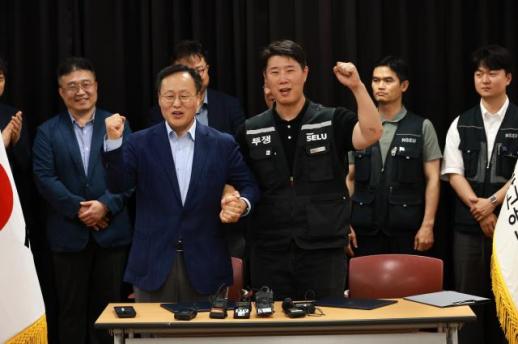 Samsung Electronics Avoids Major Strike as Union Votes on Tentative Agreement Samsung Electronics and its labor union reached a tentative agreement just hours before a planned strike. Labor Minister Kim Young-hoon intervened in the negotiations, which lasted six hours at the Gyeonggi Employment and Labor Agency, leading to the agreement. On May 20, the union's joint action headquarters announced that the planned strike from May 21 to June 7 would be postponed until further notice. All members are expected to participate in a vote on the tentative wage agreement from May 23 at 9 a.m. to May 28 at 10 a.m. Choi Seung-ho, chairman of the union's joint action headquarters, expressed gratitude for the government's mediation efforts and acknowledged the internal conflicts that had caused public concern. He stated, "We have reached a tentative agreement just hours before the strike and decided to postpone it. The vote will take place from May 22 to 27." Yeom Young-gu, head of the Samsung Electronics DS People Team, apologized to employees for the prolonged negotiations and thanked the union and the government for their efforts. He emphasized the importance of the agreement in fostering a cooperative labor-management culture and committed to implementing the terms faithfully. Minister Kim remarked, "Our support for democracy stems from our belief in the power of dialogue to address common challenges. I extend my sincere gratitude to both parties for reaching a tentative agreement through autonomous negotiations." He acknowledged the anxiety felt by the public amid challenging domestic and international conditions and credited the government's role in facilitating dialogue. "This is a growing pain, and I believe it demonstrates the K-competitiveness of resolving issues through conversation," he added. Regarding the specifics of the agreement, Kim noted that while there were contentious issues, both sides made concessions to find a solution. Choi explained that the company agreed to postpone the distribution method for loss-making divisions for one year, which had been a point of contention. Yeom added that the company and the union shared a common goal and worked collaboratively to resolve the issues, highlighting the minister's contributions to the successful conclusion of the negotiations. The tentative agreement was reached after the labor committee's mediation failed earlier that morning. Kim emphasized the government's commitment to facilitating dialogue and understanding the reasons behind the breakdown in negotiations to find a way forward. He concluded by stating that while principles are important, there are no absolute exceptions, and he was pleased that the company accepted the agreement. Yeom noted that the agreement reflects a commitment to rewarding performance while adhering to fundamental principles. 2026-05-20 23:22:13
 -
 Samsung Avoids Strike Crisis but Faces Member Vote on Agreement Samsung Electronics has temporarily averted a major crisis as a strike loomed. Just over an hour before a planned strike on May 21, the company and its labor union reached a tentative agreement. However, concerns remain as a final vote by union members is still pending. The Samsung Electronics union's joint action committee announced around 10:30 p.m. on May 20 that the strike scheduled from May 21 to June 7 would be postponed until further notice. With the strike averted at the last moment, the union immediately began the process of securing member input and control. A vote on the tentative agreement for the 2026 wage negotiations will take place from 9 a.m. on May 23 to 10 a.m. on May 28. This agreement effectively buys Samsung Electronics valuable time, as even a brief halt in semiconductor production can lead to losses in the hundreds of billions of won. The postponement is seen as a decisive move by both sides to prevent a crisis. However, it remains uncertain whether the tentative agreement will ultimately be approved. If the results of the member vote a week from now show a majority against the agreement, the union has indicated it will immediately resume plans for a long-term strike. Essentially, the timer on this crisis has been reset to one week. Should the vote reject the agreement and a strike materialize, the government is likely to activate its previously announced strong legal measures, including the 'emergency mediation authority.' On May 17, Prime Minister Kim Min-seok stated in a public address, "If the Samsung Electronics strike poses a significant threat to the national economy, the government will have no choice but to consider all legal measures, including emergency mediation authority." The government cannot afford to remain passive in the face of disruptions to the semiconductor supply chain, which is vital to the national economy. Emergency mediation authority is a powerful legal measure that the Minister of Employment and Labor can invoke under the current Labor Union and Labor Relations Adjustment Act when there is a significant risk to the national economy or public safety. Once invoked, the union must immediately cease all dispute activities, and strikes are prohibited for 30 days. This effectively imposes a 'cooling-off' period to prevent the escalation of the strike. During this cooling-off period, if no voluntary agreement is reached between the parties, the Central Labor Relations Commission can decide to mediate, and the mediation decision will have the same effect as a collective agreement, requiring both sides to comply.* This article has been translated by AI. 2026-05-20 23:19:05
 -
 Samsung and Labor Union Agree on 10-Year Bonus System Tied to Stock Samsung Electronics and its labor union have confirmed that their tentative wage and collective bargaining agreement, reached just before a general strike, includes a 10-year validity period for the bonus system. This agreement not only establishes the method for calculating bonuses but also formalizes the payment method and duration, setting the framework for Samsung's performance compensation system for the next decade. According to industry sources on May 20, Samsung and the union signed the tentative agreement and decided to postpone the general strike while proceeding with a member vote from May 23 to 28. The agreement reportedly includes a total bonus of 12%, combining an OPI of 1.5% and a special management bonus of 10.5%. The bonuses will be calculated based on performance criteria agreed upon by both parties. The previously contentious cap on bonus amounts has been eliminated. The special management bonus will only be paid if minimum operating profit requirements are met. If performance falls below certain thresholds, the special bonus will not be awarded. A notable aspect of the agreement is the payment method. The tentative agreement stipulates that bonuses will be paid entirely in company stock after taxes, rather than in cash. This approach is seen as a compromise aimed at linking employee compensation to the company's long-term value. It is also reported that there will be restrictions on the sale of these shares. The distribution structure for bonuses has also been established. Sixty percent of the total will be allocated to profitable divisions within the DS sector, while the remaining 40% will be distributed across the entire DS division. Differential treatment for unprofitable divisions will be implemented starting in 2027. Although there were last-minute conflicts over compensation for unprofitable divisions, both sides found common ground by not applying penalties for this year's bonuses. Industry observers believe this agreement shifts the focus of the Samsung bonus debate from "how much will be received this year" to "what criteria will be used for future distributions." The 10-year validity period and stock payment method place burdens and responsibilities on both the company and the union. The company must institutionalize the bonus criteria over the long term, while the union must accept the uncertainties associated with stock prices and performance. However, the special management bonus will only be awarded if minimum operating profit is achieved during the 10-year period. The agreement also includes provisions for cooperative initiatives. Samsung plans to announce a funding plan for cooperative efforts soon and will operate joint programs with the union. This is interpreted as a measure to mitigate external impacts, given the concerns about the general strike affecting suppliers and the semiconductor ecosystem. The union will inform its members about the tentative agreement and conduct a direct and secret ballot for approval. The agreement must receive majority attendance and majority support to be finalized. The union has decided to postpone the planned general strike until the voting results are announced. This tentative agreement was reached after negotiations resumed under the leadership of Minister of Employment and Labor Kim Young-hoon, following the breakdown of mediation by the Central Labor Relations Commission the previous day. While the worst-case scenario of a first-ever general strike at Samsung Electronics has been averted for now, the long-term implications of the bonus calculation criteria and stock payment method will likely be evaluated during the member voting process. 2026-05-20 23:16:14
 -
 Samsung Electronics Reaches Tentative Agreement Amid Strike Threat Samsung Electronics and its labor union have reached a tentative agreement on wages and collective bargaining. This development comes amid discussions of a potential first-ever total strike, alleviating concerns over semiconductor production disruptions and uncertainty in the industry. On May 20, Samsung Electronics issued a statement confirming the tentative agreement, stating, "The agreement was reached thanks to the support of the public, shareholders, and customers, as well as the dedicated mediation efforts of the government and the steadfast commitment of our employees." The company also apologized for the heightened concerns in the market and industry due to labor disputes, saying, "We sincerely thank everyone and deeply apologize for the worries we have caused during this time." The tentative agreement was reached just hours before a planned total strike. Although the parties could not find common ground during post-adjustment discussions at the Central Labor Relations Commission, negotiations continued under the leadership of the Minister of Employment and Labor. The union has decided to suspend the total strike and will present the tentative agreement for a vote among its members. Samsung Electronics expressed its commitment to improving labor relations, stating, "We will humbly work to build a more mature and constructive labor-management relationship to prevent such situations from occurring again." The company added, "We will do our utmost to fulfill our roles and responsibilities as a business and contribute more to the national economy." (While this tentative agreement has temporarily mitigated the risk of a strike, key issues such as performance-based bonuses and the institutionalization of compensation systems remain structural challenges for future labor relations.)* This article has been translated by AI. 2026-05-20 23:06:50
 -
 Samsung Live: Strike suspended, union puts the agreement to vote until May 27 SUWON, May 20 (AJP) -Samsung Electronics narrowly avoided a closely watched 18-day general strike late Wednesday after marathon last-minute negotiations led by Labor Minister Kim Young-hoon produced a tentative wage agreement between management and the company’s largest labor union. The deal halted what could have become the biggest labor disruption in the history of the world’s largest memory chipmaker, which accounts for nearly 40 percent of the global DRAM market and roughly one-fifth of South Korea’s exports. The agreement came after weeks of escalating tensions over bonus structures, compensation for employees in loss-making divisions and the removal of caps on performance-based incentives. The National Samsung Electronics Union (NSEU) announced that the planned strike scheduled for May 21 through June 7 would be suspended pending a vote by union members on the tentative deal. Under “Protest Directive No. 3” issued Wednesday night, the union said all strike actions previously declared under its earlier directive would be put on hold “until further notice.” Union members will vote on the tentative 2026 wage agreement from 2 p.m. Thursday through 10 a.m. May 27. Details were not revealed, but the sticking point would involve compensation for loss-making divisions of Samsung Electronics. The breakthrough followed more than six hours of direct mediation by Labor Minister Kim at the Gyeonggi Regional Labor Office in Suwon, after earlier series of government-led post-adjustment talks at the National Labor Relations Commission had collapsed over disputes involving compensation for workers in deficit-running business divisions. Earlier in the day, union chief Choi Seung-ho had declared negotiations deadlocked and vowed to proceed with the strike as planned. Samsung Electronics had also sharply criticized the union in an internal statement, accusing it of demanding “socially unacceptable” compensation for loss-making units even after the company had already accepted most proposals on incentive structures. But signs of a late reversal emerged after Samsung quietly deleted the internal statement from its employee bulletin board while negotiations resumed under Kim’s direct supervision. Vice Labor Minister Kwon Chang-joon later joined the talks around 8:15 p.m., fueling expectations of a dramatic settlement only hours before the planned walkout. At a late-night joint press briefing following the agreement, union and management representatives appeared together holding hands in a rare public show of reconciliation after months of confrontation. “We sincerely apologize for causing concern internally,” Choi said, bowing deeply before reporters. “We have decided to suspend the joint struggle after reaching a tentative agreement through autonomous negotiations led by the labor minister.” Choi thanked union members for their support throughout the months-long dispute and said the union would focus on stabilizing labor-management relations while preparing for the membership vote. “We will do our best to become a mature labor union that can proudly present results,” he said. Yeo Myung-gu, Samsung Electronics vice president and head of the People Team, also apologized to employees for the prolonged negotiations. “We are grateful to employees, the government and the union for helping bring these talks to a conclusion,” Yeo said. “This agreement will become the starting point for a new culture of coexistence between labor and management. We will faithfully implement the terms of the agreement and do our utmost for mutual growth.” Labor Minister Kim framed the settlement as a victory for dialogue over confrontation. “We never let go of the thread of dialogue because we believe in democracy and the power of conversation,” Kim said. “Samsung is a national company supported by the Korean people. I hope this agreement will be faithfully implemented so the company can overcome these growing pains in a manner worthy of Korea’s No. 1 company.” Kim also thanked National Labor Relations Commission Chairman Park Soo-geun for helping narrow differences between the two sides on key issues. Industry officials had warned that a prolonged strike involving as many as 50,000 unionized workers could severely disrupt semiconductor production and inflict economic damage estimated at up to 100 trillion won ($72 billion). 2026-05-20 23:04:18
 -
 Samsung Avoids Major Strike, Easing Semiconductor Production Concerns Samsung Electronics' labor union has postponed a planned strike just over an hour before it was set to begin. The potential for the company's first-ever total strike has been averted for now, easing concerns in the industry about disruptions to semiconductor production and the global supply chain. According to industry sources on May 20, the Samsung Electronics union's joint action committee announced in a directive to members that "the total strike scheduled for May 21 to June 7 is postponed until further notice." The union plans to hold a vote on the tentative wage agreement from 9 a.m. on May 23 to 10 a.m. on May 28, 2026. As a result, the strike that was set to begin on May 21 has been halted just before it could materialize. Although the tentative agreement has not yet been finalized, the union's decision to withdraw the strike card has significantly reduced uncertainties regarding the operation of Samsung's semiconductor production lines. This postponement is seen as a result of government mediation working at a critical juncture. The labor and management teams resumed negotiations around 4:40 p.m. in Suwon, Gyeonggi Province, under the leadership of Labor Minister Kim Young-hoon. After a third round of mediation by the Central Labor Relations Commission ended in failure the previous day, it appeared that the strike would proceed on May 21. However, the negotiations were reopened just before the strike, leading to a last-minute turnaround. The two sides had been engaged in mediation at the government office in Sejong since May 18, but they could not narrow their differences over performance bonus criteria and the institutionalization of compensation systems. The second meeting adjourned past midnight, and the third meeting the following morning also ended without agreement. Immediately after the negotiations broke down, the union announced it would proceed with the strike as planned on May 21. Samsung Electronics issued a statement asserting that "there should be no strike under any circumstances," and pledged to continue efforts to resolve the issues through further negotiations and direct dialogue. As both sides maintained firm positions, concerns grew in the industry about the likelihood of an actual strike. However, the situation changed when negotiations resumed under the Labor Minister just a day before the strike. The government reportedly pressured both sides to reach a voluntary agreement, considering the potential impact of a strike on semiconductor production and the national economy. The business community had also expressed concerns that a strike could disrupt not only production but also the supply chains of partner companies and exports. With the postponement of the strike, Samsung Electronics has temporarily alleviated fears of production disruptions in the semiconductor sector. This is particularly significant in businesses where timely delivery to global clients is crucial, such as high-bandwidth memory and foundry services. A prolonged strike risk could have had unavoidable repercussions. However, if the tentative agreement is rejected in the member vote, the potential for a total strike could reignite, leading analysts to view this decision as more of a "temporary reprieve" than a complete resolution. Additionally, the core issues of performance bonus criteria and compensation for loss-making divisions remain unresolved and could resurface in the future. Internal decision-making processes and representation issues within the union also remain as separate challenges. An industry insider remarked, "This postponement of the strike is a significant event not only for Samsung Electronics but for the entire South Korean semiconductor industry. However, if the underlying conflict structure remains unchanged, similar crises could arise again at any time."* This article has been translated by AI. 2026-05-20 22:58:21
 -
 Samsung Live: Samsung Union halts historic strike after eleventh-hour wage deal SEOUL, May 20 (AJP) - Samsung Electronics' largest labor union on Wednesday night suspended its planned full-scale strike, narrowly averting a historic walkout just an hour before it was scheduled to begin. The dramatic breakthrough came after management and union leadership reached a tentative agreement on the 2026 wage negotiations. "The general strike scheduled from May 21 to June 7 will be suspended until further notice," the union’s joint strike committee announced in an urgent directive to its members. The union instructed all members to participate in a mandatory vote to ratify the tentative agreement, which will run from May 22 to May 27. The late-night resolution caps off a chaotic day of negotiation, following the initial collapse of official government-mediated talks in Sejong earlier in the morning. 2026-05-20 22:48:16
 -
 Korea's Lee ratchets up rhetoric on Israel, labor unrest and corporate ethics SEOUL, May 20 (AJP) -South Korean President Lee Jae Myung delivered an unusually combative series of remarks Wednesday, lashing out at Israel over its seizure of aid vessels carrying South Korean activists, warning Samsung Electronics labor unions not to “cross the line” ahead of a major strike, and condemning fashion platform Musinsa for what he called the mockery of South Korea’s democracy movement in a controversial advertisement. The remarks, made during a Cabinet meeting and emergency economic review session at the presidential office, reflected Lee’s increasingly direct and emotionally charged governing style as his administration grapples simultaneously with geopolitical tensions, labor unrest and cultural controversies. The president's sharpest comments were directed at Israel following the interception of humanitarian aid vessels headed toward the Gaza Strip carrying South Korean activists. According to civic groups and government briefings, Israeli forces intercepted the vessel Lina Al Nabulsi early Wednesday near Gaza waters. The ship reportedly carried South Korean activist Kim Ah-hyun and Korean American activist Jonathan Victor Lee. Another vessel, the Kyriakos X, carrying South Korean activist Kim Dong-hyeon, had been seized two days earlier. After receiving a briefing from Vice Foreign Minister Kim Jin-ah and National Security Adviser Wi Sung-lac, Lee openly questioned the legal basis for the operation. “What is the legal justification for the seizure? Is that Israeli territorial water?” Lee asked during the meeting, according to participants. “If Gaza is not Israeli territory, shouldn’t we protest this?” When Wi explained that Israel exercises military control over Gaza and regulates access to the area, Lee pressed further, asking whether that amounted to “illegal invasion under international law.” He described Israel’s actions as “too extreme and too inhumane,” adding that South Korea had “been patient for too long.” The president also referenced the arrest warrant issued by the International Criminal Court against Israeli Prime Minister Benjamin Netanyahu. “Wasn’t an arrest warrant issued because he was recognized as a war criminal?” Lee asked. After aides clarified that the ICC had issued a warrant but had not formally declared Netanyahu a war criminal, Lee replied, “Then he is a war-crime suspect.” The ICC issued arrest warrants for Netanyahu and other Israeli officials in 2024 over allegations tied to the Gaza conflict, including war crimes and crimes against humanity. Lee also suggested South Korea should independently examine whether to align itself with countries that have signaled willingness to enforce the ICC warrant should Netanyahu enter their territory. The remarks immediately triggered backlash from conservative opposition figures, who accused Lee of recklessness in handling a highly sensitive international conflict. People Power Party floor leader Song Eon-seok criticized the president for approaching “an extremely complex international dispute through a simplistic domestic political lens of good versus evil.” Reform Party leader Lee Jun-seok urged the president to “exercise restraint,” warning that “a single remark from a president can determine a nation’s fate.” He was equally unabashed on the looming strike at Samsung Electronics, where the company’s largest labor union plans an unprecedented walkout beginning Thursday after wage negotiations collapsed. Without directly siding with management, Lee cautioned the union against overstepping its mandate. “The right to collective action exists to protect socially vulnerable workers,” Lee said. “It is not a form of force granted for a small number of individuals to pursue only their own interests.” He emphasized that corporations involve multiple stakeholders, including investors who bear financial risks and workers entitled to fair compensation. “No one should unilaterally cross the line,” Lee warned. The remarks came as Samsung faces the prospect of a prolonged strike involving tens of thousands of workers, many tied to the semiconductor division that has powered the company’s surge during the global AI boom. The administration has been under mounting pressure to prevent labor disruptions at one of South Korea’s most strategically important companies, amid concerns over broader economic fallout and supply-chain instability. Lee separately criticized online fashion platform Musinsa over a resurfaced 2019 advertising controversy involving the late democracy activist Park Jong-chul. The controversy centered on an advertisement for quick-drying socks that used the phrase, “I hit the desk and it dried instantly,” a parody of the infamous phrase “I hit the desk and he died with a gasp,” used by authorities to cover up Park’s torture death during military rule. Park’s death in 1987 became a catalyst for South Korea’s June Democracy Movement. Lee condemned the advertisement in a social media post earlier Wednesday, writing: “This mocked and insulted Park Jong-chul’s torture death and the June Democratic Uprising that followed. Money may be evil, but how can people behave like this?” Musinsa issued another public apology Wednesday, saying it deeply regretted the campaign and acknowledging that “the wounds caused by the reckless judgment and lack of internal process remain serious even after seven years.” The company said its executives had personally apologized to the Park Jong-chul Memorial Foundation in 2019 and had since implemented historical education programs for employees and stricter content review procedures. Shinsegae Group and Starbucks Korea also faced public backlash over marketing campaigns linked to the Gwangju Uprising, widely regarded as one of the defining moments in South Korea’s modern democratic history. Critics accused some campaigns of trivializing or commercializing the symbolism of the May 18 movement through insensitive branding and promotional imagery, reigniting long-running tensions in South Korea over how corporations invoke historical memory for marketing purposes. 2026-05-20 21:55:27
 -
 Special Prosecutor to Investigate Yoon Suk Yeol for Military Coup Charges on June 6 Special Prosecutor to Summon Yoon Suk Yeol for Military Coup Investigation The second special prosecutor team, led by Kwon Chang-young, will investigate former President Yoon Suk Yeol for charges related to a military coup. On May 20, the special prosecutor's office announced that it plans to summon Yoon on June 6 as a suspect in the coup investigation. Yoon has expressed his willingness to cooperate with the investigation. Yoon is accused of conspiring with former Defense Minister Kim Yong-hyun to incite a riot by sending armed soldiers to the National Assembly and the National Election Commission during the declaration of a state of emergency on December 3. Previously, the special prosecutor's office had requested Yoon's appearance as a suspect on April 30, but his team did not comply, leading to a failed investigation. After notifying him again on May 23, Yoon's team indicated a refusal, prompting both sides to negotiate a new schedule. South Korean Tanker Passes Through Strait of Hormuz Amid Conflict Amid the ongoing conflict between the U.S. and Iran, one of the 26 South Korean vessels trapped in the Strait of Hormuz has successfully navigated through the waterway. On May 20, the Ministry of Foreign Affairs announced that a South Korean tanker passed through the Strait of Hormuz and is continuing its journey, with approximately 10 crew members on board. The government has consistently requested the safety and freedom of navigation for all vessels, including its own, through diplomatic channels, including four phone calls between South Korean and Iranian foreign ministers, a two-week special envoy mission, and communications through embassies. A ministry official stated, "We will continue to work to ensure the safety and passage of our vessels in the Strait of Hormuz." New R&D Funding Program to Support SMEs and Public Research Institutions A large-scale financial support program aimed at assisting the commercialization of technologies from public research institutions and small and medium-sized enterprises (SMEs) is set to be implemented. The Ministry of SMEs and Startups announced on May 20 that an amendment to the Small and Medium Enterprises Technology Innovation Act was approved during a State Council meeting and will take effect immediately. Historically, SMEs have struggled to secure funding for commercializing promising technologies obtained through research and development or transferred from public research institutions. The amendment introduces new financial support systems, including "commercialization guarantees" and "liquidity guarantees," to alleviate the financial burden associated with translating national R&D outcomes into industry applications. The total support amount for this initiative is 340 billion won, with 260 billion won allocated for commercialization guarantees and 80 billion won for liquidity guarantees. The ministry plans to begin providing guarantees as early as next month. Government Secures 245.7 Billion Won for Compensation to Historical Victims The government has secured approximately 245.7 billion won in contingency funds to compensate victims of significant historical injustices. According to the Ministry of Justice, the State Council approved the expenditure of 245.7 billion won for compensation during a meeting held at the Blue House on May 20. Justice Minister Jeong Seong-ho directed the swift restoration of rights and practical recovery for historical victims by instructing the withdrawal of appeals in major compensation lawsuits related to incidents such as the Brothers Home and the Seongam Academy in September, and the Yeosu-Suncheon 10.19 incident in October. As of March this year, the government has withdrawn appeals in 863 cases involving 3,587 individuals, including 116 cases (756 individuals) from Brothers Home, 42 cases (357 individuals) from Seongam Academy, 608 cases (1,570 individuals) from the Seongam Education Center, and 97 cases (904 individuals) from the Yeosu-Suncheon 10.19 incident. Consequently, 2,202 victims from these cases have received approximately 199.579 billion won in compensation. Xi Jinping Expected to Visit North Korea Next Week Amid Rising Tensions Chinese President Xi Jinping is expected to make a state visit to North Korea as early as next week, according to reports. On May 20, U.S. news magazine Time cited anonymous sources stating that China and North Korea are likely to strengthen their cooperation in response to Japan's rising militarism, with Xi's visit plans progressing. Time interpreted Xi's potential visit as a response to Japan's shift from a long-standing pacifist stance to a more assertive geopolitical posture. Recently, Japan has relaxed its restrictions on arms exports for the first time in 60 years following the appointment of Prime Minister Sanae Takaichi and is pushing for constitutional amendments to formally recognize the Self-Defense Forces. The country is also significantly increasing its defense budget and expediting related legislation. However, there has been no official announcement regarding Xi's visit to North Korea yet. Turkey Proposes NATO Fuel Pipeline Project to Enhance Energy Supply Turkey has proposed a fuel pipeline project to NATO that could serve as an alternative to the Strait of Hormuz. On May 20, Turkish Defense Ministry spokesperson Rear Admiral Zeki Aktürk announced at a press conference that the NATO fuel pipeline project is undergoing approval procedures within the alliance to strengthen energy supply for NATO allies on the eastern front. Aktürk emphasized the importance of this project in light of the recent situation in the Strait of Hormuz, stating that it could reduce NATO's reliance on maritime fuel transport and enhance fuel supply and interoperability. He also mentioned that if the pipeline project moves forward, NATO's common funds would be utilized. 2026-05-20 21:52:47