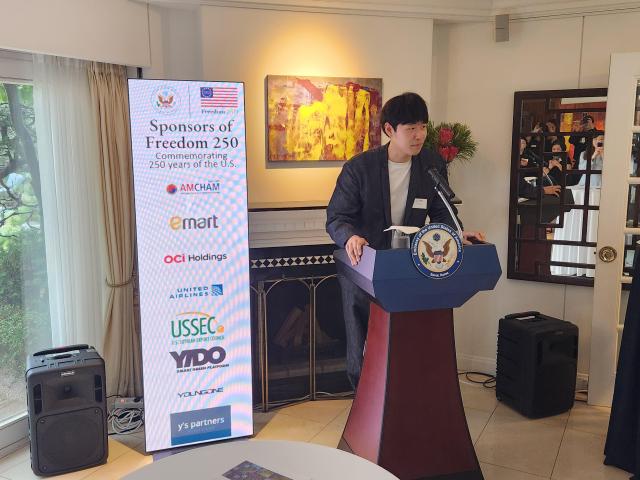
SEOUL, May 20 (AJP) - SEOUL — The United States Embassy in Seoul hosted South Korean contemporary artist Park Ju-eon for a special exhibition and talk on Wednesday afternoon, using cultural diplomacy to mark the upcoming 250th anniversary of the country's founding. The event took place at the US Charge d'Affaires' residence near central Seoul.
The gathering served as the second installment of Freedom of Expression: Freedom 250 U.S.-Korea Creative Dialogues. The yearlong campaign highlights the enduring cultural partnership between the two nations through continuous artistic exchange, with collaborative events scheduled to run throughout the year.
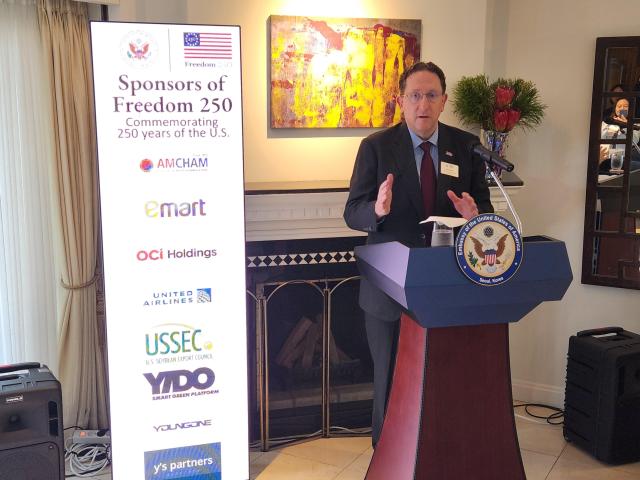
James R. Heller, the U.S. Charge d'Affaires ad interim, framed the event as a critical opportunity to engage with art and ideas concerning freedom of expression. He noted that the program contributes to a broader vision by highlighting the enduring connections between the U.S. and South Korea.
"His presence here shows the vitality of our two countries' strong cultural ties," Heller told the audience. "Art and cultural exchange are essential pillars of our lives. Cultural diplomacy enriches our societies and builds trust and opens dialogue, and it makes other types of cooperation possible."
During his presentation, Park detailed his creative journey, tracing his artistic roots back to a year spent traveling across the U.S. as a 12-year-old. While he did not know he would become a painter at the time, a later visit to the Art Institute of Chicago deeply altered his trajectory. The distinctive modernist architecture and bold abstract paintings he saw there stirred his senses, cementing a goal to return to the city to learn how to paint.
As a graduate of the School of the Art Institute of Chicago, Park explained how the American educational environment shaped his approach to abstract painting by providing individual freedom alongside advanced structural systems. His time at the institution pushed him to ask why he was creating the work, rather than simply deciding what to paint.
"This experimental spirit where no set answers exist made me incredibly persistent," Park said. "I worked every single day to find freedom of expression while strictly controlling myself through self-imposed rules. For me, experimentation was not just a simple attempt, but the greatest force sustaining my artistic practice."
The exhibition in Seoul showcased several of his large-scale works, which serve as a visual archive of his time in the U.S. and his continuous drive to break away from traditional representational imagery.
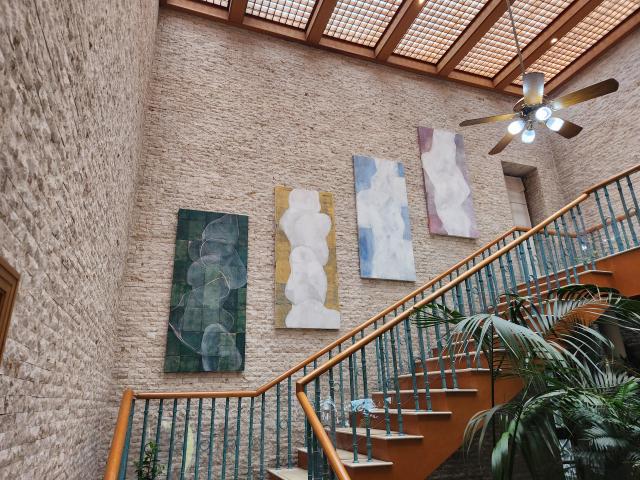
Park shared practical examples of his unconventional techniques, which he developed as a student to overcome the fear of failure and experiment with pure abstraction. Driven by a need for affordable materials he could paint heavily on, he turned to unexpected sources.
"I headed to the Home Depot, a large American hardware store, and started buying the cheapest material I could find there: doors measuring 32 inches by 72 inches, to use instead of canvases," Park said. "With an empty mind, I moved my brushes intuitively along the trajectory of my body, and as a result, lines resembling human forms began to build up on the surface."
The Seongbuk-dong exhibition featured a variety of his technical experiments, including massive pieces tracking the physical rhythm of his artistic process and complex monotype grids.
Park described his drawing process as essential database research for experimenting with the transparent layering of colors and repetitive marks. He explained that his monotype process, which involves applying paint to a plate and pressing it directly onto a surface, was designed to extract the purest form of color.
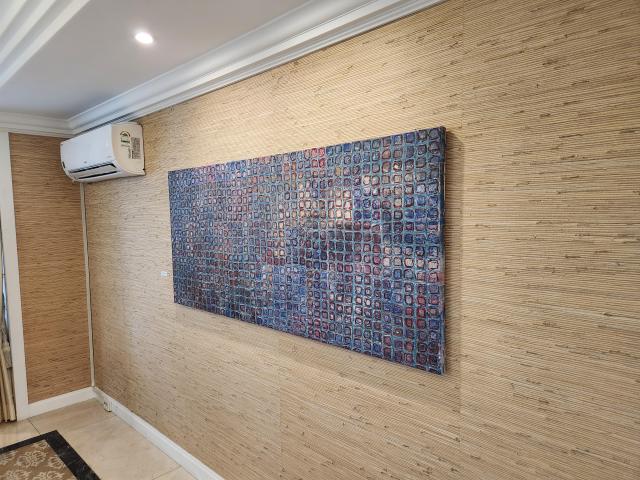
"By almost entirely erasing intentional brushstrokes or the artist's artificial control from the surface, it is a process I thought of to extract the inherent character and materiality of the color in its purest form," he noted.
This experimentation culminated in large-scale works like "Chicago 2125," a massive piece displayed in the residence's piano room that reflects the city's grid-like architecture, and "Chromatic Deposition Lemon," a recent work created out of frustration with the small size of standard acrylic plates.
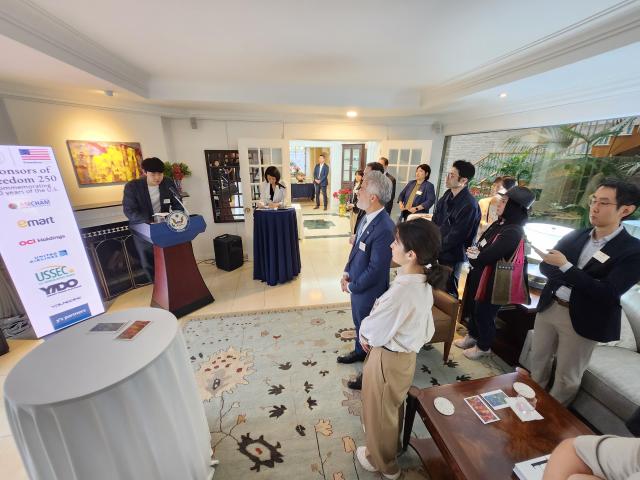
"Just as I was feeling frustrated by the scale of the small acrylic plates or gel plates I had been using, I saw a rough rubber mat blocking a street drain," Park recalled. "Curiosity struck me: 'What if I press acrylic paint using that large, rough rubber mat?' I put it to use in my work right away."
The artist credited his ongoing drive to push boundaries to the foundational years he spent in the U.S.
"The coexistence of rules and freedom taught to me by the country of America, along with the continuous experimental spirit, has kept me going without stopping for a single day," Park said.
Copyright ⓒ Aju Press All rights reserved.