

Journalist

Ko Yu-hwan
-
 Major Universities in South Korea Criticize Election Mismanagement Criticism is growing among university students regarding the "shortage of ballots" that occurred during the 9th nationwide local elections held on June 3. On June 4, anonymous posts from students at major universities, including Seoul National University, Korea University, Yonsei University, Sungkyunkwan University, Hanyang University, Chung-Ang University, Hongik University, Inha University, and the Korea Advanced Institute of Science and Technology (KAIST), were shared on the student community platform Everytime. Students characterized the incident not as a mere administrative error but as a serious violation of democratic principles and voting rights, calling for responsible explanations and reforms from the Election Commission. Korea University students stated in their posters, "Due to a failure in demand forecasting and a shortage of ballots, voters had to wait for extended periods in the heat. This is a significant flaw that effectively infringes upon the voting rights guaranteed by the Constitution." At Chung-Ang University, students referenced George Orwell's novel "Animal Farm," questioning, "Are some voters' votes more equal than others?" They argued that limiting voting opportunities for certain voters due to administrative reasons contradicts the principle of equal elections. Hongik University also criticized the Election Commission, stating, "An unprecedented situation occurred in the heart of the capital, where voting was halted due to a shortage of ballots." Voices emphasizing the historical significance of democracy followed. Students at Yonsei University mentioned the late Lee Han-yeol, who sacrificed his life during the 1987 democratization movement, asserting, "Every citizen has the right to fully exercise their vote, and the state must guarantee this right." Inha University students referred to the history of the April 19 Revolution and the democratization movement, stating, "Today's citizens must reconsider what they need to protect for democracy." Hanyang University students echoed similar sentiments, saying, "Korean democracy was built on countless sacrifices. Given the controversy over voting rights infringement, thorough investigations and responsible actions are necessary." Calls for restoring procedural legitimacy transcended political affiliations. Students at Seoul National University emphasized, "If voting is only valued when it benefits me, then that is not a principle but a preference," urging the need to restore trust in the electoral process itself, regardless of political outcomes. Sungkyunkwan University stated, "This is a matter of upholding the basic principles of democracy, regardless of left or right," demanding a review and improvement of the entire electoral process. KAIST students noted, "In some areas, voting continued even after exit poll results were announced, creating an unprecedented situation," calling for clear identification of causes and measures to prevent similar occurrences in the future. Across university campuses, voices emphasizing the fairness of electoral procedures and the guarantee of voting rights are growing. Students collectively stated that the ballot shortage should not be dismissed as a simple mistake but should serve as an opportunity for accurate cause identification and institutional reform. Currently, the Election Commission is investigating the circumstances surrounding the ballot shortage at some polling stations, and no evidence of organized electoral fraud has been confirmed. 2026-06-04 14:12:00
 -
 Lotte Duty Free Opens Gentle Monster Store at Kansai International Airport Lotte Duty Free has opened a Gentle Monster store, marking the first of its kind in Japan's duty-free sector. The store was launched on June 2 in the International Departure Area of Kansai International Airport's Terminal 1, as announced on June 4. This location is designed as a sensory space that goes beyond mere product sales, themed around the exploration of the human inner self. Large artistic objects are strategically placed throughout the store to capture the attention of travelers. A star-shaped installation at the entrance creates an ambiance reminiscent of morning sunlight, symbolizing the shining hearts and individuality of humanity. Notably, three giant head kinetic sculptures inside the store feature expressions of deep contemplation and moving eyes, artistically representing human thoughts and emotions, providing visitors with visual inspiration and a unique shopping experience. The opening of Gentle Monster is expected to create strategic synergy with the recent major expansion of Kansai International Airport, which served approximately 25.72 million passengers last year, making it the largest international airport in the Kansai region. Following a recent four-phase renovation, the airport's annual international capacity has been expanded to 40 million passengers. Lotte Duty Free first entered the Japanese duty-free market in 2014 and currently operates high-end jewelry brands such as Bulgari and Chaumet. As travel demand continues to recover, interest in eyewear is also on the rise. From January to May of this year, Lotte Duty Free's eyewear category sales increased by approximately 26% compared to the same period last year. The opening of Gentle Monster comes amid a clear trend of increasing demand for sunglasses and glasses during travel. A representative from Lotte Duty Free stated, "We will continue to attract differentiated brands and engage in space marketing to provide the best shopping experience for travelers worldwide, further solidifying our position in the global duty-free market." * This article has been translated by AI. 2026-06-04 14:09:00
 -
 CJ ENM Shares Drop Over 3% Following TVING Data Breach Shares of CJ ENM fell more than 3% during trading on June 4 due to the fallout from a data breach involving its subsidiary, TVING. According to the Korea Exchange, as of 2 p.m. on June 4, CJ ENM's stock was trading at 39,500 won, down 1,250 won (3.07%) from the previous trading day. The stock opened at 39,850 won and has continued to decline, hovering around the 39,000 won mark. The drop in share price is attributed to weakened investor sentiment following the data breach incident at the online video service (OTT) platform TVING. On June 2, TVING confirmed that an unidentified hacker had gained unauthorized access to its database and leaked files. The breach reportedly exposed some personal information, including member IDs, names, birth dates, phone numbers, and email addresses. TVING stated, "Upon detection, we immediately blocked the attack IP and modified cloud access controls. We have also enhanced database access monitoring and implemented additional security measures to prevent further damage." Additionally, the company announced plans to establish a dedicated customer service center to assist affected users and urged them to be cautious of any suspicious calls, emails, or messages. TVING also recommended changing passwords for accounts that share the same credentials.* This article has been translated by AI. 2026-06-04 14:09:00
 -
![[WNMC 2026] The Era of Readers Seeking News is Over... AJPs AI Experiment Draws Global Attention](https://image.ajunews.com//content/image/2026/06/04/20260604134815698517_518_323.jpg) [[WNMC 2026]] 'The Era of Readers Seeking News is Over'... AJP's AI Experiment Draws Global Attention "We cannot wait for readers to come to us; we must go to them." On June 3, the 77th World News Media Congress (WNMC) in Marseille, France, attracted over 1,000 journalists and media executives from more than 60 countries. Among the attendees were A.G. Sulzberger, chairman and publisher of The New York Times, and Katharine Viner, editor-in-chief of The Guardian, who gathered to discuss survival strategies for journalism in the age of AI. Seo Hye-seung, editor-in-chief of Aju Media Group's English news agency AJP, was the only speaker from South Korea. With AI emerging as a central theme at this year's congress, AJP's presentation highlighted new possibilities for journalism in the AI era. During the session titled "How AI Is Transforming the News Experience," Seo introduced AJP's multilingual news production and global audience expansion strategies. He defined AJP's identity as "Asian Substance in English," proposing a new role for English-language news agencies in the AI era. "We have discovered our role as a news agency that conveys Asian stories in the language that AI understands best," he said. Aju Media Group publishes content in five languages: Korean, English, Chinese, Japanese, and Vietnamese. AJP serves as the English-language news agency at the center of this multilingual strategy. Seo explained that AJP has utilized AI as a starting point for designing its news production and distribution systems. In an environment where generative AI is transforming news production and distribution, AJP is differentiating itself by using AI not just as a translation tool but as a content expansion platform. "Our goal is not to be journalists who use AI well, but to be journalists that AI can learn from and follow," he said, adding that as technology advances, the role of journalists in reporting from the field and interpreting context becomes even more crucial. This aligns with the message delivered by Sulzberger during his keynote address on the first day of the congress. Sulzberger emphasized that "the important facts that people know ultimately come from journalism's unique reporting," asserting that even as generative AI advances, the role of journalism in uncovering new facts cannot be replaced. He criticized AI companies for using journalistic content as training data without providing fair compensation, stating, "AI operates on information produced by journalism." One of the most frequently mentioned concepts at this congress was 'Liquid Content.' This model involves reconfiguring a single reporting outcome into various forms such as articles, videos, audio, and summaries, tailored to meet readers' situations and needs. News is evolving to be provided in diverse formats that cater to readers' needs rather than waiting for them to seek it out. In fact, major global news organizations are leveraging AI not just as a tool for automating tasks but as a means to redesign reader experiences. Experiments are ongoing to offer personalized news recommendations, transform article archives into interactive services, and reprocess a single article into multiple formats for consumption in ways that readers prefer. While technology is rapidly changing, what readers seek remains reliable information and facts uncovered directly by journalists. Although AI can change how news is produced, it cannot replace the fundamental reasons for the existence of journalism. The way news is delivered to readers is changing, but the value of journalism in discovering and verifying new facts remains unchanged. This was the overarching message of the congress. 2026-06-04 14:09:00
[[WNMC 2026]] 'The Era of Readers Seeking News is Over'... AJP's AI Experiment Draws Global Attention "We cannot wait for readers to come to us; we must go to them." On June 3, the 77th World News Media Congress (WNMC) in Marseille, France, attracted over 1,000 journalists and media executives from more than 60 countries. Among the attendees were A.G. Sulzberger, chairman and publisher of The New York Times, and Katharine Viner, editor-in-chief of The Guardian, who gathered to discuss survival strategies for journalism in the age of AI. Seo Hye-seung, editor-in-chief of Aju Media Group's English news agency AJP, was the only speaker from South Korea. With AI emerging as a central theme at this year's congress, AJP's presentation highlighted new possibilities for journalism in the AI era. During the session titled "How AI Is Transforming the News Experience," Seo introduced AJP's multilingual news production and global audience expansion strategies. He defined AJP's identity as "Asian Substance in English," proposing a new role for English-language news agencies in the AI era. "We have discovered our role as a news agency that conveys Asian stories in the language that AI understands best," he said. Aju Media Group publishes content in five languages: Korean, English, Chinese, Japanese, and Vietnamese. AJP serves as the English-language news agency at the center of this multilingual strategy. Seo explained that AJP has utilized AI as a starting point for designing its news production and distribution systems. In an environment where generative AI is transforming news production and distribution, AJP is differentiating itself by using AI not just as a translation tool but as a content expansion platform. "Our goal is not to be journalists who use AI well, but to be journalists that AI can learn from and follow," he said, adding that as technology advances, the role of journalists in reporting from the field and interpreting context becomes even more crucial. This aligns with the message delivered by Sulzberger during his keynote address on the first day of the congress. Sulzberger emphasized that "the important facts that people know ultimately come from journalism's unique reporting," asserting that even as generative AI advances, the role of journalism in uncovering new facts cannot be replaced. He criticized AI companies for using journalistic content as training data without providing fair compensation, stating, "AI operates on information produced by journalism." One of the most frequently mentioned concepts at this congress was 'Liquid Content.' This model involves reconfiguring a single reporting outcome into various forms such as articles, videos, audio, and summaries, tailored to meet readers' situations and needs. News is evolving to be provided in diverse formats that cater to readers' needs rather than waiting for them to seek it out. In fact, major global news organizations are leveraging AI not just as a tool for automating tasks but as a means to redesign reader experiences. Experiments are ongoing to offer personalized news recommendations, transform article archives into interactive services, and reprocess a single article into multiple formats for consumption in ways that readers prefer. While technology is rapidly changing, what readers seek remains reliable information and facts uncovered directly by journalists. Although AI can change how news is produced, it cannot replace the fundamental reasons for the existence of journalism. The way news is delivered to readers is changing, but the value of journalism in discovering and verifying new facts remains unchanged. This was the overarching message of the congress. 2026-06-04 14:09:00 -
 Korean Ministry of Science Appoints Jang Seok-bok as New Director of IBS The Ministry of Science and ICT has announced the appointment of Jang Seok-bok as the new director of the Institute for Basic Science (IBS), marking the fourth director in the institute's history. Jang, who also serves as the head of the Molecular Activation Catalysis Research Group at IBS and a distinguished professor at the Korea Advanced Institute of Science and Technology (KAIST), will begin his five-year term immediately. Born in 1962, Jang graduated from Korea University with a degree in chemistry in 1985. He earned his master's degree in chemistry from KAIST in 1987 and completed his Ph.D. at Harvard University in 1996. Jang has made significant contributions to the field of organic chemistry and catalytic reactions, being recognized as one of the top 1% researchers globally for eight consecutive years. He currently serves on the editorial board of the Journal of the American Chemical Society (JACS), a leading journal in the field of chemistry. Since the establishment of the IBS research group in 2012, Jang has led the Molecular Activation Catalysis Research Group. His appointment marks the first time an IBS research group leader has been elevated to the position of director. The Ministry of Science and ICT expressed optimism about Jang's appointment, stating, "With a scholar who possesses both academic authority and practical experience in research, we expect IBS to advance as a leading global research institution and contribute to the development of the domestic basic science research ecosystem." IBS was established in November 2011 to conduct world-class basic science research, with its headquarters located in Daejeon. The institute collaborates with major science and technology universities in South Korea, including KAIST, Pohang University of Science and Technology (POSTECH), Ulsan National Institute of Science and Technology (UNIST), and Gwangju Institute of Science and Technology (GIST), to foster cooperative research initiatives. 2026-06-04 14:09:00
 -
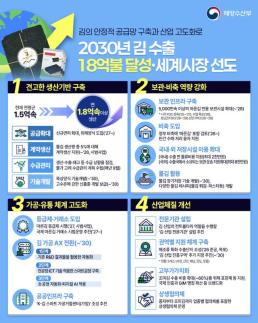 South Korea Aims for $1.8 Billion in Seaweed Exports by 2030 The South Korean government is taking steps to expand the export of seaweed, often referred to as "black semiconductor" due to its rising popularity. To meet surging global demand, the government plans to increase production and enhance efficiency by integrating artificial intelligence (AI) into the production, distribution, and supply processes. On June 4, the Ministry of Oceans and Fisheries unveiled its "Seaweed Export Supply Chain Innovation Plan" during a meeting of the Task Force on Living Costs, chaired by Deputy Prime Minister and Minister of Economy and Finance Koo Yun-cheol. Seaweed, a key export item in the K-seafood sector, achieved $11.3 billion in exports last year, with demand projected to reach 210 million packs (one pack equals 100 sheets) by 2030. Currently, domestic production of dried seaweed stands at an average of 15 million packs annually. If production does not increase, the country may face shortages and rising export prices. In response, the Ministry established a "Seaweed Export Supply Chain Innovation Task Force" in January, led by Fisheries Policy Director Choi Hyun-ho, to devise strategies. To stabilize production, the government plans to expand seaweed farming areas. It will explore phased expansion of offshore farming in waters deeper than 35 meters after conducting trials, and it aims to establish land-based farming systems to produce seaweed outside of the ocean. A ministry official stated, "We will develop new varieties that are resilient to high temperatures and land-based farming technologies by 2030 to secure stable production amid climate change. We will also include dried seaweed in our stockpiling efforts and provide low-interest loans to the private sector to minimize supply instability and price volatility." In addition to increasing production, the government will also revamp processing and distribution systems. AI will be introduced into the seaweed processing stages to promote automation. In the first phase, the government will distribute equipment for foreign matter inspection and automatic packaging, and it plans to increase the number of smart seaweed factories in collaboration with the Ministry of SMEs and Startups by 2030. Ultimately, it aims to achieve full automation for companies building smart factories through the development of physical AI technology. Furthermore, a "K-Seaweed Smart Processing Hub" will be established to consolidate research, industry, technology, and facilities in one location. The government will also enhance storage capabilities for dried seaweed, aiming to increase storage facilities to hold about 30% of annual production by 2028. Given that 77% of domestic dried seaweed is produced in Jeollanam-do, the government plans to expand the Naju Distribution Center and construct new distribution centers in Jeollanam-do and the central region. Finally, the government is pursuing the establishment of a specialized agency to oversee the seaweed industry. Since April, the Ministry has been conducting a feasibility study for this agency, which will last for one year. To increase the export share of seasoned seaweed to 60%, the government will also enhance tailored support for export companies and accelerate branding efforts for the English name of Korean seaweed, "GIM." Through this innovation plan, the Ministry expects to produce over 18 million packs of seaweed annually by 2030. Additionally, it aims to achieve $4.2 billion in seafood exports and $1.8 billion in seaweed exports by 2028. Minister Hwang Jong-woo stated, "Through the Seaweed Export Supply Chain Innovation Plan, we will ensure stable seaweed supply and demand management while advancing the industry. We aim to stabilize seaweed prices so that consumers can enjoy it without burden and further solidify the status of our seaweed in the global market."* This article has been translated by AI. 2026-06-04 14:06:00
 -
 New Rules to Compensate Consumers for Hotel Booking Cancellations To prevent hotels from unilaterally canceling reservations to raise prices, new consumer compensation regulations will be established. Under the proposed measures, hotels that cancel existing bookings to sell rooms at higher rates will be required to refund the deposit and compensate consumers with 200% of the canceled accommodation fee. On June 4, Deputy Prime Minister and Minister of Economy and Finance Koo Yun-cheol chaired a meeting of the Special Task Force on Living Costs at the Government Seoul Building, where the implementation status and future plans for measures to eradicate price gouging were discussed. In response to a surge in hotel prices and unilateral booking cancellations during recent BTS concerts in Busan, the government has decided to strengthen consumer protection measures. During the concert week, some hotels in Busan reportedly raised their rates by an average of 2.4 times, with some prices increasing as much as 7.5 times compared to the previous and following weekends. As of May 29, a total of 311 complaints regarding tourism inconveniences were reported, with 256 of those related to booking cancellations. The government will revise consumer dispute resolution standards to address cancellations made for the purpose of price increases or resale. The proposed amendments will include provisions for refunding deposits and compensating consumers with 200% of the canceled accommodation fees. A related bill is expected to be introduced later this month. Additionally, the government plans to implement a "price assurance system" that requires hotels to report and publicly disclose peak season rates. Hotels will be mandated to report their seasonal rates to local governments and make this information available on booking platforms and their websites. Measures will also be considered to penalize hotels that charge above reported rates or fail to report their rates in advance. Enforcement against price gouging will also be intensified. A joint government inspection team, including the Ministry of Interior and Safety, the Ministry of Culture, Sports and Tourism, the Ministry of Health and Welfare, the National Tax Service, the National Police Agency, the Fair Trade Commission, and local governments, will focus on violations related to the mandatory posting of accommodation rates and unreported lodging operations. Strict measures will be taken against confirmed cases of collusion or tax evasion. The government will also enhance penalties for businesses engaging in price gouging. The point deduction for hotels during grading evaluations will increase from a maximum of 10 points to 30 points for unfair pricing practices. Penalties will also be imposed during the selection process for various government support programs and events. As the summer vacation season and various festivals approach, the government plans to continue special inspections in collaboration with relevant departments and strengthen its response system to ensure immediate on-site inspections and administrative actions upon receiving complaints. 2026-06-04 14:06:00
 -
 Government to Stabilize Supply of Cabbage and Radishes Amid Summer Heat and Rain Concerns As concerns rise over unstable agricultural supply due to expected heavy rains and high temperatures this summer, the South Korean government announced it will activate a Summer Agricultural Supply Stabilization Task Force starting on the 15th. The government also plans to supply 21,000 tons of cabbage and radishes to stabilize prices.On June 4, the Ministry of Agriculture, Food and Rural Affairs held a special task force meeting at the Government Seoul Complex to discuss the 'Measures for Stabilizing Agricultural and Marine Products Supply in Preparation for Summer Heat and Rain.'According to the Korea Meteorological Administration, this summer is expected to be hotter and wetter than usual. The average summer temperature over the past decade has been recorded at 24.6 degrees Celsius, and this year may exceed that figure. Rainfall is likely to be particularly high in June and July.These climatic forecasts raise concerns about poor crop growth and decreased productivity in livestock. Prolonged high temperatures could lead to calcium deficiency in crops, sunburn, and reduced egg-laying rates in poultry.In August 2024, for instance, cabbage prices surged by 90% compared to the previous year due to high temperatures. In 2023, 100,000 laying hens and broilers died from the heat.In response, the Ministry of Agriculture will collaborate with the Rural Development Administration, the National Agricultural Cooperative Federation, and the Korea Agro-Fisheries & Food Trade Corporation (aT) to monitor crop conditions and respond swiftly to any signs of crisis starting on the 15th.Key items for supply management include cabbage, radishes, pork, chicken, and eggs, which will be closely monitored for growth and production trends. Proactive measures will be implemented to stabilize the supply of these products.Additionally, the government plans to supply 21,000 tons of cabbage and radishes (15,000 tons of cabbage and 6,000 tons of radishes) and utilize 7,000 tons from storage facilities to address any reductions in supply. They will also encourage an increase in planting area for shipments after September through advance purchase contracts.To counter rising egg prices, the government will diversify import sources, bringing in 31.23 million fresh eggs from the United States, Thailand, and Brazil. Furthermore, by the end of this month, they will prioritize the import of 11 million hatching eggs and will gradually import the remaining quantities.The government is also considering special discount support during the summer vacation period based on the supply and price situation of agricultural and livestock products, as well as working with self-help organizations to lower delivery prices.In light of concerns over rising sea temperatures, comprehensive measures against high temperatures and red tides will be implemented. The government will expand real-time sea temperature monitoring networks and enhance information sharing, while also distributing the largest-ever supply of high-temperature response equipment, such as liquefied oxygen supply devices. Simultaneously, they will promote seafood consumption to encourage early harvesting before high-temperature-related deaths occur. 2026-06-04 14:06:00
 -
 Government Considers Lifting Oil Price Cap if Global Prices Stabilize The South Korean government is considering lifting the oil price cap if global oil prices stabilize structurally. However, with the recent consumer price inflation rate soaring to 3.1%, officials plan to maintain the price cap to ensure stability in essential goods and services. On June 4, Deputy Prime Minister and Minister of Economy and Finance Ku Yun-cheol chaired a task force meeting at the Government Seoul Office to discuss recent consumer price trends and response measures. The government stated that it would review the possibility of lifting the price cap if supply uncertainties are resolved with the resumption of shipping through the Strait of Hormuz or if global oil prices stabilize and the risk of sharp increases diminishes. However, during ongoing uncertainties in the Middle East, officials plan to manage the price cap flexibly based on market conditions. Since implementing the price cap in March following the outbreak of conflict in the Middle East, analysis has shown that without the cap, the consumer price inflation rate last month would have risen to 3.7%, 0.6 percentage points higher than the reported 3.1%. The reduction in fuel taxes is estimated to have contributed about 0.3 percentage points to this figure. In light of persistently high oil prices, the government plans to alleviate the burden on vulnerable groups. This includes swiftly executing support payments for high fuel prices, raising the subsidy limit for diesel used by freight trucks by 52.8%, and providing price-linked subsidies for tax-exempt fuel for farmers and fishermen. The government is also considering additional incentives for gas stations that contribute to price stability, such as selecting and rewarding 'good gas stations.' To stabilize essential goods prices, the government will implement measures to increase supply. This includes introducing tariff quotas for pork and chicken to boost supply volumes and considering emergency tariff quotas for the second half of the year. Discounts for agricultural and fishery products provided by the government and producer organizations will be expanded to a maximum of 50%. Additionally, to stabilize egg prices, the government plans to increase imports of fresh eggs from the United States and Thailand, and release 8,000 tons of government stockpiled seafood, including pollock, mackerel, squid, and hairtail, at prices 30-40% lower than market rates. A task force will be established to ensure stable supply of agricultural and livestock products in preparation for summer heatwaves and heavy rains. To manage prices for essential services, the government will conduct special inspections in collaboration with relevant departments to address excessive pricing and price collusion in accommodations ahead of the summer vacation season and local festivals. It plans to push for legal amendments to introduce a voluntary price reporting system for accommodations and establish consumer protection measures that require compensation of 200% of the accommodation fee for unjustified cancellations. Furthermore, the government will launch a data plan that allows continued use of basic communication services even after the data limit is reached, aimed at reducing communication costs.* This article has been translated by AI. 2026-06-04 14:03:00
 -
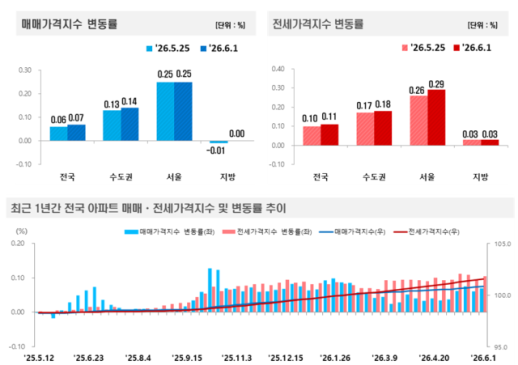 Housing Prices Rise in Dongtan Amid Semiconductor Industry Boom Apartment prices in Seoul have maintained a steady increase of 0.25% for six consecutive weeks, reflecting a strong trend in the metropolitan area. In Dongtan, Hwaseong, expectations surrounding the semiconductor industry have led to a significant surge of 0.60%, marking the highest increase nationwide, while other regions remained stable. According to the Korea Real Estate Agency's report on nationwide apartment price trends for the first week of June, the average apartment sale price across the country rose by 0.07% compared to the previous week. The metropolitan area saw a 0.14% increase, with Seoul specifically rising by 0.25%, while other regions showed no change at 0.00%. Despite a cautious buying sentiment in Seoul, transactions continued, particularly in newly built, large-scale, and transit-oriented developments, sustaining the upward trend. In the northern districts, Dongdaemun (0.37%), Seongdong (0.35%), Gangbuk (0.35%), and Seongbuk (0.34%) led the price increases. In the southern districts, Gangseo and Yeongdeungpo both rose by 0.31%, with Songpa (0.28%), Guro (0.27%), and Dongjak (0.25%) also experiencing gains. In Gyeonggi Province, Dongtan in Hwaseong led the charge with a 0.60% increase. Gwangmyeong (0.43%) and Seongnam's Sujeong District (0.42%) also continued to rise in key residential areas. Conversely, Gwacheon (-0.19%) and Icheon (-0.16%) showed declines, particularly in large and established residential areas. In Incheon, prices increased by 0.02%. Yeonsu District (0.06%) and Donggu and Michuhol Districts (each 0.04%) saw gains, while Namdong District (-0.02%) and Gyeyang District (-0.01%) faced declines. The regional market displayed notable disparities. While Jeonbuk (0.07%) and Jeonnam (0.06%) experienced increases, Gwangju (-0.11%), Jeju (-0.04%), and Daegu and Daejeon (each -0.03%) saw decreases. As a result, overall prices in the provinces remained stable. The rental market also continued its upward trend. Nationwide, apartment rental prices rose by 0.11%, with the metropolitan area increasing by 0.18% and Seoul by 0.29%. In Seoul, demand for rentals in educational districts, transit hubs, and large complexes remained steady, leading to an increase greater than the previous week's 0.26%. In Seoul, Songpa District recorded the highest increase at 0.50%, followed by Seongdong (0.48%), Dobong (0.47%), Seongbuk (0.43%), and Nowon (0.41%). In Gyeonggi Province, Dongtan (0.37%), Gwangmyeong (0.34%), and Hanam (0.32%) showed notable increases. Nam Hyuk-woo, a researcher at Woori Bank's Real Estate Research Institute, stated, "As expectations for improvements in the semiconductor industry grow, we are seeing a strong housing market in the southern Gyeonggi residential areas. In particular, the apartment market in Dongtan, which is well-connected by transportation and has excellent living conditions, is leading the upward trend." He added, "In northeastern Seoul, there is a relative shortage of rental and lease properties, and the increase in rental prices is significant. This has likely prompted some renters to shift to the buying market due to the rising rental costs."* This article has been translated by AI. 2026-06-04 14:03:00