

Journalist

Kwon,sung jin
-
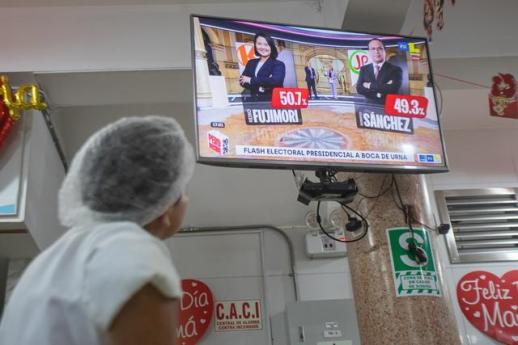 Peru's Presidential Election: A Crucial Test for Latin America's Right-Wing Shift Peru's presidential election has emerged as a critical test for the right-wing expansion in Latin America. In the runoff election, exit polls indicated that right-wing candidate Keiko Fujimori narrowly led left-wing candidate Roberto Sanchez. If Peru shifts to the right, it could bolster the trend of right-wing governance seen in Argentina, Chile, and Ecuador. On June 7, Reuters reported that the polling agency Ipsos found Fujimori, representing the Popular Force party, at 50.7% and Sanchez, from the Together for Peru party, at 49.3%. Another agency, Datum, reported Fujimori at 50.53% and Sanchez at 49.47%. AFP noted that the margin between the two candidates falls within the margin of error, effectively making it a tie. Official results may take time to finalize. The main issue at stake is public safety. Peru has seen a surge in homicides and robberies, leading to protests and political instability. The Associated Press reported that a government survey last year found 84% of urban residents expressed concern about becoming victims of crime in the future. This climate of insecurity has favored Fujimori, who has emphasized tough measures against organized crime. Fujimori is the daughter of former President Alberto Fujimori, who gained support through a hardline approach to crime but left a legacy of authoritarian rule and human rights abuses. In this campaign, Fujimori has focused on combating organized crime, pledging to militarize borders, deploy police and military to high-risk areas, and implement mandatory labor for inmates. Sanchez has centered his campaign on reducing inequality and expanding the role of government. He is classified as a leftist politician aligned with former President Pedro Castillo. Sanchez has promised to amend the current constitution, which supports a market-oriented system, and reform mining rights. He has also proposed increasing investments in rural areas and expanding government economic intervention. However, Sanchez's reform proposals have raised concerns about market instability. Fears that constitutional amendments and increased government intervention could lead to stricter regulations have affected investor confidence. Reuters reported that as Sanchez gained momentum in polls, the Peruvian stock market showed signs of weakness. This election is also tied to shifts in the political landscape of Latin America. Reuters noted that right-wing presidents have recently been elected in Argentina, Chile, Costa Rica, and Ecuador, while Bolivia ended nearly 20 years of socialist rule last year. If Fujimori wins, Peru, a major copper-producing nation, would join the ranks of countries with right-wing governments. Relations with the United States are another variable. Fujimori has signaled a desire to align with right-wing leaders in the U.S., Argentina, Chile, and Ecuador. In contrast, Sanchez advocates for an expanded government role, particularly in rural areas and the mining sector. Newsweek has identified Peru and Colombia as the next tests for the rightward shift in the political landscape of the Americas. A victory for the right-wing candidate does not guarantee political stability. Peru has experienced significant political turmoil in the past decade, with nine presidents, including interim leaders. Whichever candidate wins will have to navigate a divided Congress and low political trust. Newsweek characterized this vote as a referendum on Peru's approach to crime while also assessing whether the trend of right-wing governance in Latin America will continue. If Sanchez manages to turn the tide, the left could use Peru as a base to push for wealth redistribution and increased control over resource industries. If the race remains close until the final results, ongoing political instability is likely after the election.* This article has been translated by AI. 2026-06-08 15:51:00
 -
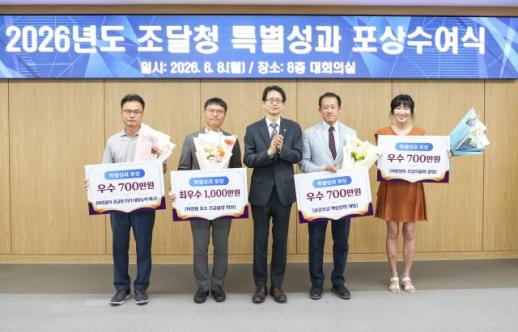 Procurement Agency Awards Employees for Supply Chain Innovations The Procurement Agency has awarded 31 million won to employees who actively responded to supply chain crises and contributed to innovations in public procurement. On June 8, the agency presented special performance awards to four employees who achieved significant policy outcomes, including securing emergency supplies of urea for vehicles. The awardees were selected through a process that included candidate nominations, internal and external performance verification, and evaluations. The awards included a grand prize of 10 million won and three excellence awards of 7 million won each. Shin Bong-ki, an official, received the grand prize for securing emergency supplies of urea through direct negotiations with local manufacturers in Vietnam. He visited Vietnam and negotiated prices with three manufacturers, successfully securing more than two months' worth of supplies. Kim Gwang-hwan, another official, along with Kim Seong-hwan, a manager, and Jeong Hwa-yeon, a secretary, were recognized with excellence awards. Kim Gwang-hwan secured contracts for key raw materials, including aluminum, in response to the outbreak of war in the Middle East, increasing stockpiles and ensuring timely distribution to small and medium-sized enterprises while monitoring the supply situation for urea. Kim Seong-hwan expanded procurement market opportunities for companies in depopulated areas and non-capital regions, directly supporting them. He also developed a plan for the government to prioritize purchasing AI products and services as part of an initiative to boost the AI industry. Jeong Hwa-yeon met with over 400 procurement companies and more than 200 demand agencies over three months to establish a foundation for the autonomy of local government procurement. Baek Seung-bo, the head of the Procurement Agency, stated, "Public procurement requires accurate field assessments and continuous improvements to unreasonable systems, procedures, and practices. We will fairly evaluate and generously reward employees who actively seek solutions."* This article has been translated by AI. 2026-06-08 15:51:00
 -
 Yoon Suk Yeol Claims Legality of Martial Law Amid Special Investigation Former President Yoon Suk Yeol has asserted the legality of emergency martial law during his first questioning by the second comprehensive special investigation team, led by Special Prosecutor Kwon Chang-young, denying all related allegations. During a regular briefing on June 8 at the Gyeonggi Government Complex in Gwacheon, Special Prosecutor Kwon Young-bin stated that during the investigation on June 6, Yoon claimed, "I still believe that the emergency martial law is legal," when asked about its constitutionality and legality. Kwon noted that this statement is documented in the official record. According to Kwon, Yoon did not exercise his right to remain silent during the questioning and responded to the investigation team's inquiries, although he generally denied the allegations. Kwon explained that Yoon stated he believed the martial law was legal, which justified his instruction to inform foreign nations about it, and he did not acknowledge any wrongdoing or abuse of power. The questioning began at 10 a.m. on June 6. Initially, Yoon raised objections to the police investigator conducting the questioning, which hindered the process. Kwon mentioned, "Yoon expressed that prosecutors should conduct the investigation, but we clarified that the police officers assigned to the special prosecutor's office also have legitimate investigative authority." Eventually, Yoon agreed to be questioned by Police Superintendent Park Myung-woon, with Kwon present, and the afternoon session proceeded smoothly. The special investigation focused on allegations of obstruction of official duties, but Kwon indicated that the likelihood of additional summons is low. Kwon stated, "We asked about three-fifths of the prepared content in a condensed manner and had sufficient time to discuss important aspects. While there are some regrets, we believe the investigation concluded on June 6, and further questioning is unnecessary." The special investigation team plans to summon Yoon again on June 13 at 10 a.m. as a suspect in the rebellion charge under military law. They are examining the circumstances surrounding the declaration of emergency martial law and the deployment of military forces to the National Assembly and the National Election Commission.* This article has been translated by AI. 2026-06-08 15:51:00
 -
 Shin Dong-bin Encourages Employees to Enhance Competitiveness at Lotte Awards Lotte Group announced on June 8 that it held the 2026 Lotte Awards to recognize employees who contributed to enhancing the company's competitiveness.The awards ceremony took place at the Lotte Hotel World in Jamsil, Songpa District, Seoul, and was attended by over 100 people, including Shin Dong-bin, Chairman of Lotte Group, representatives from the holding company, subsidiary CEOs, and award recipients from various sectors.Shin Dong-bin stated, "Today's award cases clearly demonstrate our DNA of challenge. I believe in our resilience, which shines even brighter in times of crisis, and I urge everyone to boldly enhance the group's competitiveness through daring challenges."This year's grand prize was awarded to Lotte Hotels & Resorts, recognized for its role in hosting major events, including the 2025 Asia-Pacific Economic Cooperation (APEC) dinner held in Gyeongju last year. The company dispatched over 400 staff for cooking and service during the event and provided protocol service training to local hotel employees in Gyeongju prior to the event.In the sales and marketing category, Lotte GRS received top honors for launching a collaborative product with the black-and-white chef Napoli Mafia, while Lotte Wellfood was recognized for driving growth in the Kancho brand. Lotte Advanced Materials won an award for applying eco-friendly plastic to TV housings, and Lotte Basic Materials was acknowledged in the research and development category for its development of PP products for battery separators.The newly established brand and CX design category honored Lotte Construction for operating the high-end residential brand 'Le El' and Lotte GRS for its space renewal initiatives. Additionally, the challenge category, aimed at promoting a culture of innovation, was awarded to Lotte Fine Chemical for developing eco-friendly superabsorbent resins.Meanwhile, Lotte reported that its operating profit in the first quarter of this year for key business sectors, including food, retail, chemicals, and hotels, surged 181% year-on-year to 787.6 billion won.* This article has been translated by AI. 2026-06-08 15:48:00
 -
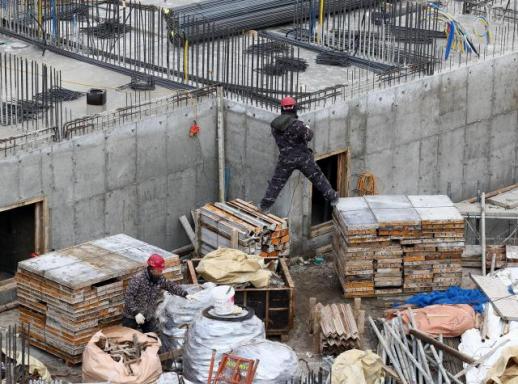 Government Considers Public Oversight in Private Construction Inspections The government is exploring the possibility of public involvement in the construction oversight and inspection system, which has primarily operated in the private sector. The National Architectural Policy Committee, established under the President, has initiated a feasibility study on restoring public inspection functions, raising the prospect of a partial revival of the direct site inspection system for public officials that was abolished in 1995.According to industry sources on June 8, the National Architectural Policy Committee commissioned a study last month titled "Feasibility and Effectiveness of Restoring Public Inspection Functions for Enhancing Building Quality and Safety." The budget for the study is 60 million won, and it is set to run from July to December for six months. The scope includes all public and private construction, covering legislative amendments, stakeholder consultations, and responses to discussions in the National Assembly. This has led to speculation that the study may go beyond mere research and consider the potential for institutionalization.A committee official stated, "Currently, construction quality and safety management is focused solely on private oversight, and this study aims to explore whether there are areas where public oversight can be implemented. We are approaching this with an open mind to strengthen public functions for both public and private construction." However, the official clarified that this is still a topic of internal discussion and research, and no policy decisions have been made yet.The discussion around restoring public inspection functions is rooted in the 1995 amendment to the Construction Act, which abolished the direct site inspection system by public officials. Until then, officials responsible for permits would visit construction sites at key stages, such as rebar placement, to ensure compliance with design plans. However, following a trend of deregulation, the system was replaced by a requirement for private inspectors to submit written interim reports.Calls for reinstating public inspection functions have persisted, particularly following construction accidents. After the collapse of an underground parking lot at an apartment complex in Incheon in 2023, civil society argued that the weakening of public site inspection functions was a structural cause of poor construction quality and demanded the revival of the system. There is a growing awareness that relying solely on a private oversight system has limitations in preventing substandard construction.However, the implementation of public inspection functions is expected to face challenges. If introduced, it could significantly impact the private inspection market, which is estimated to be worth billions of won annually. The request for proposals includes an analysis of the potential effects on the private inspection market, indicating that backlash from the inspection industry is likely.The effectiveness of public inspections at small construction sites is also a concern. Small-scale projects, such as villas and multi-family homes, have been identified as blind spots for oversight, but it remains uncertain whether local government construction officials can adequately inspect the tens of thousands of sites across the country. Additionally, concerns about corruption and collusion among public officials, which were among the justifications for abolishing the system in 1995, need to be re-evaluated.An industry representative noted, "For the research findings to lead to actual legislative changes, cooperation with the Ministry of Land, Infrastructure and Transport and discussions in the National Assembly will be crucial. We expect significant challenges in overcoming industry resistance and the limitations of local government personnel."* This article has been translated by AI. 2026-06-08 15:45:00
 -
 Shinhan Bank Unveils 'Super SOL' Integrated Platform with Park Bo-gum as Model Shinhan Bank is ramping up promotional activities ahead of the official launch of its integrated financial platform, 'Shinhan Super SOL,' which combines banking, card, securities, and insurance services into one app.The bank announced that it will begin a teaser advertising campaign on June 8, ahead of the platform's official launch on June 17.Shinhan Super SOL is a revamped version of the existing Shinhan SOL banking app, designed to provide access to key financial services from the bank, securities, card, and life insurance sectors all in one place. The platform will also feature a generative artificial intelligence (AI) agent service.The advertisement, themed 'The Financial Universe in Your Hand,' showcases how Shinhan Financial's major services are interconnected within a single platform. Actor Park Bo-gum will appear in the campaign.The teaser ads will be released across various channels, including terrestrial and cable TV, YouTube, and theaters.A Shinhan Bank representative stated, "We prepared this advertisement to celebrate the launch of Shinhan Super SOL, which consolidates the core financial services of our banking, securities, card, and life sectors. It expresses our commitment to providing customers with a completely new level of convenience that transcends the familiar boundaries of traditional finance."* This article has been translated by AI. 2026-06-08 15:45:00
 -
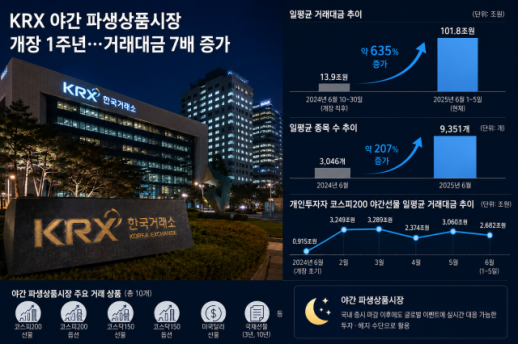 KRX's Night Derivatives Market Sees Trading Volume Surge Over Past Year As the night derivatives market marks its first anniversary, trading volume has surged more than sevenfold over the past year. Steady demand from investors seeking to respond to U.S. stock market movements and global events has driven rapid growth in trading activity. According to the Korea Exchange, the average daily trading volume in the night derivatives market from June 1 to June 5 reached 101.81 trillion won. This represents an increase of approximately 635% compared to the average daily trading volume of 13.85 trillion won recorded shortly after the market opened in June of last year. The number of traded items has also significantly increased, with the average number of items traded daily rising from 3,046 last year to 9,351 this year, a jump of about 207%. While the night derivatives market has traditionally been viewed as dominated by foreign investors, participation from individual investors has noticeably increased amid heightened market volatility. The night market is considered competitive as it allows investors to respond to U.S. market trends, international oil prices, exchange rates, and geopolitical factors even after the domestic market closes. In fact, the average daily trading volume of individual investors in KOSPI 200 night futures surpassed 3 trillion won for the first time in February, reaching 3.25 trillion won. In March, it increased to 3.29 trillion won, then decreased to 2.37 trillion won in April, before rebounding to 3.06 trillion won in May. This month, it has maintained a level around 2.68 trillion won, which is about three times higher than the 915 billion won recorded in June of last year. The night derivatives market, which officially opened on June 9 last year, has improved access for investors. Unlike the previous indirect method linked to the European derivatives exchange Eurex, trading can now be conducted solely with domestic derivatives accounts, eliminating the need for separate overseas accounts. The market features the same expiration structure and competitive fee system as the regular market. Currently, a total of 10 products are traded, including KOSPI 200 futures and options, KOSDAQ 150 futures and options, U.S. dollar futures, and treasury futures. This diverse range of products serves as investment and hedging tools to respond to global variables that arise after the domestic market closes. However, the exchange noted that the increase in trading volume should not be interpreted solely as market activation. The significant rise in the domestic stock market over the past year has also contributed to higher prices of underlying assets. A representative from the exchange stated, "The index level itself has risen significantly, which has expanded the absolute trading volume. However, it is reasonable to view the gradual increase in participation as investors become aware of the market's existence." He added, "Given the nature of night trading, there is considerable participation from foreign investors looking to respond to overseas market movements. Expanding institutional participation is one of our future challenges," and emphasized that diversifying products and expanding the market base are long-term goals.* This article has been translated by AI. 2026-06-08 15:42:00
 -
 Iran and Israel Clash Again, Oil Prices Surge Over 4% Despite President Donald Trump's calls for restraint, Iran and Israel have engaged in military conflict again, just two months after a ceasefire. Concerns over escalation and uncertainty surrounding U.S. negotiations with Iran have led to a more than 4% surge in international oil prices. On June 8, local time, the Israeli military reported that it had struck military targets in western and central Iran. The Islamic Revolutionary Guard Corps (IRGC) claimed that Israel used air-launched ballistic missiles. The Israeli military stated, "We targeted Iran's surface-to-surface missile launchers and infrastructure unrelated to the energy sector." The Israeli attack followed missile launches from Iran aimed at Israel. The IRGC had previously announced an attack targeting the Ramat David airbase near Nazareth. The Israeli military confirmed that missiles were fired from both Iran and Yemen towards Israel and activated its defense systems to intercept them. The military clashes were triggered after Israel conducted airstrikes on the outskirts of southern Beirut, Lebanon, on June 7. The Israeli military described the strikes as targeting Hezbollah positions, stating they were a response to rockets fired by Hezbollah towards northern Israel. Iran retaliated against Israel's attack on Lebanon, leading to Israel's counterattack on Iran. The Washington Post noted that this was the first Iranian attack on Israel since a ceasefire was brokered by the U.S. on April 8. Additionally, the ceasefire between Israel and Lebanon, also mediated by the U.S., appears to have been undermined. As ceasefires have been repeatedly broken, concerns about escalation are rising, impacting the energy market. With instability in the Middle East, expectations for the normalization of oil transport through the Strait of Hormuz have diminished. As of 3:28 PM KST, Brent crude futures rose 4.80% to $97.56 per barrel, while West Texas Intermediate (WTI) futures increased by 4.59% to $94.70. Trump's Efforts for Ceasefire Before World Cup The latest exchanges occurred shortly after President Trump urged both sides to refrain from escalating the conflict. According to Axios, Trump spoke with Israeli Prime Minister Benjamin Netanyahu on June 7, expressing optimism about achieving a favorable outcome and requesting restraint from further attacks. In a phone interview with Fox News on the same day, Trump stated regarding Iran, "This attack will not help negotiations," adding, "What I want to tell Iran is, you fired missiles, so stop and return to the table for an agreement." However, Trump maintains that he is still committed to a diplomatic resolution despite the renewed military clashes. In a phone interview with the Financial Times following Iran's attack on Israel, he stated that Iran's missile strike would not affect his willingness to pursue diplomatic solutions. He also commented on whether Netanyahu would accept a U.S. agreement with Iran, saying, "He will have no choice," and emphasized, "I make all the decisions; it’s not his decision." Trump is particularly focused on achieving a ceasefire in the Iran conflict before the North American World Cup begins on June 11. He indicated that negotiations with Iran could progress toward an agreement on Monday, Tuesday, or Wednesday of this week. This suggests a push for a memorandum of understanding (MOU) that would extend the ceasefire for 60 days and initiate denuclearization talks ahead of the World Cup. However, there are concerns that more than just phone calls will be needed to curb Israel's military actions in Lebanon. According to the influential Arab media outlet Al Jazeera, Trita Parsi, co-founder of the Quincy Institute, stated, "If you want to stop Netanyahu and make him align with U.S. interests, a simple phone call won't suffice." Parsi identified U.S. intelligence access and a multi-layered air and missile defense system as key pressure points. He argued that measures must be taken to limit Israel's operational range and effectively strip Iran of its ability to strike, asserting that without active U.S. support, Netanyahu cannot carry out such operations.* This article has been translated by AI. 2026-06-08 15:39:00
 -
 K-Beauty Exports Surge, ODM Companies Expand Supply Chains and Infrastructure The global K-beauty boom has prompted the domestic cosmetics manufacturing industry, particularly Original Design Manufacturers (ODM), to enter a fierce competition for production capacity. Companies are making aggressive investments in digital supply chains and expanding factories worth hundreds of millions of dollars to establish a foundation for long-term growth. According to the Ministry of Trade, Industry and Energy, cumulative cosmetic exports from January to May this year surpassed $5.6 billion, significantly exceeding the approximately $4.6 billion recorded during the same period last year. Cosmetics have become the top export item among five promising consumer goods categories, which include agricultural and fishery products, fashion apparel, household goods, and pharmaceuticals. Notably, cosmetic exports in May alone reached $1.18 billion, marking a 24.2% increase compared to the same month last year, setting a record for May exports. Cosmetic exports are projected to reach $10.2 billion in 2024, marking the first time surpassing the $10 billion mark, following last year's record of $11.4 billion. The upward trend is expected to continue this year, with forecasts suggesting that annual exports could reach an all-time high. While exports to China, the largest market for Korean cosmetics, have slowed, growth has been observed in Europe and the Americas, contributing to overall increases. Statistics from the Korea International Trade Association indicate that from January to April, exports to the U.S. rose by 40.5% year-on-year to $880 million, the highest among all markets. In contrast, exports to China fell by 14% to $650 million. Exports to the U.K. reached $160 million, and to the Netherlands, $110 million, reflecting increases of 172.2% and 231.0%, respectively, compared to last year. Germany (122.6%), Estonia (225.1%), and Mexico (116.8%) also reported triple-digit growth rates. In response to the surging demand for K-beauty, ODM companies are moving quickly. Cosmecca Korea announced on June 5 that it has decided to acquire land and a factory in Cheongju worth 64 billion won. This acquisition amounts to 10.13% of its total assets of 631.8 billion won as of the end of last year. The company aims to increase its annual production capacity, currently at 1.3 billion units, to meet diverse orders from global clients, including skincare, hydrogel masks, and sun care products. On the same day, Cosmax revamped its collaboration platform, 'eBiz,' to diversify its supply chain. The new system allows any raw material company worldwide to easily propose new ingredients through an English page, lowering entry barriers that previously required intermediaries. Korea Kolmar plans to end operations at its Beijing factory by the end of the first half of this year and invest approximately 170 billion won to expand its Sejong factory. Production will be centralized at its Wuxi factory in China, significantly boosting domestic production capacity. Additionally, Korea Kolmar has been operating its second factory in the U.S. since last year, establishing a foothold for exports to the North American market. CNC International is also constructing a large new factory in Cheongju Central Valley with an investment of 79 billion won. The new facility will occupy over 60,000 square meters, more than six times larger than its existing factories in Hwaseong and Yongin, and is expected to increase annual production capacity by 1.4 billion units to a total of 1.45 billion units upon completion in September next year. An industry insider stated, "As K-beauty exports expand beyond China to North America and Europe, the role of ODM companies is becoming increasingly important. How proactively they respond in terms of facility expansion, raw material sourcing, research and development, and local supply chain establishment will determine their market dominance in the future."* This article has been translated by AI. 2026-06-08 15:39:00
 -
 Park Hong-geun Calls for Comprehensive Review of All Financial Projects The government has initiated a public discussion on 'public participation in expenditure reform' led by the financial authorities, marking the first of its kind. At this event, Park Hong-geun, Minister of the Ministry of Strategy and Finance, announced plans for a rigorous review of all financial projects ahead of next year's budget preparation. Speaking at the 'Open Discussion on Expenditure Restructuring' held in Mapo-gu, Seoul, on June 8, Park stated, "The 2027 budget will be the first budget entirely overseen by the Lee Jae-myung administration. This year is the only opportunity to implement significant restructuring." He emphasized, "Next year's budget will involve a comprehensive review of all financial projects, aiming for a 15% reduction in discretionary spending, a 10% cut in mandatory spending, and the elimination of 10% of projects. We must boldly reduce unnecessary expenditures and invest decisively to enhance growth potential for an irreplaceable South Korea, ensuring that the benefits of growth are distributed across generations, regions, and social classes." This discussion follows a meeting last August led by the President on national fiscal savings, marking the first time the financial authorities have addressed expenditure restructuring as a formal agenda. The Ministry of Strategy and Finance explained that this discussion was organized to incorporate public voices throughout the budget preparation process, following the 'National Finance Town Hall Meeting' in April and the 'Youth Live Talk' in May. Representatives from 19 central ministries, including the Ministry of Finance and the Ministry of Science and Technology, as well as experts from research institutions like KDI, civic groups, journalists, youth advisory groups, and the general public attended the event. The discussion was broadcast live on KTV and the Ministry of Strategy and Finance's YouTube channel, with Park responding directly to questions raised in real-time comments. During the discussion, participants highlighted the need to completely redesign the existing financial expenditure system in response to demographic changes such as low birth rates and an aging population. In discussions on social, educational, and cultural issues, the necessity of reforming the local education finance grant system was emphasized. Professor Lee Jeong-hwan of Hanyang University pointed out that despite a decrease in the school-age population, the grant amount linked to domestic taxes remains unchanged, leading to some funds being allocated to non-essential projects, stressing that reform cannot be delayed any longer. In the employment and welfare sector discussions, topics included the restructuring of unemployment benefits and basic pensions. Professor Yoon Dong-yeol of Konkuk University raised concerns about the issue of repeated benefit claims and the phenomenon where unemployment benefits exceed earnings, calling for necessary reforms. Professor Seok Jae-eun of Hallym University noted that income disparities among elderly recipients of basic pensions are widening, advocating for a gradual adjustment of the benefit range and enhanced support for low-income groups. In the economic sector, the need for restructuring agricultural and food budgets and small business support programs was raised. Researcher Kim Mi-bok from the Korea Rural Economic Institute diagnosed that urgent structural reform of agricultural and food budgets is needed, including differentiating policy measures based on beneficiaries. Researcher Um Bu-young from the Small and Medium Business Administration pointed out that the individual operation of small business support programs by various ministries leads to redundancy and budget dispersion, calling for the integration of functions and bold restructuring of underperforming projects. Concerns about indiscriminate public facility construction were also raised in discussions on local finance. Researcher Son Jong-pil from the National Finance Research Institute suggested that policy focus should shift from building new public facilities to the efficient management and reallocation of existing ones to enhance local government financial efficiency. Minister Park expressed agreement with the various opinions raised during the discussion, stating, "We will concentrate our efforts on bold institutional improvements to ensure that mandatory expenditure projects, which impose a significant long-term burden on national finances, are operated more efficiently." He added, "The valuable opinions shared today will serve as a crucial milestone for the 2027 budget. We will continue to expand opportunities for the public to actively participate in the budget preparation and fiscal policy formulation processes."* This article has been translated by AI. 2026-06-08 15:33:00