

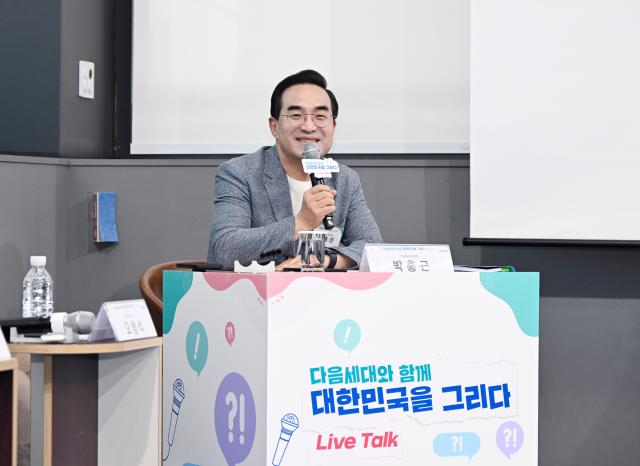
The government has initiated a public discussion on 'public participation in expenditure reform' led by the financial authorities, marking the first of its kind. At this event, Park Hong-geun, Minister of the Ministry of Strategy and Finance, announced plans for a rigorous review of all financial projects ahead of next year's budget preparation.
Speaking at the 'Open Discussion on Expenditure Restructuring' held in Mapo-gu, Seoul, on June 8, Park stated, "The 2027 budget will be the first budget entirely overseen by the Lee Jae-myung administration. This year is the only opportunity to implement significant restructuring."
He emphasized, "Next year's budget will involve a comprehensive review of all financial projects, aiming for a 15% reduction in discretionary spending, a 10% cut in mandatory spending, and the elimination of 10% of projects. We must boldly reduce unnecessary expenditures and invest decisively to enhance growth potential for an irreplaceable South Korea, ensuring that the benefits of growth are distributed across generations, regions, and social classes."
This discussion follows a meeting last August led by the President on national fiscal savings, marking the first time the financial authorities have addressed expenditure restructuring as a formal agenda. The Ministry of Strategy and Finance explained that this discussion was organized to incorporate public voices throughout the budget preparation process, following the 'National Finance Town Hall Meeting' in April and the 'Youth Live Talk' in May.
Representatives from 19 central ministries, including the Ministry of Finance and the Ministry of Science and Technology, as well as experts from research institutions like KDI, civic groups, journalists, youth advisory groups, and the general public attended the event. The discussion was broadcast live on KTV and the Ministry of Strategy and Finance's YouTube channel, with Park responding directly to questions raised in real-time comments.
During the discussion, participants highlighted the need to completely redesign the existing financial expenditure system in response to demographic changes such as low birth rates and an aging population.
In discussions on social, educational, and cultural issues, the necessity of reforming the local education finance grant system was emphasized. Professor Lee Jeong-hwan of Hanyang University pointed out that despite a decrease in the school-age population, the grant amount linked to domestic taxes remains unchanged, leading to some funds being allocated to non-essential projects, stressing that reform cannot be delayed any longer.
In the employment and welfare sector discussions, topics included the restructuring of unemployment benefits and basic pensions. Professor Yoon Dong-yeol of Konkuk University raised concerns about the issue of repeated benefit claims and the phenomenon where unemployment benefits exceed earnings, calling for necessary reforms. Professor Seok Jae-eun of Hallym University noted that income disparities among elderly recipients of basic pensions are widening, advocating for a gradual adjustment of the benefit range and enhanced support for low-income groups.
In the economic sector, the need for restructuring agricultural and food budgets and small business support programs was raised. Researcher Kim Mi-bok from the Korea Rural Economic Institute diagnosed that urgent structural reform of agricultural and food budgets is needed, including differentiating policy measures based on beneficiaries.
Researcher Um Bu-young from the Small and Medium Business Administration pointed out that the individual operation of small business support programs by various ministries leads to redundancy and budget dispersion, calling for the integration of functions and bold restructuring of underperforming projects.
Concerns about indiscriminate public facility construction were also raised in discussions on local finance. Researcher Son Jong-pil from the National Finance Research Institute suggested that policy focus should shift from building new public facilities to the efficient management and reallocation of existing ones to enhance local government financial efficiency.
Minister Park expressed agreement with the various opinions raised during the discussion, stating, "We will concentrate our efforts on bold institutional improvements to ensure that mandatory expenditure projects, which impose a significant long-term burden on national finances, are operated more efficiently."
He added, "The valuable opinions shared today will serve as a crucial milestone for the 2027 budget. We will continue to expand opportunities for the public to actively participate in the budget preparation and fiscal policy formulation processes."
* This article has been translated by AI.

Copyright ⓒ Aju Press All rights reserved.