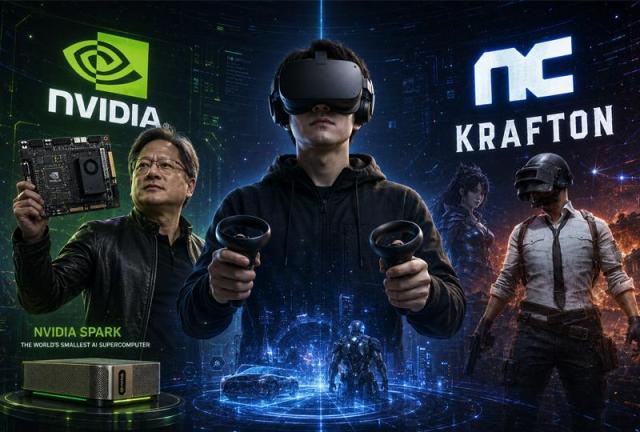
Just last weekend, he returned to the gaming world that first bought what he was selling — this time as the most courted man in artificial intelligence.
The Nvidia CEO made his way to a PC parlor near Sinnonhyeon Station in southern Seoul on Sunday, his third such visit in a single trip, and met game developer Krafton's executive director Chang Byung-gyu and NCSoft CEO Kim Taek-jin in quick succession over the very games his cards were built to run.
"Nvidia grew up together with you," Huang told the South Korean game executives, casting the country's studios as both the cradle of his company and a pillar of its AI ambitions.
To Kim, he offered a smaller tribute: "You are my wingman."
South Korea has earned the sentiment. Its gamers have bought more than 50 million GeForce GPUs over 25 years, Nvidia said last year, and the country has long served as a fast-moving testbed for nearly everything the company ships.
But South Korea has dealt Huang sharp lessons too. In 2018, he flew to Seoul to propose a sweeping partnership with Samsung Electronics spanning high-bandwidth memory, contract chipmaking and his CUDA software platform.
Samsung turned him down. Whatever the details, the cost has compounded by the year. Rival SK hynix rode HBM to the heart of the AI boom and became Nvidia's main supplier of the memory, while Samsung has spent the past two years scrambling to qualify its own chips and close the gap.
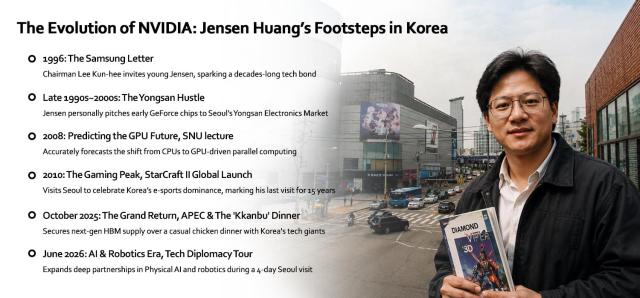
If South Korea is where Huang's story keeps turning, its game makers now mark the latest bend. Long the biggest buyers of his chips, they are being recast as partners that build the lifelike virtual worlds in which the next generation of AI can be tested.
The logic is straightforward. Years of running massive multiplayer servers, rendering vast virtual worlds and animating believable characters have left Korean studios with precisely the tools AI now demands — environments where agents, digital twins and physical-AI systems can be trained and proven before they reach the real world.
Krafton, which co-developed a generative AI "co-playable character" with Nvidia, will roll out an AI companion called PUBG Ally as a beta in PUBG: Battlegrounds Arcade this month, building on the "Smart Zoi" agent in its life-simulation title inZOI. The technology lets a character converse and play naturally alongside a human user.
"Krafton has come this far thanks to the fans who have stayed with Battlegrounds for so long," Chang said. "Building on our partnership with Nvidia, we will create new experiences not only in games but in AI."
The studio is putting the next-generation DLSS through its paces in Cinder City and its forthcoming Aion 2.
On his first day in the country Huang headed straight for a PC parlor run by esports club T1 — the merchant who once worked Yongsan's aisles, back among the machines that started it all, in the one market that has never let him take success for granted.
Copyright ⓒ Aju Press All rights reserved.