
Journalist

Kwon Gi-won
-
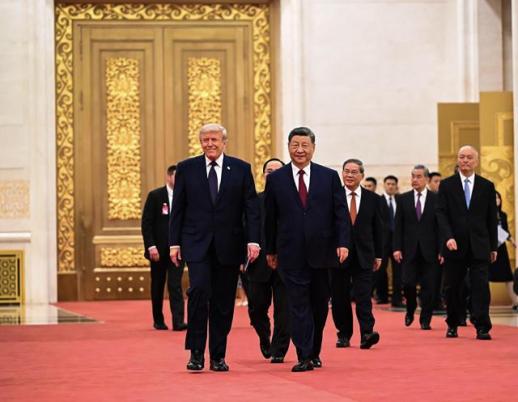 Asia Deep Insight: Trump and Xi in the Shadow of the Thucydides Trap BEIJING, May 14 (AJP) -long the stone paths of the Temple of Heaven, beneath crimson walls and fading imperial roofs, President Donald Trump of the United States and President Xi Jinping of China walked side by side on May 14, 2026. The atmosphere was neither openly confrontational nor genuinely warm. It carried something more consequential: the careful restraint of two powers that understand they are now shaping the architecture of the twenty-first century. Later that evening, during the state banquet at the Great Hall of the People, Xi Jinping delivered a sentence that immediately reverberated far beyond Beijing. “The great rejuvenation of the Chinese nation and Make America Great Again are fully compatible.” It was a brief diplomatic phrase, but the world understood its deeper meaning. Behind those words stood the defining geopolitical question of our age: Can the United States and China escape the Thucydides Trap? The phrase itself originates from the ancient Greek historian Thucydides, whose account of the Peloponnesian War remains one of history’s most enduring studies of power transition. Reflecting on the conflict between Sparta and Athens, he wrote: “It was the rise of Athens and the fear that this instilled in Sparta that made war inevitable.” More than two millennia later, the concept was revived and expanded by the Harvard political scientist Graham Allison, who argued that when a rising power threatens to displace an established one, structural tensions often push nations toward confrontation, even when neither side truly desires war. Today, that historical framework has become inseparable from the evolving relationship between Washington and Beijing. For nearly eight decades, the United States has presided over the global order through the dominance of the dollar, unmatched naval power, technological leadership, financial institutions, and a vast alliance network. China, meanwhile, has risen with extraordinary speed, transforming itself from a manufacturing platform into a strategic superpower with ambitions that extend across artificial intelligence, semiconductors, electric vehicles, quantum technology, rare earth supply chains, and global infrastructure. What unsettles Washington is not merely the scale of China’s economy. The deeper anxiety lies in the possibility that Beijing may eventually construct a parallel system of power — one capable of functioning independently of the American-led order. From Beijing’s perspective, however, the United States is no longer seen simply as a competitor. Chinese leaders increasingly interpret American export controls, semiconductor restrictions, investment barriers, alliance restructuring, and Indo-Pacific strategy as elements of a broader containment effort aimed at slowing China’s ascent. The result is a widening spiral of strategic distrust. Yet unlike the rival powers of ancient Greece, the United States and China are bound together in ways that make outright conflict extraordinarily dangerous. American consumers remain deeply connected to Chinese manufacturing. Chinese growth, in turn, still relies heavily on global dollar liquidity and access to international markets. The world’s semiconductor ecosystem stretches across America, Taiwan, South Korea, Japan, and China in a web of mutual dependence. Even the fiercest technological rivalry unfolds within a shared economic bloodstream. This is why the modern version of the Thucydides Trap is unlikely to resemble a conventional great-power war. The struggle is instead unfolding through overlapping forms of competition: semiconductor restrictions, artificial intelligence supremacy, supply-chain fragmentation, financial sanctions, maritime rivalry, currency pressures, energy corridors, cyber influence, and technological sovereignty. In that sense, Xi Jinping’s vision of “national rejuvenation” and Donald Trump’s MAGA movement are not simply political slogans. They are competing civilizational narratives. MAGA seeks to restore American industrial strength, revive the middle class, secure energy independence, reinforce borders, and bring manufacturing back home. China’s national rejuvenation, meanwhile, reflects a much deeper historical ambition: the determination to overcome what Beijing calls the “Century of Humiliation” and restore China to what it sees as its rightful position at the center of global civilization. The difficulty is that both visions are rooted in forms of national primacy. Washington seeks to rebuild supply chains around American strategic interests. Beijing pursues technological self-sufficiency and broader international use of the renminbi. The United States reinforces alliances; China expands influence through BRICS, the Global South, and alternative trade and infrastructure systems. Can these two trajectories coexist? Perhaps not harmoniously. But coexistence through disciplined management may still be possible. That would require several forms of strategic restraint. First, both powers must separate economic competition from military confrontation wherever possible. Mechanisms preventing accidental escalation around Taiwan and the South China Sea are no longer optional; they are essential safeguards for global stability. Second, both sides must recognize that complete economic decoupling is neither realistic nor sustainable. Excessive restrictions and retaliatory measures risk weakening not only their rival, but the global economy itself. Third, political rhetoric intended for domestic audiences must not be allowed to harden into irreversible geopolitical miscalculation. Strong leadership may generate applause at home, but in an age of nuclear weapons and artificial intelligence, recklessness carries civilizational consequences. Perhaps the most important image from the Beijing summit was not the banquet itself, but the quiet walk through the Temple of Heaven. For centuries, Chinese emperors came there to pray for harmony between heaven and earth. That the president of the United States and the leader of China walked those grounds together was more than ceremonial symbolism. It reflected a deeper reality: neither nation can erase the other from the future of the international order. Global markets understand this well. If Washington and Beijing stabilize their relationship, financial markets may regain confidence, while semiconductor, logistics, energy, and technology sectors could recover momentum. But if tensions intensify again, supply-chain fragmentation and inflationary pressures may once more destabilize the world economy. Any serious crisis in the Taiwan Strait would immediately reverberate through the global semiconductor industry and beyond. For South Korea, the challenge is especially delicate. Seoul depends on the United States for security while remaining deeply connected to China economically. Its semiconductor, battery, automotive, shipbuilding, and artificial-intelligence industries all stand directly within the fault line of U.S.-China rivalry. South Korea therefore cannot afford simplistic alignment. It must instead cultivate the strategic flexibility and industrial resilience expected of a sophisticated middle power. History never repeats itself precisely. But human fear often does. What Thucydides ultimately understood was not merely the movement of armies, but the psychology of rising and declining powers. When the insecurity of an established power collides with the confidence of an ascending one, the international order becomes dangerously unstable. And yet humanity today possesses something ancient Greece did not: the awareness that total war between great powers would likely mean mutual ruin. The future of U.S.-China relations, therefore, may depend less on which nation becomes stronger than on which proves more capable of restraint. Trump’s MAGA vision and Xi Jinping’s national rejuvenation project are moving along different historical paths. But they must still find a way to coexist without destruction. That may be the only path by which the twenty-first century avoids falling fully into the Thucydides Trap . * contribution from Aju correspondent Bae In-sun in Beijing 2026-05-15 07:34:00
 -
 Trump and Xi Hold Historic Meeting in Beijing Amid Global Tensions On May 14, 2026, the world turned its attention to the Temple of Heaven in Beijing as President Donald Trump and Chinese President Xi Jinping walked side by side. With few aides present and only interpreters accompanying them, the two leaders strolled slowly between the red walls and wet stone paths, creating a scene that transcended a mere diplomatic event. It symbolized a pivotal moment in the direction of 21st-century global order. The meeting marked the first face-to-face encounter between the two leaders since the Asia-Pacific Economic Cooperation (APEC) summit in Busan last October, and it was Trump's first visit to Beijing in nearly nine years. The talks lasted approximately 135 minutes at the Great Hall of the People, followed by a walk in the Temple of Heaven, where Chinese emperors once offered sacrifices to the heavens. The meeting was visually impressive, featuring an official welcome ceremony, a military honor guard, national anthems, gun salutes, a red carpet, handshakes, and conversations, culminating in the stroll through the Temple of Heaven. However, beneath the surface, the discussions were serious. Topics included tariffs and trade, artificial intelligence and semiconductors, the Taiwan issue, Iran's nuclear program, the Strait of Hormuz, the Ukraine war, and the Korean Peninsula, essentially covering nearly every front of the global order. Most importantly, the meeting demonstrated that despite being on the brink of confrontation, the United States and China still need each other. The relationship between the two nations is no longer simply one of hostility or cooperation; it is a structurally interdependent relationship where both countries can neither completely contain nor fully disengage from one another. Language of Cooperation Amidst Competitive RealitiesThe official language of the meeting was one of cooperation. President Xi Jinping emphasized that the two nations should be partners rather than rivals, working together to achieve mutual success and shared prosperity. He proposed a new framework for U.S.-China relations termed a "constructive strategic stability relationship," which advocates for cooperation while managing competition and avoiding conflict. President Trump echoed similar sentiments, stating that the U.S. and China are the most important and powerful countries in the world and that cooperation between them could lead to significant achievements for both nations and the world. He referred to Xi as a "great leader" and expressed respect for the Chinese people. Trump also highlighted the presence of major American business leaders accompanying him, encouraging the expansion of business ties with China. However, the essence of the summit lies more in its structural realities than in mere words. The U.S. cannot completely sever ties with China, nor can China abandon the U.S. market and technological ecosystem. The U.S. needs China's manufacturing capabilities and market, while China relies on U.S. advanced technology, financial systems, consumer markets, and global corporate networks. Thus, both nations must engage with each other while competing, applying pressure yet shaking hands, and preventing the collapse of the global economy. This Beijing summit was a reflection of that cold interdependence. Symbolic Stroll at the Temple of HeavenThe most symbolic moment of the summit was the walk through the Temple of Heaven. This site is not merely a tourist attraction; it is where emperors of the Ming and Qing dynasties conducted rituals to confirm their divine mandate. In Chinese civilization, the concept of the mandate of heaven symbolizes the legitimacy of governance, the basis of order, and the fate of the nation. Xi's decision to take Trump to this location was not just a touristic gesture; it was a diplomatic statement reflecting China's self-perception as a successor to thousands of years of civilization, rather than just an economic power. The U.S. is a relatively young republic, just over 250 years old, while China identifies itself as a 5,000-year-old civilization. The U.S. has historically influenced the world through its institutions, military power, dollar, and technology, while China seeks to reclaim its central position through its history, population, manufacturing, and national mobilization capabilities. The fact that the two leaders walked together on the rain-soaked stone paths of the Temple of Heaven with only an interpreter present is also significant. While aides and protocol shape the dialogue in formal settings, it is in these moments of walking that the leaders' instincts collide. The stroll in the Temple of Heaven posed an unspoken question from China to Trump: "Will the U.S. view China merely as a competitor, or recognize it as a civilizational state with which it must manage the global order?" The rain-soaked paths of the Temple of Heaven did not depict two civilizations standing under the same umbrella but rather two great powers with different timelines calculating a shared future. Azaleas and Symbolic DiplomacyAt the center of the meeting venue were blooming azaleas. Chinese media interpreted the azaleas as symbols of prosperity, fortune, and optimism, with the mixed pink and white arrangement representing a harmonious future. China has historically conveyed messages through the arrangement of plants at meeting venues. During then-Secretary of State Antony Blinken's visit to China in 2023, lotuses were displayed, and in 2024, a plant arrangement symbolizing uncertainty drew attention. Chinese diplomacy speaks not only through words but also through visuals. The choice of location, flowers, colors, paths, protocol, meals, and walks all convey messages. The azaleas at this summit represented China's optimistic portrayal that the U.S. and China could choose harmony over conflict. However, the beauty of the flowers does not erase the harsh realities of geopolitics. In fact, the more beautiful the flowers at the meeting venue, the harsher the underlying realities may be. While the azaleas symbolize prosperity and optimism, the actual U.S.-China relationship embodies both prosperity and distrust. Thucydides Trap: A Question from Xi JinpingDuring his opening remarks at the summit, President Xi Jinping revisited the concept of the "Thucydides Trap." This concept refers to the idea that an established power may feel threatened by the rise of a new power, leading to competition and potentially conflict. Xi warned that mishandling the Taiwan issue could lead to confrontation or disputes between the U.S. and China, jeopardizing their relationship. Xi's mention of this concept was no coincidence. China has long proposed a "new type of great power relations" to the U.S., which centers on the recognition of China's rise by the U.S., while China avoids direct confrontation and both nations manage the Pacific and global order together. In simpler terms, China is essentially telling the U.S., "Do not contain us; recognize us as a G2." However, the likelihood of the U.S. accepting this outright is low. Acknowledging China as a co-manager of the global order would require the U.S. to relinquish part of its status as the sole hegemon. Conversely, if the U.S. continues to contain China, China will accelerate its self-reliance, supply chain independence, internationalization of the yuan, and military expansion. This point represents a dangerous crossroads for today's world. Trump's Realism and a Changing AmericaInterestingly, President Trump's demeanor during the meeting was notably different. In the past, he had aggressively pressured China, employing tariffs, technology restrictions, and supply chain separation as hallmarks of his China policy. However, at this Beijing summit, he exhibited a more pragmatic attitude. He referred to Xi as a "great leader" and stated that the U.S. and China are the most important and powerful nations in the world. What accounts for this change? The answer lies in the realities facing the U.S. Currently, the U.S. is managing multiple fronts simultaneously: the war in Ukraine, crises in Iran and the Middle East, efforts to contain China, domestic political conflicts, and financial burdens. While the U.S. projects strength, its financial and industrial capacity to manage all fronts perfectly is not what it once was. In the competition for artificial intelligence dominance, the U.S. excels in design and platforms but still relies on Asia for its manufacturing supply chain. Ultimately, the U.S. has begun to acknowledge the reality that complete decoupling from China is difficult. Concrete Agreements on Iran and HormuzThe most concrete agreements reached during the summit pertained to Iran and the Strait of Hormuz. The White House stated that the two leaders agreed that Iran should not acquire nuclear weapons and that the Strait of Hormuz must remain open for the free flow of global energy. They also confirmed their opposition to the militarization of the Strait and any attempts to impose tolls on its passage. This aspect is crucial. While the U.S. and China may clash over Taiwan and semiconductors, they share mutual interests in energy maritime routes. China is one of the world's largest energy importers. A blockade of the Strait of Hormuz would impact the U.S. as well, but it would be particularly devastating for China, which heavily relies on Middle Eastern oil. Therefore, the free passage through Hormuz is a key condition for China's economic stability. Notably, the White House also highlighted Xi's interest in increasing purchases of U.S. oil to reduce China's dependence on Hormuz, which could serve as a buffer to ease U.S.-China tensions if realized. However, this does not signify a strategic reconciliation. A more accurate term would be "selective cooperation." The two nations manage the potential for conflict over Taiwan while fiercely competing in semiconductors, yet they confirm shared interests regarding Iran and Hormuz. This may represent the operational reality of the new G2 era. Taiwan Issue Remains a Deep DivideThe Taiwan issue continues to be the most dangerous flashpoint. President Xi emphasized that the Taiwan issue is the most critical matter in U.S.-China relations. He warned that while proper handling could stabilize relations, mishandling could lead to conflict or disputes, endangering the entire U.S.-China relationship. Although Trump praised the meeting as "excellent," he did not respond to questions about discussions on Taiwan. This silence is significant. It could indicate avoidance, but it may also represent a strategic reserve. The U.S. cannot abandon Taiwan, yet it also does not desire direct confrontation with China. China can postpone addressing the Taiwan issue, but it cannot fold it indefinitely. Ultimately, the Taiwan issue was not resolved at this summit; it was merely sealed for the time being. If the Strait of Hormuz is the heart of energy, the Taiwan Strait is the heart of semiconductors and supply chains. The region is crucial for the global advanced semiconductor supply chain and Northeast Asian maritime routes. A military conflict in the Taiwan Strait would not only affect China and Taiwan; it would simultaneously disrupt South Korean exports, Japanese industries, American tech companies, and the global financial market. Semiconductor War Swallows Tariff ConflictAnother key aspect of this visit was the presence of American business leaders. Jensen Huang of NVIDIA and Tim Cook of Apple were among the prominent figures who accompanied Trump to Beijing, where he encouraged them to expand cooperation with China. This was not merely an economic delegation; it underscored that the sharpest front in U.S.-China tensions has shifted from tariffs to semiconductors and artificial intelligence. In the past, tariffs symbolized U.S.-China conflict. The trade war during Trump's first term revolved around tariff rates, trade deficits, and agricultural purchase commitments. However, the current focus is on chips—artificial intelligence chips, graphics processing units, high-bandwidth memory, advanced equipment, and data centers have become the new battleground. NVIDIA represents the symbol of U.S. technological hegemony, while Apple illustrates the deep entanglement between China's manufacturing ecosystem and the U.S. consumer economy. Their presence indicates that Trump views this summit not merely as a diplomatic event but as a platform for technology, market, and supply chain negotiations. The U.S. cannot completely cut off access to the Chinese market for its companies while restricting advanced chips to China. Conversely, China desires U.S. chips while simultaneously accelerating its domestic production. Sanctions and trade, pressure and dependence, restrictions and markets are all in motion simultaneously. This is the current semiconductor war. Conclusion: Rain at the Temple of Heaven, Azaleas, and a New World OrderThe rain at the Temple of Heaven was not merely a weather phenomenon. The azaleas at the center of the meeting were not just decorative. The rain symbolized the transition of the global order into a new season, while the azaleas represented China's message of prosperity and harmony amidst conflict. However, history does not move solely based on the language of flowers. Hegemony cannot be conceded through words, and civilizations do not reconcile overnight. The U.S. and China will continue to cooperate and compete, sometimes needing each other and at other times fearing one another. The significance of the Beijing summit lies in this reality. The U.S. can no longer ignore China, and China cannot overlook the catastrophic consequences of a confrontation with the U.S. Both nations dream of a shared world but envision different futures. Yet that world is singular. On the rain-soaked paths of the Temple of Heaven, Trump and Xi walked with differing timelines of civilization. One speaks of making America great again, while the other speaks of the great rejuvenation of the Chinese nation. The question remains whether these two visions will clash or coexist. The answer has yet to be written. However, the Temple of Heaven in Beijing on May 14, 2026, left one clear scene: the two great powers of the world can pause at the brink of war to engage in dialogue. Whether that dialogue marks the beginning of a new order or merely a prelude to postponed conflict depends on future choices.* This article has been translated by AI. 2026-05-15 07:30:00
 -
 Special Prosecutors Summon Yoon Suk Yeol for Investigation on May 26 The comprehensive special prosecutor team investigating remaining allegations after the three major special investigations has summoned former President Yoon Suk Yeol to appear as a suspect at the end of this month. According to Yonhap News on May 14, the second comprehensive special prosecutor team, led by Kwon Chang-young, plans to investigate allegations of abuse of power against Yoon. The team suspects that Yoon directed the transmission of messages justifying the declaration of martial law to allied countries, including the United States, through the National Security Office and the Ministry of Foreign Affairs immediately after the declaration. The messages reportedly included statements such as, "This action is to protect liberal democracy," and "Yoon Suk Yeol maintains a stance against North Korean leftists and anti-Americanism." The special prosecutor team intends to investigate the circumstances surrounding the delivery of messages justifying martial law to allied countries and whether Yoon issued related directives. However, Yoon's side has expressed difficulty in preparing for the summons, citing the lack of specific details in the summons notice and a busy trial schedule, leaving his attendance undecided. The special prosecutor team plans to first summon Kim Tae-hyo, former first deputy director of the National Security Office, as a suspect for questioning on May 15 regarding related allegations.* This article has been translated by AI. 2026-05-15 03:28:39
 -
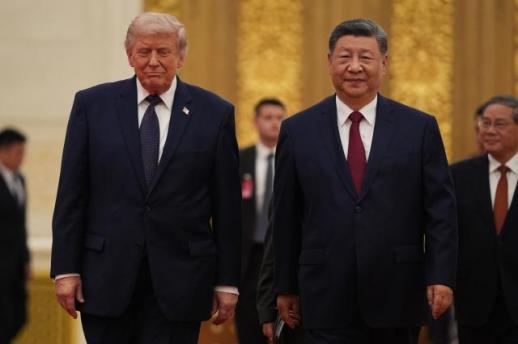 China Reverses Approval for U.S. Beef Exporters Amid Trade Talks On the same day as the U.S.-China summit, Chinese authorities temporarily restored the export qualifications of hundreds of U.S. beef exporters, only to revoke them shortly after, creating confusion. According to Yonhap News Agency on May 14, the General Administration of Customs of China changed the export registration status of over 400 U.S. beef slaughter and processing plants from 'expired' to 'valid.' These companies had not renewed their five-year export registration, granted between March 2020 and April 2021, for more than a year. This change sparked optimism in the U.S. livestock industry regarding the resumption of exports to China, including facilities owned by major food companies Tyson Foods and Cargill. However, shortly after reports emerged, the registration status on the customs administration's website reverted back to '(permit) expired.' As a result, the hopes of U.S. beef exporters turned to uncertainty within just a few hours. The White House had previously indicated that this issue could be discussed at the U.S.-China summit. Reuters reported that the General Administration of Customs did not respond to inquiries regarding the reason for the change in permit status. Market analysts suggest that this move may indicate China is using the import of agricultural products as a bargaining chip in trade negotiations with the U.S. U.S. beef exports to China peaked at $1.7 billion in 2022 but fell to about $500 million last year.* This article has been translated by AI. 2026-05-15 03:27:13
 -
 President Lee Shares U.S. Treasury Secretary's Post, Emphasizes U.S.-Korea Partnership President Lee Jae-myung stated on May 14 that "South Korea and the United States are the most important partners supporting each other's growth."In a post shared on X (formerly Twitter), President Lee highlighted U.S. Treasury Secretary Scott Besant's message, affirming that despite challenging international circumstances, the two countries will work closely to create opportunities and pave the way for shared prosperity.He emphasized that as South Korea prepares to assume the G20 presidency in 2028, it will communicate with the United States, the G20 president in 2026, to fulfill its responsible role in the international community.President Lee also referenced his meeting with Secretary Besant the previous day at the Blue House, noting that it reaffirmed the deep trust and commitment to cooperation between the two nations.In his post on X regarding the meeting, Secretary Besant expressed gratitude for the warm welcome and the strong U.S.-Korea alliance, stating, "Through extensive discussions, I reaffirmed the United States' commitment to advancing economic cooperation between our two countries and recognized South Korea's economic achievements."* This article has been translated by AI. 2026-05-15 03:25:49
 -
 Chinese Vessels Begin Transit Through Hormuz Strait Following Iranian Approval Some Chinese vessels have begun transiting the Hormuz Strait after receiving permission from Iranian authorities, according to local media reports. On May 14, Yonhap News reported that Iran's Fars News Agency cited sources stating, "Following a decision by Iranian authorities, some Chinese vessels started their transit through the Hormuz Strait from the night of May 13 (local time)." The report noted that these vessels were granted permission to navigate under the condition that they comply with Iran's transit regulations. Sources claimed that this move resulted from diplomatic efforts by Wang Yi, China's Foreign Minister, and the Chinese Ambassador to Iran. They added, "The transit of Chinese vessels was promoted based on the deep and strategic partnership between the two countries." Iran's state television also reported, citing the Islamic Revolutionary Guard Corps Navy, that over 30 vessels authorized by Iran passed through the Hormuz Strait starting on the night of May 13. However, it has not been confirmed whether all of these vessels are Chinese. This development coincides with U.S. President Donald Trump's visit to China for a summit with Chinese President Xi Jinping. As the situation in the Middle East and issues concerning Iran are expected to be key topics during the U.S.-China summit, analysts interpret this as Iran emphasizing its cooperation with ally China to strengthen its position.* This article has been translated by AI. 2026-05-15 03:24:53
 -
 Minister Kim Jong-kwan Warns of Urgent Mediation Amid Samsung Union Strike Threat Minister of Trade, Industry and Energy Kim Jong-kwan urged for prompt dialogue between management and labor regarding the planned strike by Samsung Electronics' union, warning that urgent mediation may be necessary if the strike proceeds. On May 14, Kim posted on social media, titled "I earnestly urge Samsung Electronics' management and labor to compromise," stating, "The date for the total strike at Samsung Electronics is approaching." He noted that while the Central Labor Relations Commission requested a resumption of talks, management agreed, but the union believes there is no reason for further discussions unless management changes its stance. He expressed concern, saying, "If an agreement is not reached, the union plans to begin a total strike on the 21st, which is regrettable and worrisome." Kim emphasized Samsung Electronics' economic significance, stating, "The importance of Samsung Electronics to our economy cannot be overstated." He highlighted that the company's sales account for 12.5% of the national GDP and employs approximately 129,000 people, calling it a national representative company. He added, "One in ten citizens is a shareholder in this national enterprise," noting that Samsung's performance and stock prices directly affect the lives of citizens through various pension funds, including the National Pension Service. Regarding the semiconductor industry, he expressed concern, calling it "almost the only core strategic asset of our country and a unique growth engine for the future." He stated, "The semiconductor industry is a winner-takes-all sector that competes based on investment speed and scale," emphasizing that continuous process innovation and large-scale investments are necessary for survival. He warned that competing nations are expanding their positions in the semiconductor market with strong government support and bold investments, stating, "The moment we lose our competitiveness, survival becomes difficult, not just finishing second, leading to a downward spiral." Kim noted that a factory shutdown could result in production losses of up to 1 trillion won per day, and if all wafers currently being processed are damaged, potential losses could reach 100 trillion won. He also mentioned the impact on approximately 1,700 partner companies, the erosion of trust in the global supply chain, and the pressure on foreign clients to relocate their production facilities. He stated, "What is more concerning than visible losses is the intangible national loss, such as damage to our economic credibility," reiterating the need to prevent a strike under any circumstances due to the seriousness and ripple effects of the situation. He added, "As the Minister of Industry, I believe that if a strike occurs, urgent mediation will be unavoidable." Finally, he urged management to propose reasonable compensation and for the union to demand a rational distribution that does not undermine the company's future and sustainability, appealing to meet the expectations of citizens, domestic and foreign customers, and investors.* This article has been translated by AI. 2026-05-15 03:23:16
 -
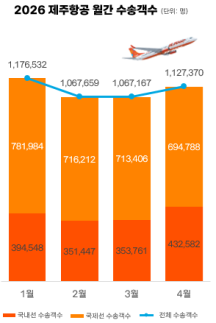 Jeju Air Surpasses 1 Million Passengers for Four Consecutive Months Jeju Air announced on May 14 that it has exceeded 1 million passengers for four consecutive months from January to April this year. According to the Ministry of Land, Infrastructure and Transport's aviation information portal, Jeju Air transported 1,127,370 passengers in April, a 20.3% increase from 936,899 during the same period last year. Domestic flights saw an increase from 387,429 to 432,582, a rise of 11.7%, while international flights grew from 549,470 to 694,788, marking a 26.4% increase. In particular, Jeju Air recorded 1,176,532 passengers in January, 1,067,659 in February, and 1,067,167 in March, making it the only South Korean low-cost carrier (LCC) to achieve over 1 million passengers each month. In April, Jeju Air accounted for 23.8% of the total passengers among nine domestic LCCs, with 25.3% on domestic routes and 23.1% on international routes. The airline's load factor also exceeded the LCC average, with an overall load factor of 91.9% in April, surpassing the LCC average of 89.5% by 2.4 percentage points. Domestic flights achieved a load factor of 97%, while international flights recorded 89.1%. Jeju Air is responding flexibly to travel demand through efficient route operations. Since the start of the winter schedule on October 26 last year, the airline has increased its Incheon-Osaka route from four to seven flights per day. Additionally, as part of a corporate merger remedy, it has utilized all slots allocated for the Gimpo-Jeju route, increasing service to four round trips daily starting March 29. On May 12, Jeju Air began trial operations on the Incheon-Jeju route with two flights per week. Starting June 11, it will launch a new route from Incheon to Kobe, further enhancing its competitiveness on Japanese routes. Jeju Air is accelerating its market share growth by expanding its domestic routes and focusing on medium-haul international flights. The airline plans to adjust its supply of medium-haul routes, which are popular during the summer vacation season, to actively attract passengers during peak periods. As competition among LCCs intensifies, Jeju Air aims to maximize its competitiveness through efficient fleet operations and rapid route restructuring. A Jeju Air official stated, "We are continuing flexible route operations to respond to changes in travel demand due to fluctuations in fuel prices and exchange rates, and we will strengthen our competitiveness through efficient route management even in a volatile market."* This article has been translated by AI. 2026-05-15 03:21:29
 -
 Nexon Reports Record First Quarter Earnings Under Global Strategy Nexon’s global market-focused restructuring strategy, led by Chairman Patrick Soderlund, has shown a strong start as the company reported its highest quarterly earnings to date. On May 14, Nexon announced that it achieved revenues of 1.42 trillion won, operating profit of 542.6 billion won, and net profit of 533.8 billion won for the first quarter of 2026. This represents a 34% increase in revenue, a 40% rise in operating profit, and a 118% jump in net profit compared to the same period last year. The improvement in performance is attributed to the strengthened competitiveness of key intellectual properties (IPs) such as 'MapleStory' and 'Dungeon Fighter,' along with strategies to expand into North America, Europe, and Southeast Asia. Soderlund, who took over as chairman of Nexon Japan in February, outlined a focus on high-potential projects during the '2026 Capital Market Briefing' in March. Previously, he served as the executive vice president at Electronic Arts, where he led the development of global hits like 'Battlefield' and 'Mirror's Edge.' He is seen as the right person to enhance Nexon's competitiveness in North America and Europe. Notably, 'Arc Raiders,' developed by Embark Studios, which Soderlund co-founded, contributed to revenue growth in those regions during the first quarter. Success in Diversifying Key IPs and Expanding Global Revenue Soderlund's emphasis on strengthening key IPs and expanding into global markets has resulted in significant achievements for the 'MapleStory' IP and new titles in the first quarter. Nexon confirmed the potential for platform diversification of its franchise IP through the release of a sequel to 'MapleStory' in the first quarter. The idle RPG 'MapleStory Growing' has performed exceptionally well since its launch in November, topping revenue charts on major app markets. In the first quarter, it also attracted new users from North America, Europe, and Southeast Asia. The user-generated content platform 'MapleStory World' saw a 79% increase in revenue year-over-year in Taiwan, driven by the Lunar New Year update. The original PC version of 'MapleStory' is undergoing a hyper-localization strategy to enhance its influence in Western markets, with overseas revenue increasing by 8% year-over-year due to winter updates. Nexon plans to apply the diversification strategy used for 'MapleStory' to 'Dungeon Fighter.' The mobile idle game 'Dungeon Fighter Growing' is set to launch later this year, alongside ongoing development of 'Dungeon Fighter Classic,' 'Dungeon Fighter: Arad,' and 'Project Overkill.' The expansion into global markets has also driven record quarterly earnings. 'MapleStory' and the new PC title 'Arc Raiders,' released last October, signal a shift in Nexon's revenue structure, which had been heavily reliant on East Asia. The proportion of overseas revenue increased from 52% in the first quarter of last year to 62% in the first quarter of this year. Revenue from North America and Europe surged by 310%, while Southeast Asia saw an increase of 111%. 'Arc Raiders' sold an additional 4.6 million units in the first quarter, bringing its global cumulative sales to 16 million within six months of release. Thanks to its success in Western markets, Nexon's quarterly PC and console revenue surpassed 1 trillion won for the first time. Growing Expectations for Annual Revenue of 5 Trillion Won As a result, expectations are rising for Nexon to become the first domestic gaming company to achieve annual revenue of 5 trillion won. In 2024, Nexon became the first domestic game company to surpass 4 trillion won in annual revenue. Last year, all quarterly revenues exceeded 1 trillion won, resulting in a record annual revenue of 4.5072 trillion won. In 2024, former Nexon CEO Lee Jung-hun set a goal to reach 7 trillion won in annual revenue by 2027. However, Soderlund announced in March during the CMB 2026 that the timeline for achieving the previous revenue target has been postponed. He has yet to disclose a new annual revenue target. Despite the delay in the previous target, the first quarter revenue of 1.42 trillion won increases the likelihood of Nexon surpassing 5 trillion won in annual revenue for the first time among domestic game companies. This year, Nexon plans to expand investments focused on core franchises and projects with high global appeal under a strategy of selection and concentration. Nexon has signed a long-term publishing agreement for the 'FC' franchise with EA in South Korea and extended its publishing contract for 'Dungeon Fighter' in China with Tencent for another 10 years. The company is also pursuing new partnerships and expanding its next-generation IP lineup. In March, Nexon announced a publishing agreement with Blizzard Entertainment for the Korean service of the PC version of 'Overwatch' within the year. The extraction survival game 'Paradise: Last Paradise' is currently in development with a target release next year. Additionally, Nexon plans to expand its IP portfolio for global market penetration through self-developed titles such as 'Vindictus: Defying Fate,' 'Durango World,' and 'Uchi the Wayfarer.' Following the refund and stringent personnel measures taken after the probability error incident in 'MapleStory Growing,' there are positive assessments that these actions could help restore user trust. 'MapleStory Growing' reached the top of the revenue charts shortly after its launch in November but faced a probability error incident that led to refund procedures in February. Refunds were processed for all in-game items purchased from the launch date of November 6 last year to January 28 this year, targeting users who requested them. Industry estimates suggest the expected refund cost is around 130 billion won. The refund amount for in-game items in 'MapleStory Growing' was reflected in the fourth quarter of last year and the first quarter of this year. Lee Jung-hun, CEO of Nexon Japan, stated, "We will secure mid- to long-term growth drivers through strategic partnerships and a new lineup of titles, and we will enhance profitability and global competitiveness through the innovative initiatives strategy presented at CMB 2026."* This article has been translated by AI. 2026-05-15 03:18:53
 -
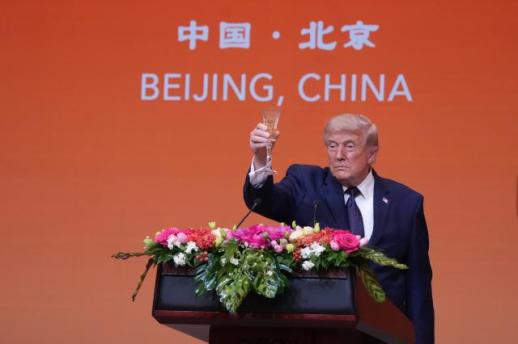 Trump Calls US-China Talks 'Very Productive'; Invites Xi Jinping to White House President Donald Trump positively assessed his recent summit with Chinese President Xi Jinping and officially invited Xi and his wife, Peng Liyuan, to visit the United States. According to Yonhap News Agency, during a state dinner hosted by Xi at the Great Hall of the People in Beijing on May 14, Trump stated, "We had very positive and productive discussions and meetings with the Chinese delegation." He added, "Tonight is also a precious opportunity to discuss various matters we talked about among friends," and expressed optimism that these discussions would lead to beneficial outcomes for both the United States and China. Trump formally requested Xi and Peng to visit the White House on September 24. At the end of his remarks, Trump proposed a toast, emphasizing the importance of a rich and lasting relationship between the American and Chinese peoples. This statement is seen as a reaffirmation of the commitment to stabilize relations between the two countries following the summit. Earlier in the day, the leaders agreed that Iran should not possess nuclear weapons and that the Strait of Hormuz should not be militarized or subject to tolls.* This article has been translated by AI. 2026-05-15 03:16:32